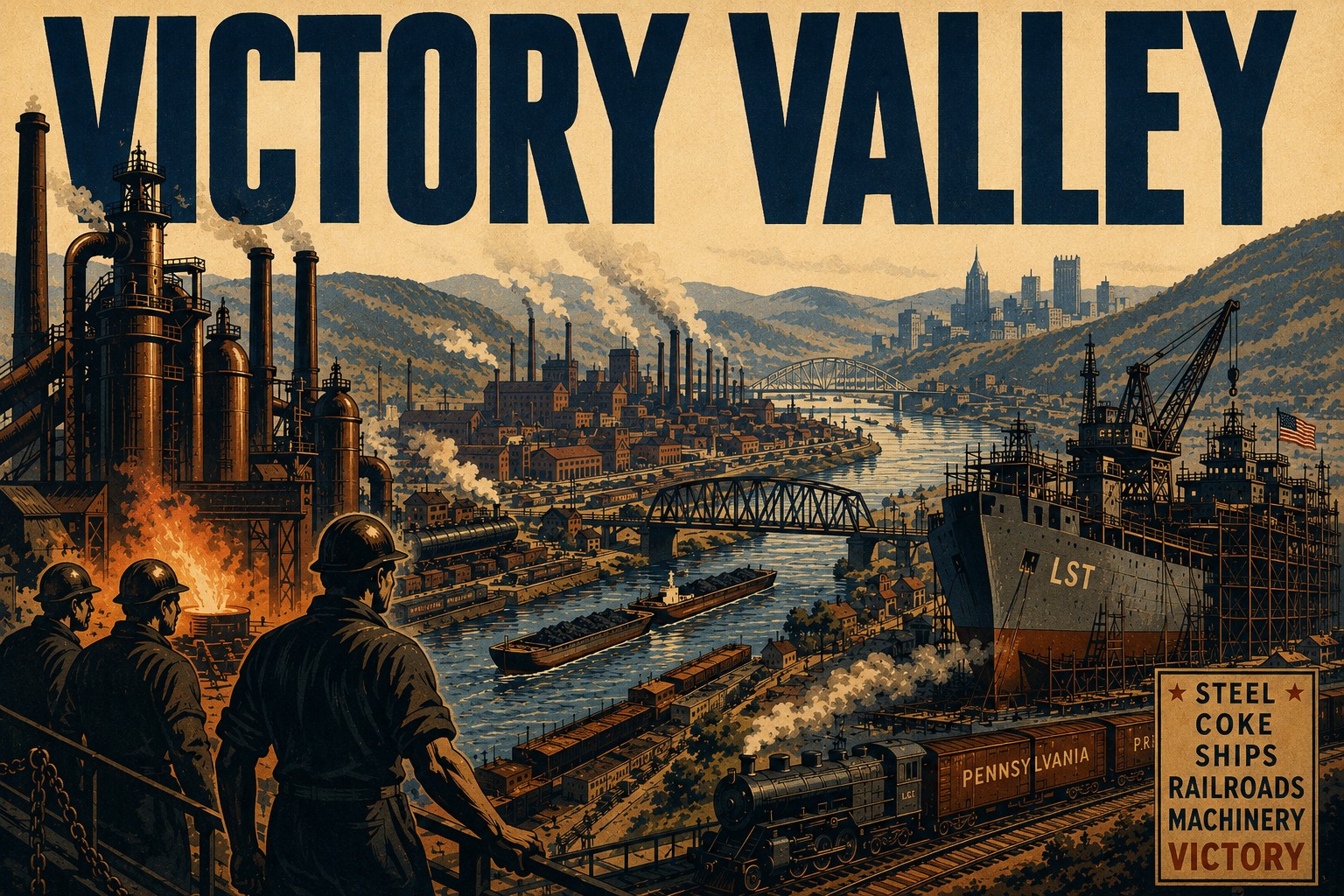
NOTE: The battles and the generals have earned their place in the books and the movies. D-Day, Midway, Eisenhower, Patton; those stories get told, and told well, as they should be. The home front fought a different war. That war produced enough material for volumes and mostly went unknown outside the archives. This four-part series is my attempt to help close some of that gap: The Sell, The Long Wait, We Are Ready, and Victory Valley.
Start with the geography, because in southwestern Pennsylvania the geography is the story.
Four rivers converge here. The Monongahela comes northwest out of West Virginia, through the coal and coke country, picking up towns along its banks the way a freight train picks up cars; Brownsville, Monessen, Donora, Clairton, McKeesport, Homestead, Braddock, before emptying into Pittsburgh.
The Youghiogheny runs north through the Laurel Highlands, past Connellsville, until it joins the Mon at McKeesport.
The Allegheny comes down from the northeast. In Pittsburgh, the Monongahela and Allegheny meet to form the Ohio, which heads west.
Geology dictating destiny. These rivers meeting at one point, each one a corridor of industry, each one pointed toward Pittsburgh like an arrow.
The landscape of southwestern Pennsylvania was not settled and then industrialized. It was industrialized and then settled, and the difference shows in every hillside and river bend.
There was no town square, no organic market center around which everything else arranged itself. There was the mill. The mill decided where the housing went, where the streets ran, where the churches were built. The rivers carried raw materials in and finished product out, and the towns filled the space between.
By 1941 those towns had been filling that space for the better part of a century. The men working the mills and the mines were in many cases the sons and grandsons of men who had built them; Slovak, Polish, Italian, Irish, and black workers who had come to these river valleys because the work was here and stayed because their families grew here.
They had survived the Homestead Strike of 1892, the Great Steel Strike of 1919, and a Depression that had hit industrial Pennsylvania with particular cruelty. They had fought for their unions in the 1930s with a ferocity born of decades of company towns and company violence.
The New Deal had given them legal standing, and the late 1930s had brought a fragile stability that felt, if you didn’t squint too hard, like something permanent.
Then December 7th happened. And the mills were running three shifts.
The question of what southwestern Pennsylvania would contribute to the war was not, in any meaningful way, a question. The region had been the industrial core of the country for half a century. It knew what it was for.
The furnaces were already running. The coke ovens along the Youghiogheny were already burning. The railroads were already moving coal and steel through the river corridors at volumes that would have been unimaginable a decade earlier.
The war asked all of it to happen faster, at higher volume, without stopping, for four years.
This is the story of what that actually meant; for the men who worked the furnaces and kept their no-strike pledge, for the families displaced to make room for expanding mills, for the workers who asked a question the government preferred not to answer, for the coke towns along the Yough that brought cold ovens back to life because the war needed the carbon.
It is the story of a region that was, in a particular and documentable sense, one of the centers of the Allied war effort; and that went about its business with the same unglamorous intensity it had always brought to everything else.
The mills ran. The trains ran. The war got won. This was Victory Valley.

Victory Valley
In 1943 the United States produced 89.1 million tons of steel. Germany and Japan combined did not match it. By 1945 Pennsylvania was producing as much steel as all Axis powers combined.
Read that again. One state. All of them.
The military had a name for the region: Victory Valley. A Navy official called its performance “victory through steel power.” Both names were accurate, and neither one was hyperbole.
What was happening in the river valleys of southwestern Pennsylvania during the war years was not just impressive industrial output; it was the material foundation on which the Allied strategy, and the Arsenal of Democracy, rested.
You cannot invade North Africa, Sicily, Italy, and France, fight a simultaneous island-by-island campaign across the Pacific, and supply the Allied nations through Lend-Lease without steel. Enormous, continuous, uninterrupted quantities of it. The Mon Valley and the Youghiogheny coke country provided it.
The specifics are worth stating because the aggregate numbers, as large as they are, don’t quite capture what was actually being built here.
U.S. Steel and its subsidiaries broke 1,000 previous production records by 1942. The Homestead Works, the same plant that had been the site of the most violent labor confrontation in American history fifty years earlier, tripled its forged armor production after undergoing the largest single expansion of any comparable facility in the country.
The Mesta Machine Company in West Homestead produced more than half of all 155mm gun tubes fired during the entire war. Every time an American artillery crew sent a round downrange in Europe or the Pacific, there was better than even odds the barrel it came through was made twelve miles from Pittsburgh.
The shipyards deserve their own mention. The Dravo Corporation, operating on Neville Island in the Ohio River just west of Pittsburgh, built 20 percent of all LSTs (Landing Ship, Tank) used in the war.

The LST was the unglamorous workhorse of Allied amphibious operations, the flat-bottomed vessel that ground its bow into beaches at Anzio and Normandy and Leyte Gulf and disgorged the tanks and troops that took those beaches. One in five of them was built on the river formed at the confluence in downtown Pittsburgh.
Jones and Laughlin (J&L, or as the locals call it, the “Jane Ell”) produced armor plate and railway components. Allegheny Ludlum developed the specialized alloys that went into aircraft and tank production.
The region spent $511 million on factory expansion during the war years; the sixth largest capital investment of all cities in America.
The coke that fed the blast furnaces came largely from the Youghiogheny country. The Pittsburgh coal seam running through Fayette and Westmoreland Counties was the standard coking coal of the industrial world; nearly pure carbon, the ideal fuel for the temperatures a steel furnace required.
By the early twentieth century the beehive ovens surrounding Connellsville had been supplying more than half the country’s coke, requiring 2,000 railcars a day to haul it away.
The ovens at Leisenring, which had gone cold in the late 1920s when the beehive era gave way to the by-product ovens, were brought back online specifically for the war. The war needed carbon. The Yough country had it.
The railroads moved everything. Without them the production numbers were warehouse figures, not war figures. The Pennsylvania Railroad was the primary artery; its main line running through the heart of the region, connecting the mills to the coasts and the training camps to the embarkation ports.
The Pittsburgh and Lake Erie ran the length of the Mon Valley, hauling coal and coke north to the furnaces and finished steel back south. The two roads together formed the circulatory system of the Arsenal of Democracy, and the volume moving through them during the war years was staggering.
The PRR alone moved 17.5 million military personnel across its system between 1941 and 1945, requiring 29,670 extra trains.
The Altoona Works sat at the center of all of it. One hundred and twenty-five buildings on 218 acres, the largest railroad shop complex in the world, employing 16,000 workers at its wartime peak.
In 1943 the Juniata Shops within the complex completed 111 new locomotives, the single highest annual production in the facility’s history, while simultaneously building military vehicles, tank treads, and aircraft components.
The Altoona Works were on the German saboteurs’ target list for Operation Pastorius, the same plot that sent agents to Altoona and New York and Chicago in the summer of 1942. The Germans understood what American planners sometimes took for granted: take out the shops and you cripple the trains, and take out the trains and the steel stays in the valley instead of going to war.
They were caught before they could act. The shops kept running.
One-fifth of all bituminous coal produced in the United States came from southwestern Pennsylvania. The region fed the furnaces, built the guns, made the ships, moved the soldiers, and kept the trains running that connected all of it together. The Navy may have called it Victory Valley. The people who lived there called it home and went to work.

The Price of the Mill
In 1942 the Defense Plant Corporation approved a $90 million expansion of the Homestead Works.
Ninety million dollars in 1942 money. The expansion would add plate mills capable of producing the heavy steel needed for ship construction at a scale the existing facility couldn’t approach. The military needed the plate. The Homestead Works could produce it. The math was easy.
The problem was the land.
The existing mill sat on the south bank of the Monongahela, hemmed in by the river on one side and the town of Homestead on the other. To expand, the Defense Plant Corporation needed 120 acres of adjacent land; residential and commercial land, the land the town of Homestead was built on.
The solution was equally straightforward, in the way that wartime solutions to civilian complications tend to be. The land was acquired. Twelve hundred buildings came down. Eight thousand people, roughly half the population of Homestead, were told to find somewhere else to live.
Eight thousand people. Half a town. Cleared to make room for a plate mill.
The people who moved were not strangers to what the mill had taken from them before. Homestead’s history with the Carnegie Steel Company went back to 1892, when Henry Clay Frick had locked out the Amalgamated Association of Iron and Steel Workers and called in 300 Pinkerton agents by barge to break the union.
The workers had met the barges with rifles and dynamite. The battle that followed left ten men dead, seven workers and three Pinkertons, and the riverbank at Homestead soaked in a type of history that the town never entirely forgot.
The union lost that fight. It took another forty years and the Wagner Act and the CIO before the steelworkers of Homestead had legal standing to bargain collectively.
The men and women displaced in 1942 were in many cases the grandchildren of the men who had stood on those riverbanks in 1892. The union their grandfathers had bled to build — the United Steelworkers, finally recognized, finally legal, finally functioning — told them the war came first. And they went.

They packed what they had and they found somewhere else and they went, because the plate mills needed to go where their houses had been and the war needed the plate mills and there was no option available in 1942 for the argument that this was too much to ask.
It is worth being exact about what this was and what it wasn’t. The displacement was not about being malicious. Nobody at the Defense Plant Corporation or U.S. Steel sat down and decided that the residents of Homestead deserved to lose their homes and their neighborhood because they were expendable.
The war needed the mills expanded and the mills needed the land and the land had people on it, and the bureaucracy of wartime mobilization processed that sequence of facts and produced an outcome. The outcome was eight thousand people with nowhere to go and a neighborhood, many actually, that ceased to exist.
The expanded plate mills ran without pause from 1943 through the end of the war. The steel they made went into ships. The ships crossed oceans. The soldiers aboard those ships hit beaches like Anzio, Normandy, and Leyte Gulf, that the war required someone to hit.
The chain of consequence running from a displaced family in Homestead, Pennsylvania to a beach in France is not a short one, and most of the people at the Homestead end of that chain never saw the other end of it. They just moved when they were told to move and got on with things, because that was what the moment required and they understood it, and understanding it didn’t make it easier but it made it possible.
That is the thing about southwestern Pennsylvania in wartime that can make for a difficult summary. The region gave the war everything it asked for; the steel, the coal, the coke, the rail capacity, the labor, the compliance with dislocations that would have been unthinkable in peacetime.
It gave these things without being asked twice, and in some cases without being asked at all. The mills knew what the war needed before the contracts were signed. The workers knew what the pledge required before Philip Murray made it official.
And still, the cost deserves mentioning. What the region gave, it gave fully; and fully given things leave marks.
Eight thousand people. Twelve hundred buildings. Half a town.
The plate mills ran. The ships got built. The war got won.

The Pledge
On December 8th, 1941, the day the United States declared war on Japan, Philip Murray went on the radio.
Murray was the president of the Congress of Industrial Organizations (CIO); five million workers, many of them in the mills and mines of southwestern Pennsylvania. He was a Scotsman who had come to the Pennsylvania coalfields at sixteen, worked his way up through the United Mine Workers under John L. Lewis, and emerged as the CIO’s president in 1940 with a reputation for hard negotiating and harder principle.
He was not a man given to grand gestures. What he said on December 8th was a grand gesture anyway, because the moment required it.
The CIO’s members, he announced, were ready and eager to defend the country. They would not strike. For the duration of the war, the industrial workers of America would keep their places at the furnaces and the machines and the assembly lines and they would not walk out, regardless of grievance, regardless of provocation, regardless of what the companies did or didn’t do in return.
The no-strike pledge was effective immediate and it covered every union under the CIO’s umbrella.
He added one condition. He said the workers expected that no selfish advantage would be taken of the sacrifices they were prepared to make.
That condition was not enforceable. Murray knew it when he said it. He said it anyway, because it was the honest articulation of what the pledge was actually asking; not just labor peace for the duration but a mutual agreement between workers and the institutions that employed them and the government that oversaw both.
We will give you this. You will not exploit it. That was the deal Murray was proposing, and the other parties to the deal were not bound by it the way his members were.
The pledge held. That is the first and most important thing to say about it, because it was not a given that it would. Five million workers, across four years of dangerous and exhausting labor, under a wartime no-strike agreement that their employers had every incentive to take advantage of; and it held.
The furnaces ran. The mines produced. The mills turned out steel at rates no one had thought possible. The men who made that happen were doing it under conditions that would have produced a strike in any peacetime year, because the conditions in wartime steel mills were what they had always been: brutal, hot, and dangerous, and now relentlessly so around the clock.

The cracks in the effort are worth mentioning. Wildcat strikes broke out; unauthorized work stoppages that the union had to discipline, sending its own representatives to pull men back to their stations and impose sanctions on workers who had walked out over grievances the pledge prevented them from addressing through legitimate channels.
The union found itself, in those moments, functioning as an enforcement arm of the industrial order it had spent decades fighting. The men on the receiving end of that enforcement understood the logic. Understanding the logic did not make it feel less like a betrayal.
Wages were frozen under War Labor Board guidelines. The board had established the Little Steel Formula in 1942, capping wage increases at 15 percent above January 1941 levels; a ceiling that made sense as an inflation control measure and felt like a ceiling in every other respect to workers whose cost of living kept climbing regardless of what the formula said.
A man earning what he had earned in 1941, working harder and longer in 1943, watching the company post war contract profits while his own paycheck stayed flat; to be sure, that man had legitimate grievances. The pledge said he couldn’t act on them. He kept the pledge anyway.
What Murray had asked for in reciprocity, that no selfish advantage be taken, was honored imperfectly at best. Companies that had spent decades resisting unionization found the no-strike pledge a pleasant arrangement, insulated as they now were from the pressure that had finally forced recognition in the late 1930s.
Executive compensation was not frozen the way wages were. Profits on war contracts were quite real, if regulated. The workers noticed. They kept working.
Murray himself never stopped pushing. He argued before the War Labor Board for wage adjustments. He proposed industry councils that would give labor a formal voice in war production decisions; a proposal the Roosevelt administration studied and declined to implement.
He fought within the constraints of the pledge rather than abandoning it, because he understood that abandoning it would hand the companies and the government a political weapon that would set the labor movement back further than any wage freeze.
The pledge was a sacrifice. Murray made it with open eyes and spent four years trying to limit the damage it did to the people who kept it.
The men in the mills of southwestern Pennsylvania kept it too; in Homestead and Braddock and Clairton and McKeesport and Donora, on three shifts around the clock, in conditions that hadn’t improved because the pledge prevented them from demanding improvement.
They kept it because Murray asked them to and because the war required it and because they understood, in the way that people who have lived through hard things understand complicated obligations, that some costs are worth bearing even when the bearing is unequal.
The furnaces ran. That was what mattered. The furnaces ran.

Should I Sacrifice to Live Half American?
On January 31, 1942, fifty-four days after Pearl Harbor, a twenty-six-year-old defense worker named James G. Thompson sat down and wrote a letter to the editor of the Pittsburgh Courier.
Thompson was from Wichita, Kansas. He was working in a defense plant, contributing to the war effort the same way millions of other Americans were contributing to it, and he had been thinking about what that contribution meant and what it was worth and what he was owed in return.
He put the question simply, in language that cuts through careful phrasing and hits the way it intends to.
Should I sacrifice to live half American?
The Courier published it. It was the largest black newspaper in the country; 400,000 subscribers nationwide, a readership that extended far beyond Pittsburgh and far beyond Pennsylvania.
It had been founded in 1907 in a city that sat at the confluence of rivers and railroad lines and industrial ambition, a city where black workers had been coming to find work in the mills for decades, and where what they found when they arrived was the same thing black workers found everywhere in America: work available, dignity optional.
Thompson’s letter proposed something. He called for a Double V campaign; two victories, represented by two V’s over an eagle, standing for victory abroad over fascism and victory at home over racism.
The consistency was obvious: if American democracy was worth fighting for, it was worth extending to the people being asked to fight for it. The Courier ran a Double V logo on its front page on February 7th, one week after the letter ran, and announced the campaign formally.
The response was overwhelming. Eighty-eight percent of Courier readers surveyed in October 1942 supported it. Black soldiers carved the Double V into their skin.
The campaign ran weekly for over a year, born in Pittsburgh, distributed to 400,000 subscribers across the country, aimed at a contradiction the official home front campaigns had no interest in examining.

The OWI was selling the war as a fight for democracy and freedom. The Courier was asking what democracy and freedom meant to the people in uniform, or working the furnaces and the shipyards and the defense plants who would go home at the end of their shift to neighborhoods where the democracy and freedom being advertised didn’t fully apply.
It was the most honest public conversation about the war’s contradictions happening anywhere in America. And it was happening here, in these river towns, in the pages of a Pittsburgh newspaper.
The black workers in the mills of southwestern Pennsylvania occupied a peculiar position in the wartime economy.
Migration from the South had been bringing black workers to the Pittsburgh region since the First World War; pulled north by the mills, which needed labor and were willing to hire black workers when white workers wouldn’t fill the shifts, and pushed by the conditions of the Jim Crow South that made the mills look like opportunity regardless of what they actually offered.
What they actually offered was work that was dangerous and poorly paid and racially stratified; the better jobs going to white workers by custom and by union agreement, the hardest and hottest work going to black workers who had less standing to refuse it.
The war expanded the industrial workforce and created new pressure on those arrangements, but it didn’t erase them. Black workers found more jobs available and found the same hierarchies in place when they got there.
The Great Migration that had been moving black Americans north since 1910 accelerated during the war years, bringing new workers to Pittsburgh and the river towns at a rate the existing housing and infrastructure couldn’t absorb.
The Hill District in Pittsburgh, already crowded, grew more crowded. The mill towns along the Mon saw their black populations increase and their racial tensions increase with them.
Through all of it the Double V campaign kept running, asking its question, refusing to accept the answer that the question should wait until the war was over. Thompson had anticipated that answer and addressed it in his original letter.
He wrote that he considered the obligations of citizenship serious and binding; he was willing to fight, willing to sacrifice, willing to contribute fully to the war effort. He was asking for the same consideration in return. Not after the war. Now. As a condition of the sacrifice being made by him, not as a reward for doing it.
The campaign began to quiet by late 1942 and into 1943. The wartime prosperity was finally reaching black workers; more jobs, higher wages than the Depression had allowed, the first black officers being commissioned in the armed forces, early signs that the pressure was producing some movement, all created its own complicated pressure on the campaign’s urgency.
Progress, even incomplete progress, makes confrontation feel risky to people who have recently acquired something worth protecting. The Courier moderated its tone. The campaign didn’t disappear. It became less insistent.
The FBI was paying attention from the beginning. J. Edgar Hoover’s bureau monitored the Courier throughout the war, watching the Double V campaign for signs of subversion, treating the paper’s insistence on democratic reciprocity as a potential threat to wartime morale rather than as the expression of democratic principle it clearly was.
The surveillance produced nothing, because there was nothing to find. Thompson and the Courier were not subversives. They were Americans asking America to mean what it said.
That question, born here, in Pittsburgh, in the pages of a newspaper founded in a city built by the labor of the people the question was about, did not get answered during the war.
The war ended and the Double V campaign’s second V remained undelivered. What the war did produce, for black workers in southwestern Pennsylvania and across the country, was a changed economic baseline, a generation of black veterans who had fought for something and intended to collect, and a set of arguments that the next twenty years would spend working out in courts and streets and legislatures.
The Pittsburgh Courier kept publishing. The mills kept running. The question Thompson had asked in January 1942 kept waiting for its answer.

Those They Sent
Twelve miles from Connellsville, in the town of Uniontown, a boy named George Catlett Marshall grew up in the closing decades of the nineteenth century, in a house his family had lived in for generations, in a region whose coal and coke he would have known the smell of without thinking twice about it.
He left for the Virginia Military Institute and built a career in the United States Army that nobody in Uniontown could have predicted would end with him running the largest military force in American history.
Marshall was the Army Chief of Staff for the entire Second World War; the architect of American mobilization, the man who built the force that fought in North Africa and Italy and France and across the Pacific, the strategist whose judgment Roosevelt and Churchill trusted more than almost anyone else’s.
He would go on to design the economic reconstruction of postwar Europe, the program that would carry his name and win him a Nobel Peace Prize. The man who commanded the Arsenal of Democracy grew up twelve miles from the ovens that helped build it.
That is not a coincidence. That is southwestern Pennsylvania, doing what it has always done, producing what the moment required without making a show of it.

The region sent its steel and it sent its sons, and the second number is harder to count than the first.
Allegheny County alone suffered 3,982 casualties during the war. Eight men from the Pittsburgh metropolitan area received the Medal of Honor; the country’s highest military decoration, awarded for actions that the citation language always struggles to fully convey.
The 28th Infantry Division, the Pennsylvania National Guard, the Keystone Division, marched down the Champs-Élysées and under the Arc de Triomphe in August 1944 after helping liberate Paris, the men in its ranks drawn heavily from the mill towns and mining towns of the state that fed it.
Pennsylvania sent 1.25 million of its own into the armed forces over the course of the war, including 22,000 women.
The mill worker who kept the no-strike pledge through four years of brutal shifts came home each night to a house with a blue star in the window, his son somewhere overseas carrying a rifle or a tank built from steel his own hands had helped make.
The family displaced from Homestead in 1942 to make room for the plate mill expansion found out, eventually, that their old neighborhood had become a factory turning out the steel that built the ships that carried American troops across two oceans; including, in some cases, their own sons.
The black steelworker who read James Thompson’s letter in the Courier in 1942 kept working through the war on the promise of a second victory that hadn’t arrived yet, and sent his own sons into segregated units for a country that hadn’t finished deciding what it owed them.
On the evening of December 7th, 1941, an eight-year-old boy named David McCullough came out of the Syria Mosque theater in Pittsburgh with his older brother, having just watched a performance of the ballet Rodeo.
The streets outside were different than they had been when the boys went in. People were talking in a tone of voice that hadn’t been there a few hours earlier.
McCullough didn’t fully understand what had happened, but he understood that something had, and he would spend the rest of his life as one of the country’s great chroniclers of exactly these kinds of moments; the instant when ordinary life and historical consequence collide on an ordinary street, and a person standing there simply has to absorb it and keep going.

That is roughly what southwestern Pennsylvania did for four years. Absorbed what the war required and kept going.
The region didn’t deliberate over whether to contribute everything it had. It had been contributing everything it had to the country’s industrial needs for half a century already, in peace and in the previous war, and the second war asked for more of the same at a scale and a pace that would have broken a place with less practice at it.
Twenty-seven percent of the nation’s steel. More than half its 155mm gun tubes. A fifth of its landing craft. A fifth of its soft coal. The locomotives that moved it all, built in the largest railroad shop complex in the world, in a town the German saboteurs understood was worth targeting because everyone else underestimated it.
A no-strike pledge kept by men who had every reason to break it. A displaced neighborhood that became a shipyard’s worth of steel. A newspaper that asked a question the country still hadn’t answered. A general from Uniontown who ran the whole war.
The mills are mostly gone now. The coke ovens cooled decades ago. The towns along the rivers are smaller than they were, and quieter, and the work that built them moved overseas or simply stopped. That is a different story, told elsewhere, and it does not erase what happened here between 1941 and 1945.
For four years, this stretch of river valley was one of the most important places on earth, and almost nobody outside of it knew it at the time, and fewer remember it now.
They made the things. They sent the people. They didn’t stop.
That’s the whole of it.




Leave a Reply