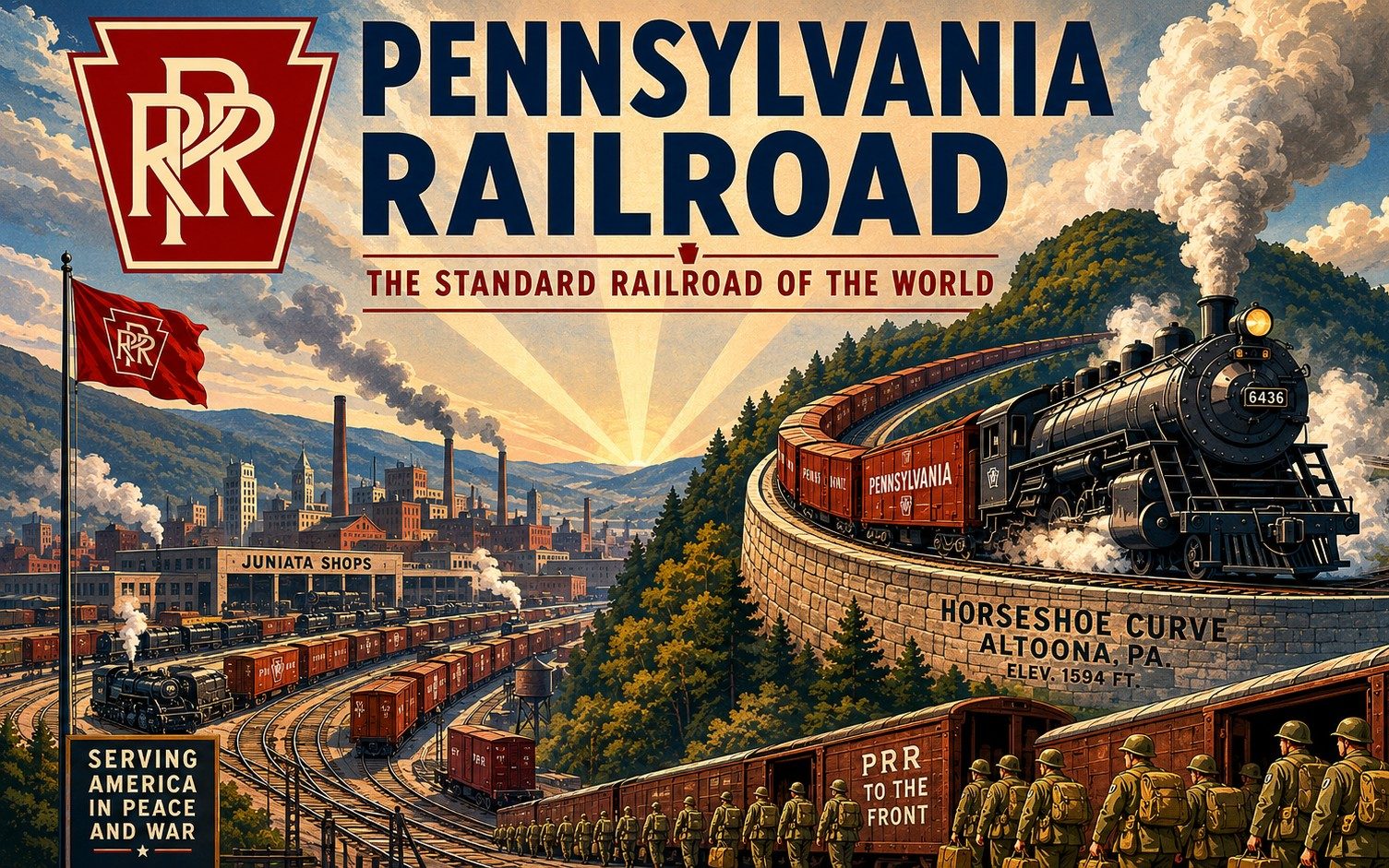
By 1882, the Pennsylvania Railroad was the largest corporation on earth. Not the largest railroad. Not the largest corporation in America. On earth. Full stop.
That’s worth remembering, because it tends to get lost. The PRR isn’t a household name anymore; it merged into Penn Central in 1968, and Penn Central cratered two years later in what was the largest corporate bankruptcy in American history.
But for roughly a century, the Pennsylvania Railroad was the circulatory system of the American economy. Steel, coal, troops, grain, mail, passengers. If it moved between the Atlantic seaboard and the Midwest, there was a good chance it moved on PRR rails.
Perhaps oddly, the railroad was born out of fear. Philadelphia’s merchants watched the Erie Canal open in 1825 and understood immediately what it meant: New York had a water route to the interior of the continent, and Philadelphia did not. Trade that had flowed naturally toward Philadelphia began bleeding northward.
The Baltimore and Ohio Railroad compounded the problem, threatening to push Baltimore past Philadelphia as the dominant mid-Atlantic port. Pennsylvania’s legislature responded in 1846 by chartering the Pennsylvania Railroad; not out of vision, exactly, but out of the urgency that comes from watching a competitor gain ground.
What they built outgrew the emergency that created it. By the Gilded Age, the PRR operated more than 10,000 route miles across 13 states. It employed more than 250,000 people; more workers than the U.S. Army fielded at the start of the Civil War.
It called itself the “Standard Railroad of the World,” a title nobody gave it. The PRR gave it to itself, and the extraordinary part is that the boast was completely defensible.

The numbers from World War II alone are almost hard to process. From January 1941 through the end of 1945, 17.5 million soldiers, sailors, marines, and coastguardsmen moved over the Pennsylvania Railroad system; and that figure doesn’t touch the millions more on furlough.
Those strictly military movements required nearly 30,000 extra trains composed of roughly 400,000 cars. The PRR carried 10 percent of all American freight and 20 percent of all passengers across its system during the war. Over 45,000 PRR employees enlisted. 1,307 of them didn’t come home.
There is a tendency, when discussing American industrial capacity in World War II, to turn to the factories and shipyards; Detroit, Kaiser’s Richmond yards, Willow Run. All of it warranted.
But raw production is useless if you can’t move it. The tanks, the steel, the ammunition, the men; they had to get from where they were made to where they were needed. The Pennsylvania Railroad was how that happened, at a scale that had no equal.
None of it worked without crossing the Allegheny Mountains.
That’s the part that gets glossed over. The Alleghenies aren’t the Rockies; they won’t stop you in your tracks with sheer altitude, but they are relentless. Ridge after ridge, running southwest to northeast across Pennsylvania like a series of locked doors.
For the first half of the 19th century, crossing them meant a brutal ordeal on the Allegheny Portage Railroad: a system of inclined planes, stationary steam engines, and canal portages that required passengers and freight to transfer repeatedly across 36 miles of rough terrain.
Philadelphia to Pittsburgh in four days, if the weather cooperated.
The PRR needed a better answer. J. Edgar Thomson, the railroad’s chief engineer and later its president, provided one; and what he built above a small mountain town called Altoona would become one of the most consequential pieces of infrastructure in American history.
It would also become a target.

What Thomson Built
Thomson’s solution was a curve.
That sounds too simple for a problem that had stymied engineers for a generation. The Alleghenies had a crossing, the Allegheny Portage Railroad, built by the state in the 1830s, but calling it a solution was generous.
Freight and passengers traveling from Philadelphia to Pittsburgh transferred to canal boats at Hollidaysburg, rode the canal to the foot of the mountains, then boarded a series of cars hauled up ten inclined planes by stationary steam engines pulling hemp rope, then transferred again at Johnstown.
The crossing covered 36 miles and consumed the better part of two days. It was the 19th century’s way of saying the mountains had won.
J. Edgar Thomson disagreed. Thomson was the PRR’s chief engineer and later its president; one of the more underappreciated figures in American industrial history, largely because Andrew Carnegie absorbed so much of the era’s biographical attention.
His reading of the terrain above a small Blair County town called Altoona identified something the Portage engineers had missed or ignored: a natural hollow carved into the mountain by Burgoon Run, flanked on either side by ravines.

Fill the ravines and you had a ledge. Build on the ledge and you could run a track that gained elevation gradually, a 1.8 percent grade, compared to the Portage system’s punishing inclines, sweeping around the mountain in a single arc.
Trains entering from the east would round the curve and continue west without stopping. No transfers, stationary engines, or ropes necessary.
The physics were sound. The execution required filling two mountain ravines by hand.
Thomson hired approximately 450 Irish immigrants, men from Counties Cork, Mayo, and Antrim, who had come to Pennsylvania looking for work and found plenty of it. They attacked the problem with picks and shovels, black powder charges and mule-drawn carts. Every bit of it moved by hand.
They cut away the face of the mountain to carve the ledge, then hauled the material across to fill Kittanning Run and Glen White Run on either side of the curve’s center. It was the kind of work that aged men fast. It paid about a dollar a day.
The Horseshoe Curve opened February 15, 1854. Philadelphia to Pittsburgh in fifteen hours. The Portage Railroad, with its ropes and transfers and stationary engines, was finished as a going concern. It closed three years later.
What Thomson built was a 2,375-foot arc curving roughly 220 degrees around the head of a hollow at 1,594 feet of elevation. Inside the arc, the mountain falls away to the valley below.
A train entering from the east appears to be heading directly at anyone standing at the base of the curve, then sweeps around and continues west; an effect that remains slightly disorienting even when you know it’s coming. Engineers came from Europe to study it. The PRR’s competitors tried to replicate it and mostly settled for admiring it instead.
By 1879, the railroad had built an observation park inside the curve; the first park in America designed specifically for watching trains.
Families spread out on summer afternoons and watched the trains come and go: passenger limiteds and coal drags, mail trains running east and west without slowing. Benches, a fountain, a view of the mountain falling away below the tracks. People came from Pittsburgh and Philadelphia and points between. It was a place Altoona was proud of, and had reason to be.
In January 1942, six weeks after Pearl Harbor, the park closed. A chain-link fence went up. Men with rifles appeared. No public announcement explained why.
The people of Altoona could guess. They had been watching the trains too; watching what was on them, how often they came, how they never seemed to stop.

Pastorius
The Germans called it Operation Pastorius.
The name was deliberate. Francis Daniel Pastorius was a German-born lawyer and scholar who led the first organized group of German immigrants to America in 1683, founding Germantown in what is now Philadelphia; the first permanent German settlement on the continent.
The Nazis chose his name as a dark salute to German roots in American soil, a signal that this operation understood the country it was targeting. The irony in that choice, which will sharpen considerably before this story is finished, is that the operation’s fallout would be turned against the very community Pastorius founded.
In June 1942, two groups of German agents came ashore by submarine; four on a beach near Amagansett, Long Island on the night of June 12th, four at Ponte Vedra Beach in Florida four days later.
All eight had lived in the United States before the war. They spoke the language without an accent. They knew the geography, the culture, how to buy a train ticket and order a meal and disappear into a crowd. The Abwehr, German military intelligence, had selected them carefully for exactly those qualities.
They arrived with explosives, detonators, incendiary devices, and a target list that tells you more about the American war economy than most official histories bother to.
Hydroelectric plants at Niagara Falls. Aluminum Company of America (Alcoa) facilities in Illinois, Tennessee, and New York. Locks on the Ohio River near Louisville. Hell Gate Bridge in New York. Penn Station in Newark. And from the heart of the Pennsylvania Railroad: the Horseshoe Curve above Altoona, and the Juniata locomotive repair shops in the same city.
Three PRR facilities on the same list. That was not coincidence. The Germans had done their homework.

By the summer of 1942, roughly 8,700 freight cars were moving through Gallitzin, the tunnel just west of the Curve, every single day. Supply trains and troop trains rounded the Horseshoe Curve on average once every fifteen minutes.
The steel coming out of Pittsburgh, the coal from the western fields, the men moving toward the ports; all of it funneled through that 2,375-foot arc above Altoona. Knock it out, and you didn’t merely disrupt rail traffic. You created a bottleneck that would back up across the entire eastern industrial supply chain, buying Germany time it desperately needed as American production began hitting full stride.
The plan was sound. The men carrying it out were less so.
George Dasch was the ringleader of the Long Island group, a former waiter who had spent years in the United States and harbored serious doubts about the mission almost from the moment the submarine surfaced.
Within days of landing, he had made his decision. On June 15th he called the FBI’s New York field office, identified himself as “Franz Pastorius,” and attempted to explain the entire operation; the agents, the targets, the explosives. The agent on the other end of the line decided he was a crank and hung up.
Dasch took a train to Washington.
On June 19th he walked into FBI headquarters and placed $84,000 in cash on a desk, the operation’s full budget, which he had been carrying in a briefcase, and kept talking until someone paid attention. Within two weeks, all eight agents were in custody. The operation that had been designed to cripple American war production collapsed before any of its members got within striking distance of a target.
J. Edgar Hoover presented it to the press as a triumph of FBI surveillance and investigative work; the Bureau’s vigilance had cracked a sophisticated enemy plot.
That version of events was almost entirely false. The FBI had hung up on Dasch and been handed the case by a man who walked in off the street with a suitcase full of money. Hoover knew this and suppressed it for decades. Dasch spent the rest of his life trying to get the record corrected and his sentence commuted. Neither happened.

Six of the eight were electrocuted at the District of Columbia jail on August 8, 1942, less than eight weeks after landing on Long Island. The military tribunal that tried them lasted eight days.
Dasch received a thirty-year sentence; Ernest Burger, who had also cooperated with the FBI, got life. Both were quietly deported to West Germany in 1948. Dasch petitioned for a presidential pardon until his death. It was never granted.
The Horseshoe Curve, once the interrogations made clear what the targets had been, was immediately placed under 24-hour military guard. The chain-link fence that had gone up in January was reinforced. Floodlights appeared. County police patrolled the Juniata Shops. Special watchmen were posted at the Gallitzin tunnels.
For the next four years, the only people allowed near the Curve were PRR employees and military personnel.
The trains kept running. One every fifteen minutes, right on schedule, as though nothing had happened.
In Altoona, something had happened. The news that the Horseshoe Curve had been a target, that German agents had come ashore with the explicit intention of destroying the railroad that the city had built its entire identity around, hit hard.
It also, in the way that fear tends to work, needed somewhere to go. A phone call or telegram had been traced from Altoona to a New York apartment where the ringleaders had been staying.
That was enough.

Dutch Hill
Altoona did not build itself.
The city existed because the Pennsylvania Railroad needed a base of operations at the foot of the Allegheny crossing; a place to maintain locomotives, repair cars, and house the workforce that kept the trains moving.
The PRR established its machine shops there in 1850, four years before the Curve opened, and the workers followed. They came from Ireland and Italy, from the American South, and from Germany. They filled the hollows and hillsides around the railroad yards and named their neighborhoods accordingly.
The German section was called Dutch Hill. “Dutch” the way it always meant in Pennsylvania; from “Deutsch,” the German word for German, anglicized over generations into something that sounded like it referred to the Netherlands but never did.
By 1790, roughly a third of Pennsylvania’s population was of German descent.
The wave of immigration that crested in the 1850s — driven partly by economic hardship, partly by the failure of the liberal revolutions of 1848, which sent educated and politically-minded men fleeing Prussian repression — brought another million Germans to America, many of them to Pennsylvania, many of those to the railroad towns of the central part of the state.
They built churches, mutual aid societies, and social clubs. They learned the machinery of the Juniata Shops and passed the knowledge to their children.
By 1942, Dutch Hill was not a neighborhood of recent arrivals. It was three and four generations deep.
The evidence connecting Altoona to Operation Pastorius was a single phone call or telegram, traced from the city to a New York apartment where the ringleaders had been staying before departing for Germany.
Federal investigators never established who made the contact, or whether it bore any relationship to the sabotage plot at all. The lead was thin to the point of transparency.
It was enough.
On July 2nd, 1942, the same day President Roosevelt signed the order authorizing the military tribunal that would try the captured agents, FBI agents and Pennsylvania state police, joined by Altoona city police, fanned out across Dutch Hill and into the adjacent Italian neighborhood that had grown up alongside it.
They knocked on somewhere between 200 and 250 doors. Residents were taken to the post office on 11th Avenue, where a three-man loyalty board waited to assess whether they could be trusted. Radios were seized and destroyed. Papers were confiscated.
A number of residents had been reported by neighbors and co-workers; people they knew, people they had worked alongside at the Juniata Shops, people they had lived next to for years.
No evidence of any connection to the Pastorius plot was found. No charges were filed.
The raids produced nothing except damaged property and frightened families.

The men of Dutch Hill who worked the locomotive shops — who kept the engines running that pulled the troop trains and the ammunition trains around the Horseshoe Curve, one every fifteen minutes — came home from their shifts to find their homes searched and their radios smashed.
Their wives had been taken to a government building and asked to prove their loyalty. Their neighbors had informed on them.
Some of those same men were in uniform. German-Americans from Altoona enlisted and served, as they did across the country. Some did not come back.
The captured saboteurs were executed in August. The military tribunal lasted eight days, start to finish. The war moved on.
Altoona moved on too, in the way that communities absorb things they cannot speak about; by not speaking about them. The raids were never acknowledged by the agencies that carried them out. No apology came. No inquiry followed.
Decades later, when historian Dennis McIlnay researched the Pastorius connection for his book on the Horseshoe Curve, he found almost nothing documenting what had happened on Dutch Hill. The shame of a community having turned on its own neighbors, he concluded, had likely done most of the burying.
What remains is a single confiscated radio, on display today at Baker Mansion in Altoona. That appears to be the only memorial Dutch Hill received.
We’ll return to the name one more time. Operation Pastorius. Named for the man who led the first Germans to Pennsylvania in 1683, who founded the settlement that became Germantown, who laid the roots of what would grow into one of the largest ethnic communities in American history.
The Nazis chose that name as a signal; German belonging in American soil, a heritage worth reclaiming through sabotage.
The operation named after the founder of Pennsylvania’s German community was used to justify raids on Pennsylvania’s German community. The Horseshoe Curve kept running. The trains didn’t stop.
Dutch Hill said nothing, and has said nothing since.



Leave a Reply