In 1868, Andrew Carnegie was 33 years old and earning $42,000 a year. That was not a typo. At a time when the average American worker brought home a few hundred dollars annually, Carnegie was already wealthy beyond most people’s comprehension; and he was only getting started.
That year, he sat down and wrote himself a letter.
He wrote that the pursuit of wealth beyond what a man needed was degrading. He set $50,000 a year as the ceiling; anything above that was to be given away. He planned to retire at 35, move to Oxford, and spend the rest of his life reading and doing good in the world. He had seen what the relentless pursuit of money did to men, and he wanted no part of it.
Well, he did not retire at 35. He did not retire at 45 or 55 either. He became, instead, arguably the wealthiest human being who had ever lived. He ran one of the most powerful industrial empires in the history of the world. He did not move to Oxford.
But he kept the letter. And when he finally did retire, 33 years later, he spent the remaining 18 years of his life doing exactly what he had promised himself he would do; giving it all away, systematically and deliberately, on a scale the world had never seen.
Most people know the name Andrew Carnegie. Far fewer know the story. It starts in a one room cottage in Scotland, with a boy watching his father’s world collapse.
Life in Dunfermline
Andrew Carnegie was born on November 25, 1835, in Dunfermline, Scotland, an ancient town that had once been the medieval capital of the country, home to kings and abbeys and a history that stretched back a thousand years.
By the time Carnegie arrived, it was a weaving town. His father William was a handloom weaver, skilled at his craft, politically engaged, and convinced that working people deserved better than the world was giving them. The Carnegie cottage had one room. It served as kitchen, living room, and bedroom simultaneously. Andrew slept in it, ate in it, and grew up in it.
William Carnegie was a Chartist; part of a working-class movement demanding political rights for ordinary people. The dinner table conversation in the Carnegie home often focused on democracy, labor, and the obligations of society to its citizens.
Andrew absorbed all of it. It would show up, decades later, in his writing in ways that would surprise people who assumed an industry baron had no business talking about the dignity of labor.
Then the steam-powered loom arrived in Dunfermline.
The change did not happen all at once. It crept in, the way those things do, one machine at a time, until the men who had spent their lives mastering a craft found that the craft no longer needed mastering.
William Carnegie was not lazy. He was not thoughtless. He was simply, and suddenly, obsolete. The industrial revolution had come for him, and there was nothing to be done about it.
The plot twist worth considering is this: the same revolution that destroyed William Carnegie’s livelihood would make his son the most powerful industrialist in the world.
“I began to learn what poverty meant. It was burnt into my heart then that my father had to beg for work. And then and there came the resolve that I would cure that when I got to be a man.” –Andrew Carnegie
Andrew Carnegie watched the machine age devour his father, and then spent the next fifty years riding it to the top as its master. Whether that gave him any particular sympathy for the men in his mills is a question his biography answers only partially, and not always favorably.
With William’s income gone, Margaret Carnegie took over. She opened a small grocery. She mended shoes. She kept the family fed and housed, and she did it without complaint.
She was the toughest person in the Carnegie household, and everyone in it knew it. Andrew would spend the next five decades trying to prove himself worthy of her opinion of him, with complicated results for everyone involved.
In 1848, the family borrowed money and emigrated. Andrew was twelve. They crossed the Atlantic and landed in Allegheny, Pennsylvania, a small city just across the river from Pittsburgh, where a community of Scottish emigrants had already settled.
The cottage in Dunfermline was behind them. Whatever came next was going to have to be built from nothing, in a city that a visitor once described as hell with the lid off.

Barefoot Square
The neighborhood they landed in had two names. Locals called it either Barefoot Square or Slabtown, and neither name was meant as a compliment. The Carnegie family’s house on Rebecca Street was a flimsy frame building; a long step down from the stone cottage in Dunfermline, which had at least been solid.
Pittsburgh in 1848 was extraordinary and miserable in equal measure. The city sits at the confluence of three rivers (the Allegheny and the Monongahela, which form the Ohio River in the middle of downtown) and had become the industrial heart of a rapidly expanding country. It was also, by most accounts, nearly uninhabitable.
The steel mills and iron furnaces burned around the clock, and the smoke they produced settled over everything. Carnegie wrote that it permeated every surface. You could wash your face and hands and be just as dirty an hour later. The sky above Pittsburgh was a permanent gray. People who lived there long enough stopped noticing.
Andrew went to work at the Anchor Cotton Mills when he was twelve years old. The job was bobbin boy; twelve hours a day, six days a week, feeding and changing spools of thread in a hot, loud factory. He earned $1.20 a week. He later wrote that he counted every hour he spent in that building, and that the memory of it never left him.
He got himself out the way he would get himself out of every difficult situation for the rest of his life: by paying attention and making himself useful in ways that went beyond what the job required.

A supervisor noticed that the boy had clean, careful handwriting and moved him to clerical work. From there he maneuvered himself into a position as a telegraph messenger, delivering messages across Pittsburgh for $2.50 a week. The raise was welcome. The opportunity was the real prize.
He memorized every street in the city. He learned the face and name of every prominent businessman he delivered to, so he could recognize them on the street and skip the formality of asking who they were.
He was not just doing a job. He was studying Pittsburgh’s power structure from the ground up, filing away names and relationships and habits. He understood, at thirteen or fourteen, that information about people was worth more than information about addresses.
He also taught himself Morse code. He would arrive at the telegraph office early, before the operators came in, and practice on the machines. Within months he had made himself indispensable. He was promoted to operator at $20 a month, a higher wage than most grown men earned. He was fifteen.
It was around this time that he encountered Colonel James Anderson, a local businessman and philanthropist who had accumulated a personal library of several hundred books and opened it to working boys every Saturday.
Carnegie used it the way a drowning man uses a rope. He read everything Anderson had; history, biographies, politics, economics, literature. The library made him into something very useful: curious, broadly informed, and permanently convinced that access to books was the most valuable thing one human being could offer another.
“This is but a slight tribute and gives only a faint idea of the depth of gratitude which I feel for what he did for me and my companions”. –Carnegie on Colonel James Anderson
He never forgot Anderson. When Carnegie eventually built 2,509 public libraries across the United States and the English-speaking world, he was not engaged in abstract philanthropy. He was paying a specific debt to a specific man, at a scale Anderson could not have imagined and Carnegie could not have predicted when he was a fifteen-year-old boy borrowing books on Saturday afternoons.
At the telegraph office, he met Thomas Scott.

The Man on the Ladder
Thomas Scott was the superintendent of the Pennsylvania Railroad’s western (Pittsburgh) division; one of the most important railroad men in America, charming and sharp and possessed of a genuine gift for identifying talent in people younger than himself. He noticed Carnegie at the telegraph office and hired him as his personal secretary and telegrapher at $35 a month.
Carnegie later described the moment with the kind of vivid detail that people reserve for the experiences that genuinely change their lives. He wrote that it felt as though he had been lifted to paradise, that he felt his foot upon the ladder and knew he was bound to climb.
He was seventeen years old, and for the first time in his life he was working for a man who was teaching him something beyond the immediate task at hand.
What Scott taught him was how business actually functioned at the level where real money moved. Not bookkeeping and logistics; the complex architecture of capital. How investments were structured. How inside information operated. How relationships between powerful men translated into contracts and opportunities. How to read a situation and position yourself before the situation fully developed.
“I was now fairly launched upon the railway, and with a master to whom I was devoted.” –Andrew Carnegie on Thomas Scott
It was an education available nowhere else, and Carnegie absorbed it with the same focus he had brought to memorizing Pittsburgh’s streets.
Scott also began engineering Carnegie’s early investments. When an opportunity arose to buy shares in the Adams Express Company, Scott facilitated the purchase. Carnegie’s mother mortgaged the family home on Rebecca Street to raise $600 so Andrew could put in $500.
It was an act of faith that Margaret Carnegie performed without apparent hesitation, which tells you something about both her nerve and her confidence in her son.
The first dividend check arrived in an envelope. Carnegie later wrote about opening it in disbelief. Money had appeared without his having worked for it, simply because he had placed capital correctly and waited. He called it one of the most important moments of his life. He had understood, in theory, how wealth compounded. The envelope made it real.
He moved quickly after that. He invested $217.50, borrowed from a bank, in the Woodruff Sleeping Car Company, an early predecessor to the Pullman car. Within two years it was returning $5,000 annually, more than three times his railroad salary.
He put money into oil, into iron, into bridge construction. By 1863, when he was 28 years old, his total income had reached $42,260 (over $1 million today). His railroad salary only accounted for $2,400 of it.
When Scott was promoted and transferred to Philadelphia in 1859, Carnegie was named superintendent of the Pennsylvania Railroad’s western division; the same position Scott had held when Carnegie first walked into his office as a teenage telegrapher. He was 24.
He hired his younger brother Tom as his personal secretary, and his cousin Maria Hogan as a telegraph operator, making her the first woman to hold that position in the country. He had been on the railroad for seven years. He now ran the western division of the largest railroad in America.
When the Civil War broke out, Scott was appointed Assistant Secretary of War by Abraham Lincoln, tasked with coordinating military railways and telegraph lines for the Union. He brought Carnegie to Washington with him.
Carnegie spent the early months of the war overseeing telegraph operations for the Union Army in the eastern theater; riding out to repair lines that Confederate sympathizers had cut in Maryland, organizing communications during the first chaotic weeks of the conflict. He got sunstroke working in the field one afternoon and went home to recover. He never saw combat.
“Mr. Scott was a man of large views and was in my eyes the greatest of railroad men.” –Andrew Carnegie
In 1864, his draft number came up. He paid $850 for a substitute to serve in his place. The practice was legal; the Union Army permitted it, and men of means did it routinely. Carnegie did it, went back to his desk, and appears never to have fully made peace with the fact. It’s mentioned in his autobiography in the careful, slightly over-explained way that discomfort tends to surface in memoirs.
He resigned from the Pennsylvania Railroad in 1865. The railroad had given him everything that came next: capital, connections, a master class in how industrial America functioned at its highest levels, and the confidence of a man who had run something large and not broken it.
Thomas Scott had shown him the ladder. Carnegie had climbed it faster than either of them expected. He was 29 years old, already wealthy, and entirely finished with working for other people.

The Bridge Builder
Carnegie’s first venture after leaving the Pennsylvania Railroad was the Keystone Bridge Company, founded in 1865. The idea behind it was easy enough: wooden railroad bridges burned, rotted, and collapsed. Iron bridges did not. The country was in the middle of an unprecedented railroad expansion, and every mile of new track eventually crossed a river, a gorge, or a valley. Carnegie intended to build the bridges.
The timing was almost perfect. Keystone won contract after contract as the railroads pushed west, and Carnegie structured the business the way he would structure every enterprise for the rest of his career; he put his name on it, hired talented men to run it, held them to demanding standards, and collected the returns while keeping his attention on the next opportunity.
He was not an engineer and never pretended to be. He was something more rare, and, in the American economy of the 1860s, considerably more valuable: a man who understood how to organize capital, talent, and relationships into a machine that produced money reliably.
Then James Buchanan Eads showed up with an idea that most of the engineering community considered borderline insane.
Eads wanted to build a bridge across the Mississippi River at St. Louis. Not a modest crossing; a triple-arch steel structure of a scale that had never been attempted anywhere in the world.
The Mississippi at St. Louis is wide, deep, and churned by currents that had already claimed more than one ambitious engineering project. Eads had studied the river obsessively for years, having built ironclad gunboats for the Navy during the war. He understood the water. What he had never done was build a bridge.
The engineering establishment pointed this out at length and with considerable enthusiasm. Eads ignored them. He had done the work and research, and he was confident in them in the way that only people who have done the calculations themselves tend to be.
Keystone won the subcontract to fabricate and erect the steel superstructure. This is where Carnegie and Eads ran into each other. Carnegie pushed hard for iron rather than steel. Iron was proven. Iron was cheaper and easier to work with. Steel was newer, less predictable, and harder to manufacture to consistent quality and in any quantity. From a businessman’s perspective, Carnegie’s caution was entirely reasonable.
Eads refused. He specified steel of a grade and consistency that had never been produced for a construction project; every single component to be tested, every piece that failed the standard to be rejected regardless of cost or delay. He was not interested in Carnegie’s opinion about what was practical and cost effective. He had designed the bridge, and the bridge required steel.

They argued. Carnegie pushed back repeatedly. Eads did not move an inch.
Carnegie eventually provided the steel, met the specifications, and watched the bridge go up across the Mississippi over the better part of seven years. When it was finished, he had the good grace to admit it was magnificent, and the intelligence to understand what it had shown him.
The Eads Bridge was dedicated on July 4, 1874, with President Ulysses Grant presiding and General William Tecumseh Sherman driving the ceremonial spike. Before the opening ceremony, a circus elephant was led across the bridge. Why? A popular belief held that elephants possessed an instinctive sense for structural integrity and would refuse to cross anything they judged unsafe.
The elephant crossed without breaking stride. Two weeks later, fourteen locomotives crossed simultaneously to remove any remaining doubt.
The bridge stands today, still carrying traffic across the Mississippi, now serving the St. Louis MetroLink light rail system. It is one of the most beautiful structures of the nineteenth century, and it was built over Carnegie’s objections about the material.
That last part would change the future of the United States. Carnegie had been forced, by a stubborn engineer who would not compromise his specifications, to produce steel of a quality he had not previously believed was achievable in quantity.
Having seen that it was achievable, he updated his thinking. He had also watched steel do something iron simply could not have done: carry those loads, span those distances, hold against that river. By the time the bridge opened, Carnegie had already begun laying the groundwork for what would come next.
Steel was the future. He had resisted the evidence, examined it honestly, and changed his mind. In the history of American industry, that intellectual honesty may have been worth more than any bridge.

The Steel King
Carnegie came back from a trip to England in 1872 having met Henry Bessemer and watched his converter turn molten iron into steel in twenty minutes flat. The process was not new—Bessemer had patented it in 1856—but seeing it operate at scale did something to Carnegie’s thinking that no amount of reading about it had managed.
He came home convinced that steel rails would replace iron rails on every railroad in the country, that the demand would be enormous, and that whoever could make steel most cheaply would own the market.
He broke ground on the Edgar Thomson Steel Works outside Pittsburgh in 1874. Carnegie named the mill after his old boss and mentor, Edgar Thomson, the longtime president of the Pennsylvania Railroad, who had died that same year. The two men had a relationship built over Carnegie’s formative railroad years, and Carnegie considered Thomson one of the great businessmen of the age.
His naming of the largest and most advanced facility of it’s type in the world after his former boss was a show of real respect and affection for a man who had helped shape him. That it also happened to flatter Carnegie’s single most important potential customer was, one suspects, a coincidence Carnegie was entirely comfortable with. The contracts followed accordingly.

His operating philosophy was uncompromising. He plowed profits back into the plant rather than distributing them. He drove costs down through technology, through relentless pressure on his managers, and through an almost pathological focus on a single question: what did it cost to make a ton of steel? Not what it sold for, what it cost.
He told his managers that if they could show him the cost of every operation down to the last cent, he could run the business. He meant it literally. Managers who could not answer his cost questions tended not to remain managers for long.
He also had an instinct for talent that bordered on uncanny. He surrounded himself with men who were better than him at the specific things he needed done—metallurgy, operations, logistics—and gave them room to work.
Charles Schwab, who would later run U.S. Steel, came up through Carnegie’s organization. So did William Jones, the brilliant superintendent of Edgar Thomson whose production innovations kept Carnegie Steel ahead of every competitor for two decades.

Carnegie paid Jones an enormous salary, equal to that of the President of the United States (nearly $1 million per year today; the President’s salary was purposefully prestigious during that time), and considered it one of the best investments he ever made.
The acquisition of the H.C. Frick Coke Works in the early 1880s was the move that made Carnegie Steel truly invincible. Henry Clay Frick controlled the Connellsville coalfield; the same coalfield that had made that corner of southwestern Pennsylvania the coke capital of the world, the fuel supply without which Pittsburgh’s steel mills could not operate.
Carnegie had been buying coke from Frick. Acquiring Frick’s operation gave him direct control of his fuel supply and eliminated a significant variable from his cost equation.
It also brought Frick himself into the organization as a partner and manager, which solved Carnegie’s most persistent operational problem: he needed someone in Pittsburgh who could run the empire day to day while Carnegie looked to other ventures from New York.
Frick was the right man for the operational job in the way that a sledgehammer is the right tool for certain problems. He was disciplined, brilliant, completely unsentimental, and totally unbothered by being disliked.
He could make hard decisions and live with the consequences in a way that Carnegie, for all his toughness on costs, preferred to avoid when the consequences were visible and human. Carnegie liked Frick precisely because Frick would do what needed doing without Carnegie needing to watch.
That arrangement would eventually produce a catastrophe. But in the 1880s, it produced steel.
Carnegie kept building. He leased iron ore deposits in the Mesabi Range of Minnesota from John D. Rockefeller at rates that made Rockefeller wince in retrospect. He acquired Great Lakes ore carriers to move the ore. He built or bought the rail connections between the ore, the coke, and the mills.
By the time he was finished, Carnegie Steel controlled every step of production from the raw ore in the ground to the finished steel leaving the Pittsburgh yards. He did not need suppliers. He did not need partners. He needed customers, and the expanding American economy was generating those faster than he could fill the orders.
By 1890, Carnegie Steel was producing more steel than the entire nation of England.
Think about that. One company, owned by one man who had arrived in America forty years earlier with nothing, was outproducing the country that had invented the industrial revolution.
The scale of it was difficult to process then and remains difficult to process now. Pittsburgh’s landscape was black with the output of it. The rivers ran strange colors. The men who worked the furnaces did so in conditions that would be unrecognizable, and illegal, today. Carnegie knew all of this and largely preferred not to dwell on it.
He was living in New York by this point, managing the entire operation from a distance, visiting Pittsburgh only a handful of times each year. The empire ran because he had built the systems and installed the people to run it.
He spent his time in New York society, cultivating relationships with politicians, writers, and industrialists, corresponding with presidents and prime ministers, and thinking about what he was going to do with all of the money once he finally allowed himself to stop making it.
He was the richest man in America. Possibly the richest man in the world. And somewhere in a desk drawer, he still had that letter he had written to himself in 1868.

The Life He Kept Off the Books
For a man who spent decades as one of the most famous people in the world, Andrew Carnegie’s personal life was surprisingly private, and surprisingly complicated by a single figure who never appeared in any boardroom or business negotiation.
Her name was Margaret Carnegie, and she was his mother.
She had kept the family alive in Allegheny when William Carnegie’s weaving career collapsed. She had mortgaged the house on Rebecca Street so Andrew could make his first investment. She had crossed an ocean with three children and made something out of nothing on the other side of it.
Andrew Carnegie was, by every available account, devoted to her in a way that went beyond motherly affection into something closer to reverence. He had promised his dying father he would take care of her, and he did, in ever grander style as the money accumulated. But make no mistake, the devotion was genuine, not obligatory.
It also had consequences.
Carnegie was a bachelor until he was 51 years old. He had met Louise Whitfield in New York in the late 1870s. She was the daughter of a prosperous businessman, educated, charming, and twenty years his junior. He was drawn to her immediately, and she to him, and they conducted what can only be described as an extremely prolonged courtship that tested Louise’s patience over nearly a decade.
When Carnegie wanted to invite her to accompany him on trips, Margaret interfered. When the subject of marriage arose, Margaret’s feelings on the matter made themselves known through means that stopped short of direct opposition but achieved the same result.
Louise waited. She was either remarkably patient or remarkably determined, and probably both.
Margaret Carnegie died in November 1886. Andrew married Louise Whitfield on April 22, 1887; four months later. He was 51, she was 30. If anyone in their social circle found the timing noteworthy, the history books don’t preserve their comments.

By all accounts the marriage was genuinely happy. Louise was not a decorative presence; she was a real partner in his philanthropic work, managed the considerable logistics of their social and domestic life with apparent skill, and provided Carnegie with something that his decades of business and social maneuvering had not: a home that felt like one.
She also understood, in the manner of a woman who had waited nearly a decade to marry the man, exactly who she had married and what mattered to him. She did not try to change it. She worked with it.
Their daughter Margaret was born in 1897. Carnegie was 61 years old when she arrived, and his reaction was not the controlled satisfaction of a man of his age and temperament; it was overwhelming, unabashed joy of a kind that surprised people who thought they knew him.
He had built steel mills and bridge companies and accumulated one of the greatest fortunes in human history, and apparently none of it had prepared him for the experience of becoming a father.
He bought Skibo Castle in the Scottish Highlands shortly after, a ruined thirteenth century estate on a loch in Sutherland, about as far north as Scotland gets before running out of country. He had it rebuilt and expanded into something magnificent, with a pipe organ in the great hall and a swimming pool and guest quarters for the stream of luminaries who would pass through over the coming years.
Mark Twain came. Rudyard Kipling came. Prime ministers and presidents corresponded from there. Carnegie called it ‘Heaven on Earth’, which was not false modesty; he meant it.
The private Carnegie that emerged from Skibo is somewhat different from the public one. He rose early and wrote prolifically; his autobiography, his essays, his enormous correspondence. He read constantly and across an extraordinary range of subjects.
He was genuinely funny, with a dry wit that his letters preserve far better than his public speeches. He was self-aware in ways that the robber baron caricature cannot accommodate.
He knew who he was, what he was, knew the contradictions embedded in his life, and wrote about them with more honesty than most men of his wealth and era managed.
He was also, beneath the confidence and the charm and the accumulated authority of fifty years of succeeding at everything, still in some way the bobbin boy from Allegheny who had spent his Saturdays in Colonel Anderson’s library trying to make himself into someone.
The hunger that had driven him up from Rebecca Street never entirely left. It just changed what it was hungry for.
By the late 1880s, he had begun to work out what that was. The answer came in the form of an essay that would shape American philanthropy for the next century and beyond.

The Gospel of Wealth
In June 1889, Carnegie published an essay in the North American Review titled simply “Wealth.” It was not a long piece; a few thousand words, written in the direct, unadorned style Carnegie favored when he was saying something he actually meant.
It became, almost immediately, one of the most debated documents in the history of American money. It is still being argued about today.
His argument was not complicated. Carnegie accepted, without apology, that industrial production produced extreme inequality and that was unlikely to change. The concentration of wealth in the hands of a relatively small number of people was, in his view, an unavoidable product of the economic system that had also produced railroads, steel mills, and a standard of living unimaginable to previous generations.
He was not going to pretend otherwise to make anyone feel better about it.
“All we can profitably or possibly accomplish is to bend the universal tree of humanity a little in the direction most favorable to the production of good fruit under existing circumstances.” –Andrew Carnegie, “Wealth”
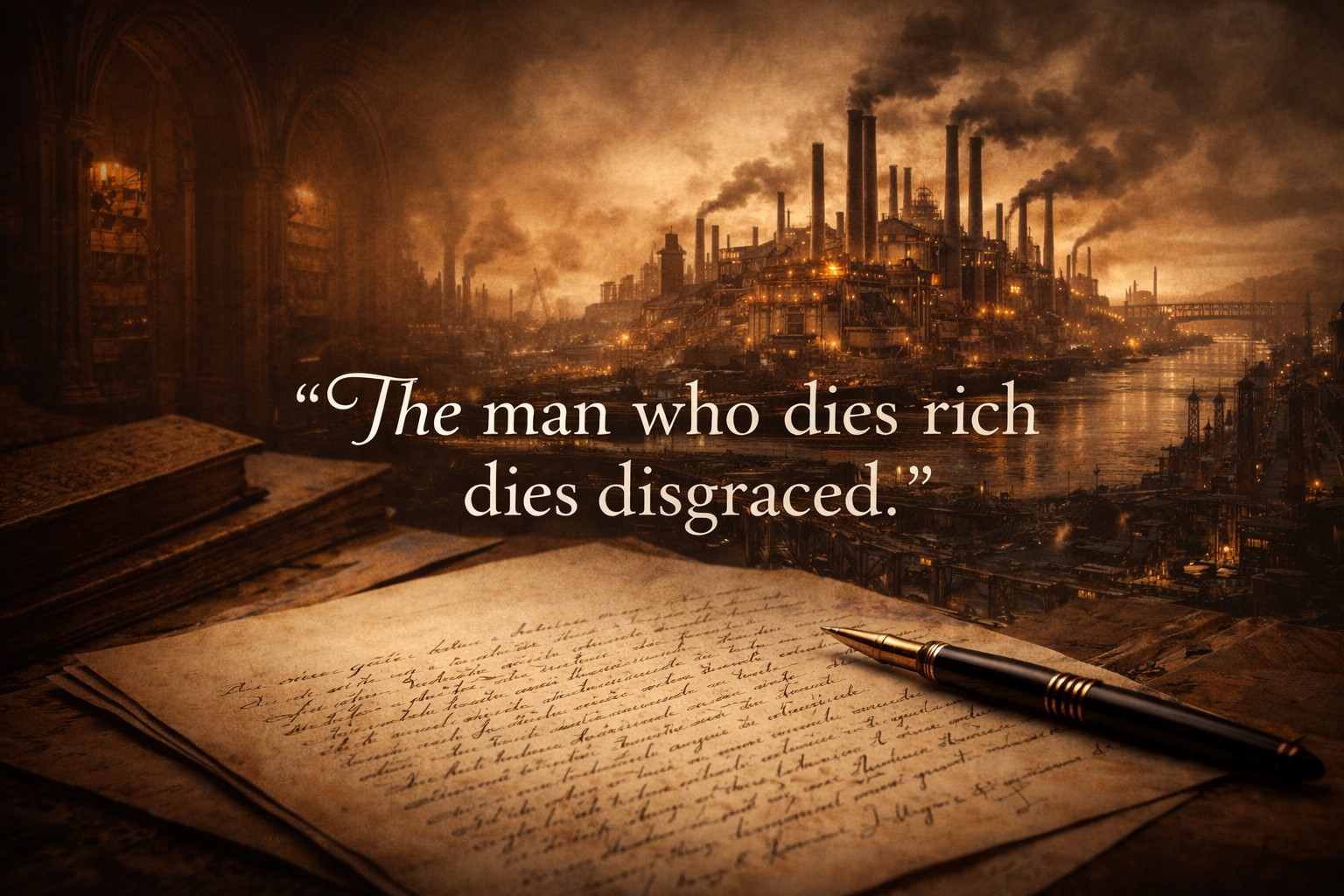
What he refused to accept was that a man of great wealth had no particular obligation attached to it. A man who died rich, he wrote, died disgraced.
The fortune had been generated by the society that surrounded and sustained the man who accumulated it—by the workers, the customers, the infrastructure, the legal system, the whole apparatus of civilization—and the man who kept it all for himself and his heirs had, in Carnegie’s view, fundamentally misunderstood what it was for.
The duty of the rich man, as Carnegie laid it out, was to administer his surplus wealth for the good of the community; not through charity in the conventional sense, not through handouts and relief funds, but through building the conditions under which people could improve themselves.
Libraries. Universities. Concert halls. Parks. The tools of self-advancement, made available to people who could not otherwise access them. Give a man a fish, as the saying goes, and the Gospel of Wealth had nothing against that in an emergency. But Carnegie was interested in building fishing fleets.
He traced the philosophy directly to Colonel James Anderson and that Saturday library in Allegheny. The man who had opened his books to a bobbin boy on his day off had, Carnegie argued, done more genuine good with that gesture than a hundred conventional charitable donations.
He had provided the means of self-improvement to someone who had the will to use them. Carnegie intended to replicate that gift at a scale Anderson could not have imagined and at a cost that Anderson could not have borne.
The essay made a massive impact. Gladstone responded from England. Economists and clergymen argued back from both sides of the Atlantic. Some found it inspiring. Others found it self-serving; a wealthy man constructing a philosophical framework that conveniently cast his own behavior as morally superior.
That criticism was not entirely unfair. Carnegie was not oblivious to it. He published a follow-up essay, “The Best Fields for Philanthropy,” the same year, laying out in practical terms exactly how he intended to give the money away and to what ends.
He had already started. The first Carnegie library opened in Braddock, Pennsylvania, in 1889, the town where his first steel mill stood. The location was deliberate. These were the workers and families who had helped to produce the wealth.
The library was built with that wealth, in their community, available to their children. Whether it settled any such moral issue is a separate question. As an act of practical philanthropy, it worked.
2,509 libraries followed, the functional beginning of the idea of a public library. Carnegie funded them on a specific model: he provided the building and support, the community provided the land and committed to funding the books and operations in perpetuity.
He was not interested in monuments that would be built and then neglected. He wanted libraries that communities had skin in, that they had committed to maintaining because they had asked for them and accepted conditions to get them. The model was brilliant precisely because it was demanding. It produced libraries that lasted.

They are still standing. They are, in a lot of cases, genuinely beautiful buildings; Carnegie insisted on architecture that communicated that knowledge was worth housing well. Brick and stone, generous windows, reading rooms with good light.
If you have ever walked into a Carnegie library and felt that the building itself was making an argument for the value of what it contained, then you understood the point.
The Carnegie Corporation of New York, established in 1911 with an endowment of $125 million (about $4.5 billion today)—the largest single charitable gift in history at the time—became the institutional engine of his philanthropy after his retirement.
It funded universities, scientific research, teacher pension funds, and the kind of long-horizon public projects that governments were reluctant to support and private donors rarely sustained. The Corporation funded Sesame Street in its early years, contributing to a television program that would help teach generations of American children to read and count.
The money that began as steel rails and beams laid across a nineteenth century continent was still doing its work a hundred years later, in living rooms that Carnegie could not have conceived of, reaching children whose great-grandparents had not yet been born when he wrote the Gospel of Wealth.
He also established the Carnegie Hero Fund in 1904, after a mining disaster in which men died attempting to rescue trapped colleagues. The fund was designed to recognize and financially support civilians who risked their lives to save others; people who performed acts of extraordinary courage with no expectation of reward or recognition.
The medal it awarded carried an inscription from the Gospel of John: “Greater love hath no man than this, that a man lay down his life for his friends.”
Carnegie chose that inscription himself. It was not a casual selection for a man who had paid $850 for a Civil War substitute and lived with the memory of it for forty years.
Carnegie Hall had opened in 1891, funded by Carnegie at the urging of conductor and composer Walter Damrosch, who convinced him that New York needed a world-class concert venue. The opening night program featured Tchaikovsky conducting his own work, the composer having been brought over from Russia specifically for the occasion.
Carnegie apparently found the idea of building a concert hall more enjoyable than almost any other project of his philanthropic career. He liked music, he liked the idea that working people could attend performances in a magnificent space, and he liked Tchaikovsky.
By the time Carnegie Steel was sold, he had already been giving money away for years. The sale simply removed the last obstacle between Carnegie and the full-time occupation of spending what he had accumulated.
He was 65 years old, he was the richest man in the world, and he had a letter in a desk drawer from 1868 that he was finally, thirty-three years late, going to honor.

The Sale
By 1900, Carnegie Steel was a production monster in the United States. The numbers were almost abstract, cartoonish, in their scale; the mills ran day and night, the ore came down from Minnesota, the coke came up from Connellsville, and the finished product went out to railroads and construction projects and shipyards across the country and beyond.
Carnegie had built something that no competitor could match on cost, and he knew it, and his competitors knew it, and the knowledge made everyone in American industry a little nervous.
Then he announced plans to expand into finished steel products; the kind of manufacturing that would put him in direct competition with the network of industrial enterprises that J.P. Morgan had been quietly assembling.
Morgan looked at the announcement, looked at his own position, and concluded that Carnegie would have to be bought out before he dismantled the entire market.
Morgan sent an intermediary, Carnegie’s own partner Charles Schwab, to open the conversation. The message was simple: Morgan wanted to buy Carnegie Steel. What would Carnegie take for it?
Carnegie thought it over, sat down, and wrote a number on a piece of paper.
$480 million.

Schwab carried the paper back to Morgan. Morgan looked at it for a moment and agreed without negotiating. The deal closed in 1901, forming U.S. Steel, the first billion-dollar corporation in history.
Carnegie later told a friend he thought he should have asked for $100 million more, and given Morgan’s lack of hesitation, he was probably right.
On the day the deal closed, Morgan reportedly crossed a room full of businessmen and financiers to find Carnegie and shake his hand. “Mr. Carnegie,” he said, “I want to congratulate you on being the richest man in the world.”
Numbers from the nineteenth century have a way of getting past modern readers without understanding what we’re talking about. $480 million sounds like a lot, but we live in an era of inflated paper currency where the word “billion” gets thrown around casually, and a figure with only three commas can feel almost modest by comparison.
It shouldn’t.
When Morgan handed Carnegie $480 million in gold bonds, that was not theoretical wealth; it wasn’t stock that would evaporate if he tried to sell it, not a paper valuation existing primarily as a scoreboard figure as we do with modern “net worth” figures. It was real, tangible, spendable money.
Economists who have attempted to translate Carnegie’s peak wealth into today’s dollars arrive at figures ranging from $300 billion to upward of $400 billion. Andrew Carnegie controlled multiple percentage points of the entire Gross Domestic Product (GDP) of the United States.
The men we currently call the richest in the world hold the vast majority of their wealth in stock. These are numbers on a screen that fluctuate by billions between breakfast and lunch, and that could never actually be realized because selling that volume would collapse the price before the transaction was half finished.
Carnegie’s money was in gold. He could spend it, and he would; $350,695,653 worth of it.
Carnegie was 65 years old. He went home, told Louise the business was sold, and announced that the real work could now begin.
The Second Life
He meant it literally. Carnegie had spent thirty-five years making money and had, by his own reckoning, spent those years in a state of moral debt that the Gospel of Wealth had articulated but not yet discharged. The sale cleared the obstacles. He now had nothing left to do but give.
He and Louise moved between Skibo Castle in the summers and their mansion on Fifth Avenue in New York during the winters, and from those two bases Carnegie conducted what amounted to a second career of extraordinary productivity.

He wrote his autobiography. He corresponded with presidents, kings, and prime ministers on subjects ranging from international arbitration to the simplification of English spelling; a cause he supported with an enthusiasm his correspondents found endearing and a bit baffling.
He entertained constantly. He argued, with anyone who would engage him, about peace and democracy and the obligations of wealth.
The philanthropy accelerated dramatically after the sale. The libraries were already well underway, but Carnegie now turned his attention to institutions of a different scale and ambition.
Carnegie Mellon University grew from the Carnegie Technical Schools he founded in Pittsburgh in 1900; a practical institution designed to give working-class students the technical education that traditional universities were not providing.

He had watched Pittsburgh’s industrial workforce for thirty years and understood that what the next generation of workers needed was not classical education but engineering, chemistry, and applied science. The school he built reflected that belief. It became, over the following century, one of the leading research universities in the world.
The Carnegie Institution for Science, founded in Washington in 1902 with a $10 million endowment, was built on a different premise: that pure scientific research, conducted without commercial pressure or immediate practical application, was one of the most valuable things a wealthy society could fund.
Carnegie had made his fortune applying science to industry. He understood better than most businessmen that the science had to come first.
The Carnegie Endowment for International Peace, founded in 1910, was the most personal of his large institutional gifts, and the one that would ultimately break his heart.
Carnegie had become, in his retirement years, genuinely and passionately committed to the idea that war between modern industrial nations was an anachronism. He had met personally with Kaiser Wilhelm of Germany. He had funded the Peace Palace at The Hague, completed in 1913, as a permanent home for international arbitration.
He believed, with the complete, genuine conviction of a man who had spent his life solving apparently unsolvable problems through rational negotiation, that the leaders of modern nations would reach the same conclusion he had: that the costs of war so dramatically outweighed any conceivable benefit that no serious person could advocate for it.
He was wrong about this in a way that was going to be very hard to survive.

The War and the End
The Carnegie family was at Skibo in the summer of 1914 when the assassination of Archduke Franz Ferdinand set the machinery of European alliances into motion. Carnegie watched developments with mounting disbelief, then horror, then something that his family would later describe simply as collapse.
He had met Wilhelm. He had believed the conversations meant something. The Peace Palace at The Hague had been open for less than a year when the war started. The building he had funded as a permanent home for the peaceful resolution of international disputes was now sitting empty in a continent that had chosen something else entirely.
Carnegie left Skibo in September 1914 and never returned. The castle that he had called Heaven on Earth, the place where he had brought his family every summer for nearly twenty years, sat empty for the duration of World War I and for every summer after it.
He could not go back. Whatever the place had meant to him was too tangled up in what he had believed about the world, and the world had proven those beliefs catastrophically wrong.
He bought a Massachusetts estate called Shadowbrook and retreated there. His health, which had been robust well into his seventies, declined sharply after 1914. The war aged him in ways that business and pressure and the accumulated difficulties of a long life had not.
Louise continued to hope. In the winter of 1918, she mentioned to Andrew that perhaps they might visit Skibo the following summer, when the war was finally over. He looked at her and said quietly that there would not be a next year for him.
He died on August 11, 1919, of bronchial pneumonia, at Shadowbrook. He was 83 years old. Louise was at his side. Kings and presidents sent condolences. The newspapers ran long tributes. The man who had been the most famous industrialist in the world and then the most famous philanthropist in the world was gone.
By the time of his death, Carnegie had given away $350,695,653. It was approximately 90% of everything he had accumulated. His estate, what remained, was roughly $30 million, almost all of which went to foundations and pensions for his employees.
He had, with the exception of providing comfortably for Louise and Margaret, done exactly what the 1868 letter said he would do.
He is buried at Sleepy Hollow Cemetery in New York, beneath a Celtic cross cut from stone taken from Skibo Castle.
A few yards away lies Samuel Gompers, the founder of the American Federation of Labor (AFL), the man who spent his career organizing workers against the kind of industrial pressure Carnegie’s mills had applied for decades. Whether history arranged that proximity deliberately or accidentally, it seems exactly right.

What He Built
The standard verdict on Carnegie tends to reach for the contradiction; the union-busting philanthropist, the ruthless idealist, the man who wrote about the dignity of labor and then let Henry Clay Frick loose on the workers at Homestead. The contradiction is real and it belongs in any honest examination of his life.
But contradictions are not the whole story, and in Carnegie’s case they are not even the most interesting part.

The most interesting part is the story arc. A barefoot boy from a one-room cottage in Scotland arrives in America at twelve with nothing. He works a bobbin machine for $1.20 a week, borrows books from a stranger’s library on Saturday afternoons, teaches himself Morse code on an idle telegraph machine, and proceeds to build the largest steel empire in the history of the world.
Then he gives it away. Intentionally, and with a philosophical framework behind it that he had been developing since he was a young man.
The Carnegie Corporation is still operating. The libraries are still standing; thousands of them, in communities across the country, many of them still serving as public libraries more than a century after they were built.
Carnegie Mellon is still producing scientists and engineers. The Hero Fund is still giving medals to civilians who risk their lives for strangers. Sesame Street may have helped teach your children to read, and the money that made it possible began as steel laid across a nineteenth century continent by men working twelve-hour shifts in the smoke of Pittsburgh.
He was not a simple man and he did not have a simple story. He carried real contradictions to his grave, and anyone who tells you otherwise is selling you the cartoon version.
But the barefoot boy from Dunfermline who borrowed books on Saturday afternoons and never forgot what that access meant—that boy kept his word, in the end, at a scale that Colonel James Anderson could not have imagined when he opened his library door on a Saturday morning in Allegheny, Pennsylvania, sometime around 1850.
That is not nothing. In fact, it is quite a lot.







Leave a Reply