The London Book Store sat on Cornhill Street in Boston, and in the autumn of 1775 it was doing fine business. British officers browsed its shelves. Tory ladies came for the latest titles from London. It was the kind of place where the city’s loyal, well-heeled crowd felt comfortable. The proprietor was a large, and very affable man, who always seemed genuinely glad to see them.
Henry Knox was 25 years old, six feet three inches tall, and roughly 250+ pounds. He wore a silk handkerchief wrapped around his left hand to cover the scar where two fingers had been blown off in a hunting accident. He was charming. He was well-read. He had been, for years, quietly studying how to kill every person who walked through his door.
Not the individuals, to be clear. The army they represented.
Knox had been educating himself in military science since his mid-teens, working through texts that most formally trained officers hadn’t bothered to read. Caesar’s Commentaries. Sharpe’s Military Guide.
He taught himself French, not for conversation, but to access military treatises that hadn’t made it into English. He understood fortification design and entrenchment placement. He knew how to read terrain for artillery. He’d learned all of it from books, in a bookshop, while selling novels to the wives of British officers.
His life had put him there by necessity. His father, William Knox, had abandoned the family when Henry was nine; shipped off to the West Indies, died there, left a widow and ten children to manage on their own.
Henry dropped out of Boston Latin School and went to work clerking for a bookseller named Nicholas Bowes, who had the good sense to let the boy read everything in the store.
He read constantly, systematically, with the focused hunger of someone who knew that books were the only education he was going to get.
He also found Lucy Flucker there. She came into the shop, the daughter of Thomas Flucker, Royal Secretary of the Province of Massachusetts, a man who occupied the uppermost tier of Boston’s loyalist establishment. She and Knox married in 1774.
Her family was appalled. They made their feelings clear and then made them clearer still. Knox didn’t waver, and neither did Lucy. When the time came, she would sew his military commission into the lining of her cloak and walk with him out of Boston past British sentries, leaving behind everything her family had built. She never saw her parents again.
But that came later. In the autumn of 1775, Knox was still behind the counter, still selling books to occupiers, still a member of the Sons of Liberty, still doing guard duty to keep tea from being quietly unloaded in the night. He was playing an extraordinarily dangerous game with considerable composure for a man his age.
Then Washington’s letter arrived. The Continental Army had Boston surrounded but couldn’t take it; the British held the harbor, the high ground, the guns. What Washington needed was artillery, and he had almost none.
What he had was a report: Fort Ticonderoga, captured from the British the previous spring, held dozens of cannons sitting unused in the wilderness of upstate New York.
Someone had to go get them.
Washington needed a man who understood artillery and someone who understood the brutal logistics of moving heavy iron across impossible terrain. He settled on the bookseller from Cornhill Street who had taught himself all of that from books.
Knox said yes before he’d thought it through completely. That would become something of a pattern.

The Problem
Washington had been staring at Boston since June, and the situation had not improved with staring.
The Continental Army held the high ground ringing the city, Roxbury to the south, Cambridge to the north and west. But holding ground around a city is not the same as taking it.
The British occupied Boston proper and, more importantly, they owned the harbor. The British had warships in the water. As long as those ships could operate freely, the city could be resupplied and reinforced indefinitely. The Americans could sit in the hills forever and accomplish nothing.
Artillery would change the equation. Cannons placed on the right high ground, particularly Dorchester Heights which looked directly down onto the harbor, would threaten the fleet and force Howe to either fight his way out or sail away. Washington understood this. What he lacked was the guns to do it.
When Knox arrived in Cambridge in late October, Washington received him with the reserved courtesy a commanding general extends to a man he’s not entirely sure about.
Knox was a colonel by commission but a bookseller by experience. He was also, by every account, utterly confident; not boastful or arrogant in any way; just genetically incapable of regarding the problem in front of him as unsolvable. Washington, who had a knack for reading men, gave him the job.
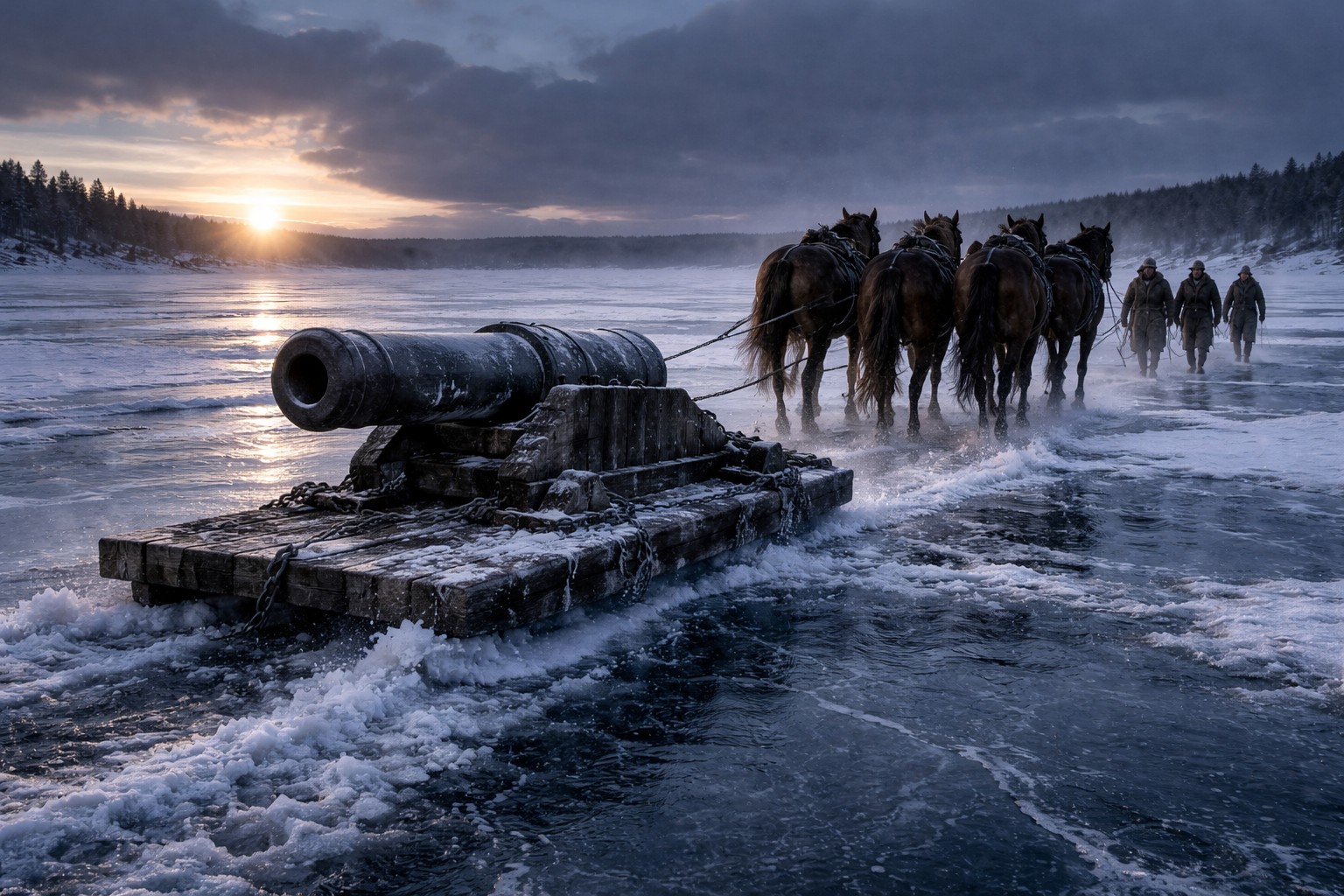
The job was this: travel to Fort Ticonderoga on Lake Champlain, inventory the captured British artillery there, and bring it back to Cambridge. In the winter. Through the Adirondacks and the Berkshires. Across frozen lakes whose ice may or may not hold the weight of a cannon.
The artillery at Ticonderoga amounted to roughly 60 tons of iron and brass; mortars, howitzers, cannons of various sizes, the largest pieces weighing well over a ton each.
None of it had wheels suited for winter travel. There were no roads worth the name through most of the route. There was no established supply chain, no dedicated workforce, no guarantee that the communities along the way would cooperate.
Knox would have to solve every one of those problems himself, in sequence, with his own money and his own persuasion, in the coldest months of a New England winter.
He left Cambridge in mid-November riding north. In a letter to Lucy he expressed optimism about the timeline. Two weeks, he thought, perhaps a little more.
It would take ten.

Reality at Fort Ticonderoga
Fort Ticonderoga had been a ruin for years before anyone thought to strip it of its guns.
The French had built it, called it Fort Carillon, and lost it to the British in 1759. The British held it for sixteen years and let it decay.
When Ethan Allen and the Green Mountain Boys took it in May 1775 — in what Allen himself described as a surprise attack carried out in the name of “the Great Jehovah and the Continental Congress,” though the garrison was mostly asleep at the time — they inherited a crumbling stone structure on a promontory above Lake Champlain, along with a substantial collection of artillery that nobody had figured out what to do with.
Knox arrived in mid-November and walked the grounds taking inventory. Fifty-eight pieces in total: cannons, mortars, howitzers, cohorns, a variety of calibers and conditions. Some were buried in mud. Some needed repair. All of them were heavy.
Knox looked at them and began doing the math that no one else had been willing to do.
He needed sleds; heavy, purpose-built platforms that could be dragged across frozen lakes and down mountain grades. He needed men to drive them. He needed animals strong enough to pull them.
He went looking for oxen, the obvious choice, and ran immediately into the first of what would be a long series of negotiations that went badly. The owners wanted more than Knox was authorized to pay. He argued, lost, and pivoted to horses instead. He struck deals with local teamsters and moved on without writing home about the change.
Every famous painting of the Noble Train of Artillery shows oxen hauling the sleds through the snow. Every one of them is wrong.
The true version, a 25-year-old bookseller haggling over livestock prices in upstate New York in December, then substituting one animal for another and hoping Washington didn’t ask why, is considerably more realistic and human than the myth.
The first serious trouble came on the water. Knox loaded the artillery onto boats to move it south across Lake George, the first leg of the journey home. One of the gundalows, a flat-bottomed cargo vessel, grounded on a submerged rock and went down.
The man responsible for her was William Knox, Henry’s younger brother, nineteen years old, serving as her captain. William sent word that she’d foundered but her gunwales were still above the waterline. She could be bailed out. She was, eventually, with help from men working in freezing water up to their chests.
Knox wrote to Lucy around this time, reporting progress with measured optimism. He did not mention that he was already behind schedule. He did not mention that he was over budget. He did not mention the gundalow.
By late December the artillery was assembled at the southern end of Lake George, loaded onto sleds, and ready to move. Knox had 58 pieces of captured British iron and brass, a crew of teamsters whose confidence in the enterprise varied considerably, a string of horses, and roughly 300 miles between him and Cambridge.
The lakes ahead were frozen. Whether they would hold was a question he would answer by crossing them.

The Stranger in the Cabin
The snowstorm came up fast, not unusual in the Adirondacks in December, and Knox made the sensible decision to stop for the night at Fort George rather than push on in deteriorating conditions. He was given a one-room log cabin. It already had an occupant.
The man’s name was John André. He was 25 years old, Knox’s exact age, and he was being held as a British prisoner of war following the fall of St. Johns earlier that autumn.
He was slight where Knox was enormous, formally educated where Knox was self-taught, and he had come to soldiering the same way Knox had: from civilian life, by choice, with a natural aptitude that surprised people who’d known him before the war.
He spoke several languages. He drew well. He was, by every account of people who met him on either side of the conflict, extraordinarily charming company.
The two men spent the evening by the fire. Outside, the storm worked itself out against the walls of the cabin. Inside, they talked about books, philosophy, music, and art; the conversation of two young men who had wandered into a war and not yet lost their appetite for the things that had interested them before it started.
Knox was traveling in civilian clothes and gave no indication of his mission. André, a prisoner without much leverage over his own circumstances, was just grateful for good company on a bad night.
They parted the next morning. Knox moved on toward Ticonderoga. André eventually made his way back to the British army, where he rose to become Adjutant General and the personal intelligence officer for General Henry Clinton.
In September 1780, André crossed behind American lines to meet with Benedict Arnold and finalize the terms of Arnold’s betrayal of West Point. He was caught on his way back, the incriminating documents hidden in his boot. A courts martial was convened with a board of officers to determine his fate. By order, Knox sat on it.

The board found André guilty of operating as a spy and sentenced him to death. Knox signed the finding. André was hanged at Tappan, New York, on October 2, 1780. He was 29 years old.
Knox said afterward that duty had never cost him more than it had that day. Whether he thought back to the cabin at Fort George, the fire, the storm, two young men talking about books while a war waited outside, is unknown. But it is hard to imagine that he didn’t.
Facing Down the Ice
The decision to cross Lake George on the ice rather than go around it was not reckless. It was the result of a risk assessment. The overland route was longer, the terrain worse, and the windows of usable winter weather were not unlimited. Knox needed to move. The ice was the fastest way south, and in January it was thick enough — probably — to hold.
“Probably” is a word that concentrates the mind considerably when you are standing on a frozen lake with a cannon sled.
The teamsters knew what they were doing, which helped. Each sled team leader carried an axe. The purpose of the axe was not for clearing brush or cutting wood. If a cannon broke through the ice and began to drag the horses down with it, the axeman cut the traces. The horses might survive. The cannon would not.
This was the acknowledged plan, discussed openly, which tells you something about how seriously everyone involved understood the stakes.
The crossing began in early January. Knox organized the teams methodically, spacing the sleds so their combined weight wouldn’t concentrate on a single section of ice.
The cannons went across one at a time, the horses stepping carefully, the teamsters reading the surface the way experienced men read it; listening for the crackling groan that means the ice is talking to you, watching for the darkening that means water is close beneath.

The first crossings held. Then one didn’t.
A cannon went through. The sled dropped, the ice gave way beneath it, and suddenly there was a hole in the lake and a gun at the bottom of it and a crew of men standing at the edge figuring out what to do next.
The horses had been cut free in time. The cannon was sitting in the shallows, her gunwales, if a cannon can be said to have gunwales, still visible beneath the surface.
Knox wrote about what followed in his diary, and his voice in that entry is worth hearing.
He described going on the ice at eight o’clock in the morning and proceeding so cautiously that before nightfall they had retrieved the cannon from the river with the assistance of the good people of the city of Albany. Then he recorded the crew’s response to getting her back: they christened the gun The Albany.
That small touch — naming a gun they’d just pulled from a frozen river, in the middle of a January night, in the middle of a mission that had already gone badly wrong twice — says more about the character of the men on that expedition than any formal account could.
They were cold, behind schedule, short on sleep, and they named the cannon. Knox understood instinctively that morale is not an abstraction. It lives in exactly those moments.
The cold was not incidental to this story. It was the story’s medium, the condition inside which everything else happened. January in upstate New York along the Hudson corridor is a particularly unforgiving kind of cold. Not the dramatic cold of a blizzard but the grinding cold of days that never get above freezing, nights that drop well below it, and wind that finds every gap in a man’s clothing and stays there.
The teamsters had been at this for weeks. Their hands were cracked. Their boots were never fully dry. They woke up stiff and went to sleep exhausted and in the morning the cannons were still there, still heavy, still requiring the same effort they’d required the day before.
Knox drove them by example as much as by authority. He was not the kind of commander who observed from a distance. He was too large, too energetic, and too personally invested in the outcome to stand apart from the work.
When a sled needed pushing he pushed it. When a team of horses balked he was at the head of them. He was also, at 25, young enough that the men pulling alongside him could look at him and understand that whatever this was costing them, it was costing him too.
The train came off the ice and moved onto land on the western bank, angling south and east toward the Massachusetts border. Behind them Lake George sat silent in the January dark, one section of its surface patched and refrozen where The Albany had gone down and come back up.
They had the cannons. They were moving. The Berkshires were ahead.
Knox wrote to Lucy that evening. He told her things were going well.
Confronting the Berkshires
Knox’s diary goes thin here. The pages covering the Massachusetts leg of the journey are missing or sparse, which means the most grueling stretch of the entire enterprise is also the least documented.
What we do have is the terrain, the weather records, and a handful of accounts from men who watched the train pass through their towns. They are enough.
The Berkshires in January are not the Berkshires of autumn foliage and country inns. The hills rise steeply from the valley floors, the grades punishing even in dry conditions, and in winter the roads, where roads existed at all, were narrow tracks of packed ice running between walls of hardwood.
Moving loaded sleds uphill required brute force. Moving them downhill required something harder still: control.
A sled carrying a ton of iron on an icy grade does not stop because you want it to. It stops because enough men and animals are throwing their full weight against its momentum, and sometimes that is not enough, and the sled goes where physics sends it.
Knox’s men knew this. They had been managing it for weeks. But the Berkshires were steeper than anything they’d crossed, and the snow was thinning out in ways that made the work harder rather than easier. Sleds need snow. Without it the runners catch and drag, the loads shift, and the animals and men tire faster.
By the time the train reached Blandford, the lead teamsters had seen enough.
They stopped. Refused to go further. The grade ahead was too steep, the snow cover too sparse, and they saw no route through that didn’t end with a cannon at the bottom of a ravine and a team of horses on top of it.
These were not cowards or shirkers; they were experienced men making a professional judgment about a genuinely dangerous situation. Knox could not bully them through it, and he was smart enough not to try.
What he needed was someone who knew the ground.
Solomon Brown knew the ground.
Brown was a local farmer, a Blandford man, and his name has survived in the historical record almost by accident; a brief mention in a handful of accounts that might easily have been left out.
He arrived with oxen and, more valuably, with intimate knowledge of the route down what the locals called the Devil’s Staircase, the descent into the Connecticut River valley that had stopped Knox’s teamsters cold. He knew where the grade leveled briefly, where the surface held, where the weight needed to shift. He led the train through it.
The cannons made it down.
Brown went home afterward. No commission, no ceremony. He had a farm to get back to. His name survived; the names of most of the men who helped that day did not, and this is worth reflecting on a bit.
The Noble Train moved because Knox willed it, yes. But it also moved because of farmers who loaned their oxen for a day and asked for nothing much in return. It moved because teamsters from Albany and Glens Falls and a dozen small communities along the route showed up in the cold and put their backs into it.
It moved because people who had no particular stake in the outcome of the siege of Boston looked at this improbable procession coming through their town and decided to help. Most of them left no record. The cannon they helped move is in a museum. Their names are gone.
That is how most history actually works, and Knox would have been the first to acknowledge it. He was not a man given to pretending he’d done things alone.
At Westfield, with the worst of the hills behind them and the Connecticut River valley opening up to the east, Knox did something that had nothing to do with logistics and everything to do with understanding people. He loaded one of the large cannons with powder and fired it.
The sound rolled out across the valley like thunder in January. The crowd that had gathered to watch — and there was a crowd, because word of the train had been traveling ahead of it — went silent for a moment and then erupted.
Most of them had never heard a cannon fired. Some had never seen one up close. They had been following the progress of the expedition through rumor and report, and here it was in their town, enormous and real and loud enough to rattle the windows.
Knox watched them react and understood something that would serve him well for the rest of the war: artillery is not just a military instrument. It is a psychological one. The sound alone changes what people believe is possible.
The train moved east out of Westfield, following the frozen Connecticut south toward Springfield, then turning northeast toward Boston. The Berkshires were behind them. Cambridge was two weeks ahead.
Knox wrote to Lucy that evening with something approaching genuine confidence for the first time in weeks. He wrote about the route ahead and the condition of the guns and his expectation of arriving in good time.
He was, for once, nearly right about the timeline.

Cambridge and the Wait
John Adams saw the train pass through Framingham on January 25th and wrote about it with the barely contained excitement of a man who understood exactly what he was looking at. Two days later, on January 27th, Henry Knox rode into Cambridge and reported to Washington.
He had been gone ten weeks. He had spent £521; more than he’d been given, more than he’d promised, more than Washington had probably anticipated. He had 58 pieces of artillery, every one of them intact. He was 25 years old and he had just done something that qualified military men had looked at and declined to attempt.
Washington received him warmly. Then the cannons went to Framingham, and nothing happened.
For six weeks, nothing happened.
This is the part of the story that most accounts skip past, impatient to get to Dorchester Heights. That’s a mistake. The waiting is not a pause in the story; it is part of the story, because what Washington was doing during those six weeks was not nothing.
He was watching the harbor, reading the weather, working out a plan efficient enough that a single night’s work could end the siege before the British understood what was happening. The cannons Knox had delivered were the instrument. Washington was still writing the music.
Knox spent those weeks in Cambridge doing the work of an artillery officer; inventorying equipment, training crews, figuring out which guns would go where when the order finally came. He was good at it. He had always been good at it, theoretically.
Now he was discovering that the theory held up, that the years of reading military texts in a Boston bookshop had given him something real and usable. That must have been a particular satisfaction for a man who had spent his young life being constantly underestimated.
He also waited for word of Lucy. She was behind British lines in Boston, and while Knox knew she was safe — he had ways of getting information in and out of the city — safe and together are different things.
He had left her in November. It was now February. The war that had seemed briefly like an adventure was settling into the longer version of a thing that takes years and costs more than you planned.
Washington opened his bombardment of Boston on the night of March 2nd. Cannons in Cambridge and Roxbury opened fire on the city; a sustained, punishing barrage that had the British scrambling to their own guns and Howe trying to figure out whether this was the main assault.
It was not. It was a feint, carefully designed to fix British attention on the north and west while Washington’s real move was being staged to the south.
The real move was Dorchester Heights.

Surprise on Dorchester Heights
The night of March 4th was a cold one, with a moon bright enough to work by.
Washington had chosen the date deliberately. March 5th was the fifth anniversary of the Boston Massacre, and he understood that history has a theatrical dimension that a good commander ignores at his peril.
But the date was also practical; the tides were right, the ground on Dorchester Heights had thawed just enough to be workable, and the feint on March 2nd had done its job. Howe was looking in the wrong direction.
The operation that night was a feat of organization that deserves more attention than it gets. Some 360 oxcarts moved up to Dorchester Heights in the darkness, their wheels wrapped in hay to muffle the sound on the frozen ground.
Knox had pre-positioned the cannons for rapid deployment. The men working the Heights had been told that silence was not optional; a single sentry raising the alarm too early could bring the British fleet around before the position was fortified.
They worked without torches where they could manage it, navigating by moonlight, moving iron and timber and earthworks into position through the night.
Knox was everywhere. Checking placements, adjusting angles, applying years of self-taught artillery theory to the actual ground beneath his feet. The Heights looked down directly onto Boston Harbor.
A gun positioned correctly up here didn’t just threaten the city, it threatened every ship in the water. Howe’s entire strategic position rested on naval superiority, and naval superiority required that his fleet be able to operate. Knox’s cannons, if properly placed, made that impossible.
By dawn the position was fortified well enough to be defensible. The cannons were in place.
General William Howe looked up at Dorchester Heights on the morning of March 5th and reportedly said that the rebels had done more work in a single night than his entire army could have done in three months.
Whether those were his exact words is the kind of thing historians argue about. That it captured his exact sentiment is not in doubt. He had been outmaneuvered, and he knew it.
He spent eleven days trying to decide what to do about it. He considered an assault on the Heights and thought better of it; the position was too strong, the cannon coverage too thorough, and the memory of Bunker Hill, where his men had taken catastrophic casualties charging an entrenched position, was still fresh enough to give pause.
He considered trying to hold Boston anyway and concluded the math didn’t work. On March 17th, after loading his troops, his equipment, and roughly a thousand loyalist civilians onto ships in the harbor, General William Howe sailed out of Boston and did not come back.
The siege was over. It had lasted eleven months. It ended because a bookseller had gone to get some cannons.
Knox walked into Boston shortly after the British left, moving through streets he hadn’t seen since November. The city was in rough condition; the British had stripped it on their way out, and the signs of long occupation were everywhere.
But it was Boston, liberated, and Knox was 25 years old and had just helped end a siege that his commanding general had not known how to end.
Washington promoted him to brigadier general before the year was out. The bookseller from Cornhill Street would go on to command the artillery at Trenton, Princeton, Brandywine, Germantown, and Yorktown.
He would become Washington’s most trusted American officer. He would serve as the first Secretary of War of the United States. The self-education that had seemed like a limitation turned out to be the thing that made him; a mind trained not by what it was told to read but by what it chose to.
Lucy came through it too. She found Henry in Cambridge after the evacuation and they were together again for the first time in months. What that reunion was like is not recorded in any detail, because Knox was not a man who wrote about private things in terms that were meant for posterity.

What is recorded is this: among the thousand loyalist civilians who sailed out of Boston Harbor on March 17th were Thomas and Hannah Flucker; Lucy’s parents, the Royal Secretary and his wife, Tories to the last. They went to Halifax. Then London. They spent the rest of their lives in exile, petitioning the Crown for compensation for what they’d lost, which was considerable. They never returned to America.
Lucy Knox never saw them again.
She had chosen her husband over her family, her country over her class, and a revolution over the world she’d been raised to inhabit. History remembers Henry Knox, as it should. But Lucy Flucker Knox walked out of occupied Boston with a military commission sewn into her cloak, left everything she had ever known, and never looked back.
The Knox marriage was, by every account of people who knew them, something out of the ordinary. Henry and Lucy adored one another. They exchanged more than 150 letters during the war, letters that read like two people who genuinely couldn’t stop talking to each other.
Lucy made the long trips to winter camps whenever she could manage it — Valley Forge, Morristown, others — over Henry’s repeated objections that it wasn’t safe. She came anyway.
When she arrived, the men noticed. She established a close friendship with Martha Washington. Contemporary accounts record that her presence in camp lifted spirits in ways nothing else did.
The soldiers found it hard to voice grievances about hardships they watched her absorb with a smile on her face and without complaint. She was, in the language of the time, beloved.
Henry Knox, the self-taught bookseller who read his way into commanding the artillery of a revolution and then the first Presidential cabinet of a new nation, seems to have understood from the beginning that he’d married someone remarkable. He was right about that too.
She deserves to be the last word.




Leave a Reply