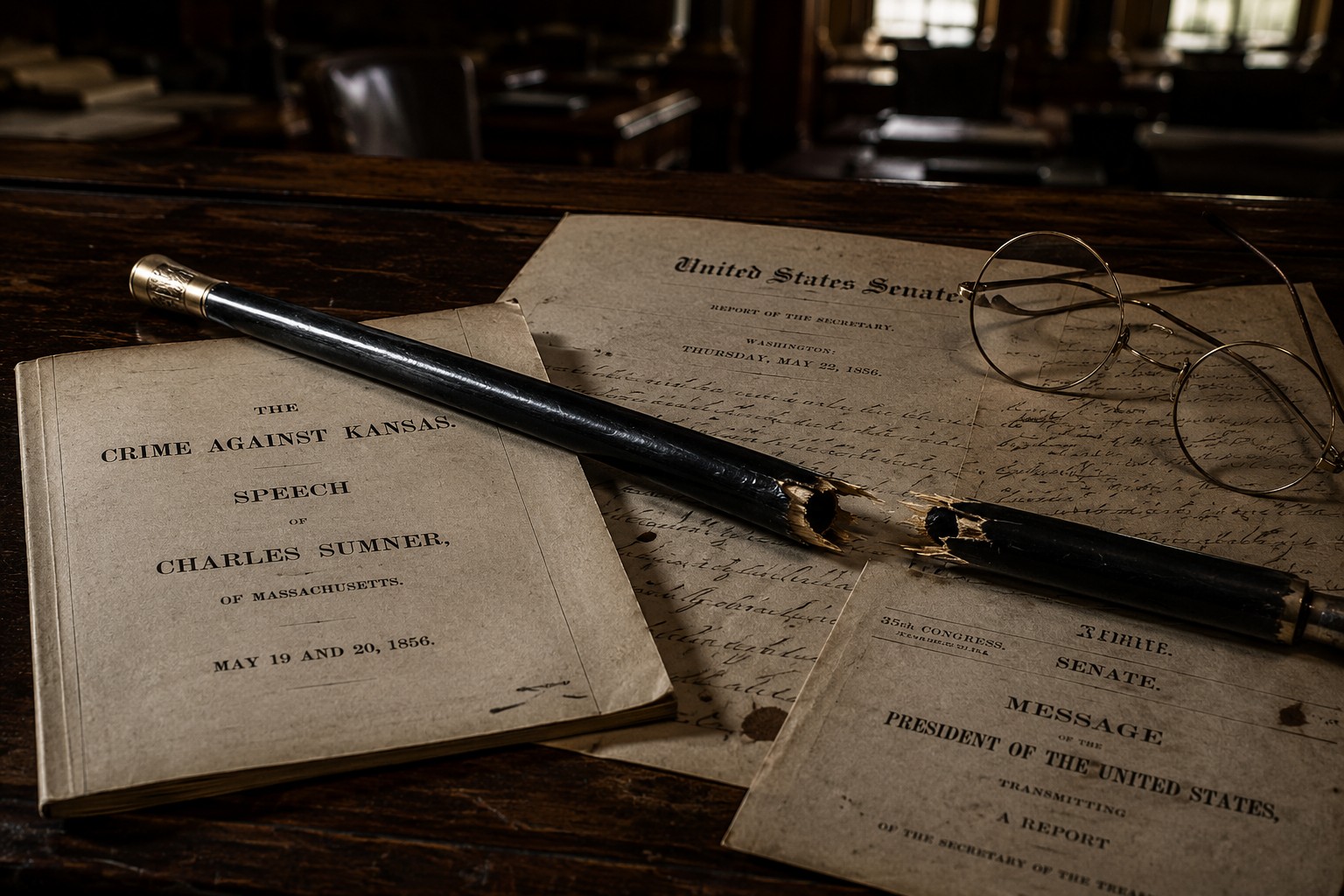
It is May 22, 1856, and the Senate has just adjourned for the day.
A few senators linger at their desks, finishing letters, signing papers, in no hurry to leave a chamber that has emptied out around them. The galleries are clearing. Somewhere nearby, a stranger with a cane is waiting for the room to thin out just a little more.
Nobody hears him coming. What they hear, a few minutes later, is a noise nobody can quite describe.
One man would later call it a crash. Another remembered thumps, pounding, a rustling disturbance he couldn’t place. A third described it simply as a scuffle, and some disturbance. The sound didn’t belong in that room, and for a moment, that confusion was worse than knowing.
Then somebody looked, and the confusion ended.
Charles Sumner is at his desk, pinned. The desk is bolted to the floor, and Sumner’s long legs are caught under it, so that when he tries to rise he can’t, not at first, not until the desk tears loose.
A man stands over him with a cane raised, and the blows are landing on Sumner’s head, again and again, faster than anyone in the room can process. The cane breaks.
The man keeps swinging anyway, using what’s left of it. Sumner goes down. The man pulls him up by the lapel of his coat and keeps hitting him.
Two other men stand nearby, and they are not helping Sumner. They are making sure nobody else does. One of them has a pistol out. Let them alone, he is shouting, God damn you, let them alone.
In under a minute, it’s over. Sumner is on the floor, bleeding, unconscious. The man with the broken cane straightens his coat and walks out of the chamber. He’s not rushing, he’s in no hurry. After all, he believes that he has just done the right thing.
This is the part of the story many people know. A senator, beaten nearly to death at his own desk, by a man who walked away from it without a second thought. It is, as far as it goes, entirely true.
It is also, as written, only half the story; and the half that’s missing is the half that explains why the man with the cane never looked back.

Two Days Before
Charles Sumner had been working on this speech for two months.
He wrote it; every word, then revised, then printed in advance, 112 pages bound and distributed before he’d said a single sentence of it out loud. He did this instead of sketching out the kind of loose talking points a senator might bring to the floor on a normal day.
He memorized the whole thing. By the time he stood up in the Senate chamber on May 19, 1856, Sumner was performing a script he had already finished; he was not casually speaking from notes.
It may not seem like much, but that point is an important part of the story. Whatever happened on that floor over the next two days, it didn’t happen because a man got worked up and said something he’d regret.
Sumner regretted nothing. He’d had two months to regret it in advance, and used the time instead to make sure every line cut exactly where he wanted.
The Senate chamber was packed and the room was 90 degrees. Sumner, six-foot-two and built like it, dressed for the occasion in lavender trousers and a light English tweed coat, which on a man less sure of himself might have looked like an affectation.
On Sumner it looked like a man who already knew he was the most interesting person in the room and intended to keep it that way for the next several hours.
He called the speech “The Crime Against Kansas,” and on the subject promised by that title, he was right. The Kansas-Nebraska Act had repealed thirty-four years of settled compromise to let slavery’s expansion ride on a rigged process, and the rigging was already turning the territory into a battlefield.
Sumner’s case against that, against the bill, against the men who’d written it, against the violence already spreading across Kansas, was a real argument, made by a man with a real grievance, and the country needed to hear it.
That part of the argument holds up. What Sumner did next does not.
What Sumner did next was turn that real argument into a personal hunting expedition, and he did it in writing and in voice, on purpose, against a man who wasn’t even in the building.
Andrew Butler, senator from South Carolina, was away from Washington that day, and Sumner had known it for as long as he’d been writing the speech.
He built the absence into his script, telling the chamber early on that he “regretted much to miss the elder senator from his seat”; a courtesy in form only, since the point of saying it was to make clear he intended to go after Butler, with no one there to answer for him.
He made references, and told the chamber that Butler “has read many books of chivalry, and believes himself a chivalrous knight, with sentiments of honor and courage”, comparing the absent sixty-year-old man to a fictional buffoon.
But those comparisons weren’t enough, so he went further. Butler, Sumner said, had taken a mistress: “who, though ugly to others, is always lovely to him; though polluted in the sight of the world, is chaste in his sight. I mean the harlot, Slavery.”
That’s the line everyone remembers, if they remember any of it. It’s not the worst one.
Butler had suffered a stroke. It had left him with a speech impairment; slowed and stuttering, the kind of thing that happens to a man’s voice after his body has betrayed him.
Sumner used it as material, twice. He told the Senate that Butler, with “incoherent phrases, discharged the loose expectoration of his speech,” and added, for good measure, that Butler “cannot ope his mouth, but out there flies a blunder.”
One line might have been a slip of temper in a long speech. Two is a theme. Senators on both sides of the slavery question sat in that chamber and visibly recoiled, because everyone in the room understood exactly what they’d just watched a healthy man do, twice, to a sick one who couldn’t answer for himself.
Stephen Douglas was there too, and Douglas, co-author of the Kansas-Nebraska Act, no friend of Sumner’s politics and very much in the line of fire himself that day, leaned over to a colleague partway through and said, “that damn fool will get himself killed by some other damn fool“.
As it turned out, he was being realistic, not dramatic.
When the speech ended, Senator Lewis Cass stood up and called it the most un-American and unpatriotic address that had ever grated on the ears of that chamber, and Cass was no defender of slavery’s expansion.
He was reacting, like everyone else in the room, to watching a man spend five hours over two days proving he could be cruel and precise at the same time, and choosing to be both.
This is the part of the story that gets left out when people tell it later, and it’s worth thinking about why. The speech’s politics don’t get erased; historians still talk about the Kansas-Nebraska Act with the same passion Sumner brought to denouncing it.
The specific, personal, physical cruelty of what Sumner said gets rounded down to words like “fiery” or “inflammatory”; words vague enough to describe almost any speech in that chamber on any given day. Vague adjectives don’t make anyone uncomfortable. The actual sentence about Butler’s stroke did.
Sumner walked out of that chamber on May 20 having delivered, by his own design, the most talked-about speech in the country. He’d also delivered, to a man not present to defend himself, insults harsh enough that it would take his cousin exactly two days to decide what to do about it.

A Man Named Butler
Andrew Pickens Butler was fifty-nine years old in the spring of 1856, and he had spent most of his adult life being the kind of man others deferred to without thinking much about why.
He’d graduated from South Carolina College in 1817, passed the bar the next year, and built a law practice across five counties before South Carolina made him a judge.
He sat on that bench for thirteen years; the State Court of Common Pleas, the kind of post that doesn’t go to men colleagues consider careless or cruel. By the time Carolina sent him to the U.S. Senate in 1846, he’d already spent more than a decade being the person other people’s disputes got handed to for a final word.
One contemporary called him the most unique and original intellect in the Senate. Another credited him with grand gifts of eloquence, action, and pathos. He chaired the Judiciary Committee for most of his time there.
None of that means Butler was a man worth admiring. He’d spent his whole career defending slavery as something closer to scripture than to policy, and he co-wrote the Kansas-Nebraska Act with Stephen Douglas; the same act tearing Kansas apart while Sumner stood up to denounce it.
Butler earned an opponent’s contempt on the merits.
What he hadn’t done was show up to defend himself on May 19, 1856. He couldn’t. He’d suffered a stroke that had already begun stealing pieces of him; his balance, sometimes his footing, and his speech, which now came out slower than it used to, with a drag in it that hadn’t been there before.
He was at home in South Carolina, sick, while a Senate colleague of five years stood up in Washington and turned that damage into a punchline twice in one afternoon.
Told about it afterward, Butler’s reaction was procedural. Instead of flying into a rage, he said that if he’d been in the chamber, he would simply have called Sumner to order; the parliamentary equivalent of a raised hand, the mildest tool available to a man who’d spent thirteen years running a courtroom.
That was the whole of his response: an old judge saying, in essence, that he’d have handled it the way he’d handled everything else in his career; by the book and without much heat.
His cousin had other plans.

The Code
Preston Brooks heard about the speech secondhand, but that was enough.
He was thirty-six years old, a six-foot Mexican War veteran with a limp from an old dueling wound, if that gives any indication of his personality. He was the kind of man that had already lived by the rules of the code duello.
He sat in the gallery while a colleague read him the worst of what Sumner had said about his cousin, and by his own account, the answer formed in his mind almost immediately: I felt it to be my duty to relieve Butler and avenge the insult to my State.
A duel was the obvious tool for that. It was also the first option Brooks dismissed, after a conversation with Laurence Keitt, a fellow South Carolina congressman fluent in the etiquette of these things.
Keitt’s answer helped to explain: dueling was a courtesy reserved for gentlemen, and the language Sumner had used in that speech put him below the threshold; no better, in Keitt’s opinion, than a drunkard.
A man like that earned a public whipping, not an honorable contest; Brooks accepted that distinction without apparently mulling it over very hard.
Then came the part that separates Brooks from a man acting on impulse: he spent real time deciding how.
He settled on a cane; gutta-percha, gold-headed, a gift from a friend a few months earlier, hollow at the core so it would splinter on impact instead of hold together for a killing blow.
The choice came after weighing two more traditional instruments for this kind of beating, a horsewhip and a cowhide, and ruling both out on practical grounds.
Sumner outweighed him by some thirty pounds and stood three inches taller, and Brooks worried that a man that size could wrench a whip out of his hand mid-strike, leaving him to fall back on the pistol he was already carrying; a line he had no interest in crossing.
“I would have been compelled to do that which I would have regretted the balance of my natural life”, he wrote.
The cane solved that problem. It was hard to wrestle away, light enough to swing fast and repeatedly, and built to break before it killed. He’d thought about the weapon with the same care a mechanic gives a tool, weighing reach against grip against how much damage it would do if it connected exactly as planned.
For two days, he waited.
He waited because the timing mattered to him as much as the method. He wanted the chamber clear, and more specifically, he wanted no women present to witness what he intended to do; a courtesy extended to the gallery that he had no intention of extending to Sumner.
On the afternoon of May 22, with Keitt and a third ally, Henry Edmundson of Virginia, trailing behind him, Brooks finally got the empty room he’d been watching for.
Sumner was at his desk, head down, autographing copies of his own speech for the mail.
Brooks walked up and spoke first: Mr. Sumner, I have read your speech twice over carefully. It is a libel on South Carolina, and Mr. Butler, who is a relative of mine.
Sumner started to rise.
That was the last calm moment either man would have for the next sixty seconds.

Thirty Strikes
The first blow caught Sumner around the head, and it took his sight immediately; not a metaphor, an actual fact he reported afterward. The force of it blacked out everything in the room, his assailant included.
“I no longer saw my assailant, nor any other person or object in the room”, he said later. “What I did afterwards was done almost unconsciously, acting under the instincts of self-defense”.
What he did was try to stay on his feet, blind, while Brooks kept swinging.
His legs were trapped. The desk was bolted to the floor and his chair ran on a track meant to slide back and give him room, and in the chaos he never found it, or never had time to.
So, he did the only thing left; he broke the desk loose, and staggered up the aisle with blood running into his eyes, unable to see where he was going or what was still coming at him.
Brooks followed and kept hitting him.
By his own count, delivered to his brother the next day, it came to “about thirty first-rate stripes” with the gutta-percha cane, each one aimed with the same care he’d put into choosing the weapon in the first place.
“Every lick went where I intended it”, he wrote. For the first five or six blows, Sumner had tried to fight back, reaching for the cane, reaching for Brooks; “he offered to make fight”, in Brooks’s words, but Brooks moved too fast for him to land anything. By the end, the resistance was gone. “Towards the last he bellowed like a calf”.
Sumner went down. He didn’t stay down by choice; Brooks kept striking him even after he’d collapsed, the cane coming down on a man who could no longer see, no longer stand, and at one point could no longer do anything but take it.
Two other South Carolinians had come into the chamber with Brooks, and their job was not to help Sumner. Henry Edmundson stood blocking the aisle. Laurence Keitt did more than block; he drew his own cane, then a pistol, and shouted at the men starting to move toward the desk: “Let them alone, God damn you, let them alone”.
Senator John Crittenden tried to get to Sumner anyway and got driven back. Representative Ambrose Murray tried too, and only made it through once the cane had already done what it was going to do.
It broke partway through, gutta-percha shattering the way Brooks had figured it would, the hollow core giving way under its own repeated impact, and Brooks kept swinging the broken half until there was nothing left worth swinging.
Then he stopped, on his own terms, the same way he’d started: deliberately, with the job finished to his own satisfaction.
The whole thing took about a minute.
Sumner lay on the floor of the United States Senate, unconscious, bleeding from his scalp onto the carpet, while the man who’d put him there straightened his coat.
Brooks didn’t run. He walked out of the chamber at an ordinary pace, past men still too stunned to stop him, and out into the Capitol grounds, where — without being asked — he stopped to explain himself to the first acquaintance he met, the governor of Missouri, because he wanted his version on the record before anyone else’s reached the city first.
He had done exactly what he came to do.

Hit Him Again
The country found out within days, and it split exactly along the line everyone expected.
The Hartford Courant called it a cowardly assault. The Edgefield Advertiser, writing from Brooks’s own home district, called it Mr. Brooks’s chastisement of Senator Sumner; a word chosen the way a parent chooses it, correction as opposed to crime.
An Alabama paper went further: Sumner, in its judgment, had been needing something of the sort since the first day he put his foot in the Senate chamber.
The Richmond Enquirer didn’t bother with euphemism at all. It called the beating good in conception, better in execution, and best of all in consequences, and recommended the treatment be repeated every morning, on the theory that the Senate’s abolitionists had been allowed to run too long without collars and needed lashing into submission.
If you want to understand where the country was at this time in history, you need to read that last word again. Lashing. A newspaper had just called for a sitting United States senator to be whipped, in print, as official editorial opinion, and meant it.
There was more than the words. Within weeks, Brooks had received dozens of replacement canes from admirers across the region, several inscribed with the same slogan: Hit him again.
Some Carolinians went further, collecting splinters from the cane that had actually broken over Sumner’s skull and turning them into rings worn on neck chains.
A shattered weapon, repurposed as jewelry; solidarity you could carry on your body. Brooks, for his part, told friends every Southern man sustains me, and from where he stood, that was true.
The North created it’s own tale, and unsurprisingly it was the opposite version.
Sumner didn’t return to his seat for three and a half years. The injuries were real; head trauma, chronic pain, a recovery that dragged on long enough that newspapers eventually started suggesting he was faking it for sympathy, a claim historians have argued over ever since.
Real or exaggerated, the empty chair did exactly what Massachusetts wanted it to do. The legislature could have replaced him. It chose not to, and left the seat sitting vacant in the Senate chamber for three years, a piece of furniture still doing political work every day Sumner wasn’t in it.
Both sides, in other words, built a monument to the same hour of violence, and both monuments were lies of omission. The canes and the rings let the South treat Sumner’s words as sufficient cause for what Brooks did to him, turning a severe beating into one clean story of honor defended.

The empty chair let the North skip past the speech too, just from the other direction, turning a man who’d spent two months writing personal cruelty into a pure martyr, silent and bleeding, asking for nothing but sympathy.
The Republican Party, still new enough in 1856 to need a story, took the empty chair and ran. Bleeding Sumner went out paired with Bleeding Kansas on banners and in speeches that year, two wounds standing in for one argument: that the Slave Power was violent by nature, North and South, Senate floor and territorial prairie alike.
It worked. The party that had been struggling to find traction two years earlier emerged from 1856 with real strength in the state legislatures, the bodies that picked U.S. senators, and a historian would later credit Brooks’s cane with doing more for the Republican Party than any single piece of legislation that decade.
Brooks never apologized, not once, not even when the House nearly expelled him over it. Forced to answer for himself, the closest he came was insisting he’d meant no disrespect to the Senate or the House; disrespect to the institutions, in other words, not to the man he’d beaten unconscious on the floor of one of them.
His constituents didn’t just forgive him. They reelected him twice in the same year, once after he resigned to let them vote on his conduct, and once more for a fresh term he’d never live to start.
He died of croup that January, five weeks before the new term began. The telegram carrying the news to Washington used a phrase Brooks had not used when describing what he’d done to a man at his desk: he suffered intensely.
Sumner lived another seventeen years, long enough to watch the war he and Brooks had both helped bring closer, and long enough to keep insisting, to anyone who’d listen, that he’d been right that day in 1856. He never apologized either.
Neither man ever did, and the country spent the next century telling the story as though only one of them had needed to.


Leave a Reply