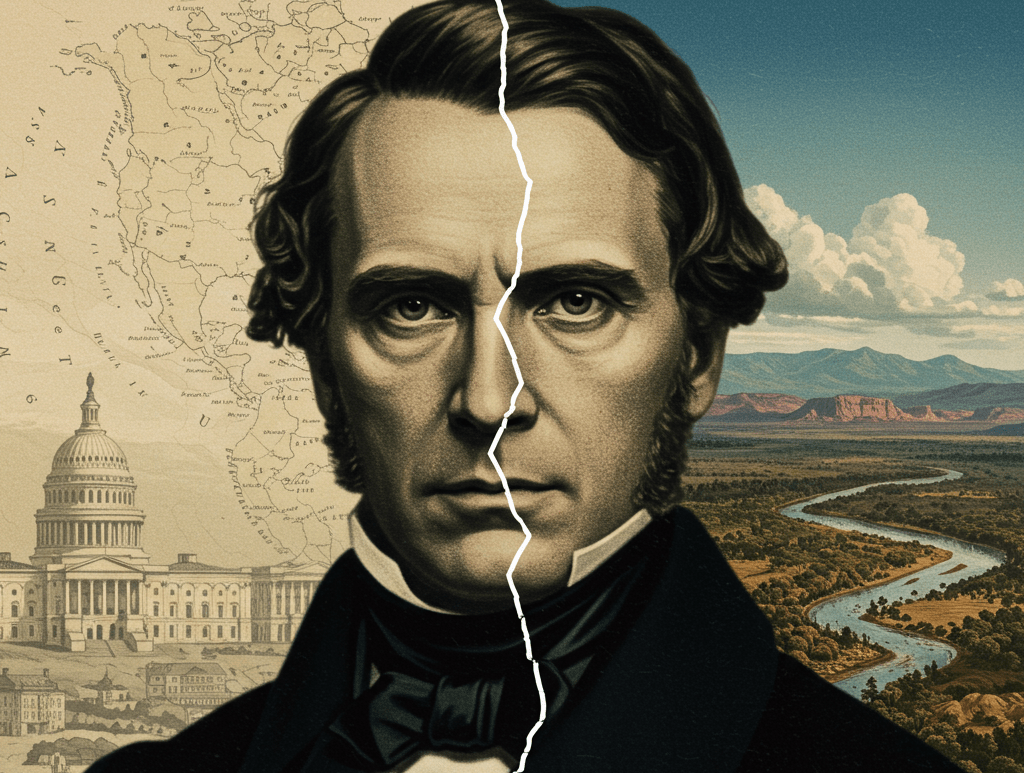
In July of 1804, Aaron Burr crossed the Hudson River to Weehawken, New Jersey, and shot Alexander Hamilton through the abdomen. Hamilton died the next afternoon. Burr was the sitting Vice President of the United States.
The two men had been circling each other for fifteen years by then, through elections and legal cases, with newspaper attacks amplifying both the whole time.
Hamilton had blocked Burr’s path more than once, most damagingly in the 1800 presidential election, when the House of Representatives spent thirty-six ballots deciding whether Burr or Thomas Jefferson would be president, and Hamilton worked behind the scenes to make sure it wasn’t Burr.
By the spring of 1804, Hamilton had said something disparaging about Burr’s character at a dinner party, again. Burr demanded satisfaction. Hamilton, against the advice of nearly everyone close to him, agreed to the field.
Dueling was already illegal in New York and frowned upon in New Jersey, where it remained barely tolerated. Hamilton was a former Treasury Secretary and the architect of the nation’s banking system. Burr was a heartbeat from the presidency. Neither fact slowed either man down.
Hamilton’s second later claimed Hamilton fired into the air on purpose. Burr’s second claimed otherwise. It didn’t matter. Burr’s shot hit, Hamilton’s didn’t, and that was the only fact anyone needed.
The killing of Alexander Hamilton did to Aaron Burr’s career what a duel was supposed to settle without doing: it ended it instantly. He was indicted for murder in both New York and New Jersey.
Federalist newspapers, already inclined to hate him, now had a corpse to point to. Jefferson, who had kept Burr at arm’s length for most of his first term anyway, dropped him from the ticket for the 1804 election without much hesitation or any real explanation.
Burr finished his term presiding over the Senate, delivered a farewell address that reportedly moved several senators to tears, and then had nowhere left to go in Washington. Nowhere left to go, period, if he intended to stay east of the Appalachians and expect to be a free man.
So he didn’t stay. By the spring of 1805, Burr had turned his attention to the one part of the country still rough enough at the edges to offer a man like him a second act: the West.

The General Who Was Already a Traitor
By the time Aaron Burr went looking for a partner in the West, James Wilkinson had been selling out his own country for nearly two decades, and nobody had ever made it stick.
Wilkinson came up through the Revolution under Horatio Gates, performed well enough at Saratoga to build a reputation, and then spent the rest of his career proving that reputations and character are two very different things.
He left the Continental Army under a cloud after getting tangled up in a scheme to push George Washington out of command, resurfaced in Pennsylvania politics for a term or two, and then moved to Kentucky in 1784 to try his hand at land speculation and trade.
The trade didn’t work. Spain controlled the Mississippi and the port at New Orleans, and without access to both, a Kentucky merchant had no way to get goods to market. So Wilkinson solved the problem the way he solved most problems for the rest of his life: he found the most useful man on the other side of the line and sold him something.
In 1787, Wilkinson took a boat down to New Orleans, met with the Spanish governor of Louisiana, Esteban Rodríguez Miró, and signed a declaration of allegiance to the King of Spain.
In exchange, Spain gave him a trade monopoly and, soon after, an annual pension. Wilkinson spent the next several years arguing to his Spanish handlers that Kentucky should break away from the United States and become a Spanish vassal state, an argument that failed to convince Kentucky but didn’t stop the payments.
The Spanish needed an asset inside the American military more than they needed Wilkinson’s politics to work. He gave them the cipher name Number 13 and asked to be called nothing else.
For the next two decades, while drawing a Spanish salary, Wilkinson held some of the highest military and civil posts available to an American: brigadier general, then senior general of the entire United States Army, then governor of the Louisiana Territory once the United States bought it out from under the Spanish he was still secretly serving.
He tipped off Spanish officials about the Lewis and Clark expedition before it left and advised them on how to intercept it. He took roughly $12,000 in Spanish silver in 1804, the same year he was appointed to help take formal possession of the Louisiana Purchase on the United States’ behalf.
The money came up the river hidden in barrels of flour, coffee, and rum, because Spanish coin moving through American territory would have ended the arrangement in the blink of an eye.
In 1794, the boat crew hired to carry one shipment figured out what was really in the barrels, murdered the courier, and scattered into the Kentucky countryside.
When they were caught and hauled in front of a magistrate, the only available interpreter happened to be another man on Spain’s payroll, who translated their confession in a way that left Wilkinson’s name out of it. The killers hanged for robbery and murder. Wilkinson kept his commission.
He was never subtle about being suspected. Detroit residents complained about his corruption enough in 1798 that the Army transferred him south to make the noise stop.
Theodore Roosevelt, writing decades later with the benefit of documents Wilkinson never knew had survived, called him the single most despicable figure in the country’s history. Frederick Jackson Turner, with the same hindsight, called him the most accomplished traitor the nation ever produced.
None of that judgment existed yet in 1805. What existed was a senior general nobody could quite prove anything against, sitting on the Mississippi with a Spanish pension in one pocket and an American commission in the other, waiting to see which side would pay better.
That was the man Aaron Burr decided to build an empire with.

Two Men, One Vague Plan
Burr and Wilkinson had known each other since the Revolution, both having served on Benedict Arnold’s staff during the failed invasion of Quebec.
That history mattered less than what each man needed in 1805. Burr needed a fresh start with enough scale to erase the wreckage of the last one. Wilkinson, as governor of the Louisiana Territory and senior general of the Army, controlled the one piece of the country that made any western scheme possible or impossible.
Burr went looking for him with more confidence than the situation warranted.
What the two men actually agreed to has never been settled, and it likely never will be, because Burr made sure of that on purpose. He spent 1805 and 1806 traveling the Ohio Valley and cultivating support among men who had every reason to want different things from him.
To land speculators, he talked about an enormous tract of land in the Texas borderlands, available for cheap and ready for settlement.
To frontiersmen still bitter about the federal government’s distance and indifference, he talked about a new western republic, independent of Washington.
To adventurers, he talked about Mexico, still Spanish territory and ripe, in the right telling, for the taking.
Burr told each man enough to recruit him and not quite enough to convict him. Harman Blennerhassett, a wealthy Irish émigré, turned his island estate on the Ohio River into a staging ground, supplying boats, money, supplies, and a base from which Burr’s recruiters could work the river towns.
Hundreds of men eventually answered the call in one form or another. Most of them believed they were going to settle land. Some of them believed they were going to fight Spain. A smaller number believed they were about to be present at the founding of something new.
Burr let all three beliefs exist at once, because clarity would have cost him men.
Historian David O. Stewart has argued that whatever Burr intended probably did cross the legal line into treason as the courts would later understand it, even if the moral case is murkier than that conclusion suggests.
In 1806, the border between the United States and Spanish territory was still unsettled enough, and the idea that the western states might eventually split from the Atlantic seaboard was common enough, even among men like Jefferson, that filibustering against Spain or angling for secession didn’t carry the weight then that “treason” carries now.
Other historians, working from the same documents, have reached the opposite conclusion: that there was no credible evidence Burr ever intended an act of war against the United States at all, only a series of overlapping land and conquest schemes that never got far enough to matter.
Burr later claimed under oath that his only real intention had been to settle a tract of land in the Louisiana Territory legally purchased and entirely his to develop.
What is not in dispute is how Burr described his own role afterward. He called Wilkinson “the projector” of the entire scheme, and said he would never have thought of such designs if Wilkinson hadn’t pushed him toward them.
Whether that was true or a convenient way to spread blame onto a man already known for treachery is impossible to say. But it is worth considering the fact that Burr, asked to name the architect of his own conspiracy, didn’t name himself.

The Letter Wilkinson Wrote, Then Rewrote
By the autumn of 1806, Wilkinson could see what Burr apparently couldn’t: the scheme was coming apart in public, and somebody was going to take the fall for it. He decided early that it wasn’t going to be him.
In the summer of 1806, Burr had sent Wilkinson a coded letter, carried west by two couriers, Samuel Swartwout and Erick Bollman, laying out his plans in unmistakable terms.
The letter described detachments rendezvousing on the Ohio by November first, naval cooperation already arranged, and Wilkinson himself elevated to second-in-command, with the rank and promotion of every officer under him left to his discretion. It was the kind of document that could hang a man, and Wilkinson knew it could hang two.
So he rewrote it. Before forwarding the cipher to Jefferson that November, Wilkinson altered the text to strip out the passages that implicated himself and enhance everything that pointed at Burr.
He paired the doctored letter with his own affidavit, in which he cast himself as a loyal officer who had only just discovered the conspiracy and moved to crush it.
He had Swartwout and Bollman arrested and shipped to Washington in irons. He fortified New Orleans, suspended habeas corpus on his own authority, and arrested several more men on nothing more than his own say.
A general already drawing a Spanish pension had just appointed himself the man who saved the republic, and he intended to be paid for it twice.
Jefferson took the offer. He had reason to know better. Wilkinson’s loyalties had been the subject of whispered suspicion in Washington for the better part of twenty years, and Jefferson had heard the accusations.
But by November of 1806, Jefferson needed a conspiracy to be real and a traitor to be named, and Wilkinson was standing there handing him both.
On November 27, Jefferson issued a proclamation denouncing Burr’s scheme as a treasonous plot to dismember the Union, ordered his arrest, and told Congress, before any grand jury had seen a single piece of evidence, that Burr’s guilt was beyond question.
Burr learned of the proclamation while still on the river, already short of the army he had promised his recruits. Fewer than a hundred men and dwindling were waiting for him at Blennerhassett’s Island that December, when he had promised his backers several thousand and a clear run at New Orleans.
He kept going anyway, picking up what stragglers he could as he drifted south. At Bayou Pierre, thirty miles above Natchez, a friend handed him a New Orleans newspaper. It carried a reward notice for his capture and a full translation of the cipher letter Wilkinson had given Jefferson.
Aaron Burr gave himself up, alone on a riverbank with the remnant of his recruits and nothing else. The man whose evidence had put a price on his head had written that evidence himself, edited it for his own protection, and was, at that very moment, the most senior general in the United States Army.

Marshall’s Courtroom
Aaron Burr’s trial opened in Richmond on August 3, 1807, and it was, from the start, a referendum on Wilkinson’s credibility as much as Burr’s guilt.
Chief Justice John Marshall presided, sitting as the federal circuit judge for Virginia, a role he held alongside his Supreme Court seat. Marshall had already shaped the legal ground months earlier in Ex parte Bollman, the case that freed the two couriers Wilkinson had arrested.
There, Marshall had ruled that mere conspiracy to levy war wasn’t enough to convict a man of treason; the Constitution required an actual assemblage of armed men, gathered for a treasonable purpose, witnessed by at least two people testifying to the same act.
Talk wasn’t treason. Letters weren’t treason. Buying boats and recruiting men wasn’t treason, however damning it looked. Treason required a moment, a place, and witnesses who agreed on both.
The prosecution, led by George Hay and pressed relentlessly by Jefferson from the White House, needed that moment to have happened on Blennerhassett’s Island, the one location where they could plausibly claim Burr’s men had assembled with hostile intent.
The defense, led by Luther Martin and Edmund Randolph, needed only to show that whatever had happened there didn’t meet Marshall’s own standard, and that Burr, a hundred miles away when it happened, couldn’t be convicted for it regardless.
The prosecution’s best witness to an armed assemblage was a man named Jacob Allbright, who testified that a militia officer named Edward Tupper had ridden onto Blennerhassett’s Island to arrest the men gathered there, only to be turned back by Burr’s followers raising their weapons against him.
It was, if true, exactly the kind of overt act Marshall’s standard demanded. It also wasn’t true. Tupper had given a prior deposition stating that he’d gone to the island without a warrant, made no attempt to arrest anyone, faced no threats, and had what he described as a pleasant visit.
Allbright had simply invented a standoff that the government’s own witness had already denied under oath.
Then there was Wilkinson, who arrived at the trial in full uniform, by every account that survives him insufferably pleased with his own importance, and was, depending on which side of the courtroom you asked, either the man who’d saved the republic or the man who deserved to be standing in Burr’s place.
Under cross-examination, Wilkinson was forced to admit what the defense had already suspected: the cipher letter he’d handed Jefferson as proof of Burr’s treason wasn’t the letter he’d received. He had altered it.
One observer in the gallery, watching Wilkinson’s performance on the stand, described him as “a mammoth of iniquity”, and meant it as a compliment to no one.
Marshall instructed the jury to ignore everything except the narrow question his earlier ruling had set: did the government prove, through two consistent witnesses, that an actual levying of war had taken place on Blennerhassett’s Island, with Burr legally present or responsible for it.
The government’s case for that fact rested on a witness who had perjured himself and a general who had committed forgery to build the rest of his testimony around it.
On September 1, 1807, the jury delivered its verdict, worded carefully at Burr’s own insistence: not guilty, as charged, by any evidence submitted to us.
Marshall had given the Constitution’s narrowest possible reading of treason, and the government, even with its own general manufacturing evidence on its behalf, hadn’t been able to clear that bar.

The Man Who Walked Free, and the Man Who Should Have
Acquittal didn’t give Aaron Burr his life back.
Effigies of him burned in cities he’d never visited. Federalist papers that had wanted him hanged for Hamilton’s death now had a second conviction denied them, and they made sure the public remembered both.
Burr drifted to Europe in 1808, hoping to find in foreign courts the relevance America no longer offered him. He didn’t find it. He spent four years abroad dodging creditors and failing to interest the British or French in any new scheme, and came home in 1812 broke, unrecognized on the street by men who would have stood when he entered a room a decade earlier.
He practiced law in New York under his own name for a while, then under the name Edwards, when his own name became too poisonous to use in public. He died in 1836, on Staten Island, in rented rooms, having outlived his own relevance by roughly thirty years.
James Wilkinson did none of that. He kept his commission. He kept his Spanish pension. He testified against Burr in Richmond, watched the case collapse partly on the evidence of his own forgery, and returned to his post as though nothing about the proceeding had touched him at all.
He faced two later courts of inquiry into his conduct and a court-martial during the War of 1812, after a badly botched campaign against Canada, and was acquitted both times, the same way he’d been acquitted of everything for thirty years running.
He left the Army on his own terms in 1815, tried his hand at writing a self-serving memoir, and then went to Mexico in 1822 hunting for one more official position to attach himself to.
He died there in 1825, in Mexico City, reportedly still negotiating for land grants days before the end.
Burr was the one America remembered as the traitor. Wilkinson, the actual Spanish agent, the actual forger, the man whose pension came up the Mississippi hidden in barrels of flour, died believing he’d be remembered as a patriot, and for several decades he very nearly was.
It took until 1854, almost thirty years after his death, for a Louisiana historian digging through Spanish colonial archives to find the correspondence that finally proved what half of Washington had suspected and nobody had ever been willing to act on.
By then it didn’t matter to anyone but the historical record. Wilkinson was past punishment. He’d been past punishment the entire time.
What survived both men was the standard Marshall set in that Richmond courtroom: that suspicion, however widely shared, is not evidence, and that a charge as serious as treason requires an actual act, in an actual place, attested to by witnesses who agree on what they saw.
Every American treason prosecution since has operated inside the boundary Marshall drew that September, including the handful brought during the Civil War and the rarer ones brought since. The case is remembered, when it’s remembered at all, as the story of an ambitious man who reached too far and got away with it.
The better-documented story is that the one man in that courtroom who had clearly committed treason was the one wearing the uniform and giving testimony against him.
Burr spent the rest of his life paying for a crime he was acquitted of. Wilkinson never paid for the one he actually committed.



Leave a Reply