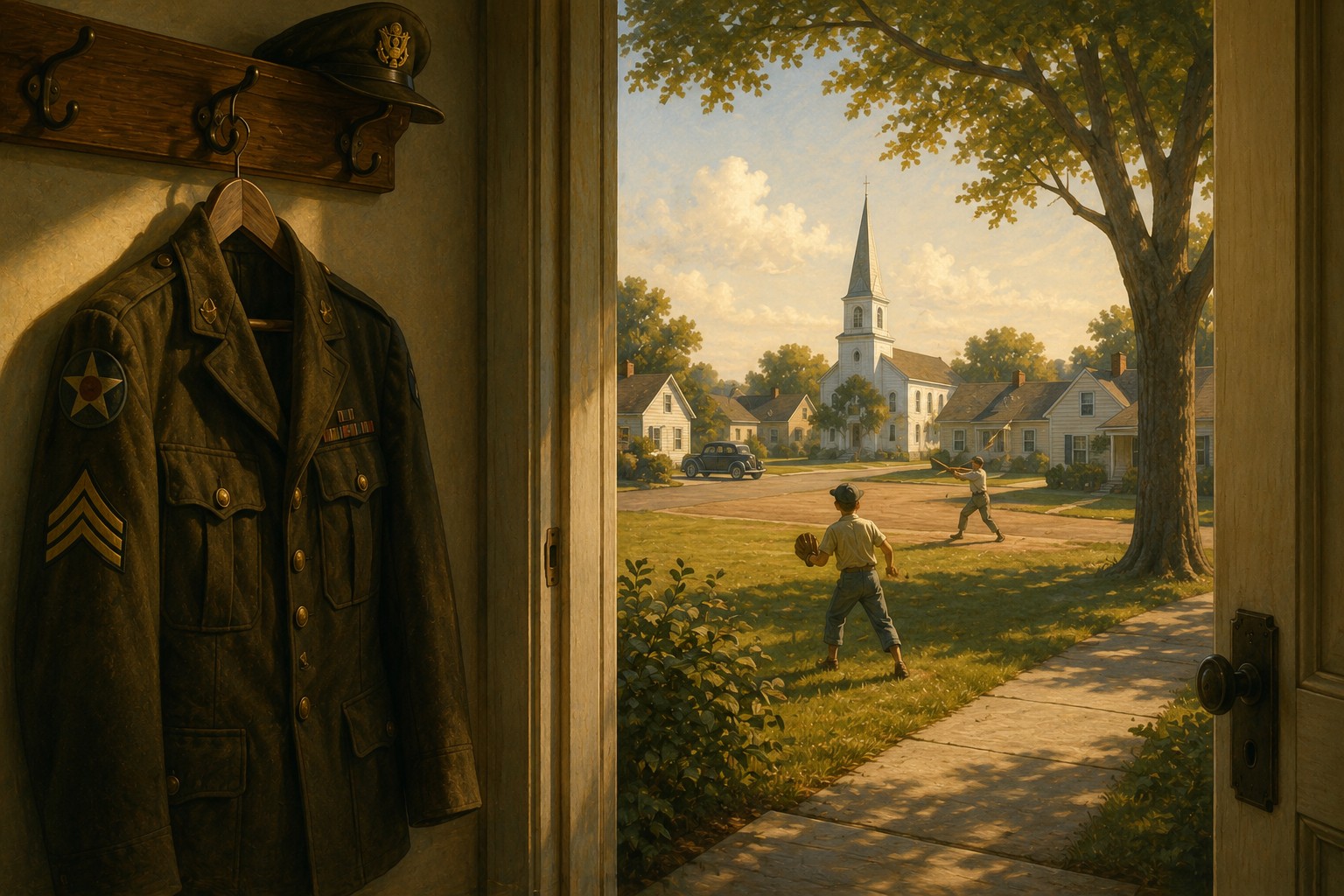
The parade ended.
The uniforms went into closets.
The medals got tucked away in dresser drawers.
America expected millions of men to return to ordinary life.
Instead, they built an extraordinary country.
In 1945, the year that parade actually happened, 76 percent of Americans belonged to a church, a synagogue, or a mosque. That number has never been matched since, not even close.
It’s as good a place as any to start, because it tells you something true about the mood of the country at the exact moment this story begins: people were ready to belong to something.
This isn’t a story about the GI Bill. Everyone already knows about the GI Bill. That’s background, the same way the war itself is background. The story is what people did with what they were given, and what they built without anybody telling them to.

Coming Home
Nobody had a plan for this many men coming home at once.
Roughly sixteen million Americans served in the Second World War. Most of them were discharged inside the span of about a year and a half, dumped back into an economy that had spent four years building tanks, not houses. The country had won. Nobody had figured out what came next.
The housing shortage came first, and it hit hard. In 1946, the federal government estimated that the country needed five million new housing units immediately, not eventually.
In Chicago that same year, the city sold off 250 retired streetcars as makeshift homes. In Omaha, a newspaper ran a classified ad offering a seven-by-seventeen-foot icebox that “could be fixed up to live in.”
Men who had stormed beaches were coming home to converted ice chests and decommissioned trolleys.
That was the welcome. A country that loved them and had nowhere to put them.

What the country did have, already built and waiting, was an organization that knew exactly what to do with a returning soldier. The American Legion had learned its lesson the hard way after the first World War, when veterans came home to nothing and the Legion nearly died out along with them.
In 1942, with the next war still underway, the Legion rewrote its own charter. It would not fade out the way the Grand Army of the Republic had faded out after the Civil War. It would become perpetual. It would open its doors to whatever generation came home next.
So when that generation did come home, the Legion was already running a welcome-home machine most people have never heard of. Booklets called “Fall In” and “At Home” went out by the thousands.
Field representatives tracked newly discharged veterans state by state, county by county, to make sure each man knew what he’d earned and how to get it. It was not glamorous work. It was somebody sitting at a desk with a list of names, making phone calls, mailing letters, finding the men before the paperwork could lose them.
The Veterans of Foreign Wars did the same thing from the other direction. Before the war, the VFW was a modest outfit, 200,000 members, mostly graying veterans of wars most Americans had already half-forgotten. By the time the postwar dust settled, it had grown to 1.5 million.
The American Legion’s was even larger. It entered the war with about a million members. By 1946, it had 3.3 million. That number is still the Legion’s all-time peak today, eight decades and several more wars later. Nothing since has come close.
Before these men did anything else, before the small businesses and the night classes and the mortgages, they joined something. That instinct, the simple, almost involuntary act of signing up for an organization the day after you’d been discharged from another one, is where everything else in this story starts.

The Wages of Peace
The mechanics of the GI Bill don’t need much explaining. Tuition paid. A modest living allowance. A home loan that didn’t require the kind of down payment that had kept renters renting for a generation. It was a door, propped open by the federal government for a few crucial years.
What matters is what walked through it.
Carl Stotz was an oil clerk in Williamsport, Pennsylvania, with no sons of his own and a habit of playing catch with his nephews. In 1939, he decided the neighborhood boys deserved an organized league of their own, scaled down to fit them.
Fifty-six local businesses turned him down before three said yes. A dairy. A lumberyard. A pretzel company. Thirty dollars each, just enough for uniforms.
He called it Little League. The war slowed it to a crawl; a handful of teams, mostly in and around Williamsport, while the men who might have coached them were somewhere else.
Then the men came home.
By 1946, there were twelve Little League chapters, all still in Pennsylvania. By 1948, there were ninety-four. By 1950, there were 307, scattered across the country, run by fathers and uncles who had never met Stotz and didn’t need to.
A 1949 feature in the Saturday Evening Post put the idea in front of fourteen million readers, and that was the end of Little League as a Pennsylvania curiosity.
One man, three businesses, and ninety dollars. A decade later, it belonged to the whole country, and almost none of the men running it were paid a dime.
That’s the theme through this entire story, if you want it in simplified. An ordinary decision, made without permission, copied by strangers until it stopped being one man’s idea and became something closer to a national habit.
Some places didn’t wait for the pattern to spread. They built the whole thing from scratch in one move.

In 1942, a home builder named Bill Atkinson heard a rumor that the Army was scouting central Oklahoma for the site of a new air depot. He bought the wheat field he suspected they’d want, two weeks before the announcement confirmed he was right.
He named his new town after the air base’s working title, Midwest City, for the Midwest Air Depot, and started building before the depot existed in anything but blueprints.
Atkinson hired a federal land-use planner to lay out curving streets designed to keep cars from speeding past houses full of children. He sold each new home with a free Shetland pony thrown in, stabled at a pony barn on his own property if the buyer didn’t have room for one.
It was the kind of detail that sounds like a gimmick and was, but it also tells you something true: this was a man selling a finished idea of family life, not just a house.
The base needed workers. The workers needed somewhere to live that wasn’t a tent or a converted barracks. Atkinson built homes, schools, and shopping centers fast enough that the National Association of Home Builders crowned Midwest City the nation’s model for postwar community development in 1951.
The population went from 10,166 in 1950 to 36,058 by 1960; more than tripling in a single decade, almost entirely on the strength of people who had nowhere else lined up to go.
What Atkinson built was the frame. What filled it, the same way it filled every other place in this story, was a long string of small, unremarkable decisions made by people who’d just gotten there.
In 1947, a returning veteran named Nick Harroz opened a grocery store at the corner of Boeing Street and Brett Drive. He called it Nick’s Brett Drive Grocery, and it did well enough that he expanded twice over the following decades.
Two years after that, a woman named Hazel Willis, who’d moved out from Ohio with what she later called no guarantees and a lot of hope, opened a preschool.
Neither of them was building an empire. They were filling a gap nobody else had gotten to yet, in a town that hadn’t existed when the war started.
The town kept building on itself the same way for years afterward, and always by doing, not by waiting. In 1957, residents voted to bond themselves for street paving. Two years later, they voted again, this time for a regional hospital, which opened its doors in 1962.
They were taxing themselves, repeatedly, for things the town didn’t yet have and had decided it wasn’t going to wait around for.
That’s what the GI Bill actually looked like at ground level. Not a policy. A grocery store on a named corner. A preschool a transplant decided the town needed and then simply opened. A town meeting where people voted to pay for a hospital that wouldn’t exist for three more years.
Pennsylvania has its own version of this story, and it deserves more than a passing mention here. Levittown, took the same Atkinson approach of frame-then-fill and ran it at a scale nobody else attempted, putting up a new house every sixteen minutes at peak production and filling developments with veterans who built scout troops, swim clubs, and dozens of fraternal organizations almost as fast as the houses went up.
That story, including the parts of it that complicate the era’s tidier myths, has already had its due elsewhere on this site, and it’s worth reading on its own terms rather than retold here.
What Williamsport and Midwest City share, different as they look on paper, is the same basic fact: nobody waited for instructions. The GI Bill opened a door. What walked through it was decided entirely by the people standing in line, one household and one storefront at a time.
They were individual decisions, made one household at a time. What happens next is what individual decisions start to look like once they find each other.

Joining Everything
Before anything else, they joined things. Lots of things.
Political scientist Robert Putnam spent years trying to measure exactly how much, and his number is the kind that’s worth going over.
He identified what he called a long civic generation, born roughly between 1910 and 1940, and tracked its membership across thirty-two major national organizations; PTA, Rotary, the Elks, the Grange, the Red Cross, the Boy Scouts, the League of Women Voters, and two dozen more.
Membership across all of them, combined, peaked around 1960. That same year, this generation made up 62 percent of the electorate choosing between Kennedy and Nixon. The country’s civic life and this generation’s civic life had become, for one decade, nearly the same thing.
Some of that was the organizations this story has already touched on. The VFW’s climb from 200,000 members to 1.5 million. The American Legion’s leap from one million to 3.3 million, a number it has never matched again. Those are the veterans’ groups, the ones built for exactly this generation and no other. They’re the easy part of the story.
The PTA is the harder part, because nobody built it for veterans specifically, and it grew anyway, faster than almost anything else in this period. Membership stood at roughly 3.5 million in the late 1940s. By 1955, it had nearly tripled, to over 9.4 million. It crossed 10 million the following year. By the late 1960s, it had passed 12 million.
That’s not a veterans’ organization swelling with new members. That’s an entire country deciding, in the space of about fifteen years, that showing up to a school meeting on a Tuesday night was simply what a parent did now.
It didn’t stop with schools and veterans. Rotary, Kiwanis, and Lions had all existed for decades before the war; Rotary since 1905, Kiwanis since 1915, Lions since 1917. The postwar generation didn’t invent the service club. It just filled every one that already existed past any level seen before, and in some cases past any level seen since.

The Freemasons hit 4.1 million American members in 1959, a peak that still stands; today the number is closer to 1.25 million despite a much larger national population. The Order of the Eastern Star climbed past 1.5 million members in the early 1950s. None of these are veterans’ organizations. They didn’t need to be. The habit had become universal.
There’s one chapter of this story that belongs at the center of it, not the edge, because it shows what the habit looked like when the country tried to refuse it.
Japanese American soldiers of the 442nd Regimental Combat Team and the Military Intelligence Service came home from the most decorated combat record of any unit in American military history, and some of them found that the VFW and Legion posts in their own hometowns wouldn’t let them in.
A few posts had gone further than simple refusal. They’d stricken the names of Nisei soldiers from their own honor rolls, including at least one Silver Star recipient killed in action.
So in Sacramento, on February 7, 1947, a group of these veterans chartered their own post instead. They called it VFW Post 8985, and for a while they held their meetings in a Buddhist church recreation hall, because they didn’t have anywhere else yet.
By 1951, they’d raised enough to buy a building, and the building carried its own piece of this same story. It had been built a few years earlier by a man named Phelix Flowers, a black entrepreneur who’d been barred from his own city’s main Elks lodge and had simply built his own restaurant instead of asking permission a second time.
Two different groups of men, excluded from two different versions of the same kind of club, ending up at the same address a few years apart, each having chosen to build rather than wait.
By 1955, with help from the Japanese American Citizens League, the post dedicated the building as the Nisei War Memorial Hall. It still stands today as the last surviving structure from Sacramento’s historic Japantown.
The man who approved the post’s original charter, a VFW district leader named Alva Fleming, was a veteran himself. He didn’t stop at one post. Fleming went on to charter fourteen segregated Nisei posts across California, in Monterey, Gardena, Fresno, San Diego, and ten other cities.
Every one of them is still active today. Veterans in the Pacific Northwest had no equivalent sponsor willing to do the same, so they built something else on their own, founding the independent Seattle Nisei Veterans Committee in March of 1946, outside the VFW structure altogether.
It’s the same story, told by men the rest of the story usually leaves out, not an exception to it or a sad footnote tacked onto an otherwise tidy tale of joining clubs.
The charter, the borrowed meeting hall, the building bought and converted by hand, the memorial dedicated a few years later; every piece of it is identical to what was happening in VFW posts and Lions clubs all over the country at the same time.
The only difference is that these men had to build their own version of the thing most everyone else simply walked into.
By 1960, the country had joined nearly everything it could find to join, and where the existing version of something turned a man away, more than a few of them built it again from nothing rather than go without. That’s not a complication of this story. It’s the clearest version of it.

Raising the Town
Having joined nearly everything there was to join, this generation turned its attention to the one thing none of those organizations could do by itself. Somebody had to raise the next batch of kids, and a remarkable number of men who’d just spent years away from home volunteered to do it for children who weren’t theirs.
The Boy Scouts of America had 2.8 million members in 1950. By 1960, it had 5.2 million, very nearly doubling in a single decade. The growth on the youth side was matched, maybe even outpaced, by the growth on the adult side.
By 1954, more than a million adult volunteers were running troops across the country, and the overwhelming majority of them were men who’d come home from the war within the previous decade.
A scoutmaster’s job has no salary attached to it. It asks for an evening a week, a weekend campout once a month, and a willingness to teach a twelve-year-old how to tie a bowline correctly on the fourth try. A million men signed up for exactly that.
In 1957, fifty thousand scouts and leaders gathered at Valley Forge for a national jamboree, a single visible snapshot of an organization that had, in a decade, become something close to a parallel school system run on the weekends.

Not every child fit neatly into a Scout troop or a Little League roster, and the parents of the ones who didn’t built their own version of the same instinct.
In Pennsylvania, a group of parents who’d been told that nothing could be done for their children founded the Arc of Pennsylvania in 1949, followed two years later by a Pittsburgh chapter of United Cerebral Palsy.
There was no federal program waiting to fund either one. There was a handful of parents who’d decided the absence of an institution wasn’t a reason to do without one, so they built it themselves, the same way a man two towns over was building a Scout troop or a Little League field.
The fire company is where all of this overlap shows up most obviously, because in most small towns, it wasn’t really one institution. It was the same several dozen men, organized under whichever name happened to fit the task at hand that week.
In Princeton Junction, New Jersey, the volunteer fire company sponsored a Little League team and an Explorer Scout troop by the late 1940s, which meant the men who answered the alarm bell on a Tuesday night were very likely the same men coaching first base on Saturday morning.
In Yulan, New York, three volunteers pooled their own money to buy a used 1927 pumper truck for about $300, kept it in a private garage until they could build a proper firehouse, and finished that firehouse in 1950 with nothing but their own labor and whatever lumber they could scrounge.
Neither town was unusual. They were typical, which is the point. A man who’d spent the war learning to organize, follow orders, and show up when he said he would didn’t stop doing those things once he got home.
He just started doing them for the volunteer fire department instead, and for the Little League team it happened to sponsor, and for the Scout troop that met in the same building on a different night of the week.
The GI Bill had given this generation an education and, for many of them, a house. The Legion and the VFW had given them a place to belong on their own terms.
But it was the fire company, the Scout troop, and the ball field that put an ordinary man in charge of somebody else’s kid for a few hours a week, gave nothing else in return, and somehow ended up being the part of this whole story that no policy history will ever think to mention.

A Civic Legacy
Robert Putnam’s number from earlier deserves one more look before this story ends, because the second half of it matters as much as the first.
Civic membership across those thirty-two national organizations peaked around 1960, right when this generation was at its largest and most active. Then it declined, steadily, for the next four decades, as that generation aged out and the one behind it didn’t sustain the habit at the same scale.
That’s not a verdict on anyone. It’s just what happens when the people who built something are eventually replaced by people who didn’t build it and don’t feel the same need to.
But before any of that decline, there was a Tuesday morning in southwest Virginia in the spring of 1951, and it’s worth ending there instead.
Dr. Charles Litton was twenty-seven years old, an optometrist, and a Navy veteran of the war that had ended six years earlier.
He read the same Saturday Evening Post article that had turned Little League from a Pennsylvania curiosity into a national fixture, and he decided his hometown of Norton, a small coal city tucked into the mountains of Appalachian Virginia, ought to have one too.
He recruited four other young men to coach the league’s four teams; Gene Mullins, Jack Hatcher, Ralph Bradley, and Reid Simmons. Like Litton, most of them veterans themselves.
The Lions Club, the Kiwanis Club, the Boosters Club, and the Junior Woman’s Club sponsored the teams, the same roster of organizations that had been filling lodge halls and church basements all over the country for the better part of a decade, now doing the same work for four baseball teams in a town of a few thousand people.
An ad ran in the local paper announcing tryouts for May 21, 1951. More than ninety white boys showed up, exactly what anyone in Norton in 1951 would have expected. Two black boys showed up as well.
Litton and his coaches didn’t turn them away. They sent the two boys back out to find more black players, so that each of the league’s four teams would end up with at least one. Two local politicians warned Litton that the state would not tolerate it. He kept the league open anyway.
On June 4, 1951, Norton fielded what’s now documented as the first integrated Little League in the South, four years after Jackie Robinson and years ahead of Virginia’s organized resistance to integrating its schools.
When Norton’s all-star team won the right to play for the state championship that summer, the league in Charlottesville refused to let an integrated team take the field at its segregated ballpark.
Norton called the bluff and offered to host instead. Charlottesville traveled to Norton, lost 12 to 3 in front of fifteen hundred fans after a parade down Main Street, and Norton went on to represent the entire state in the regional tournament.

Norton stayed exactly like the rest of its own time and place in every other respect. The schools stayed segregated. The movie theater kept its balcony. Whole neighborhoods remained closed to anyone who wasn’t white, same as they had been the year before and would be for years after.
A coal town building a baseball league didn’t undo any of that, and the men who built it never claimed it had.
The same instinct that built Norton’s league built something else a few years later, a few hundred miles south.
Four years after Norton’s tryout, sixty-one Little League teams in South Carolina broke away rather than field integrated rosters of their own, eventually forming a separate league that ran for nearly forty years before finally dropping it in 1994.
Norton is what was possible in 1951. South Carolina is what mostly happened instead. Both are true, about the same country, in roughly the same decade, and neither one cancels the other out.
History remembers this generation for the beaches, the bombers, the oceans, and the rivers crossed under fire, and it should. But the actual country they spent the next twenty years building wasn’t assembled with any of that.
It was built with hammers, report cards, church bulletins, PTA meeting minutes, a free Shetland pony thrown in with the price of a house, and a Tuesday morning tryout in a coal town nobody outside it had ever heard of, until it mattered.
The parade ended.
The uniforms went into closets.
The medals stayed in the drawer where they’d been put.
Nobody knew what came next.
They built it anyway.




Leave a Reply