On January 7, 1861, with seven Southern states already out of the Union and four more on their way, the mayor of New York City stood before the Common Council and proposed a third option that wasn’t Union, nor Confederacy. Fernando Wood wanted New York to secede from both.
He called it Tri-Insula, the city of three islands; Manhattan, Long Island, and Staten Island, cut loose from the state that taxed it and the country that regulated it.
A free city, Wood argued, “with but nominal duty on imports,” answerable to no one, dependent on no one, and most importantly, still open for business with the Confederacy.
New York’s cotton trade ran through Southern ports and Southern credit. Roughly seven-eighths of the world’s cotton supply moved through the city’s docks and banks on its way to the mills of Manchester and Lowell, and Wood’s patronage machine ran on the tax revenue that trade generated.
If the South left and New York didn’t follow some version of it out the door, the money went with it. Wood thought about it and proposed an exit.
The Common Council didn’t act on it. Lincoln hadn’t even been inaugurated yet, and within three months Fort Sumter would settle the argument for most of the city’s wavering loyalists.
New York raised troops, New York raised money, and by the war’s end its banks had done more to finance the Union than the entire industrial base of the Confederacy could match.
Wood fell in line soon after, at least publicly, and went on to a long career in Congress complaining about the war from the inside rather than threatening to leave it from the outside.
But the proposal happened. A sitting mayor of the country’s largest city stood up and suggested seceding from the Union to keep the cotton money flowing, and two and a half years later, that same city would erupt into the bloodiest civil disturbance in American history.
The two events are connected by more than chronology.
The machine that produced Fernando Wood, Tammany Hall, built on immigrant votes and Southern trade and a committed indifference to where the money came from, is the same machine that would still be running the show in July 1863.
It was when a crowd of New Yorkers burned an orphanage, lynched men in the street, and fought the United States Army to a standstill for four days because the federal government had decided to draft them into a war Wood’s machine had never wanted fought in the first place.
If you know the draft riots at all, you probably know them through Martin Scorsese. Gangs of New York opens in 1846, climaxes during the riots seventeen years later, and gives the whole affair the focus of a knife fight between two men who hate each other.
It is a good movie. It is also a movie about a conflict that, in its specifics, was already over before the riots began. The film’s central antagonist, the nativist gang boss modeled on a real Bowery Boys enforcer named William Poole, was murdered in 1855; eight years before the riots he may be remembered as having a hand in.
Poole never saw the draft, never saw the war, and never saw the mob that burned the Colored Orphan Asylum. He was dead years before any of it started.
That gap between the movie and the real history is, at least somewhat, the subject of this piece. Not because Gangs of New York committed some unforgivable historical sin; period films take liberties, and Scorsese’s Five Points looks and feels like a real place even when its plot doesn’t track real events. But because that difference is now, for most Americans, the only idea of what they think happened in New York in July 1863.
A knife fight. Some gang business. A riot in the background while the real drama plays out between two men with a grudge.
What actually happened was a four day campaign of political violence and racial terror that came within a hair of costing the Union Army its New York recruits at the exact same moment Lee was retreating from Gettysburg, and it grew out of a decade of machine politics, nativist street war, and a city that had never fully decided whether it wanted to be part of the country it was supposed to be defending.
Wood’s secession speech is the place to start, because it tells you something the riots will confirm five times over: in New York, in 1863, the line between political grievance and street violence was thinner than almost anywhere else in the Union, and the people running the city’s two major political factions both knew it.

A City Built on Two Trades
Here’s some numbers to consider: by 1860, New York was home to just over 800,000 people, and nearly 400,000 of them had been born somewhere else. More than half of those immigrants were Irish.
Walk through the Lower East Side that year and you’d find 147,000 people packed into four wards that covered a sliver of the island, Irish and German and Jewish families stacked three and four to a room, working the same docks, drinking at the same taverns, and competing for the same handful of jobs that didn’t require literacy in English.
86 percent of the city’s unskilled laborers were Irish-born. So were most of its domestic servants, more than half its blacksmiths, and a good chunk of every other trade that required a strong back and not much else.
New York’s free black population, by comparison, numbered around 12,000; less than two percent of the city. Small as that number sounds, it mattered in a major way to the Irish laborers competing against them for the lowest-paying work in the city, because in a labor market that tight, every job a black dockworker held was a job an Irish immigrant didn’t.
This wasn’t an abstract grievance dreamed up by agitators. It showed up in wages, in who got hired first, and in who got fired when work slowed down.
Tammany Hall figured out early that this entire mess of immigrant labor was a vote-generating machine, and it ran the machine hard.
New York’s Democratic apparatus spent the 1850s and early 1860s actively naturalizing Irish immigrants as fast as the courts would process the paperwork, not out of any particular fondness for the Irish, but because every new citizen was a new vote, and Tammany needed votes.
It worked. By the time the war started, the Irish vote was Tammany’s vote, more or less, and the machine controlled City Hall accordingly.
That naturalization push is going to really matter to this story soon, so hold onto it: Tammany made these men citizens. Citizenship is what would make them eligible for the draft two years later.
The machine that wanted their votes more than anything else in the world had, in the process, handed the federal government a list of exactly the people it needed for the Enrollment Act. Nobody planned that as a trap. It just turned out to be one.
Standing against all of this, at least on paper, were the Know-Nothings; the American Party, built in the 1840s on a straightforward platform of “the Irish and the Germans are going to drown this country in Catholicism, so let’s not let them vote.”
The party split apart nationally over slavery in 1855 and was functionally dead by 1860, but in New York City a local branch kept running nativist candidates well into the 1860s, propped up by the kind of street muscle you’d expect a party with no real institutional power to need.
That muscle had a name, and if you’ve seen Gangs of New York you already know a version of it: William Poole, a butcher by trade and a bare-knuckle brawler by reputation, ran with the Bowery Boys and worked as an enforcer for nativist candidates trying to hold ballot boxes and intimidate Irish voters out of polling places.
His opposite number, in effect, was John Morrissey, an Irish-born boxer who did the same job for Tammany and led a gang called the Dead Rabbits. The two men settled their rivalry in a boxing match, which Morrissey lost; nothing like the sprawling cobblestone bloodbath Scorsese stages.

A few weeks later, in February 1855, a friend of Morrissey’s named Lew Baker shot Poole in a saloon on Broadway. Poole took eleven days to die from it, and the story goes that his last words were something like “I die a true American,” with a parting shot at the Irish for good measure.
Eight years before the draft riots. That’s the time gap nobody talks about. Poole, Morrissey, the Dead Rabbits, the Bowery Boys; this entire conflict, the one the movie hangs its plot on, was already history by the time anyone in New York had heard the words “Enrollment Act.”
Morrissey went legitimate, got elected to Congress twice with Tammany’s backing, and spent his political career doing what you’d expect an old gang boss turned congressman to do: looking out for Irish interests and making sure nobody forgot who put him there.
He was very much alive and well in 1863. Poole was in Green-Wood Cemetery.
None of this is to say nativism evaporated once Poole died. It didn’t. The resentments that put a knife in Poole’s hand (or a pistol in Lew Baker’s) were structural, not personal, and structural resentments don’t go anywhere just because one brawler dies in a saloon.
But the specific gang war that gives Gangs of New York its plot was a closed chapter by the time the draft riots opened a new and far worse one.
What carried it was far more than gang rivalry. It was the underlying demographics: a city stuffed with immigrant labor competing against a small, vulnerable black population, run by a political machine that needed those immigrants’ votes and had just made all of them eligible for a war they had no interest in fighting.
Add one more ingredient, because Tammany’s relationship with the South wasn’t only about Fernando Wood’s cotton math from the last section. New York’s shipping industry, its banks, and a fair amount of its respectable wealth were tied up in the Southern trade for decades before the war started, and the city’s underground market in enslaved people, illegal since 1808 and thriving anyway, never fully went away.
Slave ships were still being outfitted in New York harbor well into the 1850s, financed by men who would never have called themselves slavers and who voted Democratic as a matter of course.
The city’s wealth and the South’s economy were laced together tightly enough that secession talk, the kind Wood floated in January 1861, wasn’t some fringe position. It was a reasonable read of where New York’s money actually came from.
So that’s the city heading into the spring of 1863: a Democratic machine that had spent a decade building immigrant political power on the back of naturalization drives, a dying nativist faction whose most violent chapter was already eight years in the past, a tiny and economically threatened free black population, and a business class with deep and largely undisturbed financial ties to the South it was now supposedly at war with.
Congress was about to hand this city a draft law. It would not go well.

The Wheel of Misfortune
By the spring of 1863, the Union Army needed bodies. A hundred and thirty regiments were due to muster out in May and June, the early wave of volunteers having served their time, and nobody in Washington trusted that a fresh round of enthusiastic enlistment was coming to replace them.
Two years of war had done what two years of war does. So in March, Congress passed the Enrollment Act, the country’s first real federal draft, and handed the job of running it to the Provost Marshal General’s office under James Fry, a veteran of Bull Run and Shiloh who knew just how badly the army needed the men this law was supposed to produce.
The mechanics were simple enough. Every male citizen between 20 and 45 went into one of two classes: single men and married men under 35 first, married men 35 to 45 only after the first class ran dry, and conscription agents spent May and June going door to door across the city’s congressional districts, writing down names.
Recent immigrants who’d filed papers declaring their intent to become citizens got 60 days to either leave the country or accept that they were now draft-eligible too. Black men were exempt, full stop, because the federal government still didn’t consider them citizens.
That exemption would matter enormously in a few weeks, and not in the way anyone drafting the law seems to have anticipated.
The part of the law that actually lit the fuse was the commutation fee. Any draftee who didn’t want to serve could pay the government $300 and walk away, or hire a substitute to go in his place for roughly the same money.
Three hundred dollars was, by some estimates, close to a year’s wages for a New York laborer. Some Republicans tried to argue the fee served a purpose; it let businessmen and skilled tradesmen stay home and keep the war’s industrial machinery running rather than getting shot at Chancellorsville.
Frank Leslie’s Illustrated Newspaper wasn’t buying it, and said so in print: this law, the paper wrote, converts the republic into one grand military dictatorship. Whatever the intent, the practical effect was exactly what it looked like from the street: if you had money, the draft was little more than a tax. If you didn’t, it was a death sentence with your name on it.
And remember what Tammany had spent the better part of a decade doing. The machine had naturalized Irish immigrants by the boatload because every new citizen was a vote it could count on.
Now those same men, poor, freshly naturalized, with no $300 to spare and no congressman volunteering to spare it for them, made up the overwhelming majority of names going into Provost Marshal Robert Nugent’s lottery wheel.
Nugent was Irish himself and knew exactly what he was sitting on. His solution was to start the draft in the 9th District, above 40th Street, in the more sparsely populated reaches of the Upper East Side, well clear of the densely packed Lower East Side wards where the worst trouble seemed most likely to start.
It was a reasonable plan that ran straight into a terrible piece of scheduling. Nugent held the first drawing on Saturday, July 11. By four that afternoon, officials had pulled 1,200 names out of a cylindrical drum that onlookers had already started calling, sarcastically, the wheel of misfortune.
Nothing happened. The list went up, mostly working men and mechanics who couldn’t have raised $300 between all of them, and the day passed without a single act of protest or violence.
Then came Sunday. A full day off, no work to distract anyone, nothing to do but sit in the heat, drink, and reread the list of who’d been called.
Rumors went around that Copperheads were planning to seize a city armory. The rumors were false. It didn’t matter. One journalist watching it unfold described giving the city’s working men a day of idle anger and easy access to whiskey, on top of a freshly published conscription list, as being like applying fire to gunpowder.
The line reads like a flourish. It was an analysis; the kind everyone else in the city should have done and hadn’t.
Monday morning, the second drawing was scheduled to resume at the same office. The wheel was about to turn again, and this time New York was ready for it.

Five Days in July
Monday, July 13, started around four in the morning. Men moved up Eighth and Ninth Avenues toward 59th Street; stonemasons, cellar diggers, boilermakers, the same laboring men whose names had filled Saturday’s list, picking up Germans and other workers along the way.
By mid-morning the crowd had drifted down to Fifth and Sixth Avenues and cut east toward Third, where another mob, including a lot of women, had moved up from the other side of the island, pulling workers out of factories as they went.
One iron works owner on East 28th Street later said the leaders only wanted his shop closed for the day, not wrecked. They told him they just wanted a big enough crowd to make the draft stop.
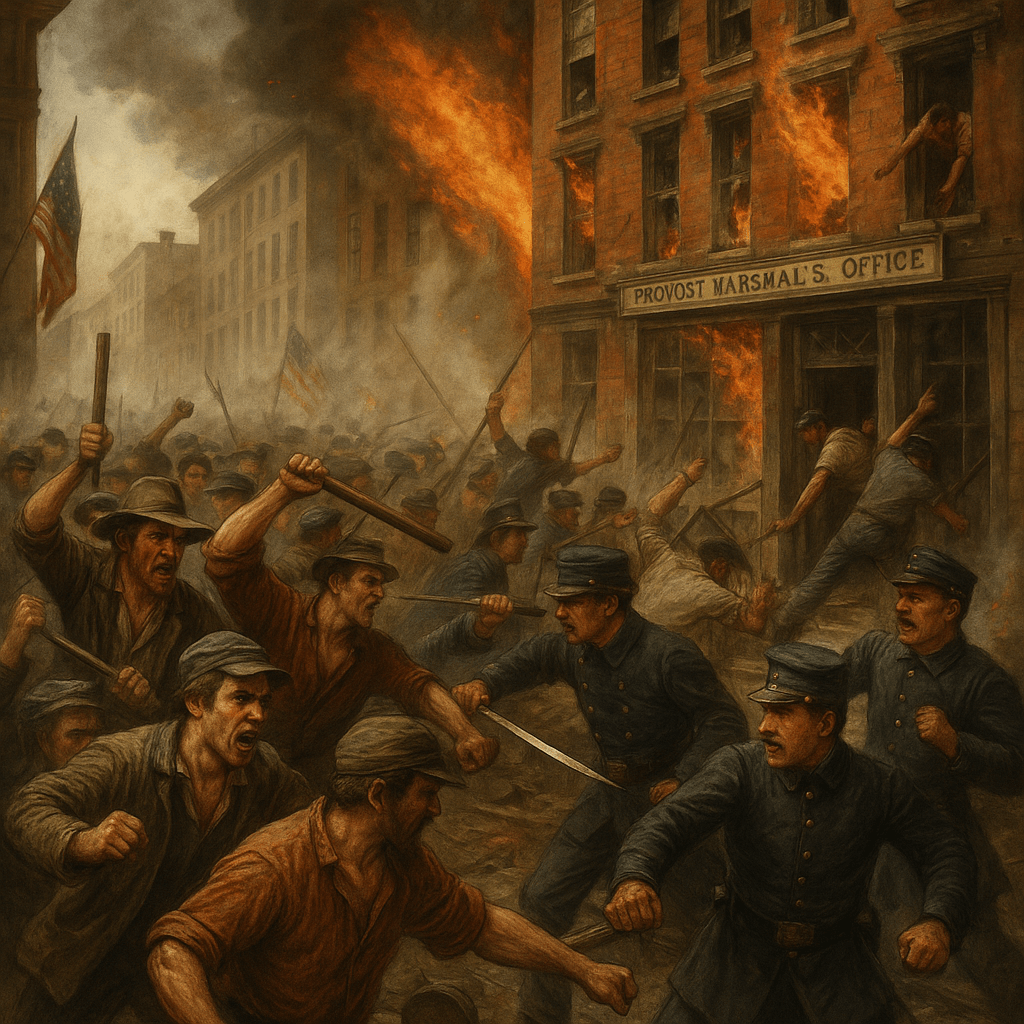
By ten that morning a crowd a reporter guessed at 10,000 — almost certainly too high, but telling of how it felt to be standing in it — had packed in front of the 9th District provost marshal’s office on Third Avenue and 47th Street, the same office that had drawn names without incident two days before.
Members of a volunteer fire company called the Black Joke, furious that their traditional exemption from militia service had been stripped, opened the violence by hurling paving stones through the office windows.
A clerk locked the draft records in a safe before the crowd drove the officials out, and the firemen who’d started it set the building on fire.
The fire didn’t stop there. When a handful of soldiers got off a volley that killed or wounded half a dozen rioters, the mob clubbed two of the soldiers to death and threw a third into the East River, dropping boulders on him until he stopped moving.
Police chief John Kennedy rode uptown that morning to see the trouble for himself and got recognized and beaten nearly to death for it; he survived only because a friend convinced the mob he was already dying and got him away in a wagon.
Command fell to Thomas Acton, who had roughly 800 men to work with after accounting for everyone deployed to Brooklyn, Staten Island, and Westchester. Acton’s view of the moment, according to one contemporary, was that he didn’t believe in speeches to a mob; his arguments were clubs and grapeshot.
Around 4 p.m., the single most infamous act of the week happened on Fifth Avenue at 43rd Street. A mob descended on the Colored Orphan Asylum, a four-story building that housed somewhere around 230 to 240 black children at the time.
The crowd looted the place, smashed the furnishings, and burned it to the ground. Every one of the children got out the back door before the fire took the building, herded to safety at the 20th Precinct by staff who’d clearly planned an evacuation route in advance.

One man in the crowd shouted for someone with a heart to help the children, and the mob brutally beat him for saying it. Two firemen, named in later accounts as Chief Engineer Decker and a man called Paddy McCaffrey, tried to fight the blaze anyway, risking the same mob’s anger to do it.
That evening, the crowd turned toward Printing House Square and the offices of the New York Tribune, whose editor, Horace Greeley, had spent years publicly backing both Lincoln and the draft; exactly the kind of man this mob wanted.
Roughly three hundred men, many in red shirts, came down Broadway through City Hall Park chanting that they’d hang old Greeley from a sour apple tree. His staff wanted him to slip out the back. He refused, walked out the front door instead, and strolled to dinner unrecognized.
Before the crowd reached the building, Inspector Daniel Carpenter arrived with 110 policemen and broke the mob apart so thoroughly that one Tribune editor remembered hearing the rhythm of it from inside; clubs landing on skulls, over and over, until the men still standing ran.
A heavy rainstorm around eleven finished what Carpenter’s men had started. The Tribune never missed an edition all week.
Tuesday was worse. Colonel H.T. O’Brien of the 11th New York Volunteers fired blanks, then live rounds, over the heads of a crowd he was trying to disperse on the Upper East Side.
The rounds didn’t stay over anyone’s head; seven died, including two children watching from an upstairs window. That afternoon O’Brien walked back into his own neighborhood to check on his family. Someone recognized him. A crowd beat him for six hours with bricks and clubs until his body was, in one witness’s words, mangled and nearly naked.
The racial violence that began at the orphan asylum only escalated. A seaman named William Williams was beaten and crushed under a flagstone for asking directions to a grocery store.
Near the docks, a British consul talked a French naval captain into taking two hundred black refugees aboard his frigate; a hundred more sheltered inside the British consulate itself, because by Tuesday a foreign warship had become safer ground in Manhattan than the streets outside.
Governor Horatio Seymour, absent when the rioting started, arrived Tuesday and gave a speech at City Hall opening with “My friends” — words that followed him for the rest of his career — before promising to push for the draft’s suspension and asking the crowd to maintain good order, as though the previous day’s burning had been a misunderstanding.
His letter asking Archbishop Hughes to calm the city’s Catholics got a public reply in the Herald rather than a private one, more concerned with scoring a point against Greeley than stopping the violence. Individual priests did more in the streets that week than either man’s words did on paper.
By Tuesday afternoon, with Brooks Brothers ransacked downtown and the city’s wealthy shipping bullion to Governor’s Island, Seymour declared the city in a state of insurrection and Mayor Opdyke appealed to Washington for federal troops.
Five regiments started moving north that day, but they would take time to arrive, and Tuesday night the rioters spent building barricades out of telegraph poles, carts, and lumber on both sides of the island.
Wednesday brought rain and no slowdown. A black shoemaker named James Costello shot a fireman chasing him before a mob of two or three hundred overwhelmed and killed him, hanging the body afterward and slicing off fingers and toes as souvenirs.
Soldiers who broke up that crowd killed at least 23 people with several volleys. Elsewhere that morning, a mob pulled a black coachman named Abraham Franklin from his own mother’s parlor and hanged him from a lamppost; soldiers cut him down and drove the crowd off, but the mob returned once the soldiers left and hanged him again.
The city’s Common Council debated a $2.5 million fund to pay the $300 commutation fee for any New Yorker too poor to afford it; a bribe dressed up as relief. Mayor Opdyke refused it, unwilling to let the mob nullify the draft by extortion.
Acton and General Harvey Brown, who’d spent the week actually cooperating while their nominal superiors argued over jurisdiction, split the city into four patrol zones. New Yorkers who could afford to leave were already loading carriages for New Jersey.
Federal troops arrived through Wednesday night and Thursday morning, many fresh off the fields at Gettysburg, where they’d finished beating back Lee’s invasion of Pennsylvania five days earlier.
By Thursday morning more than 4,000 of them were in the city; they spent the day clearing the last resistant blocks with howitzers, and by evening 6,000 troops had the city under firm control. Acton, throughout, kept a standing order in front of every precinct: receive colored people as long as you can, refuse nobody.
The fighting was effectively over by Thursday night. Friday morning, Mayor Opdyke issued a proclamation that finally matched reality; the city was calm, business was resuming, the police were alert, and a small pocket on the east side remained to be fully pacified. After four days, that was the truth at last.

What the Mob Actually Did
The history books call this event the “New York CIty Draft Riots”. Call it a riot and you’ve already started softening it.
A riot is property damage, broken windows, a crowd that gets out of hand. What happened to New York’s black population between July 13 and July 16 was something different: a sustained, citywide hunt, carried out in daylight, against people who had nothing to do with the draft, the war, or the $300 fee that started the whole thing.
Black men couldn’t be drafted. That was the conflict point of the exemption. The mob found them.
The pattern repeats with a consistency that rules out coincidence. William Williams asked for directions to a grocery store and ended up crushed under a rock.
James Costello defended his own life with a pistol and got hanged and mutilated for it, fingers and toes taken as souvenirs once he was dead.
Abraham Franklin was dragged out of his mother’s parlor, hanged, cut down by soldiers, and then hanged a second time by a mob that came back specifically to finish the job once the soldiers left.
None of these men were rioting. None of them were political. They were targets because of what they were, not anything they’d done, and the mob kept finding new targets for four straight days.
The Colored Orphan Asylum is the case that drew the most outrage at the time, and it earned it. Two hundred and thirty-some children, none of them old enough to vote or work or be drafted, lost their home because a mob decided a building full of black orphans was an acceptable place to burn.
Harper’s Weekly ran the burning as the largest of eleven illustrations in its August 1 issue covering the riots; a full page, more space than the other ten images combined.
Contemporaries singled it out because they understood, without needing modern hindsight to explain it to them, that burning an orphanage to the ground was the kind of thing that defined what the week had become.
The people who survived didn’t get to go home afterward, because for many of them, home didn’t exist anymore.
A quarter of the city’s free black population, roughly 3,000 people, lost their housing in those four days. Within two years, New York’s black population had dropped by about a fifth, from just under 12,500 in 1860 to under 10,000 by 1865.
Some of that decline was people who simply left and never came back, having decided, reasonably, that a city capable of producing four days like that one wasn’t a place they could risk raising children in.
The Colored Orphan Asylum never returned to its original neighborhood. When the board tried to rebuild nearby after the war, they found themselves unwelcome and moved the institution further uptown instead, eventually settling in what would become Harlem.
Justice, such as it was, didn’t come close to matching what had happened. Of 443 people arrested as suspected rioters, 221 were simply released. Ten more were discharged for lack of evidence, thirteen were allowed to enlist in the army instead of facing charges, and a grand jury declined to indict 36 of the remaining cases. Of the 74 cases that did get indicted, not one was ever brought to trial.
In total, 81 rioters stood before a judge at some point. 14 were acquitted. 67 were convicted, and of those, 25 got sentences of six months or less for participating in four days that killed, by the most conservative estimate available, somewhere over a hundred people and left a quarter of a community homeless.
The death toll doesn’t bring a clean number. 119 deaths can be documented with real confidence. Credible contemporary estimates ran as high as 1,500, and the difference between those two numbers isn’t just sloppy record-keeping.
Families had every reason not to report a relative’s death to the same city government whose police, soldiers, and gang affiliates had spent the week killing rioters in the streets or targeting certain groups, and a death reported was a death that could draw official attention to a family already targeted once.
The true number sits somewhere between 119 and considerably more than that, and nobody who lived through the week believed the lower figure told the whole story.
What gets lost when this becomes “the draft riots”, three words filed under labor unrest, taught alongside strikes and tax protests, is that the draft was the occasion, not the cause.
Men who couldn’t afford $300 had a real grievance against a law that let richer men buy their way out of a war they started. That grievance explains the attack on the provost marshal’s office on Monday morning.
It does not explain Wednesday, when a mob spent its morning hanging a coachman twice because the first hanging hadn’t satisfied it. Those are different things wearing the same name, and the name we’ve settled on describes only the first one.

The Movie We Remember Instead
Gangs of New York gets one thing badly wrong, and it’s not a small thing. You already know why: William “Bill the Butcher” Cutting, the film’s nativist villain modeled on Poole, anchors the entire plot as a man very much alive in 1863, leading his gang toward a climactic battle the moment the riots break out.
The movie knows the $300 fee, knows Tammany, knows enough of the period’s reality to earn real credit for the world it builds. What it gets backwards is the engine driving its climax. It needed a villain with a face and an old grudge to settle, so it kept one alive eight years past his actual death and walked him straight into an event he never lived to see.
Ask someone what the draft riots were and you’re more likely to hear about gang warfare than about a French frigate anchored in the harbor or a British embassy, sheltering hundreds of refugees who had nowhere else in the city left to go.
What really happened doesn’t need a movie villain to be horrifying, and it doesn’t get any less horrifying for being harder to dramatize. It needs only the record, told straight.
Thomas Acton’s standing order in front of every precinct: receive colored people as long as you can, refuse nobody. Two hundred and thirty children walked out the back door of a building before the mob’s fire took it, because staff had planned an escape route in advance and executed it without panic.
Abraham Franklin, dragged from his own mother’s parlor, hanged, cut down by soldiers, and hanged again once the soldiers left, because the mob wasn’t finished the first time.
A death toll nobody could pin down with any confidence, because the families of the dead had good reason not to trust the government doing the counting.
All this and more, for four days that left a quarter of a community without homes and shrank the city’s black population by a fifth.
None of that is a story about a gang war.
It’s a story about a draft law that excluded black New Yorkers from service and left them, instead, as the easiest target once the city’s anger needed one.
It’s a story about a political machine that wanted Irish votes badly enough to naturalize men by the thousand, and never considered what it meant when classes of citizenship turned out to carry a $300 price tag.
The men and women who lived through those four days didn’t need a movie to tell them what they’d seen; Frank Leslie’s and Harper’s Weekly ran the worst of it as the atrocity it was, in real time, with no hindsight required.
What they recorded, at the time, is still sitting there, waiting for the rest of us to read it instead of the version that wound up in theaters.
Leave a Reply