
Stephen Douglas had a problem, and he thought he had a solution. The Illinois senator needed a transcontinental railroad routed through Chicago — his city, his political future — and that meant organizing the vast unstructured territory between Missouri and the Rockies.
To do it, he needed Southern votes. To get Southern votes, he needed to offer the South something. What he offered them, in January 1854, was the Kansas-Nebraska Act, and with it, a doctrine he called popular sovereignty.
The idea was simple enough to fit on an index card. New territories would decide the slavery question themselves, by vote. Just settlers, ballots, and the democratic process sorting it out. Douglas called it “the great principle of self-government.” He sold it as the reasonable middle, the adult alternative to the increasingly hysterical debate consuming Washington.
There was one problem. The Missouri Compromise of 1820 had already settled the question of slavery in the Kansas territory; settled it by prohibiting it, at the 36°30′ line. That compromise had held for 34 years.
It wasn’t perfect, but it was stable, and in the politics of American slavery, stability was worth more than almost anything. Douglas’s bill repealed it. He did this deliberately, at Southern insistence, because popular sovereignty only appealed to the South if there was actually a chance Kansas might come in as a slave state.
The compromise repeal made that chance real. It also made war inevitable, though Douglas either didn’t see that or didn’t want to.
The bill passed in May 1854. President Franklin Pierce signed it. Douglas got his territorial organization. The South got its opening. And everyone who understood what had just happened understood it the same way: as a match dropped onto gasoline.
Abraham Lincoln, still a one-term former congressman from Illinois, came out of political semi-retirement to say the act had filled him with rage. “I cannot but hate it,” he said. That’s Lincoln in 1854; not yet the mythologized statesman.
The rage was widespread, because the moral logic of the repeal was insulting in a particular way. Popular sovereignty assumed that slavery’s expansion was a neutral question, a matter of regional preference no different than deciding whether to build a courthouse or a canal. In many quarters, it was.
It treated the enslaved as a secondary, at best, consideration; background in a debate about process. Free-soilers and abolitionists saw it differently: this wasn’t democracy. It was democracy’s vocabulary being borrowed to legitimize something another democratic action had already voted to contain.
And then there was the practical problem, which would prove more immediately destructive than any philosophical objection.
Popular sovereignty only works if the population doing the voting is legitimate; if the people casting ballots actually live in the territory and intend to stay there. Kansas in 1854 had almost no permanent settlers. It was, essentially, an empty stage.
Both sides immediately understood what that meant. Whoever got their people there first would win. Whoever won would shape the future balance of power in the Senate, possibly for a generation.
The race was on before the ink of Pierce’s signature was dry. What followed was two sides trying to stuff a territory with enough warm bodies to steal an election, and when that stopped working, reaching for guns. Douglas’s elegant solution had produced something that looked, within eighteen months, a great deal like a war.

Building a Town for Politics
Eli Thayer had a theory. The Massachusetts state legislator and entrepreneur believed the slavery question could be resolved the same way you’d resolve any market problem: by outcompeting the other side.
Flood Kansas with free-state settlers before the South could organize, and popular sovereignty would take care of itself. The votes would be there because the people would be there. It was, in its way, an admirably cynical reading of Douglas’s idealistic doctrine.
In April 1854, before the Kansas-Nebraska Act had even passed, Thayer chartered the Massachusetts Emigrant Aid Company, later reorganized as the New England Emigrant Aid Company. The pitch to investors was that this is both a moral cause and a sound business venture.
The company would organize and transport settlers, build mills and hotels, and establish towns. It would also, incidentally, save the republic from the slave power. Thayer saw no contradiction in that combination. He was that particular breed of New England reformer who believed virtue and profit pointed in the same direction.
The first party of settlers arrived in Kansas in the summer of 1854. They chose a site along the Kansas River, in the shadow of a hill they would call Mount Oread, and began to build.
They named the town Lawrence, after Amos Adams Lawrence; a Boston textile merchant and major company benefactor who never actually set foot in Kansas but whose money had made the thing possible. That detail says something about how this particular experiment in democracy was being run.
Lawrence was not an accident of settlement. Every decision about it was deliberate. The company established the Herald of Freedom, one of the territory’s first newspapers, to serve as the free-state movement’s propaganda organ.
They built the Free State Hotel, a massive stone structure that doubled as a fortress, with walls thick enough to withstand rifle fire. They shipped crates of Sharps breech-loading rifles, which the settlers called “Beecher’s Bibles,” after the abolitionist preacher Henry Ward Beecher who had suggested rifles were better moral arguments than scripture in Kansas.
The men who built Lawrence understood they were planting a flag, and they armed themselves accordingly.
The South watched all of this and drew the obvious conclusion. Pro-slavery settlers and their Missouri backers established their own towns to counter; Leavenworth on the Missouri River, Atchison to the north, Lecompton to the west, which would eventually become the territorial capital.
These weren’t random settlements either. They were positions on a chessboard. The geography of early Kansas was the geography of a coming fight, with every town placement a strategic decision and every new arrival a vote in a war that hadn’t started shooting yet.
By the end of 1854, Kansas had two budding societies staring at each other across an imaginary line, each convinced the other was an existential threat.
Lawrence looked east toward New England money and the Republican Party being born in the aftermath of the Kansas-Nebraska Act’s passage. Lecompton looked east toward Missouri and Washington and a Democratic administration that had already signaled whose side it was on.
The territory had been open for settlement for less than a year. An election hadn’t been held. And already, the question wasn’t whether Kansas would be free or slave; it was whether anyone would survive long enough to find out.
The Neighbors Across the River
Missouri had been a slave state since 1821, and its western border counties had grown up around that fact.
The farms along the Missouri River bottom were often worked by enslaved people. The local economy, the social order, the entire architecture of daily life in places like Jackson County and Clay County was built on the assumption that slavery was permanent and that the people around you shared that assumption.
Then Congress opened Kansas, and suddenly the neighbors across the river did not.
This is the thing that gets lost when Bleeding Kansas gets reduced to a morality play about good abolitionists and evil slaveholders. The men who crossed into Kansas to interfere with its elections weren’t an invading army. They were locals. They were the farmer who sold you seed corn, the blacksmith who shod your horses, the merchant who extended you credit through a bad harvest.
They crossed the Missouri River — a short trip, an ordinary thing — because the territory taking shape on the other side of it felt like a direct assault on everything they had built.
Senator David Atchison of Missouri put it plainly. If Kansas came in free, he told his constituents, Missouri’s slaves would flee across the border and the whole institution would unravel from the western edge inward.
Whether or not that analysis was correct, it was genuinely believed, and men who genuinely believe their way of life is being destroyed don’t tend to sit quietly and wait for the ballot returns.
What they did instead became immediately notorious. On March 30, 1855, Kansas held its first territorial legislature election. The results were…….extraordinary: 5,427 votes cast in a territory with 2,905 registered voters.
The margin wasn’t close enough to be explained by clerical error or generous interpretation. Armed groups of Missourians had crossed the border in organized parties, voted under false names, and gone home.
Governor Andrew Reeder, a Pennsylvania Democrat and Pierce appointee who had expected to run a routine territorial administration, was horrified enough to invalidate the results in eleven of forty districts. It didn’t matter. The fraudulently elected legislature simply ignored him, convened at Lecompton, and got to work.
The laws they passed were stunning in their aggression. Supporting the free-state cause in print became a criminal offense. Possessing abolitionist literature was punishable by two years of hard labor. Questioning the right to hold slaves in Kansas carried harsh penalties at hard labor.
These weren’t compromise positions. They were a declaration that the free-state settlers had no legitimate standing in their own territory; that they were, by their statements and beliefs, criminals.
President Pierce endorsed the Lecompton legislature as the lawful government of Kansas. This was the moment the federal government picked a side, and it picked the side of the men who had won by stuffing the ballot box.
The free-state settlers did what people do when the legal process has been openly stolen from them: they built their own. A rival convention met at Topeka in the fall of 1855, drafted a free-state constitution, and organized a parallel government with its own governor and legislature.
Kansas now had two capitals, two sets of laws, and two governments each claiming the other was illegitimate. Pierce called the Topeka government treasonous. The Lecompton government called it a collection of criminals.
Both governments were essentially correct about each other, in the sense that neither had come to power through anything resembling a clean election.
Douglas had promised that popular sovereignty would let Kansans decide their own fate. By the end of 1855, Kansas had decided nothing, except that the question could not be settled by voting.
The Ballot Box Dies
The Wakarusa War sounds more dramatic than it was, which is saying something, because it came within an inch of open battle.
In November 1855, a free-state settler named Charles Dow was shot and killed by a pro-slavery neighbor over a land dispute; the kind of quarrel that in a stable society ends in a courthouse and in an unstable one ends in a funeral.
In Kansas in 1855 it nearly ended in a massacre. The killing set off a chain of retaliations that brought several hundred armed Missourians to the outskirts of Lawrence by early December, camped along the Wakarusa River and waiting for an excuse to burn the town.
Governor Wilson Shannon — Reeder’s replacement, a Ohio Democrat with the political instincts of a man perpetually in the wrong room at the wrong time — finally negotiated an agreement that sent the Missourians home. Lawrence survived.
The free-state settlers celebrated. What they were actually celebrating was the last time the crisis would be resolved without bloodshed, though nobody knew that yet.
Meanwhile, the two-government problem was beginning to harden. The free-state movement had convened its constitutional convention at Topeka in October 1855, and the document they produced was a direct rebuke to everything Lecompton represented.
It banned slavery. It established a genuine legislature. It was, by any honest measure, a more legitimate expression of what Kansas settlers actually wanted than anything the Lecompton government had produced. It was also, by Pierce’s words, an act of sedition.
The Topeka government elected its own governor, Charles Robinson, and its own legislature, and sent its own congressional delegation to Washington, where they were refused their seats. Pierce sent a message to Congress in January 1856 calling the Topeka movement an act of rebellion and requesting authority to suppress it by force.
The man who had endorsed a fraudulently elected pro-slavery legislature was now threatening military action against the people that legislature had disenfranchised. The logic was consistent, at least; Pierce had decided which Kansas was real, and he was prepared to act on that decision.
Congress did not give Pierce his military authority, but the message had been sent. The free-state settlers understood they were on their own. Lawrence strengthened its fortifications. Men cleaned their Sharps rifles. The Herald of Freedom kept printing its war cry.
What’s worth pausing on, at this point in the story, is how thoroughly Douglas’s promise had already been broken.
Popular sovereignty was premised on the idea that ordinary democratic processes — elections, constitutions, law, legislative debate — were sufficient to handle the slavery question in new territories.
Kansas had now produced two fraudulent elections, two rival governments, a near-battle, and a presidential threat of military force, all within eighteen months of the territory opening. The democratic process hadn’t resolved anything. It had simply become another arena for the same fight, with the added indignity of lending that fight a procedural veneer.
The people of Kansas — the ones who had actually moved there, built homes, planted crops, and intended to stay — were watching their territory get used as a proxy battlefield by forces that largely didn’t live there and wouldn’t have to deal with the consequences.
The Border Ruffians went home after the elections. The New England Emigrant Aid Company’s directors stayed in Boston. The senators debating Kansas statehood in Washington went back to their comfortable houses when the session ended.
The settlers stayed, because Kansas was where they lived, and the violence that was coming would fall on them regardless of what anyone in Missouri or Massachusetts decided.
Spring came in 1856. The ground thawed. And something considerably worse than the Wakarusa War was about to arrive.

The Week That Bled
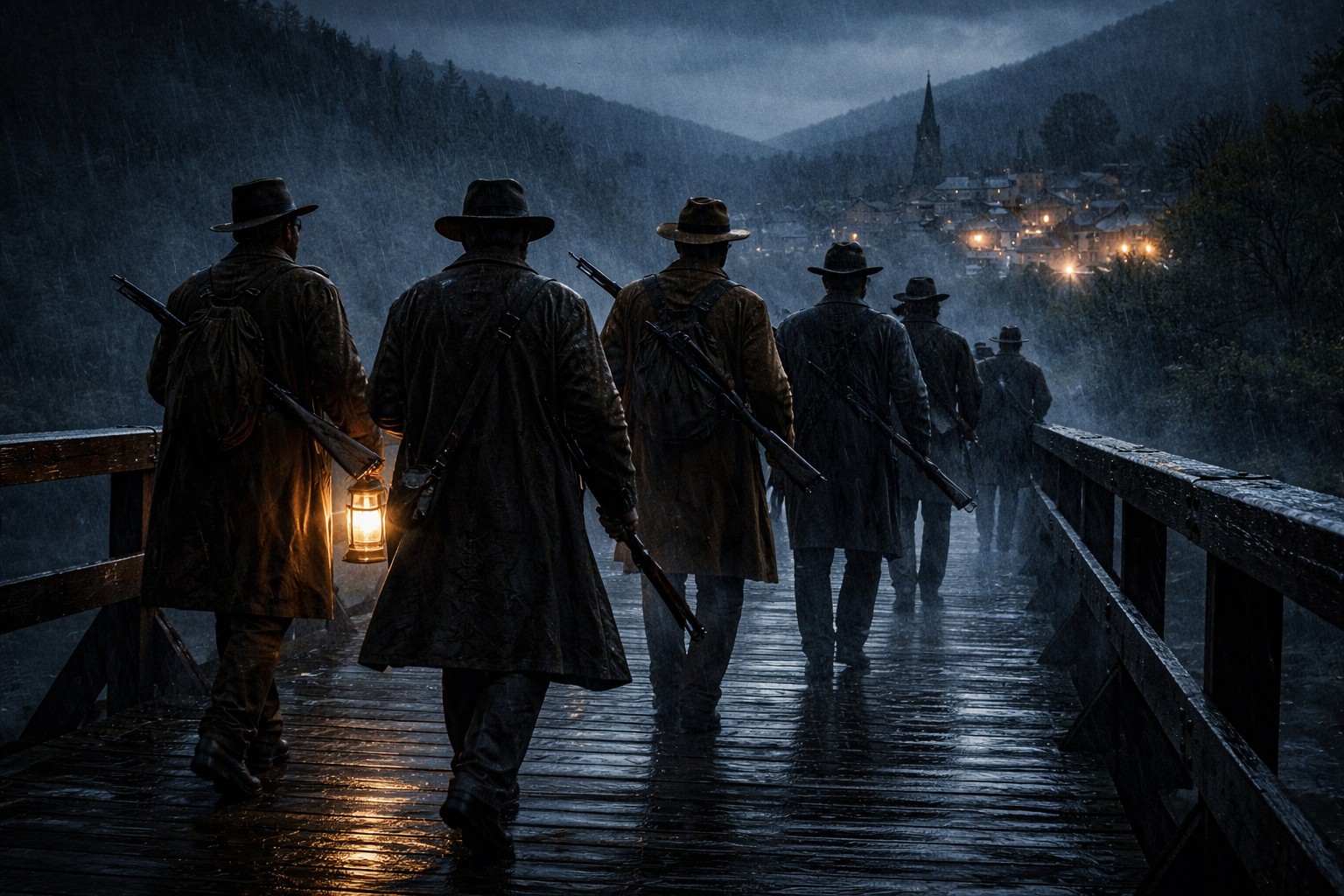
The men who rode into Lawrence on May 21, 1856 came under a red flag. Not metaphorically; an actual blood-red banner, with the words Southern Rights stitched across it.
There were somewhere between 800 and 1,000 of them, a mix of Missouri Border Ruffians and pro-slavery Kansas settlers, led by a sheriff named Samuel Jones who had a warrant for the arrest of several free-state leaders and a personal grudge against Lawrence that had been building for months.
They called themselves a posse. The distinction between a posse and an invading army was, by that point, largely administrative.
Jones and his men found Lawrence mostly undefended. The free-state leadership, still hoping to avoid giving Pierce his excuse for military intervention, had ordered the settlers not to resist. It was a reasonable political calculation and a catastrophic practical one.
The posse destroyed the two newspaper offices — the Herald of Freedom and the Kansas Free State — throwing the presses into the river. They looted homes.
They fired a cannon at the Free State Hotel, that thick-walled fortress the Emigrant Aid Company had built as a symbol of permanence, and when the cannonballs bounced off the walls, they packed the basement with gunpowder and blew it apart from the inside. One man died; a pro-slavery settler, killed by falling debris from his own side’s bombardment.
The Republican press called it the Sack of Lawrence, and the name was accurate enough. It wasn’t a battle. It was a demolition.
Two days later and a thousand miles east, South Carolina Congressman Preston Brooks walked onto the floor of the United States Senate and beat Massachusetts Senator Charles Sumner nearly to death with a metal-tipped gutta-percha cane.
Sumner had delivered a speech two days earlier called “The Crime Against Kansas”; a long, slashing indictment of the pro-slavery forces and their congressional enablers, including a particularly vicious, mocking, personal attack on Senator Andrew Butler of South Carolina, Brooks’s cousin.
Brooks had enough, and decided the appropriate response was to wait until the Senate chamber was nearly empty, approach Sumner at his desk, and beat him until the cane broke.
Sumner was so badly injured he couldn’t return to his Senate seat for three years. Massachusetts left the seat empty as a statement. The South celebrated Brooks as a hero; admirers sent him commemorative canes, engraved with slogans.
The news of Sumner’s caning reached a camp in eastern Kansas where John Brown and his sons were already furious about Lawrence. Brown had wanted to fight. He had wanted to meet the Border Ruffians outside the town with rifles and drive them back across the Missouri line.
The free-state leadership’s decision not to resist had enraged him; he considered it cowardice dressed as strategy. When word came about Sumner, his son Salmon recalled, the old man went silent for a long time. Then he said it was time to act, and that it would be something that would cause the pro-slavery men to feel what it was like to have blood on the ground.
The free-state guerrillas who had been forming since the territory opened called themselves Jayhawkers. They were irregular fighters, free-state partisans who raided pro-slavery settlements, freed enslaved people, and made life difficult for Missouri sympathizers on the Kansas side of the border.
They were not soldiers. They operated outside any formal command structure and answered largely to themselves. The pro-slavery equivalent, Missourians and their Kansas allies who crossed into free-state territory to burn, raid, and intimidate, were called Bushwhackers.
Both sides understood the other as criminals. Both sides were right, by the standards of the civilization they were in the process of dismantling.
Brown operated in a category of his own. He had Jayhawker sympathies but Jayhawker discipline had no hold on him whatsoever. He was not interested in raiding. He had something more deliberate in mind.

John Brown at Pottawatomie Creek
John Brown was 56 years old in the spring of 1856, and his life to that point had been, by any practical measure, a failure. He had tried tanning, land speculation, wool trading, sheep farming; each venture ending in debt or bankruptcy or both.
He had fathered twenty children by two wives and buried nine of them. What he had not failed at, what he had never wavered on for a single day of his adult life, was his absolute conviction that American slavery was a sin of such magnitude that God himself was keeping the ledger and would eventually demand payment in blood.
He had come to Kansas in 1855 partly to join five of his sons who had settled there, partly because Kansas was where the fight was. He was not a patient man. He was not a political man. The free-state leadership’s careful maneuvering — the constitutional conventions, the deliberate restraint in the face of the Sack of Lawrence — struck him as precisely the kind of thing men did when they lacked the courage to do the necessary thing.
Brown had no such problem.
The night of May 24, 1856. Brown gathered eight men — four of his sons, a son-in-law, and two others — and moved out along Pottawatomie Creek in Franklin County, Kansas.
He had a list. The men on it were pro-slavery settlers in the area, some connected to the Lecompton government, some simply known as Southern sympathizers. None of them had been charged with any crime. None of them were combatants in any usual sense.
The first stop was the Doyle homestead. Brown’s men pulled James Doyle and his two adult sons — William and Drury — out of the house while Doyle’s wife Mahala screamed and begged from the doorway. Her youngest son, a boy of about fourteen, was left inside; Brown’s one concession to restraint that night.
The three Doyle men were walked a short distance down the road. James was shot. William and Drury were killed with the short broadswords Brown’s men carried for the purpose. Mahala Doyle would later testify that when she found her husband the next morning, his fingers had been cut off.
The second stop was Allen Wilkinson, a member of the pro-slavery territorial legislature. He was dragged from his house over the pleading of his wife, who told Brown’s men she was sick with measles and needed her husband. They took him anyway. His body was found in the brush near his home, hacked with a sword.
The third stop was the home of James Harris, where a man named William Sherman was staying as a guest. Sherman was taken outside and killed. His body was thrown into Pottawatomie Creek.
Five men dead in a single night. The whole operation took a few hours. Brown rode away before dawn.
He never expressed remorse. He never acknowledged, in any direct way, that he had personally participated, though the historical record is clear on that point.
What he said, when pressed, was that the killings had been necessary, that the pro-slavery forces needed to understand there would be consequences, that blood was the only language they had shown any willingness to understand.
There is a version of that argument that is coherent. It is not a version that requires losing sight of what actually happened in those three farmhouses; unarmed men dragged away from their families in the dark, killed without trial, without charge, without any process beyond one man’s certainty that he was doing God’s work.
The immediate consequence was not liberation. It was retaliation. The Pottawatomie Massacre, as it came to be called, set off the bloodiest sustained stretch of Bleeding Kansas; three months of raids and counter-raids that killed another 29 people and burned homesteads across the territory. The cycle Brown had started spun well past anything he controlled.
He kept fighting through that summer. At the Battle of Black Jack on June 2, his men ambushed a pro-slavery force and captured its commander. It was a skirmish Brown declared the first regular engagement between free-state and pro-slavery forces in Kansas, which was a generous description of what was, in reality, an ambush by wanted men.
At Osawatomie in August, a large pro-slavery force burned the town and shot Brown’s son Frederick through the heart. Brown watched from a distance, then went back to fighting.
Territorial Governor John Geary arrived in September 1856 and managed, through a combination of federal troops and personal negotiation, to force something resembling a ceasefire.
The organized fighting largely stopped. Brown eventually left Kansas for the east, where he would spend the next three years raising money and planning something considerably more ambitious than premeditated, creek-side murders in the dark. Something that would end, in October 1859, at a federal arsenal in Harpers Ferry, Virginia, and a gallows shortly after.
Kansas had made Brown famous. The territory’s newspapers, North and South, had turned him into a symbol, hero or monster depending on the masthead.
He was a man who had decided, with complete sincerity and considerable brutality, that the normal rules of civilized conduct did not apply to a fight this fundamental. A lot of people in a lot of eras have decided exactly that. It rarely ends the way they expect.

The Lecompton Swindle
The guns had mostly gone quiet by 1857, but the people running Kansas hadn’t learned anything. If anything, they had decided that since violence hadn’t settled the question, a more sophisticated form of cheating might.
Kansas now had enough settlers to apply for statehood, which meant it needed a constitution, which meant a constitutional convention.
The pro-slavery minority — and by 1857 it was genuinely a minority, the tide of settlement having shifted decisively toward free-state settlers — understood this was their last real chance. They controlled the convention process through the Lecompton legislature, and they intended to use that control to its absolute limit.
The Lecompton Constitutional Convention met in the fall of 1857. What they produced was a document that made the earlier territorial laws look restrained.
Article 7 declared that slaveholder property rights existed before and higher than any constitutional sanction; meaning no future Kansas legislature, no popular vote, nothing short of a federal constitutional amendment could touch slavery once the document was ratified.
The convention then devised a ballot mechanism of such breathtaking cynicism that it deserves a moment of careful examination.
Voters would not be asked whether they wanted the Lecompton Constitution. They would be asked to choose between the Constitution with Slavery and the Constitution with No Slavery. The distinction was a shell game. The no-slavery option still guaranteed full protection for every enslaved person already in Kansas and their descendants.
It was slavery either way. The only question was whether the door was open or merely ajar. Free-state settlers, correctly recognizing the whole exercise as a fraud, boycotted the December 1857 referendum entirely.
The Constitution with Slavery passed with over 6,000 votes, more than half of them subsequently identified as fraudulent.
President James Buchanan, who had replaced Pierce and inherited his predecessor’s habit of validating pro-slavery chicanery, endorsed the result and sent the Lecompton Constitution to Congress with his recommendation for Kansas statehood. This was the moment Stephen Douglas broke.
Douglas had championed popular sovereignty as a genuine principle, or at least had convinced himself he had. Buchanan’s endorsement of Lecompton made a mockery of everything Douglas had staked his political identity on.
The senator from Illinois stood up and said so, loudly, calling the Lecompton process a travesty and the referendum a fraud. He was right. He was also, in being right, splitting the Democratic Party down the middle at precisely the moment it could least politically afford it.
The political damage was lasting.
Southern Democrats, who had expected Douglas to fall in line, never forgave him. The rift between Douglas Democrats and Buchanan Democrats would deepen over the next three years until it cracked the party entirely; producing two Democratic presidential candidates in 1860 and handing Abraham Lincoln a victory he could not have managed otherwise.
The Lecompton Constitution’s authors, in their determination to steal Kansas, had accidentally destroyed the only national political organization capable of protecting slavery through legitimate means.
Kansas voters got the final word on Lecompton in January 1858, rejecting it by a margin that left no room for confusion: 10,226 against, 138 in favor. The free-state majority had spoken in numbers the convention couldn’t stuff its way past.
The Jayhawkers were still operating through this period, raiding into Missouri, settling old scores from the 1856 fighting. The Bushwhackers raided back.
The border remained what it had been since 1854; a line that meant everything in theory and almost nothing in practice, crossed regularly by men on both sides who had decided the law was someone else’s problem.
The organized political crisis was winding down. The personal hatreds it had generated were not.
The last mass atrocity came in May 1858. A pro-slavery partisan named Charles Hamilton led a group of Border Ruffians across the line into Linn County, Kansas, rounded up eleven free-state settlers, marched them into a ravine along the Marais des Cygnes River, and opened fire.
Five men died. Five were wounded. One escaped by playing dead. Hamilton rode back to Missouri. He was never prosecuted.
The Marais des Cygnes Massacre produced the usual cycle of outrage, poetry — John Greenleaf Whittier wrote a piece about it that ran in the Atlantic Monthly — and exactly no legal consequences for the men responsible.
It was, in its grim way, a fitting end to the Bleeding Kansas era. The violence had never really been about Kansas. It had been about whether the country was going to deal with slavery or keep finding new ways to postpone that reckoning.
Every postponement cost someone their life. Marais des Cygnes was just the last invoice before Kansas finally closed its account.
The Wyandotte Constitutional Convention met in July 1859. The document they produced was clean; no tricks, no ballot mechanisms designed to produce a predetermined outcome. Kansas would be a free state.
The convention sent it to the voters, who ratified it in October 1859. The same month, John Brown raided Harpers Ferry and was hanged in December, becoming the martyr he had always intended to be.
Kansas and Brown ended their stories at almost exactly the same moment, which felt appropriate. They had been, in their different ways, the same argument all along.

The Dress Rehearsal Closes
Kansas was admitted to the Union as a free state on January 29, 1861. Twelve days later, Jefferson Davis was inaugurated as President of the Confederate States of America.
The timing was not coincidence; it was the accounts balancing themselves. The thing the pro-slavery forces had spent seven years trying to prevent had finally happened, and the thing they had been threatening in response was now happening too. The two events belonged to the same sentence.
It is worth standing back at this point and taking a full accounting of what the Bleeding Kansas period had actually been. The standard history treats it as prologue, the unfortunate warmup act before the real show at Fort Sumter. That framing undersells it considerably.
Between 1854 and 1861, Kansas had been a working laboratory for every destructive dynamic the Civil War would later produce on a continental scale, and the experiments had all run to completion.
Rival governments, each claiming legitimacy and denying it to the other — Kansas had two of them for the better part of three years.
Paramilitary forces operating outside any formal military structure, answerable to no law and no command — the Jayhawkers and Bushwhackers had written the operational manual that Missouri and Kansas guerrillas would follow straight through to 1865.
Outside money flooding into a local conflict to shape its outcome — the New England Emigrant Aid Company and the Missouri border interests had pioneered that particular mechanism before anyone had a name for it.
Propaganda turning local violence into national narrative — the Sack of Lawrence had been reported, exaggerated, and weaponized by Republican newspapers within days, helping build a party that would win the presidency six years later.
Atrocity and counter-atrocity feeding each other in an escalating cycle that no single actor could stop once it started — Pottawatomie begat the summer of 1856 begat Marais des Cygnes, each horror justifying the next.
And the complete, comprehensive failure of democratic process to contain a question that the political system had decided, over and over again, it would rather defer than answer. That, above everything else, is what Kansas demonstrated.
Douglas had believed — or performed believing — that process was sufficient. Give people a mechanism for self-determination and they would use it, and the outcome, whatever it was, would be legitimate.
Kansas proved that process is only as good as the shared assumptions underneath it. The moment one side decided the question was too important to lose through honest voting, the mechanism collapsed. And both sides had made that decision, in their own ways, before the first ballot was cast.
The name itself became a weapon. Bleeding Kansas — first appearing in print in 1856, likely coined by Horace Greeley’s New York Tribune — did more political work than any single speech or pamphlet of the era. It told a story in two words. It put a face on an abstraction.
Slavery was no longer a distant institution or a constitutional question or a matter for senatorial debate; it was something that made territories bleed. The Republican Party built a significant portion of its 1856 and 1860 electoral infrastructure on that image. Without Bleeding Kansas, the path to Lincoln’s nomination is harder to see.
The war came anyway; the bigger one, the one with armies and ironclads and a death toll that makes the Kansas casualty figures look like a rounding error. Fort Sumter gets the credit for starting it, and in the formal sense that’s accurate.
But the men who rode into Lawrence under a red flag in May 1856 had already made the essential decision: that the question could not be settled by ballots and would have to be settled by other means.
John Brown had made the same decision from the other direction at Pottawatomie Creek, three days later. Between the two of them, in the same week in the same territory, the logic of the Civil War had been stated as plainly as it would ever be stated.
Fort Sumter was four and a half years away. The war had already started.






Leave a Reply