
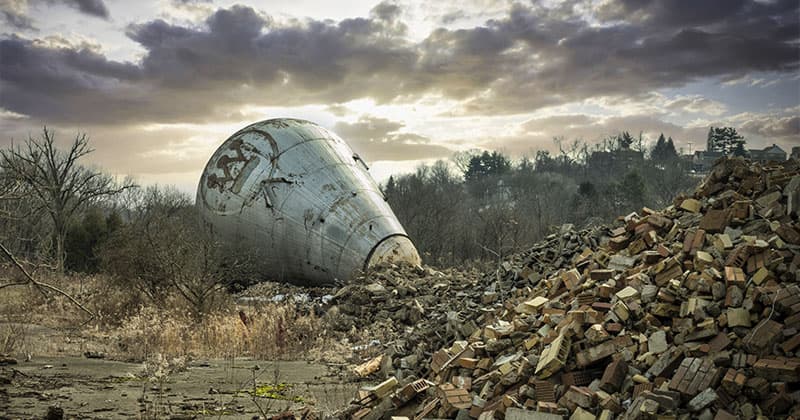
The chain-link fence at the end of Avenue A in Forest Hills doesn’t look like the entrance to a scientific frontier. It looks like the edge of a property dispute. Behind it sits a massive, bulbous steel tank, sixty-five feet long and shaped like a giant silver pear, sitting on blocks in the dirt. This is the Westinghouse Atom Smasher.
For the people who lived in this part of Allegheny County, in the Pittsburgh suburbs, during the middle of the twentieth century, this object was a permanent fixture of the skyline. It stood for nearly eighty years, a five-story tower that looked like an industrial spark plug along the tree line.
Today, it lies on its side, atop a pile of bricks. The brick building that used to enclose its lower half has been demolished, leaving the steel tank exposed to the Pennsylvania rain and elements. It is not wired for millions of volts anymore. It is just a massive, hollow shell that weighs over ninety tons.
The first time you see it, the scale of the thing is what hits you. It is too big to be a fuel tank and too strange to be part of a conventional factory. It feels out of place among the nearby houses and the suburban streets. For many locals, there is a kind of sadness to seeing it on its side.
You have to wonder how something this significant, a machine that was once the cutting edge of nuclear research and helped unlock the secrets of uranium, ended up being treated like an old boiler left in a vacant lot.
Pittsburgh is a city founded on the ability to build things. In the 1930s, it was the engineering capital of the world, a place where people didn’t just have ideas; they had the foundries and the power grids to make those ideas real. While the East Coast had the theorists and the ivory towers, Western Pennsylvania had the men who knew how to build and bolt the future together.
Westinghouse Electric was the crown jewel of this culture. George Westinghouse had already won the war of currents against Edison, and by the mid-1930s, his namesake company was looking for the next big thing. They weren’t interested in just making better toasters or sturdier transformers. They wanted to master the fundamentals of nearly infinite energy sources.
The Atom Smasher was built here because Pittsburgh was the only place with the industrial muscle to house such a monster. It was a statement of corporate mission: Westinghouse was going to find a way to turn the energy of the atom into a commodity, just like they had done with alternating current.

The Culture of the Lab
Pittsburgh in the late 1930s was the logical home for this kind of hardware. The city was comfortable with heavy moving parts. Westinghouse Electric was the backbone of the region’s technical identity, and the company viewed nuclear physics as a natural extension of the power grid.
They weren’t looking for theoretical breakthroughs in the way a university might. They wanted to know if the energy inside the atom could be harnessed to boil water and turn a turbine for a purpose.
The Forest Hills site was the headquarters of the Westinghouse Research Laboratories. It was a campus of red-brick buildings where engineers worked on everything from television tubes to jet engines.
The Atom Smasher was the flagship of this campus. It was a physical advertisement for the company’s technical reach. When it was finished in 1937, it was the largest industrial Van de Graaff generator in existence.
The neighborhood grew up around the facility. For the local residents, the Atom Smasher wasn’t a mysterious or threatening device. It was a sign of a stable paycheck. It represented a company that was healthy enough to build a five-story science project in the middle of a global economic depression.
The researchers were neighbors. They bought groceries at the local stores. The presence of the machine was a point of local pride that told the world the future was being assembled right there in Western Pennsylvania.
The Physics of Pressure
In 1937, studying the nucleus of an atom was a problem of force. If you wanted to move subatomic particles fast enough to overcome the natural electrical repulsion of an atom’s core, you needed a massive runway.
The most reliable way to achieve this at the time was with a Van de Graaff generator. This machine operated on a relatively straightforward mechanical principle: moving a physical charge from a base to a terminal until you built up a massive electrical charge.
The Westinghouse version of this machine was a giant. Inside the steel shell, a belt made of rubberized silk ran at high speed between the bottom of the structure and the top. As the belt moved, it picked up electrons and carried them to a large metal electrode at the peak.
The goal was to create a voltage difference of five million volts. For comparison, the standard wall outlet in a nearby kitchen carries 120 volts.
The pear-shaped tank was a functional safety necessity. At five million volts, electricity does not stay on a wire or a belt. It attempts to jump to the nearest ground. If the Westinghouse engineers had built this generator in an open field, it would have functioned as a lightning machine, throwing random arcs of electricity into the surrounding woods, fields, buildings, and…….people.
To prevent this, they enclosed the whole generator in a steel tank and pumped it full of dry air compressed at 120PSI. This pressure acted as an insulator, keeping the electricity bottled up inside a vacuum tube where it could be directed at a specific target.

The 1940 Experiments
The most productive years for the machine occurred just before the United States entered World War II. In 1940, researchers like William Wells and William Stephens were using the smasher for a specific set of experiments involving uranium. They were not yet looking for a chain reaction. Instead, they were trying to understand a process called photofission.
They used the accelerator to create high-energy gamma rays, which they then directed at their samples. They discovered that these rays could actually split the uranium nucleus.
This was a critical discovery because it proved that there were multiple ways to trigger fission. The data they collected in Forest Hills was published in the Physical Review, and it immediately drew the attention of the global scientific community.
Not surprisingly, the work was demanding. Operating the machine required a constant eye on pressure gauges and belt tension. The air inside the tank had to be kept perfectly dry, as even a small amount of moisture could cause a catastrophic internal spark that would shut the whole system down.
Despite our associations we attach to words like “nuclear” and “uranium”, this was still a world of manual valves and hand-written logs. The scientists were as much mechanics as they were physicists. They spent their days troubleshooting the massive silk belt and making sure the vacuum inside the acceleration tube remained perfect.
When the war began, the open era of the Atom Smasher came to an abrupt end. The machine was suddenly part of a national defense effort. While the Westinghouse lab wasn’t the location for the Manhattan Project, the expertise of the men who ran it was a valuable resource for the government.
The secrecy that descended on the site changed the way the community viewed the lab. The open-house tours and the public pride were replaced by security clearances and armed guards.
The focus of atomic science, obviously, shifted toward the military. The machine in Forest Hills, which had been built to explore the peaceful potential of the nucleus, was now a tool in a race for a weapon.
This changed the cultural DNA of the site. The machine was no longer a sign of a better world. It was a component of a much more dangerous world.
Even after the war ended, the Atom Smasher found itself in a difficult position. The nuclear age had arrived, but it arrived in a way that made the Forest Hills generator look like a relic.
The government began building much larger accelerators at national laboratories. The Westinghouse machine, which had been a giant in 1937, was now a small, aging player in a field that was being flooded with billions of dollars in federal funding.
The Onset of Obsolescence
By the mid-1950s, the Atom Smasher was obsolete. New technologies, such as the cyclotron and the synchrotron, could achieve higher energies without needing a five-story pressure tank.
These machines used magnets to whirl particles in a circle, allowing them to gain more speed in a more compact space. The Van de Graaff design was still useful for certain types of work, but for the cutting-edge research Westinghouse wanted to do, the Forest Hills machine was no longer sufficient.
In 1958, Westinghouse officially turned the machine off. The “smasher” had reached its limit. It had contributed to the discovery of the world’s most powerful forces, but it was now a twenty-year-old piece of hardware in a field where six months was a lifetime.
They didn’t tear it down, however. Westinghouse was still a massive, sprawling company, and the Atom Smasher was located in the middle of a busy research campus. It was easier to just leave it there.
For the next several decades, the silver tank stood idle. The brick building beneath it was used for storage. The vacuum tube was removed. The silk belt was gone. The machine became a piece of historical scenery that new employees would ask about on their first day of work.
The decline of the Westinghouse Forest Hills site mirrored the broader industrial downturn of Pittsburgh. As the decades passed, the labs were eventually closed and sold off. The Atom Smasher, once the center of the company’s pride, became little more than just a liability on a real estate ledger.

The property became a target for developers who saw the land as valuable but the old machine as an obstacle. In 2012, the site was sold, and the plans for the “Atom Smasher” became a point of contention. Preservationists wanted to save it, but the cost of moving or restoring a five-story, extremely heavy steel tank was astronomical. In 2015, the decision was made to demolish the brick building that supported the tank.
Workers carefully used a crane to tip the tank over onto its side to prevent it from collapsing unexpectedly. For the first time since 1937, the Atom Smasher wasn’t able to draw eyes towards the skyline. It was lying in the weeds, and since then, it has remained in that position. The surrounding property has been cleared, leaving the tank as a lone survivor in a field of rubble.
The current state of the Westinghouse Atom Smasher is a perfect illustration of how we handle our history. We are good at building things, but we are terrible at knowing what to do with them once they stop being useful.

This machine isn’t just a piece of old tech; it’s an artifact of an era’s mindset. It was a time of massive confidence. We did more than just write code; we poured steel, created electrical grids, worked the valves, and most importantly, tied it all together.
Today, our technology is invisible. It’s in our pockets, in the “cloud,” in microscopic circuits, and all taken for granted. For many good reasons, we have lost the connection to the massive, physical scale of discovery that the Forest Hills site represents.
The tragedy of the Atom Smasher isn’t that it’s broken; it’s that it’s been forgotten. Most people who drive through Forest Hills today have no idea that the rusted tank in the field helped lay the groundwork for the nuclear age. They just see an eyesore.
But make no mistake, it was built by people who were convinced they could change the world from a suburb in Pittsburgh.
Walking away from the site, you can’t help but feel that the world has moved on in a way that makes the Atom Smasher look like a relic from an ancient civilization. It didn’t fail. It wasn’t a mistake. The world just became more complicated than the machine could handle.
It was built for a future that was supposed to be clean, simple, more prosperous, and powered by the flick of a switch. Instead, we got a world of nuclear weapons, waste, geopolitical conflict, and a near global fear of the very particles this machine was built to study. The ‘future’ never arrived, or at least not in the way the Westinghouse engineers expected.

The Atom Smasher sits there, a sort of reminder of that transition. It is a bridge between the industrial age and the atomic age, though it happens to be rotting in the gap between them now.
It might eventually be moved to a museum, or it might finally be cut up for scrap when the property taxes get too high. For now, it remains in Forest Hills, a remnant of a time when simply wanting to know was reason enough to build something.








Leave a Reply