John Brown left Kansas in 1856 with two things: a national reputation and a plan that made Pottawatomie Creek look like a rehearsal. Which, in his mind, it was.
The reputation he had built carefully, if not entirely honestly. He spent the next three years touring New England; Boston drawing rooms, church halls, the parlors of men with money and principles, presenting himself as a frontier warrior for the abolitionist cause.
He was compelling in person. Tall, lean, with the kind of eyes that made people nervous. He told stories about Kansas. He did not dwell on the broadswords or murders.
The men he was cultivating called themselves, privately, the Secret Six.
Thomas Wentworth Higginson, a Unitarian minister with a taste for direct action. Samuel Gridley Howe, a physician famous for his work educating the blind. Theodore Parker, another minister, already dying of tuberculosis but still fighting. Franklin Sanborn, a young schoolteacher and Thoreau protégé barely out of Harvard. Gerrit Smith, a wealthy New York landowner who had already given away millions to abolitionist causes and showed no signs of stopping. George Luther Stearns, a Boston businessman who had helped fund the Emigrant Aid Company’s rifle shipments to Kansas.
Ministers, doctors, reformers, a rich eccentric; men who had arrived at the conclusion that slavery would not end through moral persuasion and were looking for someone willing to act on that conclusion.
Brown was willing. He told them enough to keep the money coming. He did not tell them everything, because if he had, at least some of them would have found their principles suddenly more flexible.
The plan, in full, was this: seize the federal arsenal at Harpers Ferry, Virginia, with a small force. The enslaved people of the surrounding countryside would hear the news and flood in to join the rebellion.
Brown would arm them from the arsenal’s stores — 100,000 rifles and muskets, enough to equip an army — and drive south through the spine of the Appalachian Mountains, a natural corridor running deep into the heart of slave territory.
More enslaved people would join as the column moved. The economics of slavery would collapse as the labor force walked away. The whole institution would unravel from within, and it would happen fast enough that the federal government couldn’t stop it.
Frederick Douglass had heard versions of this plan for years; Brown had been refining it since the late 1840s, turning it over and over in his mind.
In August 1859, with the operation weeks away, Brown traveled to a quarry in Chambersburg, Pennsylvania, to make one final pitch. He wanted Douglass to come. He needed Douglass, the most famous black man in America, to give the operation legitimacy and draw others in.
Douglass listened to the whole thing and told Brown he was walking into a steel trap. Harpers Ferry sat on a peninsula where two rivers met, surrounded by heights. The moment the alarm went out, those heights would fill with armed men and Brown would have no way out.
The plan required the slave population to rise immediately, in numbers large enough to overwhelm any military response, based on news traveling by word of mouth through a surveillance society specifically designed to prevent exactly that kind of communication.
Douglass was one of the most gifted thinkers of his era, and he saw the whole thing clearly. He said no.
Brown went anyway.
By the summer of 1859 he had assembled 21 men, white and black, including three of his sons, at a rented farmhouse in Maryland called the Kennedy Farm, five miles from Harpers Ferry.
They hid in the attic through the hottest months of the year, weapons stacked to the rafters, Brown’s daughter Annie and daughter-in-law Martha downstairs deflecting curious neighbors with the performance of their lives.
The men grew restless. Brown kept them occupied with drills and Bible readings and the force of his own certainty, which was, by every account, an almost physical presence.
He was 59 years old. He had failed at every business venture he had ever attempted. He had buried nine of his children. What he had never failed at, what no amount of loss or poverty or practical defeat had touched, was his absolute conviction that God had assigned him a specific task and that he was equal to it.
On the evening of October 16, 1859, he gathered his men and led a prayer. Then he told them to get on their arms. They had an arsenal to take.

The Geography of the Trap
Harpers Ferry is a beautiful place and one of those that looks, on first approach, like God designed it to be dramatic.
The town sits on a narrow wedge of land where the Shenandoah River comes in from the south and meets the Potomac driving east through a gap in the Blue Ridge. Thomas Jefferson visited in 1783 and wrote that the view was worth a voyage across the Atlantic. He was not wrong.
He also was not planning a military operation there.
The same geography that made the place beautiful made it a trap. Water on two sides. Steep, commanding heights on the third; Maryland Heights across the Potomac to the north, Loudoun Heights across the Shenandoah to the south, Bolivar Heights to the west.
A single neck of land connecting the town to the Virginia interior. Two bridges, one over the Potomac, one over the Shenandoah, as the only practical exits. Any force holding those bridges owned the town. Any force losing those bridges owned a very small, very wet peninsula with no way out.
The arsenal complex sat near the point of the wedge, a collection of brick buildings where the federal government stored and manufactured weapons. By 1859 it held the largest single concentration of small arms in the country.
That was why Brown was coming. That was also why Harpers Ferry was, of all the places in Virginia he might have chosen, the worst possible venue for what he had in mind.
The tactical problem was this: Brown needed to seize the arsenal, hold it long enough for word to spread to the surrounding countryside, wait for enslaved people to arrive in sufficient numbers, arm them from the arsenal’s stores, and then move out before any organized military response could cut him off.
Each step of that sequence required the previous one to work, and the first one, holding the arsenal, immediately compromised the last one, because holding the arsenal meant staying inside the trap.
A cavalry raid works when you keep moving. You hit, you take what you need, you ride. Brown’s plan required him to stop, hold ground, and wait; in a place surrounded by water and heights, connected to the outside world by two bridges he couldn’t adequately defend with 21 men while simultaneously managing hostages and arming recruits.
Douglass had seen this immediately. Brown had seen it too, almost certainly. His answer was that the enslaved population would arrive fast enough and in numbers large enough to overwhelm the problem before the problem overwhelmed him.
It was not just an unreasonable theory. It was flat-out wrong. The plantations and farms surrounding Harpers Ferry were not waiting for a signal. The surveillance systems slavery depended on, the passes, the patrols, the network of white neighbors watching for exactly this kind of disruption, were functioning.
Word of Brown’s arrival would spread through those systems faster than it would spread through any network Brown could establish in a single night.
He had studied the place. He had the maps. He had walked the ground. He understood what he was walking into, and he had decided that God’s plan and his plan were the same plan, and that was sufficient.
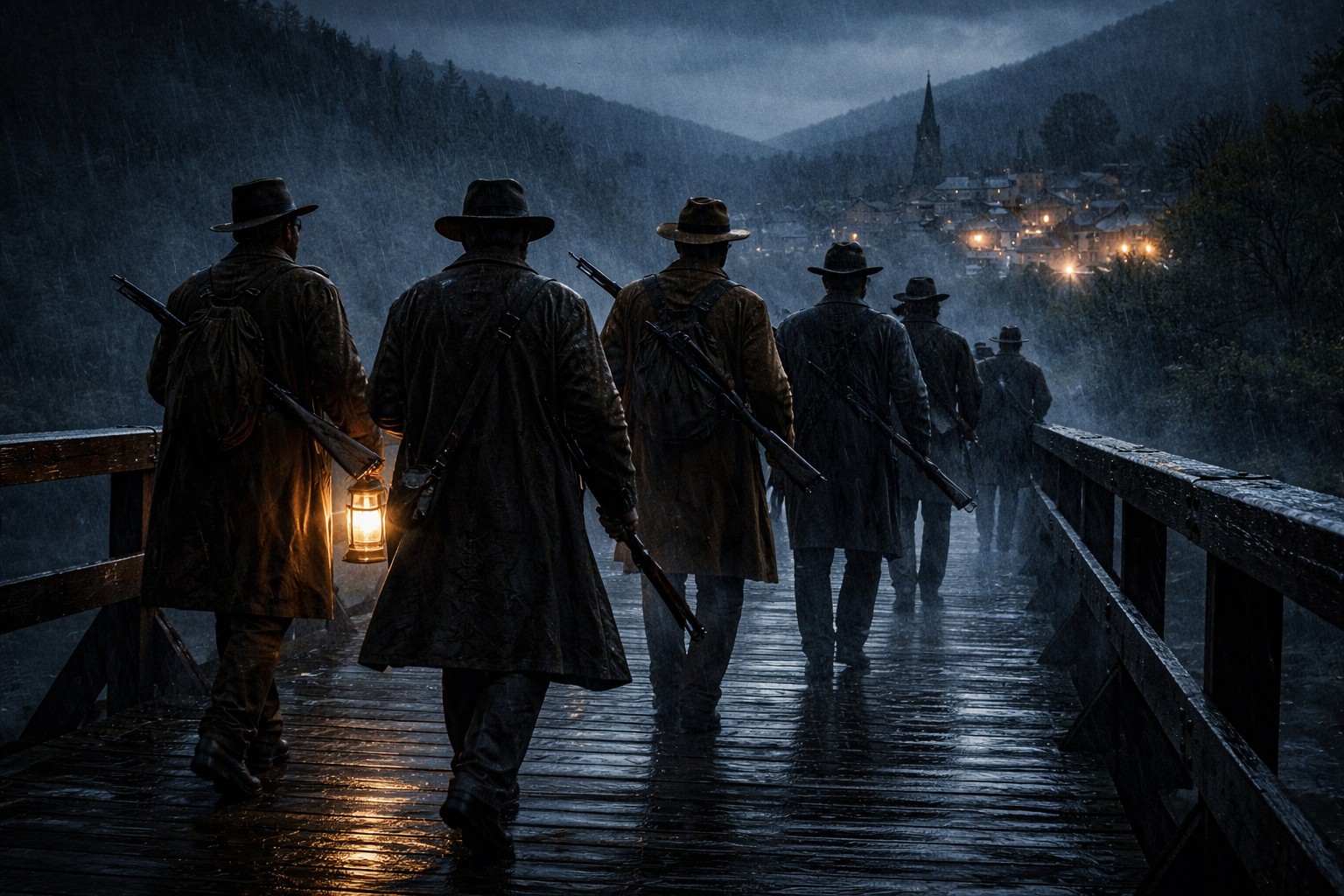
On the night of October 16th, it was raining.

Sunday Night, October 16
They moved out at eight o’clock, twenty-one men in the rain, Brown riding a wagon loaded with pikes and tools, the rest on foot. He had left three men behind at the Kennedy Farm to guard the weapons cache and bring them forward when called.
The eighteen walking toward Harpers Ferry were quiet. The road was dark. The town ahead had no idea they were coming.
The operation went smoothly in the first hour, which was the only hour it ever went smoothly. The single night watchman at the armory gate was overpowered without a shot. The Potomac Bridge fell without resistance, its lone watchman seized and held.
The Shenandoah Bridge went the same way. Brown’s men cut the telegraph wires. By ten o’clock, John Brown controlled the arsenal, both bridges, and the only exits from a town of 3,000 people; and he had done it without firing a shot.
Then came the first thing that went wrong, and it went wrong in a way that contained a specific, bitter irony Brown could not have scripted if he had tried.
Hayward Shepherd was a free black man, 44 years old, employed by the Baltimore and Ohio Railroad as a baggage master and station porter. He was well-regarded in Harpers Ferry; reliable, known to everyone, a free man who had built a stable life in a slave state, which required a kind of careful navigation that most people who have never had to do it cannot fully appreciate.
Late that Sunday night, hearing noise on the bridge, Shepherd walked out to investigate. Brown’s men called for him to halt. He turned and ran. They shot him in the back.
Shepherd lingered through the night and died the next morning. He was the first casualty of a raid launched in the name of liberating men like him.
The pro-slavery press would spend considerable energy on this fact in the weeks that followed, and for once their outrage didn’t require any embellishment. The first man John Brown’s revolution killed was one of the men it came to free. The ‘savior’ had promptly murdered one of those to be saved, shooting him in the back.
Brown pressed on. Raiding parties fanned out into the surrounding countryside to seize hostages and spread the word to the slave quarters. The most important hostage was Colonel Lewis Washington, great-grandnephew of George Washington, taken from his nearby estate before midnight.
From Washington’s house Brown’s men also retrieved a ceremonial sword; a weapon that had belonged to Frederick the Great and been presented to George Washington as a gift, passing down through the family to Lewis. Brown wanted it specifically. He gave it to one of his black raiders to carry. He had a sense of occasion.
The hostages were brought to the engine house, a sturdy brick building inside the armory complex, and held there under guard. Brown had them served breakfast from a nearby hotel. He was courteous to them throughout the night, almost formal.
Colonel Washington would later describe his captor as calm, even pleasant, which was not the description of a man who doubted what he was doing.
The slaves who were supposed to come didn’t come. A handful were brought in by the raiding parties, handed pikes, and stood in the armory yard looking uncertain.
Brown had brought 1,000 pikes specifically for this moment; long-handled weapons he believed would be natural tools for men unfamiliar with firearms. The men holding them that night had not asked for pikes and did not appear to feel liberated by them.
The revolution Brown had been planning for a decade was, by two in the morning, a hostage situation in a brick building with a steadily shrinking perimeter.
The deeper question, the one that would occupy historians for the next 160 years, is why Brown didn’t leave. He held the bridges until well after midnight. The road west into the Virginia interior was open for hours. He had his hostages, he had the arsenal’s weapons, and he had darkness and rain and a head start. He could have moved. He chose not to.
Some historians argue he was waiting for reinforcements that never materialized. Some argue he had simply not built an exit strategy into a plan that required God’s intervention to work, and God was running late.
The most honest answer is probably the simplest one: Brown believed the enslaved people were coming, and he was not going to leave without them. He had not come to Harpers Ferry to raid and run. He had come to start something. Leaving before it started was not a category of action his mind made available to him.
He was still waiting when the sun came up.

Monday: The Trap Closes
The armory workers arrived at first light and found armed strangers where the gate watchman should have been.
Word spread the way it always spreads in a small town; fast and distorted. By seven in the morning, church bells were ringing across the surrounding hills.
By eight, men were coming down those hills with whatever weapons they had — hunting rifles, shotguns, old flintlocks, one account mentions a man with a scythe — and taking positions on the heights above town.
They didn’t need orders or organization. They needed elevation and a clear line of sight into the armory yard, and the geography Brown had chosen gave them both.
The farmers and shopkeepers of Jefferson County, Virginia, were not soldiers. They were, however, angry, numerous, and shooting downhill, which compensates for a great deal of tactical inexperience.
The Baltimore and Ohio’s morning express arrived around seven, heading east. Brown stopped it, held it on the bridge for several hours while he deliberated, and then, in a decision that baffles historians to this day, let it go.
The conductor, a man named A.J. Phelps, telegraphed ahead to B&O headquarters in Baltimore before the train had cleared the next station. Baltimore wired Washington. Washington wired the Secretary of War. The entire federal government knew about Harpers Ferry before Brown’s hostages had finished their breakfast.
The local militia companies arrived through the morning and took the Potomac Bridge back by early afternoon, cutting Brown’s last clean exit. He was now stuck inside the trap. Whatever he had been waiting for through the long wet night, the waiting was over.
His remaining options had narrowed to fighting, negotiating, or surrendering, and Brown had not come 300 miles to surrender.
The afternoon turned ugly in ways that moved beyond military engagement into something darker.
The town’s mayor, a well-liked physician named Fontaine Beckham, ventured too close to the armory fence — curious, apparently, or trying to assess the situation — and a raider named Edwin Coppoc shot him dead. Beckham had been a fixture of Harpers Ferry for decades.
The town’s reaction was immediate.
A raider named William Thompson had already been taken prisoner earlier in the day. After Beckham’s death, a mob dragged Thompson from his captors, marched him to the Potomac Bridge, shot him, and threw his body into the river.
Another raider, William Leeman — 20 years old, the youngest man in Brown’s company — tried to escape by wading into the Potomac and was shot in the river, his body used as target practice by militiamen on the bank for the rest of the afternoon.
The mood in Harpers Ferry had passed beyond anger into something that no longer had much use for the concept of prisoners.
Brown pulled his remaining men and his hostages back into the engine house, a single-story brick building roughly 30 by 35 feet, built to house the armory’s fire wagon. He had the doors barricaded, loopholes punched in the walls for rifle fire.
With him were two of his sons, Oliver and Watson, along with four other raiders and ten hostages, including Colonel Washington. Outside, several hundred increasingly drunk militiamen crowded the streets of a town with more whiskey than military discipline, taking occasional shots at the engine house and arguing about what to do next.
Oliver Brown was shot through the abdomen sometime in the afternoon. He lay on the engine house floor and asked his father to kill him, to end it. Brown told him to die like a man. Oliver died like a man, slowly, while his father directed the defense of the building and waited for the slaves who were not coming.
Watson Brown was shot through the abdomen as well, trying to wave a white flag from the engine house door. He would take two days to die.
By nightfall, ten of Brown’s twenty-one men were dead or captured. Two had escaped across the Shenandoah; they would be caught within days. The remaining men were in the engine house with a wounded, aging commander who had been awake for nearly forty hours and showed, by all accounts, no inclination whatsoever to give up.
Ninety miles away, a colonel on family leave at Arlington had just received his orders.

The last stand of John Brown took place in the fire engine house of Harpers Ferry. Dubbed John Brown’s Fort, it would be the only armory building to survive the Civil War.
The Colonel at Arlington
Robert Edward Lee was not supposed to be anywhere near Harpers Ferry.
In October 1859 he was on extended leave from the Army, stationed at his wife’s family estate on the heights above the Potomac; a place called Arlington, 1,100 acres of complicated inheritance that Mary Anna Custis Lee had received from her father, George Washington Parke Custis, who had died two years earlier and left the finances in ruins and the will in dispute.
Lee was trying to sort it out. It was not going well.
The estate came with 63 enslaved people and debts that had accumulated for decades under Custis’s cheerful financial mismanagement. Lee was methodical by nature, a man who believed order was a moral condition as much as a practical one, and the disorder he had inherited offended him at a level that went beyond the merely professional.
He was also, for what it’s worth, personally uncomfortable with slavery in the abstract, a fact he mentioned in letters while continuing to manage enslaved people in practice, which is a precise summary of the position most upper-class Virginia men of his generation occupied without apparent discomfort.
Monday morning, October 17, the War Department received the B&O conductor’s telegram and began looking for someone to send to Harpers Ferry. The Army’s senior officers were scattered; no general immediately available, no regular troops within easy reach.
Someone checked the roster and found Lee’s name. A clerk rode out to Arlington with orders.
The aide who delivered them was not the most obvious choice for the job. J.E.B. Stuart was a 26-year-old first lieutenant of cavalry from Virginia, currently in Washington on entirely personal business; he had designed an improved saber attachment device, patented it, and was at the War Department that morning attempting to collect his licensing fee from the Army.
He happened to be in Secretary of War John Floyd’s outer office when Floyd’s staff needed someone to ride out to Arlington quickly. Stuart volunteered.
He borrowed a uniform coat — he was in civilian clothes — and rode out to find Lee. The two men knew each other from West Point, where Lee had been superintendent and Stuart a cadet, and from service together in Texas.
Stuart delivered the orders. Lee read them, said his goodbyes to Mary, and rode back to Washington with Stuart alongside him, Stuart still in the borrowed coat with no time to go back for his own. Lee was in civilian dress.
The force assembled at the Washington Navy Yard was not what Lee might have wished. Eighty-six Marines in parade dress uniforms — the only organized federal troops immediately available in the capital — commanded by Lieutenant Israel Greene, a competent officer who had never led men in combat.
Major William Russell came along as nominal senior officer. Two howitzers loaded with shrapnel were brought in case the situation required artillery, which Lee hoped it would not, given that the situation included ten civilian hostages in a brick building.
The B&O’s president arranged a special train. Lee, Stuart, Greene, Russell, and the Marines boarded it that evening and rode west toward Harpers Ferry through the dark.
Rumors had reached Washington all day: Brown commanding 500 men, 700, a full-scale slave insurrection spreading through the Virginia countryside. Lee had no reliable intelligence about what he was riding into. He knew the town, had passed through it on Army business. He did not know who was holding it or in what strength.
They reached Sandy Hook, Maryland, a mile from Harpers Ferry, at ten o’clock Monday night.
Lee got off the train, assessed the scene, and immediately understood two things. The rumors were wildly exaggerated; this was not 500 men, it was a small raiding party in a single building.
The militia surrounding the town was drunk, disorganized, and a serious danger to the hostages. He dispersed the worst of them, positioned his Marines in the armory yard in the darkness, and decided the assault would wait for daylight.
He spent a portion of the night writing a surrender demand by lantern light. It was precise and not unkind; the raiders would be delivered to federal or state authorities, their lives guaranteed. Lee believed they would take it. He had not yet been told who was in the engine house.
Stuart had.
He had recognized Brown from the Kansas days the moment he heard the description; the lean old man with wild eyes, the biblical certainty, the absolute refusal to be hurried or frightened.
He said nothing to Lee that night that the historical record captures, but he knew what the surrender demand’s reception was likely to be. He volunteered to deliver it himself in the morning.
Dawn came cold and clear over the Blue Ridge.

Tuesday Morning: The Engine House
Stuart walked across the armory yard alone, carrying a white flag, at seven o’clock in the morning.
The Marines were positioned behind him in two assault columns, fixed bayonets, waiting for his signal. Lee watched from the armory gate, close enough to observe, far enough back to command. The yard was quiet, though one wrong word away from becoming very loud.
Stuart approached the engine house door and knocked. A crack appeared. Brown’s face came into the gap; one eye visible, the muzzle of a carbine visible beside it, the voice behind both of them immediately recognizable to Stuart as the same voice that had argued about Kansas four years ago with the same unbudging certainty.
Stuart presented Lee’s demand. Brown read it, or had it read to him, and began to negotiate. He wanted safe passage for himself and his men to the Maryland side of the Potomac, after which he would release the hostages.
Lee had not authorized safe passage. Stuart listened for a moment — long enough to be certain Brown was not going to accept the actual terms — and then stepped sharply to the side and swept his dress hat downward in a wide arc.
The Marines came in at a run.
They hit the engine house doors with a heavy ladder used as a battering ram. The first two strikes bounced. The third strike punched a hole through the right door large enough for a man to dive through, which is exactly what Lieutenant Israel Greene did — first man in, alone for a moment in the smoke and dimness, Brown and his raiders on one side, hostages scrambling for the walls on the other.
Greene spotted Brown immediately. Brown was on one knee, raising his carbine. Greene swung his dress sword, a lightweight ceremonial weapon, not a combat saber, and caught Brown across the back of the neck with the blade. The blow knocked him forward.
Brown turned and Greene hit him again, this time driving the point of the sword at Brown’s midsection. The blade struck Brown’s belt buckle, bent over, and didn’t penetrate. Greene reversed the sword and beat Brown to the ground with the hilt.
The fight inside lasted less than three minutes. Two raiders were killed. One Marine, Private Luke Quinn, was stabbed through the abdomen with a pike and died within the hour, the only federal casualty of the operation.
The hostages walked out into the morning light unharmed. Colonel Washington, who had been Brown’s prisoner for the better part of thirty-six hours, emerged composed enough to immediately identify the raiders by name for the authorities.
Brown was dragged out and laid on the grass in the armory yard. He was bleeding from the head and the face, conscious, and talking. The questions began almost immediately. Virginia’s Governor Wise had arrived overnight, along with a collection of congressmen and reporters, and they crowded around the wounded old man in the yard. They knew this was something consequential.
Brown answered every question fully and without hesitation. He seemed, by multiple accounts, almost relieved to have an audience.
Stuart crouched beside him at some point during the questioning and took Brown’s bowie knife from his belt as a souvenir. Stuart was that kind of soldier; alive to the theater of military life in a way that Lee, for instance, never was. He kept the knife.
Brown was loaded into a wagon and taken to Charles Town, the Jefferson County seat, to await trial. He had been awake for the better part of two days. He had lost ten men. Two of his sons were dead or dying. The slave rebellion had not materialized. The arsenal was back in federal hands.
He did not appear, to anyone who observed him that morning, to believe he had lost.

The Trial He Won by Losing
The Commonwealth of Virginia moved fast. Brown was indicted on October 25th — eight days after the engine house — on three counts: murder, treason against Virginia, and conspiring with slaves to rebel.
The treason charge was legally questionable given that Brown was not a Virginia citizen, but Virginia was not in a mood for legal nuance and the presiding judge, Richard Parker, was not inclined to provide any.
Brown spent most of the trial lying on a cot at the front of the courtroom, wrapped in blankets, genuinely injured enough to warrant the accommodation and sufficiently aware of how it looked to make no effort to appear otherwise.
His lawyers — he went through several, the first ones replaced at his own insistence — argued that he was too unwell to participate meaningfully in his own defense. Judge Parker disagreed. The trial proceeded.
It lasted six days. The evidence was overwhelming and Brown did not seriously contest it. What he contested, from his cot, with the economy of a man saving himself for one specific moment, was the characterization. He was not a traitor. He had not conspired against anything worth protecting. He had acted on the only law that mattered to him, which was God’s, and he was prepared to be judged by it.
The jury took 45 minutes on November 2nd to find him guilty on all three counts. Judge Parker asked if he had anything to say before sentencing was pronounced.
Brown stood up.
He spoke for roughly five minutes without notes, in a voice that reporters in the back of the courtroom described as clear and steady. He denied intending violence against anyone — a claim difficult to reconcile with the mutilated, murdered bodies at Pottawatomie Creek, but Brown had long since organized his memory around the requirements of his mission.
He said he had acted entirely from concern for the despised poor. He said the Bible he had read all his life taught him to remember those in bonds as bound with them. He said if he had interfered on behalf of the wealthy and powerful, of the great, it would have been considered right. He said if it was deemed necessary that he forfeit his life for the furtherance of justice, he submitted to it willingly.
Then he sat back down on his cot.
The speech went out by telegraph that night and ran in the morning papers from Boston to New Orleans — front page in the New York Tribune, front page in the Richmond Enquirer, the same words landing in two countries that were already barely on speaking terms.
In the North it produced something close to a religious experience among the abolitionist community. In the South it produced fury, which was partly a response to Brown and partly a response to the Northern reaction to Brown, which was becoming its own alarming thing.
Ralph Waldo Emerson, speaking in Boston a week later, declared Brown a new saint who would make the gallows as glorious as the cross.
Henry David Thoreau had already delivered “A Plea for Captain John Brown” — a full-throated defense of a man whose methods Thoreau had spent his entire intellectual life arguing against, delivered apparently without irony.
William Lloyd Garrison, who had built his entire career on the principle of nonviolent moral persuasion, struggled visibly in print to square his pacifism with his admiration for what Brown had attempted.
The South read every word of this.
The South was reading everything Northern in those weeks with the focused attention of people looking for confirmation of what they already believed; that the abolitionist movement was not a fringe of cranks but a mainstream Northern sentiment with the intellectual establishment behind it, and that the Secret Six were not six men but a representative sample of what the North actually thought about Virginia and her institutions.
Brown had failed to start a slave rebellion. He had succeeded, inadvertently, at something nearly as dangerous to the sectional peace: he had made the South believe the North was already at war with it.
Governor Wise received letters from across the South urging him not to hang Brown, on the grounds that a living Brown in prison was considerably less useful to the abolitionist cause than a dead Brown on a scaffold.
Wise hanged him anyway, partly from legal obligation and partly because he was not a man who responded well to being told what to do.
December 2nd, 1859. Brown rose that morning in his cell, wrote several letters, and handed his guard a final note on the way out. It read:
I, John Brown, am now quite certain that the crimes of this guilty land will never be purged away but with blood. I had, as I now think, vainly flattered myself that without very much bloodshed it might be done.
He rode to the scaffold on his own coffin, seated in a wagon, looking out at the Blue Ridge Mountains in their December color. Someone nearby noted it was a beautiful morning. Brown agreed. He said he had never had the pleasure of seeing this country before, and that it was a beautiful country.
He was hanged at 11:15 in the morning. The drop was clean. He was pronounced dead within minutes.
Thomas Jackson was there with his VMI artillery cadets; 21 of them, manning two howitzers, deployed to help maintain order at the execution. He wrote to his wife that evening that Brown had behaved with absolute composure and that he was a brave man.
Jackson did not say whether he thought Brown was right. He rarely editorialized. He would be dead himself within four years, after becoming a legendary military figure shot down by his own men in the dark during his greatest victory.
John Wilkes Booth was there too. He had been rehearsing at the Richmond Theatre when he read about the upcoming execution, borrowed a uniform from the Richmond Grays militia, and traveled to Charles Town specifically to watch.
He had the actor’s instinct for being where the story was happening. He stood in the field below the scaffold and watched John Brown hang, and filed it away with everything else. He would not need a borrowed uniform for the next one.

What It Broke
The hanging was barely concluded before the South began drawing conclusions, and the conclusions it drew were not entirely wrong.
John Brown had not materialized from nowhere. He had been funded by six prominent Northern men — a minister, a physician, educators, a businessman, a wealthy landowner — who had known enough about his intentions to make them accessories in any honest accounting, and who had spent the weeks since the raid in varying states of panicked denial.
Franklin Sanborn fled to Canada. Samuel Gridley Howe followed him. Gerrit Smith checked himself into an asylum in Utica, claiming a mental breakdown that was convenient in its timing if nothing else. Higginson alone stayed put and dared anyone to charge him.
The South watched the Secret Six scatter and drew the obvious conclusion: these men had money, connections, and the sympathy of the Northern intellectual establishment, and the only thing that had stopped their scheme was the incompetence of its execution.
The next John Brown might be more competent. The one after that more competent still. The free states were producing men willing to finance rebellions, and the most celebrated minds in New England were writing pamphlets in their defense. What exactly was the South supposed to do with that information?
Southern moderates, the men who had been arguing for compromise and continued engagement with the political process, found themselves with increasingly little ground to stand on.
The radicals had been saying for years that the North could not be trusted, that abolitionism was not a fringe movement but a mainstream Northern value dressed in polite language, that the South’s only safety was in its own hands. Harpers Ferry handed those radicals the argument they had been waiting for, fully formed and gift-wrapped. The moderates never recovered their footing.
In Washington, the Democratic Party completed the fracturing that Lecompton had started. Southern Democrats, already furious with Douglas over his refusal to endorse the Lecompton Constitution, now demanded a federal slave code guaranteeing slavery’s protection in all territories; a position designed specifically to be one Douglas could not accept without destroying himself in the North. Douglas refused.
The party entered its 1860 convention in Charleston with a split that everyone could see coming and nobody could stop. It produced two candidates, Douglas for the Northern wing, John C. Breckinridge for the Southern, and handed the election to a man who hadn’t carried a single Southern state.
Lincoln understood what Brown had done to the political landscape and moved carefully around it. His Cooper Union address in February 1860 was partly a sustained argument that Brown’s raid represented no one but Brown; that radicalism and Republicanism were distinct things, that the party of free labor was not the party of Pottawatomie Creek.
The argument was accurate and also somewhat beside the point. The South was not really arguing about what the Republican Party’s platform said. It was arguing about what the North’s tolerance of men like Brown revealed about the North’s actual intentions.
Lincoln could disavow Brown all he wanted. Emerson had called the gallows glorious, and the South had written it down.
Lincoln won in November 1860 with not a single Southern electoral vote, nor anywhere close to a national majority vote. South Carolina seceded before Christmas. Six more states followed before the guns at Fort Sumter opened in April. The war that Brown had tried to start with 21 men and a wagonload of pikes was starting anyway, on a scale he couldn’t have imagined.
The men at Harpers Ferry scattered across the coming conflict in ways that would have seemed improbable if anyone had tried to predict them that December morning in 1859.
Lee went home to Arlington, agonized through the secession winter, resigned his commission on April 20, 1861 — two days after Virginia left the Union — and within a year commanded the Army of Northern Virginia.
Stuart became his cavalry chief, the most celebrated horseman in the Confederacy, killed at Yellow Tavern in May 1864 with a pistol ball through the abdomen at age 31.
Israel Greene, the Marine lieutenant who had beaten Brown to the floor with a dress sword, resigned his commission and joined the Confederate Marines; a decision history has largely forgotten, which seems appropriate given the weapon he was carrying that morning.
John Wilkes Booth went back to the stage, grew more radical as the war ground on, and spent the winter of 1864-65 planning a scheme to kidnap Lincoln and others that escalated, as schemes sometimes do, into something considerably more.
He was in Ford’s Theatre on April 14, 1865, in no borrowed costume this time. He had been present, in various capacities, at the beginning of the crisis and its end; a minor figure at Harpers Ferry, a catastrophic one at Ford’s Theatre, connected by the same furious certainty that had driven Brown to the engine house door six years earlier. The conviction that history required a dramatic gesture, that one man’s action could change the course of events, that the moment demanded everything.
Brown had believed it. Booth believed it. Neither of them was right about what it would produce.
Brown’s arithmetic, in the final accounting, was this: he failed completely at what he attempted and succeeded completely at what actually mattered.
He had come to start a war. The war he started was not the one he planned — no slave rebellion, no mountain republic, no collapse of the institution from within — but a war came anyway, and it ended the thing he had given his life to end.
Whether that vindicates him depends on how much weight you give the failures along the way; the five men dragged from their homes at Pottawatomie Creek, the ten men dead in a Virginia armory yard, the murders, the mutilations, the hostages who survived by luck and the raiders who didn’t survive at all.
He had told Frederick Douglass he was prepared to die. He was more than prepared; he had designed the whole final act around it. The trial, the courtroom speech, the composed walk to the gallows, the note handed to the guard.
The man who went to Harpers Ferry was a failed businessman and a murderer and a genuine fanatic, and he was also one of the most effective political actors of the nineteenth century, and all of those things were true simultaneously. He understood that a dead John Brown was worth more to the cause than a living one, and he made sure the country got the version that was worth more.
On the morning of his hanging, as the wagon carried him to the scaffold, he looked out at the Blue Ridge in its winter light and said it was a beautiful country. He had never seen it before.
He was not wrong about that either.



Leave a Reply