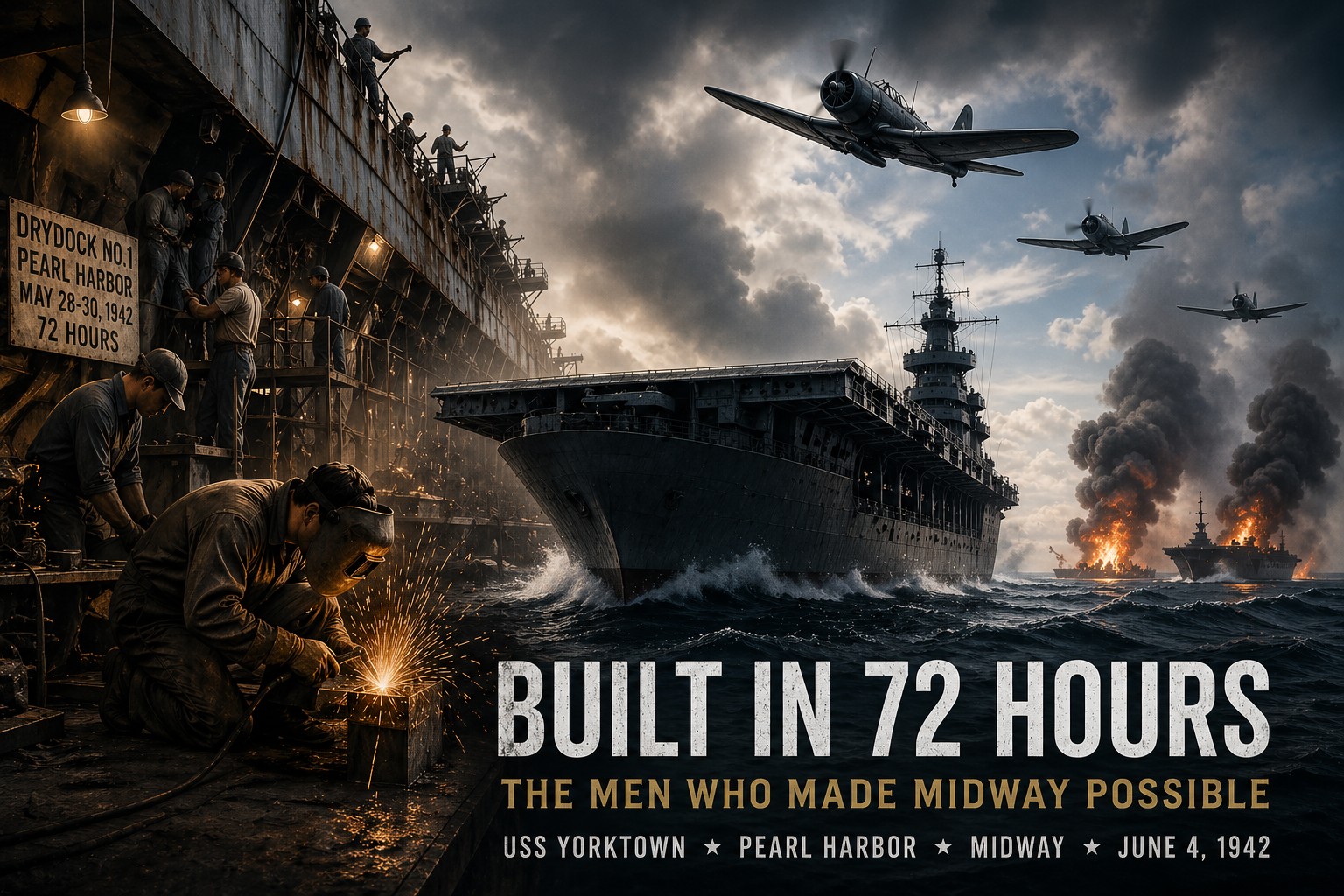
The Battle of Midway is one of the most written-about naval engagements in American history. Books, documentaries, a handful of films; the battle has never lacked for attention.
What it has lacked is a focus on what made it possible in the first place.
The story almost always begins on the morning of June 4, 1942, with American dive bombers rolling into their attack runs over the Japanese carrier fleet. That’s a reasonable place to start if you want the drama. It’s the wrong place to start if you want the truth.
The truth starts several weeks earlier and several hundred miles to the south, in the Coral Sea; and with a ship that, by any fair estimate, should never have made it to Midway at all.
The USS Yorktown had been in the thick of it at the Battle of the Coral Sea on May 8, 1942. She came out of it in one piece, technically. But only technically.
A single 551-pound armor-piercing bomb had found her; plunging through the flight deck, penetrating fifty feet of steel and decking, and detonating above the forward engine room.
Six compartments were destroyed outright. Lighting systems were gone across three decks and 24 frames. Near misses by eight other bombs had opened seams in her hull from frames 100 to 130 and ruptured the fuel oil compartments. She’d lost her radar. Lost her refrigeration.
And she was leaking; badly enough that she left an oil slick ten miles long behind her as she turned for home.
Rear Adm. Aubrey Fitch, aboard the wounded carrier, looked at the damage and put his estimate in writing: three months to repair. The Navy’s initial assessment agreed. If Yorktown was going to be fixed properly, she needed Puget Sound Naval Shipyard in Bremerton, Washington, and months of serious work.
She had neither.
What Yorktown’s captain, Capt. Elliott Buckmaster, had was an 18-day voyage back to Pearl Harbor and a damage control crew that refused to quit. During that crossing, his men worked below decks around the clock, patching and shoring as best they could.
The gaping hole in the flight deck, the one the bomb had punched clean through, they repaired so well during the transit that by the time they reached Hawaii, it was nearly invisible. What was happening below was entirely another matter, and Buckmaster knew it.
On May 25, still 100 miles from port, he managed to get a plane airborne and sent his full damage report ahead to Pearl Harbor. The man waiting for it was Adm. Chester Nimitz.
Nimitz was working with information that almost nobody else had. In the basement of Building 1 at Pearl Harbor, in a space the Navy called Station HYPO, Cmdr. Joseph Rochefort and his team of cryptanalysts had broken enough of Japan’s naval code to read the outline of what was coming.
Japan’s Kido Butai, the same carrier strike force that had hit Pearl Harbor six months earlier, was heading for Midway Island. The attack was coming on June 4. Nimitz knew it, and he knew that if Midway fell, Japan had a base within striking distance of Hawaii and the west coast.
He had two carriers he could send: Enterprise and Hornet, operating as Task Force 16 under Vice Adm. William Halsey. Against four Japanese fleet carriers, two American carriers were a long shot at best. The math only got anywhere close if he could put Yorktown back in the fight.
That meant he had nine days.
Yorktown limped into Pearl Harbor on May 27; one day ahead of schedule, which tells you something about how hard Buckmaster had pushed her. Nimitz had already ordered Pearl Harbor’s yard superintendent, Capt. Claude Gillette, to fly out to the ship while she was still at sea and make his assessment.
Gillette radioed back that it was possible to get her ready in time. Possible, but barely, and only with what he called a “supreme effort.”
The morning of May 28, Drydock Number One closed behind her. The pumps started pulling out the water. And with still a foot of water left on the drydock floor, Nimitz himself waded in, shoes and all, to see the damage with his own eyes.
He’d seen enough. He turned to the repair team assembled around him, and told them what he needed.
“We must have this ship back in three days.”
Silence. Then hull repair expert Lt. Cmdr. H.J. Pfingstag looked at the admiral and said, “Yes, sir.”
That pause before the answer may have told the story better than any words.

The Men in the Drydock
Let’s be clear about what Nimitz was asking. The standard estimate, from men who knew this ship and this kind of damage, and assumed all of the parts, equipment, manpower, and facilities were ready and at their disposal, was three months. Nimitz was asking for 72 hours.
To get there, corners would have to be cut. Not the small, inconsequential kind, but the kind that exist specifically because people get killed when you ignore them.
The first one went before the drydock even finished draining. Standard Navy procedure required a full day of purging before any hot work could begin near a ship’s fuel tanks; acetylene torches and stored aviation fuel being a combination nobody with any sense was eager to test.
Nimitz voided that rule personally. The torches were going to work immediately, fuel or no fuel. There was no day to spare for purging, and that was that.
It was the first of what one account described as “hundreds” of safety regulations that would be set aside in the hours that followed. Not forgotten; set aside. Knowingly, deliberately suspended, because the alternative was losing Midway.
By the time the drydock floor was dry enough to work, more than 1,400 men had descended on the Yorktown.
Shipfitters. Machinists. Welders. Electricians. Shipwrights. Pipefitters. They were Pearl Harbor Navy Yard tradesmen — civilian workers, most of them, alongside Navy personnel — and they came from every corner of the yard.
Families brought food to the gate because the men weren’t leaving. Sleep, when it happened at all, happened in corners of the yard, on piles of equipment, wherever a man could find a flat surface and twenty minutes.
There was no technical planning phase. There wasn’t time for one. Foremen worked directly from the Yorktown’s original construction drawings, making calls on the spot, improvising constantly.
The scene inside that drydock defied easy description. Men in every compartment, on every level, torches running, jackhammers going, the smell of burning steel mixing with the oil and seawater that still coated everything below the waterline. Stanford Linzey, a chaplain aboard the Yorktown, summed it up:
“Welders with torches, electricians, and hull technicians swarmed like ants over, around, and under the great ship.”
That’s not a figure of speech. That’s what it looked like.
The work was a masterclass in organized desperation.
The hull’s ruptured seams; well, the proper fix would have been to address each one individually, re-riveting the plating back to its original specification. That wasn’t happening in three days.
Instead, the yard workers welded enormous steel plates over long stretches of damaged hull, covering the problem rather than solving it. Faster by a wide margin. Also weaker by a wide margin; Naval historians later noted that the resulting connections were “fragile,” that the chemical composition of the steel being joined wasn’t well-suited to the welding method they were forced to use.
The shell plating on Yorktown’s port side was, in the careful language of one post-war damage report, a series of “stopgap methods.”
She was being held together with the naval equivalent of a good faith effort and a prayer.
Three of her nine boilers were left completely untouched; no time. Her superheater boilers went unrepaired, which meant her top speed was permanently compromised.
The damage that had been done to her internal support structure in several compartments couldn’t be addressed at all; it simply took too long to fix correctly. The list of things that didn’t get done was almost as long as the list of things that did.
To power all of it — the welding equipment, the lighting rigs, the machinery running around the clock across the entire ship — the electrical demand was enormous. The Navy contacted Leslie Hicks, president of the Hawaiian Electric Company, who arranged a series of rolling blackouts across Honolulu.
The city went dark in rotating sections so the drydock could stay lit. Civilians on Oahu lost their power without explanation. The explanation was classified.
On the flight deck and along the pier, armed Marines stood guard. Whatever was happening in that drydock, the Navy wasn’t advertising it.
At 11 a.m. on May 28, less than 48 hours after she’d entered the drydock, the caissons flooded and Yorktown was towed back into the harbor. Workers were still aboard. Scaffolding was being thrown over the side as she moved.
On the morning of May 30, more patched than repaired but deemed fit enough to fight, she steamed out of Pearl Harbor.
Some of the yard workers rode with her. They stayed aboard as far as Kauai, still working as the ship moved, then jumped to tugboats that were trailing her and headed back to Oahu.
A damage control team from the yard, men who had lived inside her wounds for 72 hours and knew exactly where the weak points were, didn’t leave at all. They were still aboard when she reached open ocean. They would be aboard when she reached Midway.
Nobody wrote down most of their names.

The Man Carrying the War
While the torches burned in Drydock Number One, the admiral who was supposed to lead the American carriers into battle was in a hospital bed.
Vice Adm. William “Bull” Halsey had been at sea almost without pause since December 7, 1941. When the Enterprise slipped back into Pearl Harbor the night after the attack, she pushed through water still covered in oil, the wreckage of Battleship Row visible in every direction.
Halsey stood on the bridge and took it in. He was not a man given to quiet reflection on moments like that one; what he felt, he said bluntly:
“Before we’re through with them, the Japanese language will be spoken only in hell.”
That was not an act. That was a promise, and he spent the next six months making good on it.
In January and February of 1942, his task force hit the Marshall and Gilbert Islands; the first offensive strikes the U.S. Navy had launched since the attack. In March, Wake Island.
His carriers were, for a stretch of months, essentially the only offensive force America had in the Pacific, and Nimitz used them accordingly.
Then came April, and the mission that would define the early war in the public imagination: Halsey’s task force carried Lt. Col. Jimmy Doolittle’s Army bombers to within striking distance of Tokyo, launching them from the deck of the Hornet.
When a Japanese patrol boat spotted the task force early and forced the question, it was Halsey who made the call to send the planes immediately; shorter fuel margin, higher risk, still no hesitation.
Consider what that first half of 1942 actually looked like from the bridge. While other operational commanders were rebuilding, regrouping, organizing, recruiting, or enduring the consequences of early defeats, Halsey was continuously at sea and continuously on offense.
MacArthur escaped the Philippines and spent months reconstituting his forces in Australia. Ghormley managed Guadalcanal from a headquarters ship and was eventually relieved for losing his nerve. Wainwright surrendered at Corregidor and spent the rest of the war in a prison camp.
None of that diminishes what those men faced. But no American operational commander in 1942 carried the load that Halsey carried — at sea, on land, under pressure, on offense — for as long, or with as little rest.
He was, for the critical stretch of the worst year of the war, the sharpest point of the American spear. The only one they had.
By the time Task Force 16 turned back toward Pearl Harbor after the Doolittle Raid, Halsey had been running hard for five months straight. His nearly 60-year-old body had apparently been paying attention.
The skin condition came on during the return voyage. Severe dermatitis (psoriasis); stress-induced, by most medical accounts, his immune system in open revolt after months of sustained operational tempo. It spread.
By the time he reached Pearl Harbor in late May, it had taken over enough of his body that the Navy sent him to the hospital. When it became clear the condition wasn’t resolving quickly, they put him on the cruiser USS Detroit and shipped him to San Francisco, where a specialist met him at the dock.
He called missing Midway “the greatest disappointment of my career.” That quote is the only editorial he ever offered on the subject. He didn’t complain. He didn’t make excuses. He’d run himself into the ground doing his job, and his body had presented the bill. That was the whole of it, as far as Halsey was concerned.
Before he left, Nimitz came to him with a question: who should take his place? Losing Halsey on the eve of the most important naval engagement of the Pacific War was, by Nimitz’s own account, a severe blow. Halsey’s answer was immediate.
He recommended Rear Adm. Raymond Spruance; his cruiser division commander, a surface warfare man who had screened Halsey’s carriers through every raid since December. Nimitz sorted out the question of seniority with Rear Adm. Frank Jack Fletcher and made it official.
Spruance didn’t even know Halsey was sick until the orders arrived.
Halsey was released in September 1942 and Nimitz sent him straight to the South Pacific, where the grinding campaign for Guadalcanal had stalled under a commander who had run out of fight.
What happened next says as much about Halsey as anything in his record. He was handed his new orders when his plane landed at Noumea. His reaction:
“Jesus Christ and General Jackson. This is the hottest potato they ever handed me.”
He got to work the same day.
The men on Guadalcanal found out he was coming before he arrived. Lt. Cmdr. Roger Kent, an Air Combat Information Officer who was on the island when the news broke, described the moment in terms that needed no embellishment:
“One minute we were too limp with malaria to crawl out of our foxholes; the next, we were running around whooping like kids.”
Two Marines, Kent recalled, nearly came to blows over a point of fierce disagreement: one insisting that getting Halsey was worth two battleships and two carriers, the other swearing he was worth two battleships and three.
Guadalcanal was secured by February 1943. Halsey never stopped after that, not until Japan formally surrendered on the deck of the USS Missouri in September 1945, the ship that bore his flag at the end.
The six weeks he spent in a hospital and a convalescent ward in the summer of 1942 were the only weeks between Pearl Harbor and Tokyo Bay that Halsey wasn’t in the fight. His body quit exactly once. Make of that what you will.

The Wrong Shoes for the Battle
Raymond Spruance was not supposed to be there.
He was a cruiser man, a surface warfare officer who had spent his career on destroyers, cruisers, and battleships.
In the Navy of 1942, that distinction meant something specific and visible: aviation officers wore brown shoes with their uniforms. Surface warfare men wore black.
It was shorthand for two different cultures, two different ways of thinking about naval war. What happened at Midway was that the most pivotal carrier battle in American history was commanded, on the American side, by a black-shoe admiral who had never run a carrier air operation in his life.
He found out he had the job when the summons arrived. Halsey was already in the hospital.
The two men were close friends, which given their temperamental differences requires some explanation. Halsey was loud, instinctive, aggressive, profane, and beloved; a man who led by force of personality and made decisions the way a boxer throws punches.
Spruance was nearly his opposite. Reserved to the point of being austere. Methodical. He walked everywhere, obsessively; long, solitary walks that his staff learned to interpret as thinking time rather than an invitation to join him. He didn’t drink. He didn’t smoke. He didn’t perform. Where Halsey filled a room, Spruance merely occupied one.
What they shared was mutual respect of the kind that tends to develop between men who have watched each other work under pressure.
Spruance had commanded the cruiser screen for Halsey’s task force through the Marshall Islands raids, the Wake Island strike, and the Doolittle Raid. He had seen how Halsey operated at close range, and Halsey had seen enough of Spruance to trust him with something irreplaceable.
That trust was not casually given. When Nimitz asked Halsey to name his own replacement for the most important battle of the war, Halsey didn’t hesitate. That tells you what you need to know about how he regarded Spruance.
What Spruance inherited was considerable, not to mention complicated. He got Halsey’s two carriers, Enterprise and Hornet, along with Halsey’s staff, including the chief of staff Capt. Miles Browning.
Browning was brilliant and widely acknowledged as such, which he made sure everyone understood. He was also erratic, difficult, and the kind of man who functioned best under a commander who knew when to use him and when to overrule him.
Halsey had that instinct. Spruance, new to carrier warfare and working with a staff that wasn’t his, did not; and Browning would cause problems at exactly the wrong moments during the battle itself.
But Spruance had one week to worry about all of that later. Right now he had carriers to learn.
During the voyage from Pearl Harbor to the rendezvous point northeast of Midway, a spot Nimitz had designated “Point Luck,” which under the circumstances was either optimistic or darkly funny, Spruance could be found on the Enterprise’s flight deck in almost any weather, pacing. Not aimlessly. He was working.
He pulled staff members aside one by one and interrogated them about carrier operations, air tactics, strike coordination; everything he wanted to know and needed to know before June 4. When he finished with one man, he signaled to the next.
His mind, by all accounts, absorbed information quickly and held it. He was doing in a week what most carrier admirals had spent years learning.
Nimitz had given him a sound operational plan: wait at Point Luck, let the Japanese focus their attention on Midway Island, and hit their carriers while they were occupied with the attack.
The ambush concept was solid. Executing it would require Spruance to make several critical decisions under pressure, with incomplete information, in a type of warfare he had never commanded.
It would also require a level of nerve that nobody — including, perhaps, Spruance himself — had yet had occasion to measure.
On May 30, the same morning Yorktown steamed out of Pearl Harbor with yard workers still throwing equipment over her sides, Enterprise and Hornet were already at sea. Three carriers, converging on a patch of ocean northeast of a small atoll, to set a trap for the most powerful carrier fleet in the world.
The men who built the trap were already home by then, back in Pearl Harbor or wherever home was, waiting like everyone else to find out if it had worked.

June 4th
The Japanese were not expecting three carriers.
Japan’s intelligence had Yorktown at the bottom of the Coral Sea. She had taken serious damage in that battle — everyone knew it — and the consensus among Japanese naval planners was that she was either sunk or so badly damaged as to be irrelevant.
They had built their Midway operation around the assumption that they would face two American carriers, if any. When their pilots spotted a third one on the morning of June 4, it introduced a confusion into Japanese planning that never fully resolved itself.
The ship that 1,400 men had welded back together in 72 hours, the ship that sailed out of Pearl Harbor more patched than repaired, was doing something important before she ever launched a single plane: she was a problem nobody on the Japanese side had accounted for.
Nimitz had positioned his three carriers northeast of Midway, well out of range of Japanese search patterns. Fletcher, flying his flag from Yorktown, held overall command.
He had Spruance’s Task Force 16, Enterprise and Hornet, operating roughly ten miles to his south. The plan was to let the Japanese commit to their attack on Midway Island, then hit their carriers while their flight decks were occupied with recovering and rearming aircraft.
It was an ambush, plain and simple, and it required patience; sitting still while Midway took whatever punishment Japan chose to deliver, waiting for the right moment.
The right moment came early.
At 5:34 in the morning, a Navy patrol plane out of Midway spotted the Japanese carrier force and got a message out. The report was incomplete; it confirmed carriers but didn’t give Spruance the full picture he needed.
Fletcher ordered him to proceed southwest with Task Force 16 and strike. Yorktown and Task Force 17 would follow once a second search confirmed there were no additional Japanese carriers lurking nearby.
What followed was one of the most consequential decisions of the Pacific War, made by a man who had been a carrier commander for less than two weeks.
Spruance’s staff, led by the volatile Browning, calculated a launch time that would put his aircraft over the Japanese fleet at the most advantageous moment. The math was aggressive; it assumed his planes would reach the target with minimal fuel to spare.
Spruance looked at the numbers, asked his questions, and approved the launch. Every available aircraft, fully loaded, sent immediately. He was committing everything he had on a single throw.
Enterprise and Hornet turned into the wind and began launching at around 7 a.m.
What happened next did not go cleanly. It almost never does.
The American attack came in disjointed waves: torpedo bombers without fighter escort, dive bombers arriving at different times from different directions, coordination falling apart in the chaos of a running battle across hundreds of miles of open ocean.
The torpedo squadrons went in first and were massacred. Torpedo Squadron 8 from Hornet, fifteen planes, found the Japanese fleet and attacked. Zero fighters and antiaircraft fire tore them apart. Not one plane survived. Not one torpedo hit.
The same story played out with the torpedo squadrons from Enterprise and Yorktown; slaughtered at low altitude while the Japanese combat air patrol swarmed them and the carriers below maneuvered freely.
For a stretch of that morning it looked like a catastrophe.
Then the dive bombers arrived.
The timing was almost accidental. While the Japanese combat air patrol was fully occupied at low altitude, chasing torpedo bombers and burning through ammunition, SBD Dauntless dive bombers from Enterprise found the Japanese carrier force from high altitude, undetected and uncontested.
Lt. Cmdr. Clarence Wade McClusky, leading the Enterprise group, had made a navigation decision earlier that morning; pushing further than his flight plan called for when he didn’t find the Japanese where they were supposed to be, burning fuel he couldn’t spare, refusing to turn back.
That decision put him over the fleet at exactly the right moment.
At almost the same instant, dive bombers from Yorktown arrived over a second Japanese carrier.
In the space of just a handful of minutes, three of Japan’s four fleet carriers, Akagi, Kaga, and Soryu, were fatally hit. The Yorktown’s dive bombers, VB-3 under Lt. Cmdr. Maxwell Leslie, put their bombs into Soryu. Enterprise’s planes got Akagi and Kaga.
Aircraft on the carrier decks, aviation fuel lines running hot in hangar decks, bombs and torpedoes staged for the next strike; all of it went up. Mere minutes. Three carriers. The balance of naval power in the Pacific shifted in less time than it takes to drink a cup of coffee.
Japan still had one carrier left. Hiryu, operating separately to the north, had survived. Her commander, Rear Adm. Tamon Yamaguchi, didn’t hesitate. He launched everything he had.
Hiryu’s dive bombers found Yorktown first.
Three bombs hit her in quick succession. She slowed, then stopped, fires burning, listing to port.
To Japanese pilots heading back to Hiryu, she looked finished; another Yorktown kill to report, another American carrier out of the fight. What they didn’t know was that the men below her flight deck were already fighting back.
Damage control teams, including the men from the Pearl Harbor yard who had sailed with her, who knew exactly where her wounds were and how thin the margins were, got to work. They controlled the fires. They corrected the list. They got her moving again. Within two hours of being hit, Yorktown was back up to 20 knots.
Hiryu’s torpedo bombers, sent out for a second strike and told to find an undamaged American carrier, found Yorktown instead; and because she was moving and operational, they didn’t recognize her as the ship they had just hit.
The patches held well enough to fool the enemy. Two torpedoes struck her port side. This time the list was too severe and the flooding too fast. At 3 p.m. on June 4, Captain Buckmaster gave the order to abandon ship.
Spruance, meanwhile, had a decision to make.
His scouts had found Hiryu. Enterprise launched a second strike, and late in the afternoon her dive bombers caught the last Japanese carrier with planes still on deck.
Hiryu took four bomb hits and was left burning. By nightfall on June 4, all four ships of Japan’s Kido Butai, the same force that had hit Pearl Harbor six months earlier, were sunk or sinking.
It was, by any measure, a catastrophic defeat for the Imperial Japanese Navy.
Spruance then made the decision that would follow him for years.
Rather than pursue the retreating Japanese fleet through the night, he turned east. His reasoning was straightforward: he didn’t know what else was out there, his aircraft were exhausted and his pilots spent, and a night surface engagement against Yamamoto’s battleships — which were out there, waiting — was a fight he had no business taking.
Critics called it timid. Postwar analysis of Japanese fleet positions confirmed that pursuit would have run his carriers directly into Yamamoto’s powerful surface force, ready for night combat. Spruance almost certainly saved his ships by going east.
Samuel Eliot Morison, the official Navy historian, called his performance at Midway “superb.” That’s the right word, and it came from a man not given to handing them out carelessly.
Back on Yorktown, she wasn’t finished yet, and neither were the men who refused to let her go.

Yorktown Finally Goes Down
Yorktown didn’t sink on June 4.
That’s worth pointing out, because the story of the battle tends to move on once the dive bombers have done their work, and Yorktown gets left behind in the narrative the same way she was left behind in the water; drifting, listing, abandoned.
Her story didn’t end when Buckmaster gave the order to abandon ship. It had another chapter, and it belongs in the story.
After the crew went over the side on the afternoon of June 4, Yorktown floated. She was badly hurt — the port list was severe, the flooding ongoing — but she was still there, still above water, still recoverable if someone was willing to try.
The destroyer USS Hughes was left behind to stand watch over her and to sink her if the Japanese came, which they didn’t. Not that night.
On June 5, with the immediate battle decided and the Japanese in retreat, Buckmaster got permission to go back. He assembled a salvage party — 170 volunteers, men who had already abandoned the ship once and were now asking to reboard her — and they went back aboard on the morning of June 6.
They brought portable pumps. They began counterflooding to correct the list. They patched what they could reach. Slowly, improbably, it started to work. The list began to come back. By afternoon, Yorktown was stable enough that a destroyer came alongside to take a tow line.
She was going to make it. Or so it appeared.
The Japanese submarine I-168 had been shadowing her.
I-168 had actually been ordered to shell Midway Island earlier in the battle, a secondary mission that accomplished nothing, and was subsequently directed to find and finish the damaged American carrier that Japanese pilots had reported.
She had been hunting Yorktown for the better part of two days, working carefully through the destroyer screen that surrounded the wounded ship, waiting for her moment.
On the morning of June 7, she found it.
Two torpedoes struck Yorktown’s port side. A third hit the destroyer USS Hammann, which had been tied alongside providing power to the salvage crews; Hammann broke in two and sank in minutes, taking 80 of her crew with her.
The torpedo hits that found Yorktown were exactly where her hull was most vulnerable, tearing open compartments that the Pearl Harbor workers had shored up as best they could but never fully fixed; because there hadn’t been time to fully fix them, because time was the one thing nobody had.
The salvage party went back over the side. There was nothing left to save.
Yorktown capsized and sank the morning of June 7, 1942, settling to the bottom of the Pacific in roughly 17,000 feet of water. She carried with her the men who had gone down with Hammann, the evidence of her hasty repairs, and whatever remained of three weeks of desperate improvisation by men whose names the history books never bothered to collect.
The yard workers were already home.
They had jumped to tugboats off Kauai on May 30, thrown their staging over the side, and gone back to Pearl Harbor. Some of them found out the battle had been won before they found out the ship had been lost.
The news came in pieces, the way it always did; fragments of radio reports, scuttlebutt at the yard, the slow official acknowledgment that followed.
When it all came together, the men who had welded her back into fighting shape learned two things simultaneously: they had helped win the most important naval battle of the Pacific War, and the ship they had given 72 hours of their lives to was at the bottom of the ocean.
One of those workers, interviewed decades later, described finding out that Yorktown had been sunk:
“We were all extremely sad. We won the battle, but we were working side-by-side with the ship’s workforce. We realized we lost everyone on board.”
That last part wasn’t quite accurate; many of the crew survived, but it tells you something about how those men felt about the ship and the people on her.
She hadn’t just been a job. She’d been something they’d put themselves into, in conditions nobody would have chosen, under rules that had been set aside because the situation demanded it. She was gone, and they felt it.
The damage control lessons that Yorktown’s loss taught the Navy were considerable and lasting.
Procedures were rewritten. Fire suppression methods were improved. The principle that a ship’s entire crew, from the commanding officer down, needed to understand damage control became doctrine.
Admiral Nimitz himself noted in his Midway report that gasoline fires in carriers were a serious and unresolved danger. The improvements that followed saved ships and lives for the rest of the war.
None of that brought Yorktown back. None of it put names in the history books next to the men in the drydock.

Remembering…….
Here is what the tally looks like, honestly totaled.
Three American carriers, or more appropriately two and a half, met four Japanese fleet carriers northeast of Midway on June 4, 1942. By nightfall, Japan had none.
The Kido Butai, the force that had humiliated the United States at Pearl Harbor six months earlier, was gone. The Imperial Japanese Navy never fully recovered.
The war in the Pacific didn’t end at Midway, not by a long stretch, but the initiative changed hands that day and never changed back.
The history books credit the victory to the admirals, which is fair as far as it goes. Fletcher made sound decisions under pressure. Spruance made several remarkable ones; most notably the decision to launch everything he had at the moment he did, and later the decision not to chase the Japanese into the dark.
Neither man was supposed to be in the position he was in. Fletcher had drawn skepticism from his superiors for his handling of earlier operations. Spruance had never commanded a carrier task force in his life. History handed them both roles they hadn’t auditioned for and they rose to them. That’s worth acknowledging.
But here’s what else is true: without Yorktown, the ambush doesn’t work.
Two carriers against four is a losing proposition. The third carrier is what made the numbers survivable; what allowed Fletcher to hold Task Force 17 in reserve while Spruance struck, what allowed a second strike when Hiryu counterattacked, what gave the Japanese one more problem than they had planned for.
The entire structure of the American victory depended on a ship that should have been in a repair yard in Bremerton, Washington, for the next three months.
She wasn’t, because of 1,400 men who worked through two nights and a day in conditions nobody would have designed deliberately: torches burning near fuel tanks, welding in compartments still soaked in seawater and oil, sleeping on the ground when they slept at all, eating whatever their families brought to the gate.
They worked from original blueprints spread on the drydock floor. They welded steel plates over wounds instead of healing them, because healing took time they didn’t have. They did enough. Not everything, enough.
None of them fired a shot at Midway. Most of them had never been to sea. When Yorktown steamed out of Pearl Harbor on May 30, their part was finished, and the thing they had built was no longer in their hands.
They went back to the yard and waited, the way civilians in wartime always wait; at a distance from the consequences of their work, with no ability to affect the outcome and no choice but to trust that what they’d done was sufficient.
It was.
When they found out Yorktown was sunk, they mourned. They had earned that, too; the right to feel her loss as their own. They had put themselves into that ship in a way that transcends the usual relationship between a worker and a job.
She carried their welds into battle. She carried their judgment calls and their shortcuts and their 3 a.m. decisions about which problems could wait and which ones couldn’t. When she went down, something of theirs went with her.
Their names are not in the standard histories. The books about Midway are full of pilots and admirals, and that’s as it should be; those men did extraordinary things and paid an extraordinary price.
But the pilots who rolled into their attack runs over the Kido Butai on the morning of June 4 did so from the deck of a carrier that had no business being there.
Somebody built that deck. Somebody welded those seams in the dark, next to a fuel tank, without the day of purging that the safety rules required, because an admiral had looked at the situation and decided the rules could wait.
Those somebodies won the Battle of Midway as surely as anyone who flew that morning. They just didn’t get to see it.
Halsey got back to sea in September. He went straight to work, the way he always did, and the Marines on Guadalcanal whooped like kids when they heard he was coming. He fought for three more years without stopping. The war ended on the deck of his flagship, which is a fitting place for it to have ended.
He never said much about missing Midway, beyond that single line about the greatest disappointment of his career. What the illness cost him personally, watching from a hospital bed while the battle he had spent six months preparing the conditions for was fought without him, he kept to himself.
That restraint, in a man not otherwise known for it, tells you something. Some things are too large for words, even for Bull Halsey.
The ship the yard built won the battle. The admiral the war wore down made it possible by trusting the right man when it mattered. The man he trusted did his job. And somewhere in Pearl Harbor, 1,400 tradesmen went back to work on the next ship, because there was always a next ship, and the war wasn’t going to wait.
It never did.



Leave a Reply