In 1943, America was past the shock of Pearl Harbor, but years and thousands of miles short of victory. The chaotic awakening of the nation’s war effort had given way to a grinding reality. The headlines from the Pacific and Europe were no longer dominated by disaster, but neither were they proclaiming definitive triumph.
The casualty lists, printed in the local papers with tragic regularity, were proof that this was not a distant, abstract affair. It was a costly, personal endeavor whose final conclusion was agonizingly slow in coming. For the average civilian, the vast, global conflict remained a subject of intense speculation and worry, particularly the hidden battles being fought beneath the waves.
It was this atmosphere of uncertainty that Warner Bros. released Destination Tokyo in the closing days of 1943. This was not a film meant to be an easy form of escapism, a celebratory flag-waving exercise designed to assure a quick, uncomplicated victory. Quite the opposite.
This movie arrived before triumph was assumed, before the myth of American military invincibility had really solidified in the popular mind. Instead, it presented the war as a technical challenge, a dangerous job requiring discipline and intelligence.
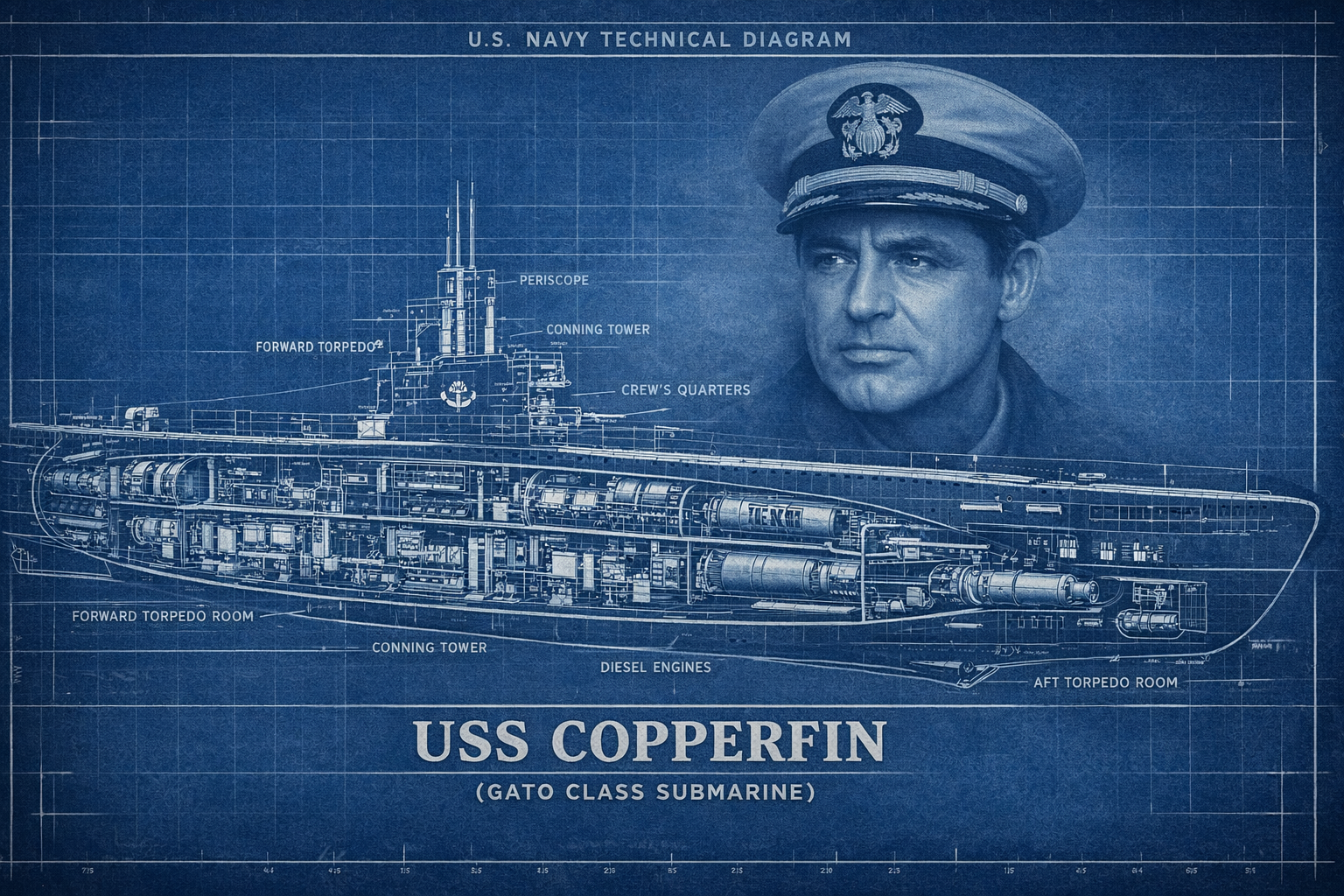
The film followed the fictional submarine USS Copperfin on a particularly dangerous and highly classified mission deep into enemy territory. What made it immediately stand out was its focus on the procedural reality of naval life.
Director Delmer Daves crafted a drama that was focused on the day-to-day existence of a submarine traveling a hostile ocean, instead of oversized heroics or flowery patriotic speeches. The focus was on the mechanics of command, the tactics of evasion, facing crisis in a unique environment, and the professional commitment of the very real men confined within the steel tube.
Perhaps the central motive of this film—and indeed, of this moment in American cinematic history—was that educating ones self and understanding the reality of war was considered a patriotic act. Destination Tokyo was not simply entertainment; it was a potent combination of instruction and heightened spirit, providing the home front a fact-based glimpse into a world few could imagine.
The movie aimed to replace civilian mystery with factual appreciation, showing that victory would be earned through expert competence, not by luck. It stands as a great example of a time when Hollywood saw its mission as helping the public grasp the gravity and complexity of the national effort. That was a long way from simply crafting fantasy.

Hollywood Goes to War: The Industry in 1942–1943
When the United States formally entered the war, the motion picture industry was not just asked to contribute; it was immediately and fundamentally co-opted. The era of the laissez-faire studio system ended, replaced by a highly formalized relationship with the federal government.
This partnership was primarily managed through the newly established Office of War Information, or OWI. This agency, recognizing the immense power of Hollywood’s mass-reaching message, was tasked not only with censoring information, but with coordinating the entire national narrative.
The OWI reviewed scripts, offered advice on characterizations, and, maybe most importantly, laid out the thematic expectations for any film dealing with the war effort.
If a studio wanted access to military cooperation, location access, equipment, or even simply reassurance that their costly production would not be classified as morale-damaging, they went through the OWI.
The priorities set by the OWI during the early years of the war, roughly 1942 through 1943, were remarkably sophisticated for wartime propaganda. They insisted that film messaging transcend simple slogans.
The key mandates focused on accuracy over spectacle, making sure that American fighting men were portrayed as competent, multi-faceted individuals, and ensuring that the public understood the technical complexities facing the Allied forces. In this environment, instruction functioned as a powerful form of persuasion, and helped guide the public toward appreciation of the immense, detailed work being done.
Submarine warfare, in particular, presented a compelling and difficult subject for the cameras. It was, by its very nature, an invisible conflict. Unlike air battles or land invasions, which offered clear visual drama, the submarine campaign was a war fought in darkness, a campaign of incredible risk and intense mental pressure that few civilians could visualize.
Public understanding of the U-boat crisis in the Atlantic and the critical importance of U.S. submarine operations in the Pacific was dangerously low. To bridge this gap, Hollywood needed a vehicle that could take the audience inside the hull and explain the complex mechanics of submerged operation and the absolute necessity of expert command.
This technical, not to mention realistic, approach was ideally suited to Warner Bros. The studio had already built a reputation for topical filmmaking, tackling issues like gangsterism, social ills, and history with a certain journalistic grit that often felt more timely and less polished than the output of their competitors.
Under producer Jerry Wald, Warner Bros. took up the challenge of translating the claustrophobic, high-stakes drama of the Silent Service into a mainstream cinematic experience.
By accepting the OWI’s mandate to prioritize procedural realism, Warner Bros. ensured that Destination Tokyo would function as a sanctioned, serious look behind the curtain of one of the war’s most mysterious operations.
The Navy’s Hand on the Helm
The success of Destination Tokyo was largely due to the unprecedented level of cooperation achieved between Warner Bros. and the U.S. Navy. The Navy was (and is) fiercely protective of the submarine force, an asset whose success depended on absolute secrecy and disciplined operational procedure.
For Hollywood to gain access to this world, the studio had to grant the military command a degree of influence that extended far beyond simple consulting. The production became a true collaboration, with the Navy effectively placing its hand directly on the helm of the film’s narrative.
This meant the presence of technical advisors on set, men who had served in the boats and understood the mechanics of the Silent Service, ensuring that every loading sequence, every gauge read, and every command given was accurate.
More significantly, the script underwent rigorous vetting. Naval officers reviewed the dialogue and the plot structure, not just to prevent the disclosure of classified information, but to guarantee the integrity of the procedures being depicted. They wanted the film to be an accurate document of naval protocol, right down to the precise location of valves and the language used in the conning tower and control room.
The emphasis on procedural accuracy was obvious throughout the finished film. The depiction of the submarine’s cramped, mechanical layout, and the complex sequence required for diving and surfacing maneuvers, felt authentic. The chain of command was portrayed with an absolute fidelity that helped to structure the human drama.
There were no shortcuts taken with the language, the routines, the attitudes, or the discipline of the crew. The audience was effectively given a guided tour through the inner workings of a wartime submarine, an educational opportunity that no recruiting brochure could replicate.
This commitment to reality was officially validated by the Navy itself. The United States Navy used reels of Destination Tokyo in the training of new submariners. The film was recognized by Navy brass as an accurate tool for familiarizing fresh recruits with the internal layout, atmosphere, and operational procedures of the Gato-class fleet submarines.
That the Navy, known for its deep skepticism of Hollywood fantasy, would endorse a fictional feature film as a legitimate tool for understanding submarine operations was an unparalleled endorsement. It showed that Destination Tokyo had transcended the bounds of entertainment to become a recognized procedural aid.
This willingness to prioritize operational detail sharply contrasted with the more heavily theatrical war films of the era, which often sacrificed authenticity for explosive melodrama, further cementing the film’s reputation as a serious cinematic effort designed to instruct as much as inspire.

Life Aboard the USS Copperfin
The most potent narrative element of Destination Tokyo is the ship itself. The USS Copperfin is more than a setting; it functions as a central character that dictates the narrative pace and the emotional tone of the entire mission.
The camera work, often confined to the narrow corridors and cramped compartments, effectively transmits the oppressive physical reality of life underwater.
The submarine is shown as a machine first and a home second, a complex device whose function requires constant tending. The environment faced by the men aboard is shown in numerous ways: surfaces seem to drip with condensation, every sound—the ping of sonar, the ominous creak of the hull under pressure—carries significance. The environment is relentlessly mechanical, making no allowances for human comfort or fatigue.
This atmosphere of confinement and mechanical reliance provides the perfect foil for the film’s version of heroism. Grand actions are sidelined in favor of the daily routine, where survival is achieved through ceaseless professionalism.
The story unfolds across watches recorded in the logbook, crew members engaging in their perpetual close quarters, meals taken in shifts on the suffocating mess deck, and the necessary periods of absolute silence during life-and-death evasive maneuvers.
The film details the process of life aboard a submarine through the cumulative pressure of routine performed under duress, instead of dramatic outbursts. Routine matters like ensuring an adequate food supply, or dealing with a sudden appendicitis case becomes an immense logistical challenge when the crew is operating thousands of miles from any friendly port, deep beneath the surface.
Noticeably, the film avoids inflated rhetoric. Captain Cassidy does not deliver fiery patriotic speeches. In fact, early in the movie, he does exactly the opposite.
Instead, command is expressed through focused orders and unwavering control. The narrative suspense is generated through the minute-by-minute struggle to keep the machine operational and the crew focused.
The audience would find itself holding its breath during the deep dive maneuvers, where the only measurable element of danger is the distance separating the sub from its crush depth, or the volume of the unseen enemy’s screws passing overhead.
By placing authenticity at the center of the story, Destination Tokyo manages to achieve a genuine, sustained drama that no amount of Hollywood bombast could equal. It shows that simply depicting how the job is done, when the stakes are existential, is sufficient to hold an audience captive.
Cary Grant, Reimagined: Stardom in Wartime
The casting of Cary Grant as Captain Cassidy was perhaps the most deliberate and telling move made by Warner Bros. in translating the Navy’s mission to the screen.
Grant was, before the war, the cinematic definition of urbanity and charm. His persona was built on a light, quick wit, and sophisticated romantic detachment. He was the epitome of a particular strain of pre-war escapism.
The idea of the star of screwball comedies and elaborate romantic dramas suddenly commanding a military vessel in a technical war film was an indicator of a comprehensive shift in how Hollywood viewed its own wartime utility. The industry was making a statement: even its most famous icons were now enlisted in the national effort, and their glamorous identities would be subordinate to the national cause.

Grant’s performance in Destination Tokyo is a masterclass in controlled understatement. His Captain Cassidy is professional above all else. His famous charm is suppressed, replaced by a trained “everyman” with the weight of command, focused on the need to succeed in their mission, and to survive.
Cassidy’s authority is earned through his consistent competence, protecting his crew, his ability to execute complex maneuvers flawlessly, and his disciplined control over his own emotions. He is not a heroic figure defined by flash or exaggerated charisma. He is, essentially, the perfect wartime leader as envisioned by the Navy and the OWI: a commander characterized by reliability and an essential focus on their purpose.
This reinvention of Grant served a dual purpose, both for the narrative and for the cultural moment in time. For the film, it keeps the story in a mature realism. By stripping away Grant’s traditional theatrical baggage, the movie emphasizes the fact that success in modern warfare was dependent on expertise, not celebrity.
For the audience, seeing a star who personified the leisurely peace-time life transform into such a focused military instrument reinforced the severity of the times. It articulated a new ideal of wartime masculinity; one that valued inner steel and professional execution over external flair.
It was an expectation placed on all men, civilian and actor alike, that they should find their purpose and serve the demanding moment.
This portrayal stands in fascinating contrast to the brash, swashbuckling, often more emotionally volatile performances delivered by some of the later leading men in films made closer to the war’s end.
The Crew as America: Unity Without Caricature
Just as Captain Cassidy represented the ideal wartime leader, the crew of the USS Copperfin was created to represent the collective American effort. The film achieved this not through a matter-of-fact display of competence drawn from diverse regional and social backgrounds, instead of heavy-handed allegory.
The characters hail from every corner of the nation, bringing with them accents and cultural features that subtly acknowledge the cultural and geographical breadth of the country. This composite crew was a careful ideological creation, showing various religious affiliations and civilian histories folded seamlessly into a unified military unit.
The process was meant to demonstrate the true nature of the great national transformation: farmers, students, and city dwellers had traded their disparate pasts for a single, overriding identity rooted in mission.

The way this unity is portrayed is one of the film’s most enduring achievements. The crew’s cooperation is presented as a simple necessity for survival, not as a source of friction that needs to be dramatically overcome. Differences in background are acknowledged, but they are consistently subordinated to the mechanical and professional requirements of the boat.
Again, respect among the men is earned through demonstrated competence; the ability to fix a failing motor, stand a watch, identify a sonar reading, or handle a medical emergency under pressure. It could be said that the focus was on merit.
This approach avoids the heavily sentimental or melodramatic reconciliation scenes found in other wartime pictures. The crew doesn’t need to learn to tolerate each other; they simply work together because the alternative is disaster.
Furthermore, Destination Tokyo exercises notable restraint in its political messaging. Compared to films produced later in the war, which often relied on easy sloganizing to rally support, this movie focuses its message internally.
The crew functions as a model for the home front, demonstrating how a diverse population could overcome its differences through shared purpose and disciplined effort. The submarine becomes a self-contained meritocracy of skill and teamwork, showing that in the face of a genuine existential threat, individual talents matter more than social position.
By depicting cooperation as an operational requirement rather than a sentimental achievement, the film offered a realistic, practical vision of national cohesion for audiences struggling to maintain morale and purpose on the home front.
The Enemy Offscreen
In analyzing Hollywood’s wartime output, the portrayal of the enemy often provides the clearest barometer of national sentiment and the progression of the conflict.
In this regard, Destination Tokyo is a distinctly early-war offering. The film depicts the Japanese enemy not as a grotesque caricature designed purely to fuel hatred, but primarily as a calculated, ever-present threat.
The focus remains tightly fixed on the mission of the USS Copperfin and the technical obstacles they must overcome, rather than on the psychological or moral flaws of their adversaries. The audience rarely sees the enemy, and then usually experience their presence through sound—distant propellers, the chilling ping of sonar searching for the American boat, and the explosion of depth charges that shake the Copperfin.
Leaning on distance and abstraction served a critical purpose in 1943. It allowed the drama to focus almost exclusively on the American crew’s skill and discipline. The Japanese forces function as a well-trained challenge that must be outmaneuvered and out-thought, not merely overcome through sheer force or emotional superiority.
This depiction avoided the casual stereotypes that would become more pervasive in later wartime films. The restrained approach acknowledged that the war was a serious, ongoing contest against a determined foe, lending greater credibility to the danger faced by the American sailors.
The decision to exercise this restraint made considerable sense in the context of 1943. With the war still intensely active and the final cost uncertain, portraying the enemy as cowardly or easy to defeat would have undermined the gravity of the growing casualty lists. The film needed to validate the immense sacrifice being demanded of the home front.
By keeping the Japanese threat ever-present but largely off-screen, the movie maintained an atmosphere of anxiety and uncertainty, reinforcing the idea that the Copperfin’s survival was a feat of specialized skill and complete focus.
This choice of tone stands in sharp contrast to the post-war and late-war depictions, which often offered retrospective certainty and celebrated massive, overwhelming victory through explicit, often simplistic, confrontation with a villainized opponent. Destination Tokyo, instead, shows a nation still measuring the size of the giant it was fighting.
Reception and Purpose: How Audiences Used the Film
When Destination Tokyo hit theaters at the end of 1943, its critical reception immediately acknowledged its unique seriousness.
Reviewers praised the film not just as an exciting picture, but as an important piece of documentation. Critics noted the sense of authenticity and the restrained performance of Cary Grant, suggesting that Hollywood had finally produced a war picture that matched the gravity of the ongoing conflict.
This critical applause was quickly followed by overwhelming popular support, solidifying the movie’s status as a major box office success of the era.

The film found a powerful connection with audiences because it served multiple functions beyond entertainment. For the millions of Americans whose sons, brothers, and fathers were serving overseas, particularly those in the newly essential and highly dangerous submarine service, the movie acted as a crucial morale booster.
It offered a window into a closed world, replacing frightening speculation about what their loved ones were enduring with a detailed, authoritative depiction of professional competence. If a sailor had to face those perils, the film suggested, they would be commanded by men like Captain Cassidy and would be equipped with the expertise necessary for survival. It validated the immense service and sacrifice of those at sea.
Furthermore, Destination Tokyo functioned as an educational experience for a populace suddenly immersed in total war. For civilians trying to grasp the complexities of modern, industrial warfare, the film demystified a key aspect of naval strategy.
The intricate procedural details—the torpedo launching sequences, the dive process, the acoustic detection methods, and the complex calculations—were absorbed by audiences as lessons in current events. The film made the point that American success was built upon advanced technology and technical expertise, not just blind courage.
In short, audiences used Destination Tokyo to increase their understanding of the war. It was a cultural artifact that reaffirmed the belief that the nation’s efforts were being managed by disciplined experts.
It allowed families to feel closer to the war effort and gave civilians a concrete frame of reference for the battles being waged thousands of miles away. It helped to maintain the national will by showing a serious, professional Navy committed to the specialized work required to achieve victory.
Why Destination Tokyo Faded from View
Despite its critical and popular success during the conflict, Destination Tokyo largely failed to retain a lasting prominence in the canon of great World War II films. As the war ended and the nation moved into the post-victory phase, the cinematic landscape of the conflict shifted dramatically. The need for films that instructed and sobered the public evaporated, replaced by a cultural appetite for movies that could celebrate overwhelming triumph and solidify a national myth.
The narratives that dominated post-war Hollywood were concerned with different subjects. They tended to feature large-scale land invasions, momentous air battles, and the dramatic, conclusive moments of victory.
These later films were often colored by retrospective certainty; the heroes knew they would win, and the stories were told with the confidence of history already written.
Films like Sands of Iwo Jima emphasized heroic sacrifice in the grand, sweeping theater of battle, offering a different kind of fulfillment to audiences seeking validation for the immense cost of the war.
Early-war films like Destination Tokyo, tied to the anxious reality of 1943, often felt strangely muted by comparison. Their focus on procedure, detail, discipline, and the sheer mechanical struggle for survival—the very elements that made them urgent and compelling at the time—rendered them less dramatic in the face of the emerging spectacle-driven war genre. The interior drama of a submarine evading depth charges simply could not compete with the visual grandeur of massed aerial dogfights or the human wave assaults featured in epics of the later years.
Furthermore, the film’s emphasis on technical realism slowly lost ground to cinematic mythology. The American public, having endured years of genuine struggle, preferred idealized narratives that flattened complexity and magnified individual bravery into near-legend.
Destination Tokyo’s sober professionalism and its depiction of war as a specialized job didn’t fit as comfortably into the celebratory, often sentimentalized post-war memory.
Consequently, a film once hailed as essential viewing faded. It is often overlooked in modern surveys of WWII cinema, despite being a powerful snapshot in time when getting the technical details right was seen not just as a dramatic device, but as a patriotic necessity.
A Film That Believed Accuracy Was Patriotism
To revisit Destination Tokyo today is to travel back to a specific, challenging moment in American history—a moment when the nation was fully engaged in a global war, but lacked any guaranteed outcome.
The film is more than just a successful war picture starring a major Hollywood celebrity; it is a cultural, historical picture that uniquely captures the spirit of 1943. It is also a perfect example of the commitment on the part of the U.S. government and the film industry to a single, essential principle: that authenticity and sober portrayal were fundamentally linked to national morale and purpose.
The entire enterprise of Destination Tokyo is indicative of a period where getting the facts right mattered. The extensive Navy cooperation, the technical language, the constrained performance of Cary Grant as Captain Cassidy, and the meticulous recreation of life within the Copperfin were all aimed at demonstrating competence.
The movie did it’s best to show that America would win not through a simplistic notion of moral superiority, but through the highly skilled, professional execution of a difficult and dangerous job by men who understood their instruments and obeyed their command structure.
The legacy of the film rests in this function, and illustrates the complex working relationship between Hollywood and the military during the early stages of the war effort.
It is a movie caught between the escapist cinema of the peacetime years and the full-blown, mythology-building spectacles that would follow. It is proof of a time when Hollywood’s mission was explicitly instructional, functioning to educate the public on the demands of modern conflict.
In 1943, realism was not just a dramatic style; it was treated as a responsibility. Destination Tokyo is a compelling and enduring piece of evidence of that for a brief period during the conflict, the most effective patriotism was exhibited by technical honesty and operational detail.
Make no mistake, Destination Tokyo remains a sophisticated, required viewing experience for anyone looking to understand the mindset of an America that knew the war was serious, technical, and still very much in doubt.








Leave a Reply