
NOTE: With the 2026 baseball season now underway, it seems like a good time to look at one of the many ways the game has shaped American society. If you think baseball is just about leisure, Brooklyn’s story may offer a different perspective.
Before this becomes a story about baseball, it needs to be a story about Brooklyn.
It’s an important point, because Brooklyn was never just a neighborhood. It was never simply the cheaper side of the bridge, the place people moved when Manhattan got too expensive. Brooklyn was its own city, and it knew it.
In 1898, it was absorbed into the newly consolidated New York City against the wishes of a substantial portion of its own residents. The annexation passed by fewer than 300 votes. Newspapers and locals dubbed it the “Great Mistake of 1898.” Brooklyn didn’t go quietly. It just went.
That wound didn’t fully close. It hardened into something the borough wore like a chip on its shoulder; a working-class pride shot through with a deep suspicion of everything Manhattan represented. If Manhattan was where money went to be seen, Brooklyn was where people went to live.
Immigrants arrived by the hundreds of thousands and planted themselves in neighborhoods so distinct they functioned like small countries; Italians in Carroll Gardens, Jews in Brownsville, Irish in South Brooklyn, Poles near the Navy Yard.
These weren’t communities in the Chamber of Commerce sense of the word. They were people who shared a block, a church, a butcher, a language. They knew each other the way people only know each other when leaving is not an obvious option. Roots had been put down.
By the first half of the 20th century, Brooklyn was the fourth-largest city in the United States; bigger than cities that today dwarf it in reputation. It had its own culture, its own accent, its own geography of meaning. Coney Island in the summer. The Navy Yard during the war. Flatbush Avenue running like a spine through the whole thing.
What it needed, what every place like this needs, was something to gather around. Something that said: this is ours, and we share it.
It found that in a baseball team whose name came from the streets. The “Trolley Dodgers”, shortened eventually to just the Dodgers, were named for the residents who spent their days darting across Brooklyn’s fast-moving streetcar lines. A description, plain and simple.
Even before they won a game, the team was already of the place in a way no franchise could manufacture. You were a Brooklyn Dodger fan because you lived there. That was the only consideration.

Dem Bums; What the Dodgers Were to Brooklyn
In Brooklyn, baseball was not a leisure activity. It was the culture.
On game days, the Dodgers poured out of radios on every block; out of open windows, off of stoops, from the back rooms of shops where someone had a set going while they worked. The borough didn’t listen to the games so much as it marinated in them.
One writer recalled a man on his block who sat outside his apartment building for every game, a portable radio in his lap, speaking with a thick Yiddish accent and rooting as hard as anyone who’d been born in Flatbush. The Dodgers had become his team. His path into the life of the place. For a borough full of people still becoming American, that was no small thing.
The team itself helped. These were the Dodgers; “Dem Bums,” as the papers and the fans called them, with a mixture of exasperation and total devotion. The Yankees were a dynasty. Polished, corporate, built for winning and for the kind of fan who expected it.
The Dodgers were something else entirely. They were beloved and maddening in equal measure, and absolutely yours. Rooting for them required a certain tolerance for heartbreak, which, it turned out, Brooklyn had in abundance.

Ebbets Field matched the team perfectly. The ballpark sat at the corner of McKeever Place and Sullivan Place in Flatbush. 32,000 seats, iron pillars that blocked sightlines in the cheaper sections, and so close to the action that you could hear the infielders talking.
It was not a grand stadium. It was a neighborhood park that happened to host major league baseball, and that distinction mattered enormously. Going to Ebbets Field felt like attending something that belonged to you.
The fans were part of the show. Hilda Chester, a large woman with a loud voice and a cowbell she rang with genuine aggression, became a fixture in the bleachers for decades.
The Sym-Phony Band, a ragtag collection of musicians who had no official affiliation with the team whatsoever, stationed themselves in the stands and played opposing batters to their seats with mocking fanfare. An umpire who made a bad call could expect a musical commentary from the Sym-Phony within seconds. Nobody hired them. Nobody had to. They just showed up, because that’s what Dodger fans did.
The players lived in the borough. Pee Wee Reese, the team’s captain, had a house in Bay Ridge. Gil Hodges, first baseman, war veteran, and arguably the most genuinely liked man in Brooklyn, was so woven into the fabric of the community that local priests reportedly asked their congregations to pray for him during a hitting slump in the 1952 World Series.
Duke Snider and Roy Campanella were not distant figures who commuted in from the suburbs for games. Their children went to Brooklyn schools. Their wives shopped at Brooklyn stores. The distance between the players and the people watching them was essentially zero.
From 1941 through 1957, the Dodgers won five National League pennants and finished second three more times. They were the most profitable team in the league.
And they lost the World Series to the Yankees six times. Six.
“Wait ’til next year” became the borough’s unofficial motto, said with a shrug, and said again with genuine pain the following October when it happened once more. Somehow, that losing made the bond tighter. Shared suffering will do that.
Then came 1955.
On October 4th of that year, the Dodgers beat the Yankees in Game 7 of the World Series. The first championship in franchise history. Brooklyn’s first championship. Sportswriter Joe Trimble wrote the next morning that the date would be “printed in letters of gold” in the history of the borough.
People wept in the streets. Complete strangers embraced each other on the subway. For one afternoon, every division in the borough, the ones drawn by money, by language, by where your parents came from, dissolved entirely. The Dodgers had done what only a shared institution can do. They had made everybody, for a few hours, the same.

Jackie Robinson and the Soul of a Borough
In 1947, the Brooklyn Dodgers did something no major league franchise had done in the modern era. They put a black man on the field.
His name was Jack Roosevelt Robinson, and the decision to sign him, pushed by Dodger president Branch Rickey, was either an act of moral courage or a calculated baseball move, depending on who you asked and when. Probably both. It doesn’t much matter. What matters is what happened next.
Robinson arrived in a country where the military was still segregated, where half the states had laws on the books designed to keep black Americans from the same water fountains as white ones, and where the idea of a black man competing professionally alongside white men in front of mixed crowds was enough to generate death threats by mail.
He received plenty of those. Opposing players sharpened their spikes and aimed them at his ankles. Opposing managers, and a few of his own teammates, early on, made their feelings plain. Entire franchises, like in Philadelphia, tried to organize boycotts rather than take the field against him.
Robinson endured it. Not quietly; that word gets attached to him too easily, and it misrepresents what he actually did. He endured it strategically, under an explicit agreement with Rickey that he would not retaliate for the first two years, no matter what came at him.
That took more discipline than most people will ever be asked to demonstrate. He channeled everything into playing baseball at a level that made the argument against him impossible to sustain.
Brooklyn watched all of this. And Brooklyn came to love him.
That wasn’t inevitable. The borough had its own racial tensions. It was a working-class place packed with competing immigrant groups, and competition for housing and jobs had never been clean or peaceful.

But the Dodgers gave Brooklyn’s diverse neighborhoods a reason to be on the same side, and Robinson gave them something to be on the same side about. When Pee Wee Reese, the team’s captain from Louisville, Kentucky, walked over to Robinson during a game and put his arm around his shoulder while the crowd hurled abuse, that gesture traveled through the borough. That was their captain. That was their team.
Robinson was a Dodger for ten years. In that time he won Rookie of the Year, the Most Valuable Player award, and a World Series ring. He was fast enough that he made pitchers nervous even when he wasn’t running; always a threat, always thinking, always one step ahead of the defense. He played second base with the kind of hard-nosed aggression that made every game feel slightly dangerous for the other side.
When the Dodgers tried to trade him to the Giants after the 1956 season, Robinson retired rather than go. He would be a Dodger or he would be done. For Brooklyn, that said everything. He wasn’t just a ballplayer who happened to wear the uniform. He was woven into the identity of the place; and he knew it, and he honored it, right up until the end.
What Robinson represented to Brooklyn went well past the box score. The borough had spent decades absorbing wave after wave of people that the rest of the country wasn’t sure what to do with; immigrants from southern and eastern Europe, black Americans moving north during the Great Migration, Jewish families fleeing persecution abroad.
Brooklyn had not always handled that gracefully. But the Dodgers, and Robinson in particular, gave the borough a version of itself it could be proud of. A place that had done the right thing when doing the right thing was genuinely costly.
That’s important when you’re trying to understand what was lost in 1957.

Enter Robert Moses: The Man Who Owned New York
Robert Moses never won an election in his life. He never had to.
From the 1930s through the 1960s, Moses accumulated power in New York with a clear understanding that the person who controls the infrastructure controls everything else.
At his peak, he simultaneously held a dozen appointed positions across city and state government. Parks commissioner. Chairman of the Triborough Bridge and Tunnel Authority. Construction coordinator. Title after title, each one coming with its own budget, its own staff, its own ability to move land and money and people.
No single mayor or governor could strip it all away, because no single mayor or governor had given it all to him. He had assembled it himself, piece by piece, over decades.
What he built was genuinely shocking, and unique in American history. The bridges that stitch New York together — the Triborough, the Verrazzano-Narrows, the Throgs Neck, the Marine Parkway — Moses built those. The highways that carved through the city’s neighborhoods — the Cross-Bronx Expressway, the Brooklyn-Queens Expressway — Moses built those too.
He created parks, beaches, housing projects, and highways on a scale that no private citizen had ever attempted in an American city. Jones Beach alone, the public beach Moses built on Long Island, drew millions of visitors a year.
The man reshaped the physical geography of the most important city in the world, and he did it without ever asking anyone to vote for him.
The catch, and it was a significant one, was that Moses decided who benefited from all of this and who didn’t. The highways he built through the Bronx displaced hundreds of thousands of residents, mostly poor, with minimal compensation and no meaningful recourse.
The bridges he designed to Long Island were built with intentionally low overpasses so that public buses couldn’t pass under them, keeping the beaches he’d built effectively off-limits to anyone without a car.
Moses didn’t stumble into these outcomes. He engineered them. He had a vision of what New York should be and who it should serve, and he pursued that vision with a focus that left very little room for anyone else’s opinion.

He was also, by most accounts, a genuinely unpleasant man to deal with. Brilliant, certainly. But contemptuous of opposition, allergic to compromise, and possessed of an ego that had been fed for so long by so many that it had grown into something malignant in its density.
Politicians who tried to rein him in found themselves outmaneuvered. Journalists who investigated him found their access cut off. For three decades, the machinery of New York ran on Robert Moses’s say-so, and Robert Moses’s say-so was final.
Into this man’s orbit, in the early 1950s, walked Walter O’Malley.
O’Malley was the owner of the Brooklyn Dodgers; a lawyer by training, a businessman by instinct, and a man who understood leverage as well as anyone in New York.
He could see what was coming. Ebbets Field was aging. The neighborhood around it was changing. The postwar boom had pushed middle-class Brooklyn families out to the suburbs, and the cars they drove out there needed parking that Ebbets Field’s 700 spaces couldn’t come close to providing.
The math was not complicated. Without a new stadium, the Dodgers had no future in Brooklyn. O’Malley wanted to build one. He had a site picked out, the money to do it, and the political will to make it happen.
What he didn’t have was Robert Moses’s cooperation. And in New York in 1953, that was the only thing that actually mattered.

The Stadium That Could Have Saved Everything
Walter O’Malley had a site in mind, and it was a good one.
The intersection of Atlantic and Flatbush Avenues in downtown Brooklyn sat at the convergence of more subway lines than almost any other point in the borough. People could get there from anywhere.
It was central, accessible, and already anchored by the Long Island Rail Road terminal at Atlantic Avenue; meaning fans from the suburbs O’Malley was losing could still get back to the Dodgers without a car. He wasn’t asking the city to hand him anything. He wanted to privately finance, privately build, and privately maintain a new ballpark.
All he needed was help assembling the land; a collection of parcels that would require the city’s power of eminent domain to consolidate. He would pay for the land himself. He just couldn’t acquire it without the city’s help.
O’Malley took his case to Robert Moses.
Moses said no.
His reasoning was straightforward, if hypcritical. A privately owned ballpark, Moses argued, did not constitute a public use under Title I of the Federal Housing Act; the same mechanism Moses had used to clear land for any number of his pet projects across the city. If O’Malley wanted those parcels, he could buy them on the open market like any other private developer.
Moses knew full well what that meant. Quietly assembling dozens of separate properties in a dense urban neighborhood, without tipping off every owner along the way, was functionally impossible.
The moment word got out, and it always got out, prices would spike and holdouts would dig in. Moses wasn’t just saying no. He was closing the door and bolting it shut.
What Moses offered instead was a site in Flushing Meadows, Queens. A publicly owned stadium, built with public money, which O’Malley could lease. Moses framed this as a reasonable alternative.
O’Malley understood it for what it was: a relocation dressed up as a compromise. Moving the Brooklyn Dodgers to Queens wasn’t keeping the Brooklyn Dodgers. It was ending them and starting something new somewhere else.
O’Malley said as much, in terms that left little room for misinterpretation. If he was going to be outside Brooklyn, he said, it didn’t matter whether he was three miles outside or three thousand. The distance was beside the point.
In the meantime, O’Malley had not been sitting still. As early as 1955, he had written to the architect Buckminster Fuller requesting designs for a domed stadium at the Atlantic Yards site. Fuller delivered.
The proposed structure would have been the first domed stadium in the world, a decade before Houston opened the Astrodome and took credit for the idea.
State legislators who reviewed the plans concluded it could pay for itself. O’Malley had secured bipartisan political support, including the backing of New York Governor Averell Harriman. He had done everything short of breaking ground. The project was real, it was funded, and it was ready.
Moses killed it anyway.
The last real chance came in the final weeks before the decision became irreversible. Nelson Rockefeller, then one of the most powerful political figures in New York, stepped forward with a proposal to purchase the Atlantic-Flatbush site and lease it back to O’Malley rent-free for twenty years.
It was a genuine lifeline. The deal collapsed over a gap of a few million dollars that neither side would move to close. Whether that gap could have been bridged with more time, more pressure, or a different cast of characters is one of those questions history leaves open.
On August 28, 1957, Moses put it in writing. In a letter to the Corporation Counsel of New York City, he declared the Atlantic Avenue site dead. Delays and complications had finished it off, he wrote. What remained was Flushing Meadow. The Dodgers’ fate was sealed in a bureaucrat’s letter that most people in Brooklyn never saw coming.
O’Malley had spent the better part of a decade trying to stay. Moses had spent the same period making sure he couldn’t. The outcome, once that letter was written, was never really in doubt.

The Last Game and the Long Silence
On September 24, 1957, the Brooklyn Dodgers played their final game at Ebbets Field.
The opponent was the Pittsburgh Pirates. The Dodgers won, 2-0. Fewer than 7,000 people were in the seats; a number that, depending on your interpretation, either means Brooklyn didn’t know it was saying goodbye or couldn’t bear to watch.
The organist, Gladys Goodding, played “Am I Blue?” and “After You’ve Gone” as the crowd filtered out. Whether that was programming or editorial comment, nobody said. The lights went off. The players went home. The borough woke up the next morning and the Dodgers were effectively gone, even if the official announcement still had a few weeks left to run.
On April 18, 1958, the Los Angeles Dodgers played their first game at the Los Angeles Memorial Coliseum. The announced attendance was 78,672, a single-game major league record. For anyone still holding out hope that O’Malley might come to his senses, that number ended the conversation.
Brooklyn’s reaction to all of this was not grief, exactly; or at least, grief is too simple a word for it. There was grief in it, certainly. But there was also fury, and the fury had to go somewhere, and most of it landed on Walter O’Malley.
The man became, in the memory of the borough, something close to a villain of mythical proportions. The joke that circulated for years afterward, that if you had a gun with two bullets and found yourself in a room with Hitler, Stalin, and O’Malley, you should shoot O’Malley twice, tells you everything about the temperature of the place.
It is a dark joke. It is also, as a measure of communal rage, completely accurate.
Robert Moses, the man who had actually maneuvered the whole situation into this outcome, escaped most of that anger.
He was never the public face of the departure the way O’Malley was, and the machinery of his power was complicated enough that most people in Brooklyn didn’t fully understand his role until Robert Caro laid it out in exhaustive detail in his 1974 biography, The Power Broker. By then, Ebbets Field had been rubble for fourteen years.
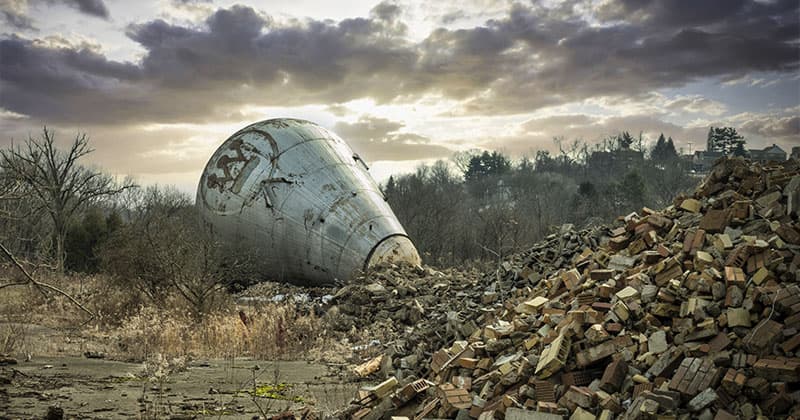
The demolition came in 1960. The wrecking ball they used was painted to look like a baseball. Someone decided that was appropriate. It is the kind of detail that would feel heavy-handed in a novel but lands differently when it actually happened.
The ballpark came down and in its place went a housing project; Ebbets Field Apartments, which still stands today. If you visit, there is a small plaque near the entrance marking what used to be there. It is easy to walk past without noticing.
The Mets arrived in 1962, an expansion team designed in part to fill the hole the Dodgers and Giants had left in the city’s National League landscape. They played in a brand new stadium in Flushing Meadows, Queens. Robert Moses’s stadium, as it happened; the one he had tried to hand O’Malley five years earlier.
Brooklyn watched from across the borough boundary and felt nothing in particular for the new team. The Mets were not theirs. The Mets were Queens. The distinction, to anyone who understood what the Dodgers had actually meant, was not a small one.
The borough never got another team. It still hasn’t.

What Was Really Lost
Here is what Robert Moses actually took from Brooklyn, and it was never really about baseball.
The Dodgers had functioned, for the better part of two decades, as the one thing a fractious and complicated borough genuinely shared. Not an idea of community; an actual one. The kind that shows up in the same place on the same afternoon and argues about the same thing and goes home through the same streets.
Brooklyn in the 1940s and 1950s was not a harmonious place. It was dense and diverse and perpetually in competition with itself, over jobs, over housing, over whose neighborhood was whose. The Dodgers didn’t erase any of that. They just gave it somewhere to set itself down for a few hours. A common language and bond for people who didn’t always have one.
When that was gone, it was simply gone. There was no replacement institution waiting in the wings, no other rallying point with the same reach across the borough’s competing neighborhoods. The Mets were in Queens. The Yankees were in the Bronx and had always been the enemy. Brooklyn was left with the memory of the thing, which is a poor substitute for the thing itself.
The deeper irony arrived in 2012, when Barclays Center opened at the intersection of Atlantic and Flatbush Avenues; the exact site O’Malley had identified sixty years earlier.
A sports arena, on the land Robert Moses had refused to touch. Home to the Brooklyn Nets, an NBA franchise that had relocated from New Jersey specifically to capitalize on the borough’s identity and energy. The developers understood what Moses never did, or never cared to: that Brooklyn was a name worth something, that the borough’s sense of itself was an asset rather than an inconvenience.
O’Malley had known that in 1953. Moses had simply chosen to disagree.
It is worth saying that Moses was not a cartoonish villain. He built things that genuinely served millions of people. His parks and beaches gave working-class New Yorkers access to open space they wouldn’t otherwise have had. His bridges and highways moved the city forward, however brutally, into the automobile age.
His career resume is real. But the resume also includes this: a man with enormous unelected power looked at a borough’s most important institution, decided its needs were an inconvenience to his plans, and used that power to make it disappear.
He did not have to answer to Brooklyn for that decision. He never did.
Brooklyn went on, as places do. The borough eventually reinvented itself. It became younger, more expensive, a destination rather than a starting point. The neighborhoods that once housed the Dodgers’ core fanbase transformed into something their original residents would barely recognize. In some ways, the Brooklyn that exists today is more famous than the Brooklyn that lost the Dodgers ever was.
But there is a version of Brooklyn that closed on September 24, 1957, and never reopened. The version where a working-class borough with a chip on its shoulder and a baseball team it had claimed as its own could look across the diamond at Ebbets Field and feel, for a few hours, entirely complete.
That Brooklyn is gone. The wrecking ball saw to that, the one painted to look like a baseball, swung by a city that could have chosen differently and didn’t.
Wait ’til next year.
There was no next year. Robert Moses made sure of it.



Leave a Reply