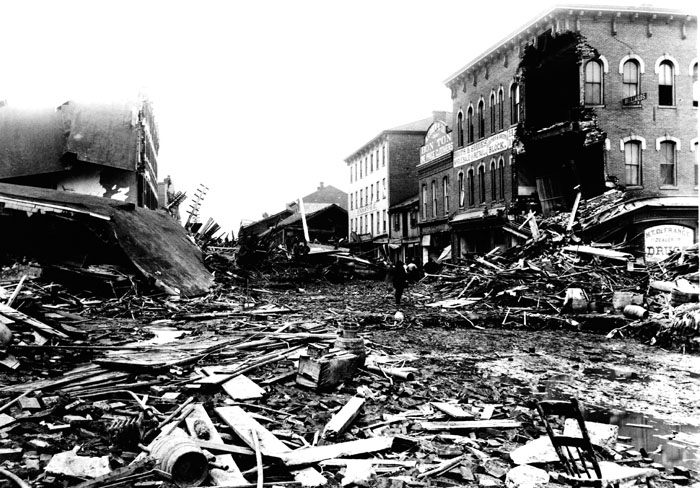
On the afternoon of Friday, May 31, 1889, an immense, terrifying volume of water—nearly five billion gallons—came crashing into the Conemaugh Valley, creating a brutal path of annihilation. This massive flood culminated in Johnstown, Pennsylvania, leaving behind a toll of over 2,200 dead and the complete physical ruin of a thriving city. The Johnstown Flood, one of America’s greatest tragedies, is a story of what happens when human error and hubris collide with the devastating power of nature.
Johnstown: The Industrial Trap
To measure the scale of the disaster, one must first recognize the identity of the community that was lost. Johnstown in 1889 was not just another small town; it was a dynamic, essential engine of the American Industrial Age. This fact, ironically, was directly tied to its perilous geography.
The city’s location, nestled in a valley where the Stonycreek River and the Little Conemaugh River merge to form the Conemaugh River, was simultaneously the source of its prosperity and its extreme vulnerability. The flat land at the confluence was necessary for the construction of vast industrial complexes, but the low-lying valley created a flood trap. Any massive surge of water funneled through the valley would be channeled and aimed directly into the city’s heart.
The economy of Johnstown was dominated by the Cambria Iron Company, which had rapidly expanded into one of the world’s largest steel producers. The mills produced the enormous quantities of steel rails, structural beams, and wire that built America’s expanding railroad network and western infrastructure. The economic opportunity created by the mills drew successive waves of immigrants, making Johnstown, like much of western Pennsylvania, a bustling mix of cultures.
Settlers from Wales, Ireland, and Germany established the earlier neighborhoods, and in the years leading up to the flood, they were joined by new arrivals from Eastern and Southern Europe, including Slovakia, Poland, and Italy. All of these working-class communities were concentrated in the dense, lower-lying sections of the city closest to the river.
The valley floor was occupied by the enormous rail yard of the Pennsylvania Railroad. This collection of infrastructure, composed of dozens of heavy steam locomotives and thousands of railcars, would be transformed into lethal projectiles within the debris wave. With a population exceeding 30,000, Johnstown was a powerful engine of American industrial growth, but it was inherently fragile due to its geography.

The Fatal Flaw Upstream: The South Fork Dam
Fourteen miles upstream from Johnstown, situated on the Little Conemaugh River, stood the aging and poorly maintained South Fork Dam. This massive earth embankment and the exclusive, wealthy retreat it held are central to the tragedy.
The dam was originally built between 1838 and 1853 to create a reservoir for the Pennsylvania Canal system. When the canal system was rendered obsolete by the railroads, the state abandoned the structure. The dam was allowed to deteriorate until 1880, when it was acquired and “repaired” by a group of the wealthiest Pittsburgh industrialists who formed the South Fork Fishing and Hunting Club.
The club became a lavish summer sanctuary for the American elite, including figures like Andrew Carnegie, Andrew Mellon, and Henry Clay Frick. They converted the reservoir into a private lake for fishing and recreation.
It is a stunning historical irony that the very men who built the nation’s infrastructure with steel and capital willfully neglected the maintenance of a structure holding billions of gallons of water above a densely populated working-class town. The negligence displayed by the Club members, driven by minor conveniences and cost savings, was directly responsible for the dam’s failure.

Structural Negligence and Lethal Modifications
While the relentless rain was the immediate trigger for the collapse, the fate of Johnstown had been sealed by the Club’s critical modifications to the structure. The dam was an earthen embankment, but its original construction was flawed; the critical central core, meant to be constructed of highly compacted, impervious puddled clay, was likely substandard. This made the entire structure susceptible to piping, where water erodes internal channels, leading to eventual collapse. The members of the Club compounded these dangers through several disastrous and ill-advised alterations.
First, to accommodate a wider, more accessible roadway across the crest, the Club ordered the dam’s height to be lowered by as much as two feet in certain sections. This alteration significantly reduced the dam’s freeboard—the safety margin between the water’s surface and the dam’s top—making it much more likely to be overtopped during a flood event.
Second, and perhaps most destructive, to protect their valuable fish stock, the Club installed fine wire screens or grates across the entrance of the spillway. The spillway is the vital channel designed to safely route excess water around the dam’s structure.
When the enormous May 1889 downpour hit, these screens quickly became clogged with branches, leaves, and other debris, effectively blocking the dam’s main emergency relief valve. The water was therefore forced over the lowered, compromised crest.
Finally, a set of five cast-iron discharge pipes, originally installed to drain the reservoir for maintenance or to relieve pressure in emergencies, had been rendered useless. Rather than fixing the valves after an earlier repair, the Fishing Club had simply sealed the pipes with masonry and mud, making it impossible to lower the reservoir level to relieve pressure during the crisis. Repeated warnings from engineers and local residents about the dam’s deteriorating condition and compromised structure were ignored by the powerful owners.

The Deluge and the Rupture
The final catastrophe was set in motion by an unprecedented, sustained rainfall event. Over a period of several days, six to ten inches of rain saturated the ground and dramatically swelled the rivers.
By the morning of Friday, May 31, the reservoir behind the South Fork Dam was visibly nearing its critical limit. Local workers and a few Club members made desperate attempts to reinforce the top of the embankment with hastily dumped mud and rock, even attempting to dig an auxiliary spillway. These efforts were too little, and too late, against the volume and speed of the rising water.
At approximately 3:10 p.m. on May 31, 1889, the structural integrity of the South Fork Dam failed catastrophically. The water began cascading over the lowered crest, quickly scouring away the earth embankment. Within minutes, the entire dam structure was gone. The immense lake, holding an estimated 4.8 billion gallons of water, was unleashed in a unified torrent.
The wall of water thundered down the narrow valley at speeds approaching 40 miles per hour, scouring the landscape clean. It obliterated the small communities in its path: South Fork, Mineral Point, East Conemaugh, and Woodvale. The wave swept up everything—trees, houses, rock, and industrial debris—creating a colossal, moving wall of wreckage estimated to be 40 feet high.
The force was amplified at the town of East Conemaugh when the flood struck the Pennsylvania Railroad’s busy rail yard. Dozens of heavy steam locomotives and countless steel railcars were added to the destructive mass, transforming the debris wave into an unprecedented, terrifying industrial weapon. Survivors reported a deafening noise, described not just as thunder, but as the sound of mountains being crushed and torn apart.

The Horrors of the Stone Bridge
The monstrous wave reached the unprepared city of Johnstown less than an hour after the dam’s collapse, striking the community at approximately 4:07 p.m. Johnstown, with its dense neighborhoods and concentration of industry in the valley floor, was instantly overwhelmed. The sheer hydraulic energy, laden with massive debris, erased entire sections of the city. Houses were lifted, torn apart, and dissolved into the current; industrial buildings simply crumpled. The destruction was immediate, and complete.
The climax of the tragedy occurred at the Stone Bridge, a massive, sturdy railroad viaduct that spanned the Conemaugh River at the eastern edge of Johnstown. Intended to withstand decades of heavy use, the bridge became a lethal bottleneck.
The colossal mass of debris—tens of thousands of tons of wood, steel, bodies, and ruined locomotives—piled up against the bridge’s stone arches, forming a horrific temporary dam. The friction and pressure within this debris pile ignited an immense fire that burned fiercely for three days.
Hundreds of people who had survived the initial flood wave by clinging to the wreckage were trapped and incinerated in the blaze. Estimates suggest that at least 800 individuals who escaped the water perished in the fire at the bridge. The bridge itself, though choked with wreckage, remained standing, a lasting monument to the power it had briefly contained and the human tragedy that unfolded upon it.

The Immediate Aftermath and Relief Efforts
The immediate aftermath was a scene of utter devastation and chaos. Piles of wreckage clogged the entire valley, sometimes forty feet high, and the air was filled with the stench of death and decay. Rescuers and survivors faced the gruesome, months-long task of sifting through the mud and wreckage to recover the dead.
The force was so extreme that bodies were later found hundreds of miles away, as far as Cincinnati, and the final body from the disaster was not recovered until 1911. The staggering final death toll of 2,209 people made it one of the most fatal events in U.S. history.
Aid and relief poured in from across the country, the flood triggering a massive national response. Connellsville, a railroad hub, became essential for funneling supplies, workers, and aid from Pittsburgh and beyond into the disaster area.
A key figure in the recovery was Clara Barton, the founder of the American Red Cross. Barton and her team arrived within days of the disaster and immediately established a structured relief operation. They remained in Johnstown for months, providing critical medical care, food, housing, and organizational structure to the devastated community.
This massive effort marked one of the Red Cross’s earliest and most significant national disaster responses. Approximately 700 victims remained unidentified and were buried in a large, shared grave in Grandview Cemetery, marked today by the Monument and Burial Plot of the Unknown Dead.

The Lack of Accountability and the Legacy of Injustice
As the facts of the dam’s poor maintenance and catastrophic modifications became clear, national public outrage mounted, focusing squarely on the negligence of the wealthy members of the South Fork Fishing and Hunting Club.
Though multiple lawsuits were filed against the club and its prominent members, the legal system failed to deliver justice. Due to the political influence and deep pockets of the Club members, coupled with legal precedents in Pennsylvania law that often shielded corporations from liability by labeling such events an “Act of God,” the cases were dismissed.
The Club members were never held financially or criminally responsible for the disaster. This legal failure, where immense wealth and power allowed direct negligence to go unpunished, became a rallying point in the burgeoning labor and reform movements of the late 19th century. The outcome solidified a widespread public perception that the Gilded Age elite operated above the law and beyond the reach of consequence for their actions, regardless of the human cost.
The Johnstown Flood ultimately served as a deadly, undeniable warning of the consequences of industrial recklessness. Though comprehensive federal infrastructure reforms would take decades to materialize, the magnitude of the catastrophe fundamentally changed how engineers and lawmakers viewed dam construction, maintenance, and public safety oversight.

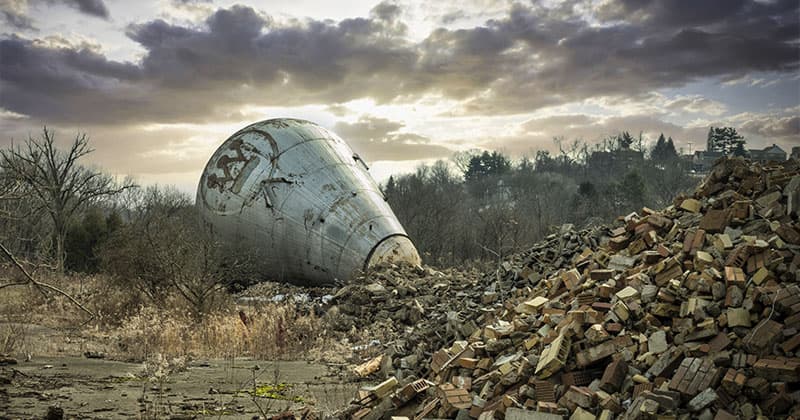
Today, Johnstown endures as a city rebuilt from unimaginable loss, its modern life forever shaped by the events of 1889. The preserved ruins of the South Fork Dam and the city’s museums exist not just as memorials, but as warnings—reminders that the disaster was not inevitable, and that human decisions carried fatal consequences. In remembering the thousands who died, Johnstown preserves more than a tragedy; it preserves a lesson in responsibility, accountability, and the cost of ignoring both.





Leave a Reply