NOTE: The battles and the generals have earned their place in the books and the movies. D-Day, Midway, Eisenhower, Patton; those stories get told, and told well, as they should be. The home front fought a different war. That war produced enough material for volumes and mostly went unknown outside the archives. This four-part series is my attempt to help close some of that gap: The Sell, The Long Wait, We Are Ready, and Victory Valley.
On December 8th, 1941, the United States declared war on Japan. Three days later, Germany and Italy declared war on the United States, and Congress returned the favor within hours.
From a strictly procedural standpoint, the country was at war. The question of whether to fight had been answered, with almost no dissent, inside of 72 hours.
The harder question, the one that would consume the next four years, was something else. Not whether, but how long. And whether the American public, with its history, its memory, and its well-earned suspicion of the people asking it to sacrifice, could be kept in the fight for the duration.
Because here’s the thing; the people who had to sell that war knew something about the people they were selling it to. They knew what the audience had been through. And it gave them real reasons to worry.
Go back twenty years. When American troops came home from the First World War, they came home to a country that had been told the war was a crusade; a fight to make the world safe for democracy, to end all wars, to build a better international order.
Woodrow Wilson said so himself, repeatedly and with tremendous conviction. Young men died in French mud believing it.
Then came the 1920s, and the slow deterioration.
The League of Nations failed. The “better international order” didn’t materialize. European powers went back to behaving like European powers.
And by the early 1930s, a growing body of writers, journalists, and politicians had a different explanation for why the United States had gone to war in 1917; one that had nothing to do with democracy and everything to do with money.
In 1934, the Senate formed a special committee to investigate. It was chaired by Gerald Nye, a Republican from North Dakota, and what it turned up, or what it appeared to turn up, landed like a depth charge in American political life.
The Nye Committee dragged the executives of munitions companies and major banks before public hearings and asked them uncomfortable questions about their profits from the war. The J.P. Morgan firm. The Du Pont family.
The pattern the committee described was damning: American banks had loaned enormous sums to Britain and France. When German submarine warfare threatened Allied shipping, those loans were at risk. The United States, in this version, had not gone to war to save democracy. It had gone to war to save the bankers’ investments.
“Merchants of death” entered the American vocabulary. And it stuck.
The committee ran from 1934 to 1936, generated enormous press coverage, and left behind a political legacy that molded everything that followed.
The Neutrality Acts of 1935, 1936, and 1937 were its direct offspring; congressional attempts to legally prevent the United States from being drawn into another foreign war by financial entanglements. Isolationism went from a temperament to a dominant movement.
The America First Committee, founded in 1940, claimed 800,000 members at its peak. Its most famous spokesman was Charles Lindbergh. A Gallup poll from July 1941, five months before Pearl Harbor, found that roughly 80 percent of Americans opposed entering the war.
None of that collapsed overnight on December 8th. Pearl Harbor created a consensus for war. It did not erase twenty years of accumulated cynicism about the people who run wars, the corporations that profit from them, or the governments that ask ordinary people to bear the cost.
This is the context in which the United States government had to build a home front mobilization operation. Among people who had been burned, or who believed they had been burned, before.
People who had buried fathers and brothers and remembered what Wilson had promised and what actually happened. People who had listened to Nye’s hearings on the radio and thought: yeah, that sounds about right.
The country was willing to fight. Whether it could be kept willing, across four years of rationing and shortages and casualty lists and slow news from the Pacific; that was the problem no one had solved yet.

What a Democracy Can’t Do
Franklin Roosevelt understood this better than most. He had watched Wilson’s presidency end in catastrophe and had spent the late 1930s trying to nudge the country toward intervention without getting ahead of public opinion.
He knew that a democracy couldn’t be dragged into a war; it had to be brought along. And he had watched, nervously, as public sentiment shifted with each new crisis in Europe.
The fall of France in June 1940 moved people. The Battle of Britain moved people more. But right up until the attack on Pearl Harbor, the isolationists had the numbers, and Roosevelt was careful not to get out ahead of them.
After Pearl Harbor, he had public support; furious, unified public support of the kind that happens maybe once in a generation. The question was what to do with it. Because raw fury fades. Anger is a sprint, not a marathon.
Sustaining the kind of civilian commitment a four-year global war required — rationing, bond purchases, production quotas, sacrificed leisure, sons and husbands sent to places most Americans couldn’t find on a map — that required something more durable than anger. It required structure. Machinery. People who knew how to talk to the public, what to say, and when to say it.
What Roosevelt needed, in short, was a salesman’s operation. And he knew exactly where to find one.
The information apparatus that preceded the OWI was, to put it charitably, a mess. Multiple agencies were generating war information simultaneously, contradicting each other, fighting over territory, and producing a confused public signal at a moment when clarity was everything.
The Office of Facts and Figures (yes, that’s a real name), the Office of Government Reports, the foreign information branches of the Coordinator of Information; they were all saying something, often different things, and nobody was in charge of the whole picture.
Roosevelt addressed it the way Roosevelt addressed most problems: he consolidated with a new agency. On June 13, 1942, Executive Order 9182 created the Office of War Information, pulling all existing domestic and foreign information functions under one roof.
The order tasked the new agency with using “press, radio, motion picture, and other facilities” to build “an informed and intelligent understanding, at home and abroad, of the status and progress of the war effort.”
That’s the official language. The plain language is easier: tell Americans what’s happening, why it matters, and what they need to do about it; and keep telling them, in every format available, for as long as the war lasts.
To run it, Roosevelt chose Elmer Davis. This was not an obvious pick for a wartime propaganda chief. Davis was a journalist; a very good one, a former New York Times man who had covered Europe and written several well-regarded novels before making the jump to radio in 1939.
At CBS, he had become one of the most trusted voices in the country. Edward R. Murrow, who knew something about trusted voices, said Davis’s Indiana accent reminded people of a friendly neighbor. By 1941, twelve and a half million people were listening to his nightly five-minute broadcast.
Davis was not a propagandist by temperament. He believed in telling people the truth, even when the news was bad. He thought the public could handle honest information; that treating them otherwise was both condescending and counterproductive.
This put him in immediate and lasting conflict with government censors who had entirely different instincts. It also meant the OWI, from its first days, contained a real philosophical disagreement about what it was supposed to be doing.
He left CBS for the OWI directorship, walking away from a $53,000 annual salary for a government wage that was a fraction of that. Whatever else you say about Elmer Davis, he was not in it for the money.

The Machine
The OWI Davis inherited, or rather, built, was a massive thing. Three thousand employees. Office space wherever Washington could find room for them. A domestic branch and an overseas branch, each with its own approach and its own pressures.
The overseas operation was essentially psychological warfare: radio broadcasts beamed at occupied Europe, leaflets dropped over enemy territory, a massive effort to maintain Allied confidence and undermine Axis morale.
The domestic operation was something different; harder in some ways, because the audience was free to ignore you, and you couldn’t use the tools a dictatorship could.
Which brought Roosevelt and Davis and the entire home front information apparatus back to the same problem they’d started with.
The American public had to be persuaded. Not ordered, persuaded. Across four years. These were people who knew they were being persuaded, and who had reasons, rooted in recent history, to be suspicious of the pitch.
They needed help. And Madison Avenue was ready to offer it.
The advertising industry’s involvement in the war effort began, depending on how you view it, as either an act of patriotism or an act of self-preservation. Probably both.
Before Pearl Harbor, an advertising man named James Webb Young, co-founder of the Young and Rubicam agency, had floated an idea to a group of industry leaders, including Raymond Rubicam, J. Walter Thompson, and Leo Burnett: an organization that would bring the entire advertising business together in service of public causes.
Three weeks after Young first pitched the concept, Pearl Harbor happened. The decision was made easy.
The advertising industry had two immediate problems once the war began. The first was obvious: with consumer goods being rationed, there was very little to sell. Factories were retooling for war production. Nylon went to parachutes. Rubber went to tires and gas masks. Tin cans disappeared from grocery shelves. Advertising agencies had clients and employees and infrastructure — and nothing to advertise.
The second problem was more subtle. Companies that had spent decades building brand recognition were suddenly invisible. If the war lasted five years, and they ran no ads for five years, what happened to the customer relationship? What if their customers forgot about them while they were gone?
The War Advertising Council solved both problems at once. It gave the industry a way to stay visible, patriotically and usefully visible, during a period when normal commerce had essentially frozen.
The government, in turn, made it worth their while. Participating companies could deduct the cost of their war-themed advertising from their taxes at a rate that sometimes left Washington covering 80 percent of the bill.
The arrangement was mutually beneficial in ways that went well beyond the patriotic. The industry got to maintain its brand presence and its infrastructure, write off most of the cost, and appear to be doing its part. The government got the most sophisticated communications apparatus in the world, essentially donated.
The War Advertising Council, working alongside the OWI’s Domestic Branch, would go on to produce what one historian described as “the greatest volume of advertising and publicity ever given to any product or agency” in history.
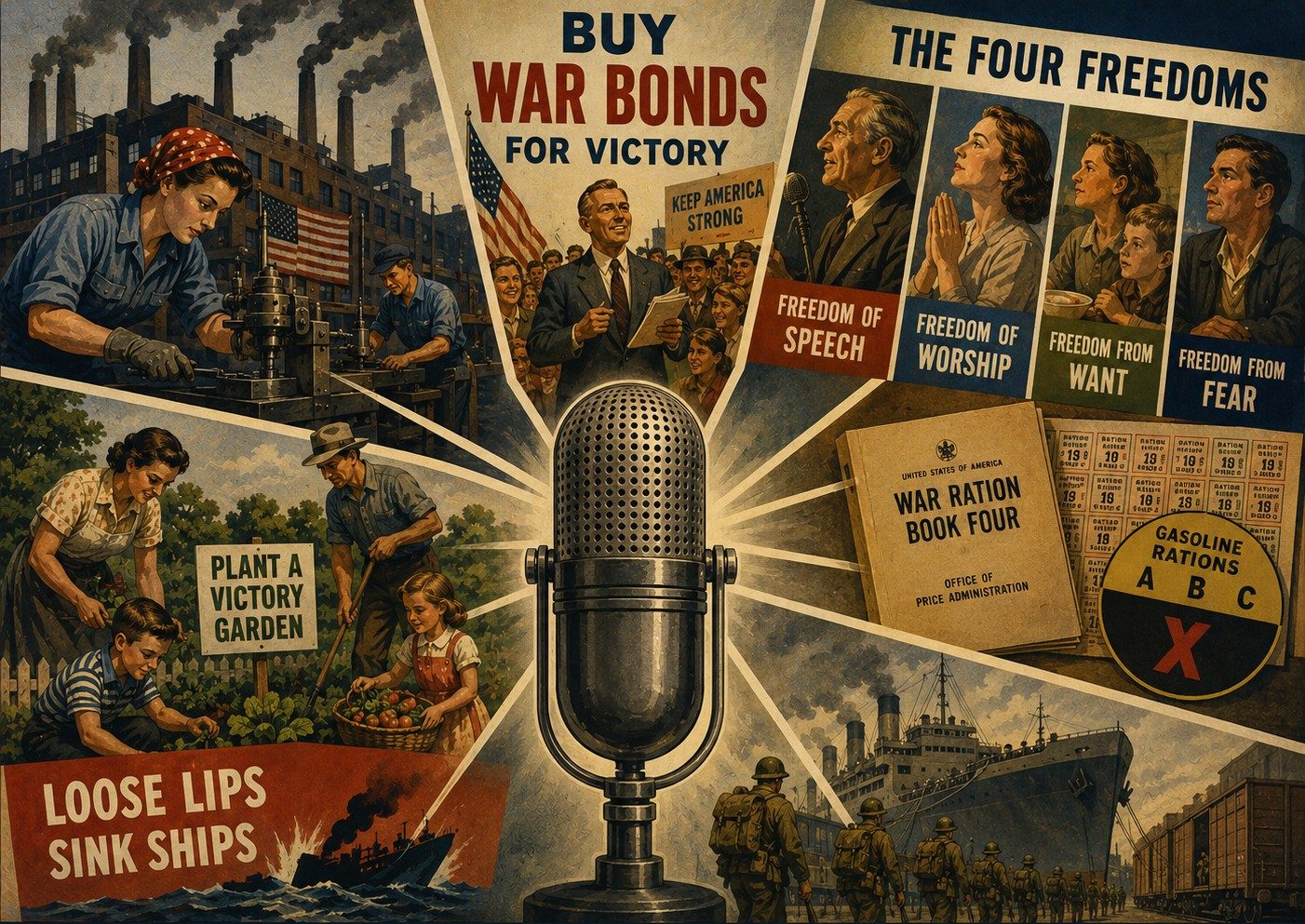
Rationing. Bond drives. War jobs. Security — Loose Lips Sink Ships. Production. Scrap collection. Victory Gardens. Every message, in every format, aimed at every American, from every direction at once.
And now the real work began. Because having the machinery wasn’t the same as knowing what to say. The OWI had its six official themes. The War Ad Council had its client roster and its media relationships.
What neither of them had, and what neither of them would fully solve across the entire war, was a reliable answer to the oldest question in the sales business.
What actually works?

Spinning the Dial
The OWI didn’t guess at what to say. It built a formal structure of messaging; six official war information themes that were pushed through every medium available and handed to every content producer willing to use them.
The nature of the enemy. The nature of the allies. The need to work. The need to fight. The need to sacrifice. And finally, the affirmative case, what Americans were actually fighting for: the Four Freedoms, democracy, an end to the kind of world the Axis was building.
Six themes sounds orderly. In practice, it was anything but.
The problem was translation. Taking “the need to sacrifice” from a government memorandum and turning it into something that made a housewife in Akron feel something; well, that was the hard part.
And the people doing that translation tried everything. Fear. Guilt. Pride. Humor. Idealism. Anger. They cycled through emotional registers the way a safecracker cycles through combinations, listening for the click.
Anger and fear came first and came easily. The sneak attack on Pearl Harbor had universally infuriated the American public. The enemy was genuinely terrifying, and the OWI didn’t have to manufacture that from nothing.
But the campaigns that leaned hardest on fear — the ones depicting Nazi brutality and Japanese aggression in graphic and often cartoonish terms — burned through their fuel quickly.
Fear is mobilizing in the short term. Sustained over years, it becomes exhausting and then numbing. People stop feeling it the same way. The poster that shocked in 1942 was wallpaper by 1944.
Guilt was the other early favorite. The theory was straightforward: if you aren’t in uniform, the least you can do is buy a bond, grow a garden, volunteer, turn in your scrap. Posters depicted American fighting men in impossible conditions and asked, implicitly, what you were doing that was so important.
Factory workers were told that punching in late or damaging equipment wasn’t just an infraction against a company; it was a betrayal of the men depending on them. Artists turned ordinary workplace incidents into acts of disloyalty. It was heavy-handed, and it worked; up to a point.
Guilt, like fear, has a shelf life. And there’s a particular kind of American stubbornness that, when pushed too hard by guilt, pushes back.
So the dial kept moving. Humor entered the mix, and not tentatively. Donald Duck went to work for the war effort, appearing in animated shorts that satirized Hitler and Hirohito with enough absurdist energy to win an Academy Award.
Jack Benny, Bob Hope, Fibber McGee and Molly, and the entire industry of American radio comedy was recruited, formally or informally, into the service of keeping morale light enough to bear.
The theory was that a country that could laugh at the enemy was a country that believed it would win. Humor was a form of confidence, and confidence was something the home front badly needed in the dark days of 1942.
Norman Rockwell did something different and arguably more durable. His Four Freedoms paintings, Freedom of Speech, Freedom of Worship, Freedom from Want, Freedom from Fear, ran in the Saturday Evening Post in early 1943 and hit the country in the heart.
They weren’t fear or guilt or humor. They were aspiration. A man standing up at a town meeting to say his piece. A family at Thanksgiving. Parents watching over sleeping children. Rockwell painted what people were fighting to protect, and he painted it in the faces of people who looked exactly like the people reading the magazine.
The paintings toured the country as part of a war bond promotion and drew millions of visitors. The Treasury Department printed them as posters. They became perhaps the single most successful piece of home front communication the government produced; and they weren’t produced by the government at all.
Rockwell pitched the idea himself, after the military initially rejected his offer to help.
That was, in a nutshell, the story of the whole campaign. The things that worked best were often the things that trusted the audience rather than manipulating it. The things that said: here is what is real, and here is what it means, rather than here is what you should feel and here is why you’re a bad American if you don’t feel it.
The OWI understood this, at least in theory. Elmer Davis had been arguing it from the beginning. His instinct to treat the public like adults, tell them the truth even when it’s hard, trust that they can handle it, was in constant tension with the more aggressive emotional manipulation that other voices within the agency and outside it were pushing.
The conflict never fully resolved. It expressed itself instead in the tonal chaos of the campaigns: a country being sold the same war through fear and humor and guilt and idealism, sometimes in the same week, sometimes in adjacent columns of the same newspaper.
By 1943, the domestic operation was in trouble of a different kind. Congressional critics, predominantly Republican and Southern Democratic lawmakers who had never been comfortable with the OWI’s reach, accused the agency of doing something beyond war information.
They called it a New Deal propaganda outfit. A vehicle for promoting Roosevelt’s domestic agenda under the cover of patriotic messaging. One Republican congressman called the OWI “a stench” under Davis’s administration.
The charges may have been overwrought, but they had enough truth and political traction to matter. Congress cut the domestic branch’s funding sharply. By 1944, the OWI was operating primarily overseas, where it couldn’t be accused of meddling in American electoral politics.
The War Advertising Council filled the gap, or tried to. With the OWI’s domestic operations curtailed, the burden of home front messaging shifted even further toward private industry. Which meant the campaigns became, if anything, more tangled.
Companies running war-themed ads had two goals simultaneously, and those goals didn’t always pull in the same direction. Help the government communicate its message. And remind consumers that your brand existed and would be worth remembering when the war ended and there were things to buy again.
The result was advertising that was sometimes cumbersome and occasionally incoherent; patriotic in the foreground, commercial in the background, neither one fully convincing.
What the campaigns were fighting, underneath all of it, was something the government’s own internal research kept surfacing: the gap between what Americans said and what Americans did. People told pollsters they supported the war effort. They meant it.
They also bought meat on the black market, traded ration stamps with neighbors in ways the law didn’t permit, and drove more than their gasoline allocation technically allowed because the man at the pump wasn’t always checking. Not out of malice. Out of the ordinary human tendency to support a principle in the abstract while making small exceptions for yourself in a particular case.
The OWI’s morale reports tracked this gap with uncomfortable accuracy. Public support for the war remained high throughout. Behavioral compliance with the sacrifice it required was considerably spottier.
The campaigns kept spinning the dial; fear, guilt, pride, humor, idealism, back to fear, looking for the frequency that would close the distance between what people believed and what people did.
They never quite found it. But the dial kept turning.

When the Machine Betrayed the Message
In the summer of 1942, the Office of Price Administration introduced gasoline rationing.
The system was simple enough, built around a hierarchy of windshield stickers that determined how much fuel a driver could purchase in a given week.
An A sticker was the baseline; three to four gallons, enough for essential local driving, nothing more. B stickers went to defense workers and others who could demonstrate a legitimate need to drive more. C stickers were for the professionals the country genuinely couldn’t do without: doctors, clergy, emergency workers.
At the top of the hierarchy sat the X sticker. Unlimited gasoline. No questions asked at the pump. Reserved, in theory, for the people whose work was so critical that rationing simply couldn’t apply to them; civil defense workers, police, firemen. People whose jobs didn’t stop because the country was at war.
And, it turned out, members of Congress.
Two hundred of them, give or take. Sitting United States congressmen who had quietly secured X stickers for themselves, entitling them to unlimited fuel while the constituents who elected them were carefully budgeting three gallons a week and finding other ways to get to work.
When the story broke, it hit exactly as hard as you would expect. Here was the government asking ordinary Americans to sacrifice, running the posters, broadcasting the radio spots, selling the patriotic duty of doing without, while the people passing the laws that created the rationing system were exempt from any restrictions. Surprise, surprise.
The damage was more than just political. The entire premise of the home front mobilization was that this was a shared burden. That everyone was in it together.

Loose Lips Sink Ships worked as a message because it implied a common stake; your careless talk endangered our boys. The bond drives worked because they framed the purchase as a personal investment in a collective outcome.
The scrap drives, the Victory Gardens, the meatless Tuesdays; all of it rested on the same foundation: we are all giving something up, and that shared sacrifice is what makes us equal participants in the same fight.
The X sticker scandal cracked that foundation. It didn’t shatter it; the home front mobilization didn’t collapse, public support for the war didn’t evaporate, Americans didn’t stop buying bonds or planting gardens in disgust. But it introduced a note of sourness into the arrangement that was very hard to argue away.
The government’s response was about what you’d expect: acknowledgment, some expressions of regret, quiet pressure on the offending congressmen to return the stickers. It was handled, after a period of outrage. It was not forgotten.
The black market was a similar story, on a much larger and more broad scale.
The X sticker scandal was a specific outrage with identifiable villains. The black market was something murkier; millions of small transactions, most of them involving ordinary people making ordinary human decisions about how much inconvenience they were actually obligated to absorb.
Meat was the biggest problem, and the press coined a word for it: meatlegging. The parallel to Prohibition-era bootlegging was intentional and appropriate. Butchers quietly took care of good customers. Ranchers sold cattle above the legal ceiling price to buyers who weren’t asking too many questions.
Underground slaughterhouses operated in conditions the OPA would have shut down immediately if they’d known where to look. The agency estimated that as much as 17 percent of the nation’s meat trade was moving through black market channels at the peak of the problem.
One in fifteen businesses, across all sectors, wholesale and retail, was charged with some kind of illicit transaction during the war years. One in five received at least a warning.
Gasoline ran a close second. Counterfeit ration coupons circulated widely enough that estimates of illegally purchased fuel ranged from a million gallons a week on the conservative end to two and a half million gallons a day on the high end.
In New York, drivers were known to follow gasoline delivery trucks through the streets, forming impromptu convoys trailing the tanker to wherever it was making its next drop, hoping to buy a few extra gallons outside the formal system.
A man interviewed by investigators described simply talking to pump attendants until they agreed to sell him gas without a stamp. Nobody threatened anybody. Nobody made a scene. The attendant just went along with it.
That last detail is worth thinking about. It wasn’t organized crime that made the black market for gasoline function; though organized crime was certainly present, stealing coupons from OPA offices and running counterfeiting operations.
It was the accumulated weight of millions of people deciding, individually, that the rule was more flexible than it was written. The butcher who knew his regular customers. The pump attendant who didn’t feel like having an argument. The housewife trading ration stamps with her neighbor in a way the law technically prohibited.
None of them thought of themselves as undermining the war effort. Most of them thought of themselves as making a reasonable accommodation to an imperfect system.
This is the part that resists easy moral judgment, and it should. The people running the black market in beef weren’t traitors. The congressman with the X sticker on his windshield was a hypocrite, but he wasn’t out to sabotage the Allied cause.
What these things represented, taken together, was something more ordinary and more human: the distance between public commitment and private behavior that exists in every society, under every system, in every war. People believed in the cause. They also wanted a steak.
What the scandals and the black market did, what they couldn’t help but do, was complicate the pitch. The campaigns were selling shared sacrifice as a moral proposition, and shared sacrifice only works as a moral proposition if it’s actually shared.

Every X sticker on a congressman’s windshield was an argument against the premise. Every pound of black market beef was an acknowledgment that the system wasn’t quite as universal as the posters suggested.
The OWI tracked all of this. Its internal reports were candid in ways the public messaging wasn’t. Morale was high but compliance was uneven. Support for the war was genuine but enthusiasm for specific sacrifices varied enormously depending on how inconvenient the sacrifice was and how visible enforcement happened to be in a given area.
The gap between what people said and what people did was real, consistent, and, importantly, not changing.
The campaigns responded the way campaigns respond when they’re not working well enough: they escalated. The bond drives grew larger and louder with each successive wave, recruiting bigger celebrities, staging more elaborate events, pushing harder on the emotional register.
Hollywood stars toured the country on bond promotion trips. Hedy Lamarr reportedly offered to kiss anyone who bought $25,000 worth of bonds, and the Treasury Department did not discourage this. The guilt appeals got guiltier. The fear appeals got more graphic.
Whether any of it was working, in any measurable way, remained genuinely unclear.
The bond drives hit their targets; but bonds were also a good investment during a period when there was nothing to buy, and separating patriotic motivation from financial self-interest was impossible.
Victory Garden participation peaked and then declined as the war stretched on. Rationing compliance was patchy in ways the OPA’s enforcement numbers only partially captured, because the OPA could only charge people it caught.
What the government had, underneath all the uncertainty, was a fact it couldn’t fully advertise and didn’t need to: winning the war was necessary, most Americans knew it was necessary, and most of them were doing more right than wrong.
The black market was real. It was also a fraction of the total economy. The X sticker scandal was genuine and damaging. It was also two hundred people out of a country of 130 million. The bond drives hit their targets imperfectly and for mixed reasons. But they hit their targets.
The machine had cracks in it. The machine was also running.

What Held
There is a version of this story that ends in cynicism: the government manipulated its citizens, the citizens cheated where they could, and the whole enterprise was held together by self-interest dressed up in patriotic clothing.
That version has the advantage of being partly true. It has the disadvantage of being incomplete in ways that are important.
The home front mobilization worked. Not perfectly, not without corruption, not without the uncomfortable symbiosis between government messaging and corporate self-preservation that produced the War Advertising Council.
It worked in the way that large human enterprises generally work when they succeed: imperfectly, inconsistently, hypocritically, and just well enough.
Bond drives across seven major campaigns raised $185 billion. Victory Gardens, at their peak, were producing roughly 40 percent of the country’s vegetables.
Factory output increased at rates that genuinely stunned the Axis powers, who had calculated that American industrial capacity would take years to mobilize and counted on that delay. It didn’t take years.
The Arsenal of Democracy, as Roosevelt called it, was running at full capacity with a speed that no one, including the people running it, had thought possible.
The scrap drives collected millions of tons of metal, rubber, and paper. The rationing system, for all its black market leakage, functioned well enough to ensure that military supply chains had what they needed.
None of that happened by accident. The OWI and the War Advertising Council and the bond drive machinery and all the rest of it were real contributors. The campaigns moved people. The question is why, and the answer is more interesting than either the cynical version or the sentimental one.
Elmer Davis had been right from the beginning. The campaigns that hit hardest were the ones that trusted the audience. Norman Rockwell’s Four Freedoms worked because they were honest. They said here is what is real, here is what it looks like, here is what we are protecting. They didn’t manipulate. They reminded.
The difference between manipulation and reminder is the difference between creating a feeling that wasn’t there and surfacing a feeling that already was. Rockwell surfaced something. The fear campaigns tried to install something, and the installation kept wearing off.
The deeper truth is that the government wasn’t manufacturing consent from nothing. Pearl Harbor had done something real and lasting to the American public; not just anger, which faded, but a settled conviction that the fight was legitimate and necessary.
This conviction coexisted with black market beef and gas ration cheating and congressional X stickers, because human beings are capable of holding genuine commitments alongside genuine self-interest without feeling the contradiction very strongly.
The housewife who traded ration stamps with her neighbor and then spent Saturday rolling bandages for the Red Cross was not being incoherent. She was being human.
What the campaigns did, at their best, was give that genuine commitment a purpose and a direction. People wanted to contribute. They needed to be told how.
Victory Gardens didn’t succeed because the OWI scared people into planting them; they succeeded because growing your own food was a concrete, visible, satisfying, and rewarding thing a person could do that connected their private action to a public purpose.
Same with scrap drives. Same with bond purchases, for many buyers. The campaigns that provided a clear and specific action to do this, right now, in your own backyard, worked better than the ones that tried to sustain a generalized emotional state.
The children understood this instinctively, which is part of why they outperformed the adults throughout. The scrap drives were organized through schools, which meant children had institutional structure that adults lacked; a collection day, a goal, a visible result.
But there was something beyond structure. The war gave children public importance they didn’t otherwise have. A ten-year-old’s contribution to the scrap drive was real and counted and was treated as such.

Adults, particularly those not in uniform, were navigating a more complicated emotional landscape: guilt about not serving, resentment of specific sacrifices, fatigue with the relentlessness of the ask.
Children were largely spared that complexity. They showed up and did the work, year after year, with a consistency that the adults around them couldn’t quite match and couldn’t entirely explain.
The OWI’s domestic operation was gutted by Congress in 1943 and was effectively gone as a domestic force by 1944. The War Advertising Council kept running. The bond drives kept escalating. The rationing system kept operating, with all its imperfections.
The war kept going; North Africa, Sicily, Italy, Normandy, the Pacific island by island, and the home front kept supplying it.
The commitment was real enough to survive the imperfect campaigns, the congressional hypocrisy, the black market transactions, and the tonal chaos of a government that couldn’t decide whether to scare people or inspire them and mostly tried both at once.
The problem of sustaining democratic commitment across four years had no clean solution. The war kept going anyway.
When the war ended in 1945, Truman cited the OWI for its outstanding contribution to victory and promptly abolished it. That sequence, praise and elimination in the same breath, said something. The machinery had served its purpose. Now it needed to go away, or at least to be seen to go away.
A democracy that had just fought a war against totalitarianism wasn’t supposed to have a permanent domestic propaganda apparatus. The optics required that the OWI be dissolved.
The War Advertising Council didn’t dissolve. It dropped “War” from its name, became the Advertising Council, and kept going; pivoting to peacetime public service campaigns with the same infrastructure, the same government relationships, and the same basic model it had developed during the war.
The partnership between Madison Avenue and Washington that the war had built didn’t end when the war did. It institutionalized. Smokey Bear. The United Negro College Fund. A Mind is a Terrible Thing to Waste. The seatbelt campaigns. The anti-drug campaigns. The drunk driving campaigns.
All of it runs through the same channel that was built between 1942 and 1945, by the same arrangement between government need and corporate self-interest that the war had made not just acceptable but celebrated.
That is the part of the home front story that never quite makes it into the Norman Rockwell version. Not because it’s sinister; most of those peacetime campaigns did genuine good, but because it complicates the tidy narrative of a nation that came together in crisis and then returned to normal.
The normal it returned to was different from the normal it had left. The relationship between the government, the advertising industry, and the American public had been permanently altered. The techniques developed to sell the war didn’t disappear with the war. They became the fixtures of American public life.
Elmer Davis went back to radio, this time at ABC, and spent his remaining years fighting McCarthyism with the same stubborn insistence on honest information that had made him an awkward fit for the OWI in the first place.
He died in 1958. The New York Times called him the Mount Everest of commentators. It was the right epitaph for a man who had spent his career believing that the public deserved the truth and was capable of handling it; a belief that put him perpetually at odds with the institutions he served and perpetually in the right.
The OWI’s six themes, the War Ad Council’s tax-subsidized campaigns, the rotating emotional pitch of fear and guilt and humor and idealism; all of it had been aimed at a problem that turned out to be less intractable than it looked.
The American public didn’t need to be manipulated into supporting a war it already believed in. It needed to be organized, directed, and occasionally reminded of what it was doing and why. The campaigns that remembered that worked. The ones that forgot it kept spinning the dial, looking for a frequency that was already there.
They just had to learn to trust the signal.


Leave a Reply