In The Shadow of Yesterday

Stories of people, places, and the echoes they leave behind……

Charles Lindbergh: The Fall and Later Life

NOTE: At one time, Charles Lindbergh was the most famous man in the world. His stunning rise to fame came through a daring feat that captured the imagination of countless millions, while his fall from grace unfolded amid the world’s greatest catastrophe—World War II. This three-part series explores the triumphs, tragedies, controversies, and enduring legacy of a man who symbolized both the heights and the hazards of fame in the 20th century. You can catch up on the story in Part One and Part Two.

The Spirit of St. Louis had carried Charles Lindbergh to unparalleled heights of fame, and the subsequent tragedy of his son’s kidnapping had plunged him into the depths of personal hell. Seeking refuge from the relentless American spotlight, he and Anne fled to Europe in late 1935, hoping that the anonymity of a new continent might finally grant them the peace that had eluded them.

They found a measure of quiet solace in the English and French countrysides, looking for a life away from the intrusive gaze that had defined their lives for so long. However, the continent they sought refuge in was a cauldron of political unrest, bubbling towards a cataclysm. Unbeknownst to them, this search for tranquility would lead Lindbergh down a path far more controversial than any flight, igniting a bitter public feud that would shatter his heroic image.

European Interlude: Shifting Views (1935-1939)

For a time, life in Europe offered a semblance of normalcy. Anne continued her remarkable writing, capturing their adventures and the nuances of their new life. But Lindbergh, ever the aviator and strategist, couldn’t ignore the rumblings across the continent. His global celebrity, paradoxically, opened doors even in his self-imposed exile. He was invited to observe European air forces, and it was Germany that particularly fascinated him.

He was a man deeply impressed by efficiency and technological prowess, and what he saw in Nazi Germany’s rapidly rearming Luftwaffe struck him with awe. He admired their discipline and dedication, their engineering, their organizational might. He met with Hermann Göring, the head of the Luftwaffe, and other high-ranking Nazi officials. These encounters, far from repelling him, seemed to confirm his assessment of German strength, fostering a belief that this was a power to be reckoned with, perhaps even admired for its resurgence.

It was in 1938 that Göring, in a gesture of perceived respect, awarded Lindbergh the Service Cross of the German Eagle, a medal he accepted. It was a moment that would later fuel accusations of sympathy, and an image that would forever haunt his legacy.

Am image of Charles Lindbergh receiving a service medal from Nazi leader Hermann Goring
Charles Lindbergh with Hermann Göring

From these observations, a strong, and troubling, conviction began to solidify in Lindbergh’s mind: Europe was weak, particularly France and Britain, and Germany was a formidable, perhaps unstoppable force. He became convinced that America’s advantage lay in its neutrality, that entanglement in another European war would be disastrous.

This nascent isolationism was compounded by a more insidious belief that the Jewish population held undue influence in American media and politics, pushing the country towards a conflict he believed was not in its national interest. These views, rooted in a dangerous blend of strategic assessment and prejudice, would soon define his return home.

The Return to America and the Rise of America First (1939-1941)

When war finally erupted in Europe in September 1939, the Lindberghs felt compelled to return to the United States. America was grappling with its role in the escalating global crisis, and Lindbergh, the nation’s most famous hero, quickly emerged as the most eloquent and respected voice for the non-interventionist movement.

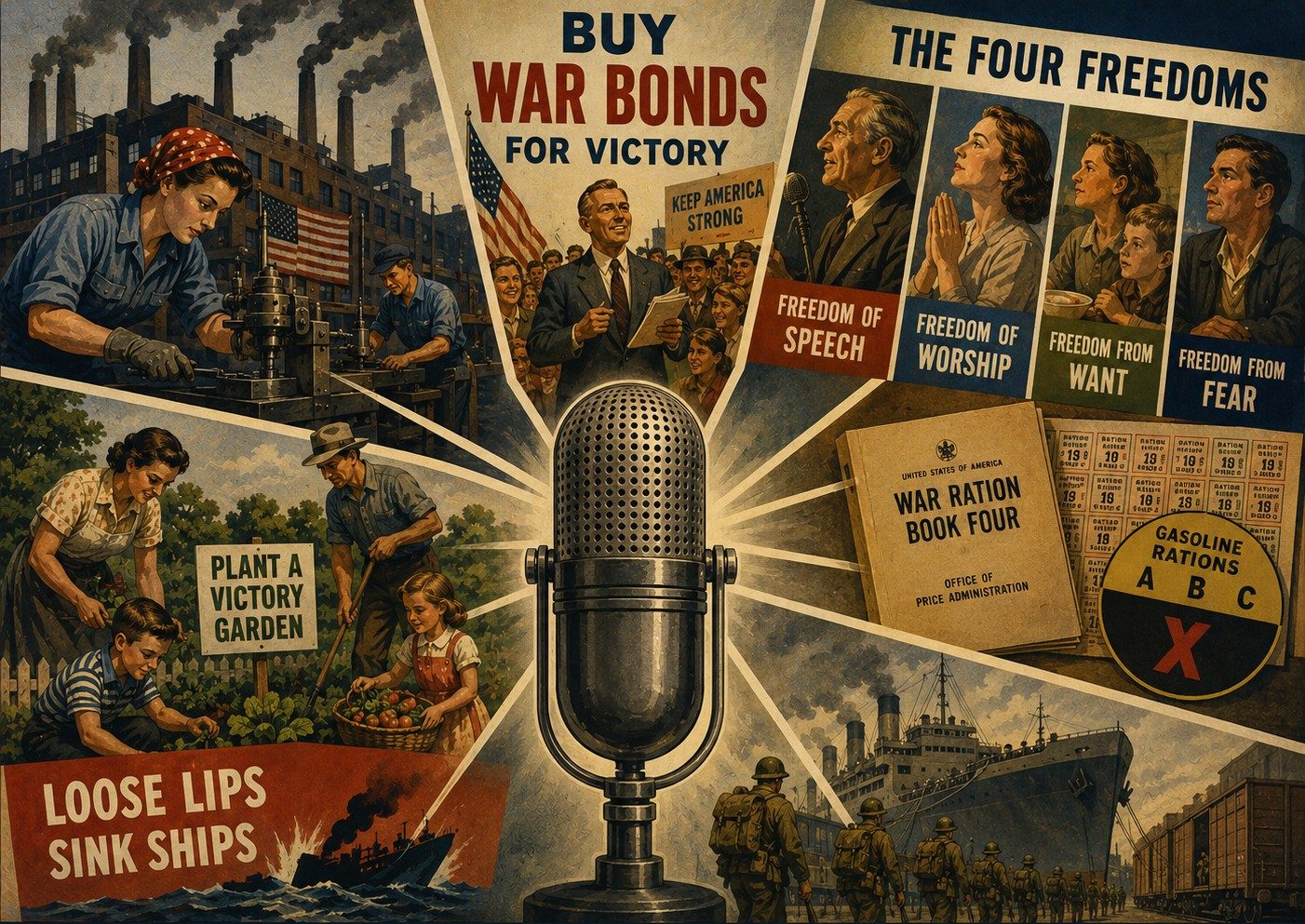
From podiums and over the radio waves, his voice, once associated only with heroic flight, now broadcast a stern warning: America must stay out of Europe’s bloody conflicts. He argued passionately that the nation’s path should be towards neutrality, and in building an impregnable defense, rather than squandering its resources on foreign wars.

His influence grew exponentially when he became the national leader of the America First Committee, the largest anti-war organization in U.S. history. Its platform was clear: “America First” meant focusing on domestic needs, strengthening national defenses, and, importantly, opposing any aid to Allied nations that might draw the U.S. into the war.

An image of Charles Lindbergh at the microphone giving a speech at an America First Rally in Madison Square Garden in 1941.
Charles Lindbergh gives a speech to an “America First” rally at Madison Square Garden in 1941.

But as the drumbeat for intervention grew louder, so too did the controversy surrounding Lindbergh. His speeches became increasingly pointed, crossing a line that many found abhorrent. In his infamous Des Moines speech in September 1941, he explicitly named “the British, the Jewish, and the Roosevelt administration” as the forces he believed were pushing America into the war.

The backlash was immediate. Accusations of antisemitism and pro-Nazi sympathies rained down on him. The public, who had once adored him, now wrestled with the agonizing realization that their heroic “Lone Eagle” had become a deeply divisive figure. The rift with President Roosevelt became public, unambiguous, a chasm between the nation’s most powerful man and its most celebrated hero.

The Fall from Grace and Unofficial War Service (1941-1945)

The public condemnation was crushing. Lindbergh, once untouchable, saw his reputation plummet. He was denounced as a traitor, a bigot, his name synonymous with disloyalty to many. After President Roosevelt publicly criticized him, Lindbergh resigned his commission in the Army Air Corps, a painful severing of ties with the field he had dedicated his life to.

However, despite the torrent of public scorn and his controversial political stances, Lindbergh remained fundamentally an American. He still possessed a burning desire to serve his country, even if the government wouldn’t officially have him. He found an unlikely path to contribution, working as a civilian technical advisor for Ford Motor Company and United Aircraft. It was in this capacity that he made his way to the Pacific theater of World War II.

An image of Charles Lindbergh in WWII with a P-38
Despite having lost his commission in the Army Air Corps, Lindbergh flew many combat missions during WWII.

Here, the man reviled at home flew alongside American pilots, teaching them crucial fuel conservation techniques for their long-range missions, sharing his unparalleled knowledge of aviation. More remarkably, he even engaged in combat, flying over 50 unofficial combat missions, exchanging fire with Japanese aircraft. This often-overlooked period revealed that his courage, the trait that had made him a hero, was still very much intact, even as his public image lay in tatters. He risked his life for a nation that had largely disowned him.

Redemption, Conservation, and Reflection (Post-1945)

After the war, a chastened Lindbergh largely withdrew from the public eye. The political lightning rod of the America First years faded, replaced by a more introspective individual. Slowly, painstakingly, he began to rebuild bridges, to mend relationships fractured by the war years.

His later life was marked by surprising new passions. He made significant contributions to medical science, working alongside the Nobel Prize-winning surgeon Dr. Alexis Carrel on the development of the perfusion pump, a groundbreaking device that could keep organs alive outside the body. But perhaps his most enduring legacy from these years was his passionate advocacy for environmental conservation.

An image of Charles Lindbergh on a conservation trip in 1968
Lindbergh on a conservation trip in 1968

He became an influential voice for protecting endangered species, campaigning for the preservation of wildlife, recognizing the delicate balance of nature. His writings, including his Pulitzer Prize-winning autobiography, The Spirit of St. Louis, offered a glimpse into the mind of a man still grappling with his past. He attempted, in various ways, to explain or contextualize his wartime views, though he never fully escaped the shadow of the controversy.

Beginning in 1957, the stoic aviator maintained a secret life. For well over a decade, Lindbergh had an affair with a German woman, Brigitte Hesshaimer, with whom he fathered three children. It was later discovered he had two other relationships that also produced children, two with Brigitte’s sister and two more with his private secretary. Anne Morrow Lindbergh remained married to Charles and there is no record of her knowledge of his affairs before his death.

Charles Lindbergh passed away in 1974, leaving behind a legacy as controversial and contradictory as the man himself.

The Enduring Complexity of an American Icon

From the audacious flight that made him a global hero, to the agonizing private tragedy that scarred his family, and finally to the controversial political views that led to his public disgrace, Charles Lindbergh’s life was a narrative of immense highs and devastating lows, unprecedented achievement as well as very precedented failings.

He was a pioneering aviator who pushed the boundaries of human achievement, a grieving father who endured unimaginable loss, a controversial political figure who spoke his mind regardless of the cost, and ultimately, a dedicated conservationist who sought to protect the natural world.

The early, overwhelming fame he experienced undoubtedly shaped his life, perhaps contributing to the isolation that allowed him to cultivate the opinions and engage in the later behavior that would badly scar his reputation. Charles Lindbergh’s story, despite his notoriety, is a very human one. His life exemplified the weight of public adoration and the often contradictory nature of human character.

Charles Lindbergh, without question, left an indelible mark on American history, and is a figure who continues to raise difficult questions about heroism, responsibility, and the enduring challenge of reconciling a nation’s reverence for its icons with the uncomfortable truths of their humanity. He is, and will always be, a mirror to America’s own evolving conscience.

16 responses to “Charles Lindbergh: The Fall and Later Life”

  1. Anna Waldherr Avatar

    W/ all due respect, I think you underplay Lindbergh’s antisemitism and support for eugenics.

    1. Scott Avatar

      I understand where you’re coming from, and I don’t disagree that Lindbergh held views that were unacceptable, Anna. That part of his record deserves to be acknowledged and not minimized.

      Where I tend to be more cautious is in drawing firm conclusions about the totality of his beliefs and motivations, particularly when we’re relying on later interpretations, secondhand accounts, or extrapolations that go beyond what the primary sources clearly show. His wife’s later statements, his wartime journals, which many historians describe as detached or “indifferent” rather than hostile, and his postwar advocacy for certain minority and indigenous groups introduce some complexity that I think is worth noting, even if it doesn’t absolve him of earlier positions.

      None of that makes (many of) his choices admirable, and it certainly doesn’t excuse the harm caused by the ideas he, and others at the time, promoted. My aim is absolutely not to rehabilitate him, but to avoid flattening a long, contradictory life into a single issue. There are plenty of places to argue that case in absolute terms; I want to explore the gray areas without losing sight of the damage. After all, I wasn’t there.

  2. wendaswindowcom Avatar

    You said Lindbergh gave his speech at Madison Square Garden in September of 1941. That would be before Pearl Harbor. Many got patriotic only after the Japanese attacks. It sounds like to me, he was trying to keep the US from fighting in other countries wars. Does not the Word of God say Blessed are the Peacemakers?

    Did he not after the attacks and more exposure of Hitler, humble himself, admitting his mistaken position and joined the fight?

    But sad to say this country has not ceased from fighting battles that were not ours. My Brother went to Viet Nam. Too bad there were not enough Lindbergh’s speaking out at that time.

    Am I wrong?

    1. Scott Avatar

      Kudos to you for recognizing the date and timeline, Wenda!

      You raise a good point about public opinion before and after Pearl. The country was intensely divided, and there was a large, earnest part of the population that was against getting involved in the war until the attacks in the Pacific. Unfortunately, that isn’t really the case, in my opinion, with Lindbergh.

      While Lindbergh was a leading voice in the “America First” isolationist movement, it is difficult for me to believe he had pacifist motives. For instance, in his public appearances, he would state that it would be appropriate for the United States to fight WITH Germany, for the preservation of the white race. It seems to me that his concern was more about who the enemy was and what they looked like, more than genuine peace-loving motivation.

      For the rest of his life, he did attempt to try to explain his wartime opinions, but I would not call it a humble mea culpa at all. There are many that believe his only motivation in even attempting to “clarify” his previous opinions were to salvage his own reputation and fame (he clearly wound up on the wrong side of history).

      Personally, I’m not willing to go quite that far, because I wasn’t in his head. The first hand accounts and diaries of his that we have are neutral, so we’re left to make our own assumptions. There are tons of conspiracy theories surrounding him, but I leave that to others. When I see new evidence, my opinion will change, but as we sit here today, he was a chaotic, contradictory man: capable of great achievements, and terrible personal behaviors.

      It’s funny you mention Vietnam, because it sort of ties in with your other comments where we were discussing government behavior. There was a famous document leak in the 1970s called the “Pentagon Papers” where, it was revealed, that 4 straight Presidential administrations (Truman, Eisenhower, Kennedy, and Johnson) had lied to the public about Vietnam, and that by 1965 most government officials knew that involvement was a mistake and impossible to win. Despite that, the action continued, and the war grew for the better part of another decade. Despite a massive anti-war movement, and the officials themselves knowing it couldn’t be won, they pressed on anyway.

      Tragic wastes of life and resources! It boggles the mind how devastating actions like that are.

      1. wendaswindowcom Avatar

        You made too many good points to ignore. I want to give him more credit than he deserves. I don’t see how anyone can think that way. So, it did not enter my head that people really are that prejudice.

        As for Viet Nam, I thought it was about money. War is a money making machine. I thought that was one reason Kennedy was killed because he brought the troops home from Viet Nam and was against the war.

      2. Scott Avatar

        Admittedly, his was a strange brand of prejudice. Anyone (including me) that tells you they have Lindbergh figured out isn’t being truthful.

        As for Vietnam, especially the involvement of JFK, it’s one of the great mysteries of the 20th century, and there’s tons of debate surrounding it. The fact is that at the beginning of the Kennedy Presidency, there were 900 American military “advisors” in Vietnam. By the time of his death, there were more than 16,000 troops in country, and restrictions had been lifted in many ways.

        What is up for debate is where it was going when Kennedy was killed, and there are two major points of view. 1) The withdrawal thesis, which is widespread in popular culture. This theory points to a memo that authorized 1000 troops to be removed by the end of 1963, and some private statements made to aides where Kennedy said he wanted to “bring the boys home”.

        The opposing viewpoint counters by saying that the memo authorizing the removal of 1000 soldiers was an accounting trick. Those 1000 troops did come home in 1963, but others were rotated in, so the total force number didn’t change. They also point out that, until his dying day, Kennedy’s public statements were consistent in his position that leaving would be a mistake.

        Without a doubt, war, within our economic system, can be a major money maker for companies. That’s not disputable. What Kennedy may have done in a second term regarding Vietnam, we’ll never know. We do know what he actually did and said when he was alive though. The record shows that several Presidents had concerns about American involvement in Vietnam, and all of them (except Nixon, who did wind it down) apparently felt that leaving would be a worse decision than staying.

        It was obviously a messy, and controversial, ordeal. But, that’s my attempt at summing up JFKs record during his time. It doesn’t seem like anything is easy!

      3. wendaswindowcom Avatar

        I believe the mindset of most at that time was prejudice. Remember your post of the cardboard subdivision that was available only to whites. Times have changed for the better.

        About JFK. I believe Oliver Stone who made two movies about JFK and basically has made him his life’s work. You will never convince me JFK was for Viet Nam. They killed him and did what they could to cover it up and smear his name. You cannot convince me otherwise.
        Poor Nixon. No one remembers that he ended the Viet Nam War. Long time ago and I do remember it.
        I sum Kennedy up by what I lived through, and I believe the Holy Spirit leads into all truth. He would not let me believe a lie. I have spent too many years searching for the truth.

      4. Scott Avatar

        Oh, without question, we’ve made major progress on that front, that’s for sure!

        I must admit to not being a fan of Oliver Stone from a historical perspective (not as a movie maker). I wouldn’t try to convince anyone about it, because I don’t think anyone really knows, and it doesn’t appear possible to prove anything.

        But, I will point out that nobody, anywhere, well ever find a public statement from Kennedy being against the war in Vietnam. That’s because they don’t exist. What they will find are statements like the following (from just weeks before his death):

        ​”I don’t agree with those who say we should withdraw. That would be a great mistake. … (This) is a very important struggle.”

        ​”What I am concerned about is that Americans will get impatient… and say that we should withdraw. That only makes it easy for the Communists. I think we should stay.”

      5. wendaswindowcom Avatar

        Well —- I’m thinking!

      6. wendaswindowcom Avatar

        Sorry, it will take more than a video that could have been altered now days to convince me. I have seen how they brain washed the public for years to believe Oswald acted alone. He did not act at all.

      7. Scott Avatar

        I was talking about Vietnam, not his assassination.

        I think there are many that want to ascribe a flawless, fairytale story to Kennedy due to the circumstances and timing of his death. I understand the desire for a pleasant tale, but he was human, and a politician.

        I’m not talking about something new, a recently released video or anything. Every speech, radio address, letter, public appearance, campaign stop; if Vietnam came up, there isn’t a single word spoken that indicates he didn’t support it. More importantly, his actions backed that up.

        Would he have changed his mind in a second term? Maybe. It’s possible the situation or his opinions may have evolved to the point where his position changed. But, in my opinion, that’s the difference between history and an Oliver Stone movie. History is the attempted collection of the record. The other is a movie aiming for a good story. In Stone’s case in particular, a story that flies in the face of every word and action that Kennedy every spoke or acted on regarding Vietnam. That doesn’t make Kennedy uniquely bad in some way; both his predecessors and successors did the same thing 🤷‍♂️

      8. wendaswindowcom Avatar

        You are still talking about media. Media is not what I will base my assumptions on. Did you hear him in person say these things? That would be proof. All I have ever heard about him was not truth. You will never convince me. You cannot prove to me Oliver Stone is wrong.😁

      9. Scott Avatar

        Well that doesn’t seem fair; Oliver Stone is solely a media figure 😉

      10. wendaswindowcom Avatar

        Hmmm. You do have a point. You are a real stinker! 😖

      11. Scott Avatar

        😉😆

  3. […] Charles Lindbergh was the movement’s most celebrated voice. The man who had crossed the Atlantic alone in 1927 and been treated as the living embodiment of American courage and ingenuity was now delivering radio addresses warning against involvement in what he characterized as a European quarrel. […]

Leave a Reply

Welcome!

I’ve always been drawn to the past and the stories that live there. Here you’ll find my musings, sometimes about history, sometimes memory, sometimes both. I hope you’ll join me for stories of the people, places, and events that made us.

Discover more from In The Shadow of Yesterday

Subscribe now to keep reading and get access to the full archive.

Continue reading