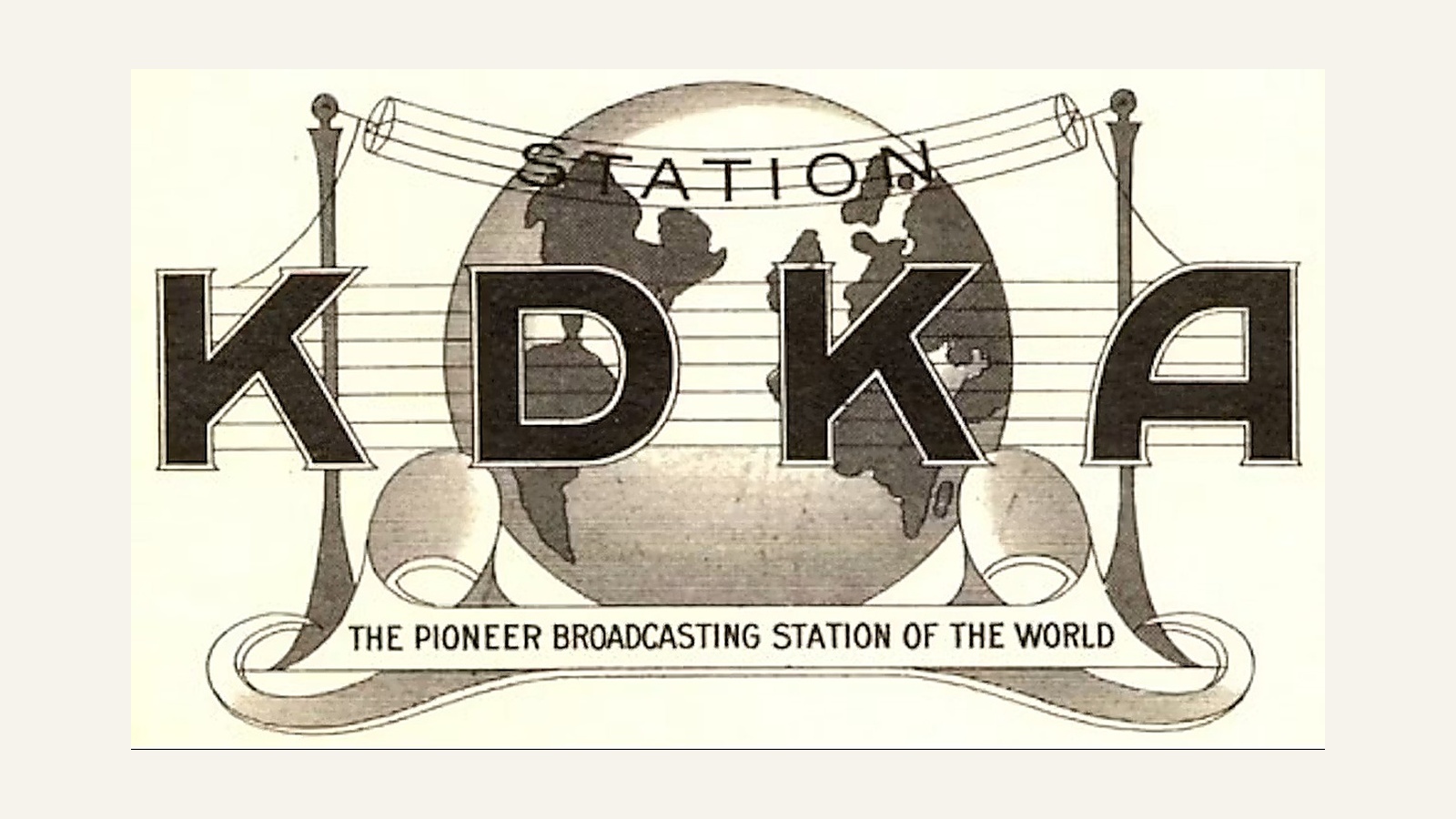
It won’t come as a surprise that November 2, 1920 was cold in the Monongahela Valley. On the roof of a Westinghouse factory in East Pittsburgh, five men crowded into a wooden shack barely big enough to hold the equipment.
A telephone line ran from the shack down to the Pittsburgh Post newsroom, where a reporter was pulling election returns as they came in and reading them back over the wire.
Inside the shack, an announcer named Leo Rosenberg took those numbers and pushed them out into the dark over a 100-watt transmitter, roughly the power of a light bulb, aimed at an audience nobody could count, in a medium that barely had a name.
They had asked anyone who heard the signal to write in. They genuinely didn’t know how far it was reaching.
What Rosenberg was doing that night had never been done before; not like this, not with a federal license, not with a corporation behind it, not with the intention of doing it again the next night and the night after that.
In four years, there would be 600 commercial radio stations across the United States. In less than a decade, radio would reshape American life, delivering news, sports, politics, entertainment, and music into living rooms from Maine to California.
Every one of those stations, every one of those broadcasts, traces a line back to that rooftop shack in East Pittsburgh.
This is the story of how it happened — and why it happened here.

The Man in the Garage
Frank Conrad was born in Pittsburgh in 1874, the son of a railroad mechanic. He attended school locally and found it largely pointless.
At sixteen, he walked out of the seventh grade and went to work for Westinghouse Electric as a bench-hand; the lowest rung on the shop floor, the kind of job where you learned by doing or you didn’t last. He lasted 51 years.
By the time he was done, he held more than two hundred patents and had an honorary doctorate from the University of Pittsburgh. He had never spent a day in a classroom past the age of twelve.
He was, in other words, a Pittsburgh type. The city ran on men like him.
Conrad was not an inventor in the romantic sense; not the lone genius rearranging the world from scratch. He was an engineer in the most practical meaning of the word: someone who understood how things worked and couldn’t stop trying to make them work better.
That is very much a difference that matters. Romanticized inventors often build a story of their importance. Engineers solve the problem directly in front of them, and a monument may show up later, if anyone notices at all, whether they wanted it or not.
His path into radio started with an argument about a watch.
In 1912, Conrad got into a dispute over the accuracy of his timepiece and decided the only way to settle it was to check it against the Naval Observatory’s time signals, broadcast out of Arlington, Virginia. To do that, he needed a receiver. So he built one.
That was the kind of man he was; the answer to a minor inconvenience was to build a piece of radio equipment from scratch. Having built the receiver, he naturally built a transmitter. By 1916, he had a licensed amateur station in the garage of his home in Wilkinsburg, a few miles east of Pittsburgh, operating under the call sign 8XK.

It was a hobby. He had a transmitter he’d largely built himself, a license from the Department of Commerce, and an audience of fellow amateur operators who enjoyed swapping technical notes over the air. Nothing more than that, or so he thought.
Then the war came.
In April 1917, when the United States entered World War I, the government ordered all civilian radio stations silent and handed the airwaves to the military.
Conrad didn’t stop working. Westinghouse had Army Signal Corps contracts, and Conrad spent the war years developing and refining military radio equipment — the SCR-69 transmitter and SCR-70 receiver among them — running experimental radiotelephone work between a station at his Wilkinsburg home and a second station at the East Pittsburgh plant.
The same garage setup he’d been running as a hobby became, for the duration of the war, a piece of military communications infrastructure. He wasn’t just tinkering anymore. He was building the technology that would define the next era of American life, on contract for the United States government, and getting very good at it.
When the civilian ban lifted in October 1919, he went straight back on the air. Within weeks, something unexpected started happening: people were writing in. Not other amateur operators trading technical observations; ordinary listeners, asking for music.
Conrad started playing phonograph records. The requests kept coming. He eventually announced a schedule: two hours of programming every Wednesday and Saturday evening.
His sons Crawford and Francis helped out with announcing, playing piano, handling equipment. A local record shop, realizing Conrad was wearing out their merchandise faster than he could buy it, cut a deal to loan him records in exchange for on-air mentions.
Frank Conrad, without quite meaning to, had just invented the promotional tie-in.
The garage in Wilkinsburg had become, without anyone planning it, a radio station with a regular audience, scheduled programming, and a sponsorship arrangement. Pittsburgh’s Gazette Times ran enthusiastic reviews of the broadcasts. Letters poured in from listeners across the region.
None of this was the point. Conrad was a Westinghouse engineer. The station was a hobby, something he did because he found it interesting. The idea that there was a real business buried in what he was doing hadn’t fully occurred yet; not for him, anyway.
Someone else made that connection.

The Department Store Ad
Harry Davis was Westinghouse’s vice president of engineering and manufacturing, and in the fall of 1920 he was stuck with a problem that had been nagging at the company for nearly two years.
The war had been very good to Westinghouse. Military contracts had kept the factories running at full capacity, and the company had poured enormous resources into wireless technology; manufacturing, development, personnel, the whole apparatus.
When the Armistice came in November 1918, the contracts dried up overnight. Westinghouse was left holding a massive investment in wireless technology, a workforce trained to build it, and no clear idea what to do with any of it.
Davis had been aware of Conrad’s garage broadcasts. Hard not to be; Conrad worked for him. But awareness isn’t the same as insight, and it wasn’t until the morning of September 29, 1920, that the insight arrived.
That morning, the Joseph Horne department store in Pittsburgh ran a newspaper advertisement. It described a wireless receiver the store had installed to pick up Conrad’s broadcasts from 8XK, and it offered similar sets for sale to the general public; available right there in the store’s radio department.
Davis read that ad and understood immediately what it meant. Conrad’s broadcasts weren’t just a curiosity. They were demand generation. Every person who bought a receiver to tune into 8XK was a potential customer for Westinghouse technology.
And if a garage in Wilkinsburg could pull that off with a hobbyist’s setup and a borrowed phonograph, a proper station — licensed, professional, with reliable scheduled programming — could do it at a scale that would dwarf anything Conrad was running out of his house.
The ad did more than just sell radio receivers. It handed Davis the business model for an entire industry.
He called a meeting. The plan was simple, if not more than a little ambitious: build a transmitter, secure a federal license, and put a real station on the air in time for the presidential election on November 2nd. Six weeks away.
Any other city, any other company, and the answer is probably no. Not enough time, not enough people who knew how to execute it, not enough infrastructure to pull it together on that schedule. But Davis wasn’t working from scratch, and he wasn’t working in a vacuum. He was standing in the middle of Pittsburgh.
By 1920, the Westinghouse Electric and Manufacturing Company employed roughly 50,000 people in the Pittsburgh region alone. East Pittsburgh and the surrounding communities weren’t just places where Westinghouse happened to have a plant; they were, in a meaningful sense, Westinghouse towns, communities built around the company’s presence and shaped by its workforce.
These were people who had spent the war years building military radio equipment, who understood the technology at a level nobody else in the country could match, and who were accustomed to solving hard problems on tight schedules.
The engineering culture that George Westinghouse had cultivated for decades — practical, technically sophisticated, oriented toward making things work rather than theorizing about them — was concentrated in one industrial valley in southwestern Pennsylvania.
Pittsburgh was, by 1920, the most formidable heavy industrial environment in the United States. The city was producing close to a third of all the steel in the country. Carnegie had built his empire on the Monongahela. Frick had fueled it from the Connellsville coalfield. Westinghouse had electrified it.
The infrastructure of the industrial era — not just the steel and the coal, but the engineering talent, the manufacturing capacity, the institutional confidence that comes from having built enormous things and made them work, was concentrated in one valley in southwestern Pennsylvania.
When Davis needed a transmitter built in six weeks, he had an army to draw from.
Work on the transmitter began immediately. On October 27, 1920, the Department of Commerce issued the first commercial radio broadcast license ever granted in the United States; to KDKA, Westinghouse Electric and Manufacturing Company, East Pittsburgh, Pennsylvania.
The call letters were pulled from a roster maintained for ship-to-shore maritime communications, and KDKA happened to be next on the list. They meant nothing. They would come to mean everything.
Six days later, Leo Rosenberg sat down in that wooden shack on the factory roof and started reading election returns into the dark.

Election Night
The broadcast ran for eighteen hours.
Rosenberg wasn’t a professional announcer; after all, the profession didn’t exist yet. He was a Westinghouse publicist, like nearly everyone involved that night, drawn from the same pool of company men who had spent the war building military radio equipment and now found themselves inventing something new without a manual for how it was supposed to work.
There was a banjo player on hand to fill the gaps between returns. That detail says everything about where broadcasting stood on November 2, 1920; the most significant technological debut of the twentieth century had a banjo player as its backup plan.
The returns came in over the phone from the Pittsburgh Post newsroom. Harding over Cox, a landslide building through the night.
Rosenberg read the numbers as they arrived, into a microphone that was essentially a converted telephone handset; the same crude instrument that would show up again and again in KDKA’s early broadcasts, repurposed and improvised because the equipment the medium actually needed hadn’t been invented yet.
Outside, the cold November air carried the signal over the Monongahela Valley and beyond. Estimates put the audience at around 500 listeners scattered across the eastern United States, most of them fellow amateur radio operators who happened to have a receiver capable of picking up the signal.
Five hundred people. The invention of a mass medium.
Frank Conrad wasn’t in the shack. He was in his garage in Wilkinsburg, at 8XK, acting as a backup transmitter in case the East Pittsburgh equipment went down.
The man who had started the whole chain of events, who built the station, played the records, cultivated the audience that convinced Davis there was a business here, listened to election night from a distance, ready to catch the broadcast if it fell.
It didn’t fall. Rosenberg read returns until the wee hours of the morning, Harding’s margin growing with every update, and when it was over KDKA had done something no licensed commercial radio station had ever done before.
It had broadcast a scheduled program to a general audience, and it intended to do it again tomorrow.
That last part was the thing that separated KDKA from everything that came before it. Other stations had broadcast music, news, and voice transmissions in the months leading up to November 1920. What they hadn’t done was commit to a permanent, scheduled, commercially-backed operation aimed at a mass civilian audience.
Davis hadn’t licensed KDKA as an experiment or a public gesture. He had licensed it to sell Westinghouse radio receivers, which meant the station needed to keep broadcasting, keep improving, and keep attracting listeners who would go out and buy equipment to hear what was on next.
The business model demanded continuity. From the night of November 2, 1920, KDKA has never stopped broadcasting. It is the longest continuously operating radio station in the United States, and it earned that distinction by design. Davis built it to last.
The country noticed almost immediately. Papers across the nation ran stories about the broadcast. The Kansas City Star called KDKA a “wireless telephone.” Amateur radio operators who had picked up the signal wrote in from as far away as the Gulf Coast.
Within months, other companies were eyeing the model Davis had demonstrated, trying to figure out how to replicate it. The patent disputes that had paralyzed the wireless industry for years suddenly had a deadline; too much money was at stake to leave them unresolved.
Radio receivers began migrating from hand-built hobbyist equipment toward mass-produced consumer goods. The medium that had barely had a name on election night was, by the following spring, becoming an industry.
All of it traceable to a wooden shack, a banjo player, and five hundred people with receivers who wrote in to say they’d heard something remarkable coming out of East Pittsburgh.

The Year of Firsts
If election night was the beginning, 1921 was the proof.
Davis and his team at Westinghouse understood something that their competitors were still working out: a radio station was only as valuable as its programming. The license and the transmitter were the infrastructure. What you put on the air was the product.
And so, almost from the moment the Harding returns were done, KDKA started pushing outward; into churches, boxing rings, baseball stadiums, political halls, and concert venues, staking out territory in every corner of American life that a microphone could reach.
The first move came on January 2, 1921, exactly two months after election night. Davis wanted a religious program for Sunday evenings; a church service, live and remote, something that would demonstrate what the medium could do beyond a studio.
The way it came together was pure Pittsburgh: a Westinghouse employee named Fletcher Hallock, who sang in the choir at Calvary Episcopal Church in the East Liberty neighborhood, suggested his own congregation. Somebody knew somebody, which is the most Pittsburgh way imaginable to start a cultural revolution.
The church’s rector, the Reverend Edwin Van Etten, was skeptical, worried about the distraction the broadcast equipment would create, worried about the dignity of the service, but he agreed. Westinghouse installed wireless telephone receiving apparatus in the chancel.
On the evening of January 2nd, Van Etten’s colleague delivered a sermon titled “The Wood and the Sword” to a congregation that extended, for the first time in the history of Christianity, as far as a radio signal could travel.

The Calvary broadcasts continued every Sunday evening for forty-one years, until 1962. Before Jerry Falwell, before Fulton Sheen, before every televangelist who ever pointed a camera at a pulpit, there was a nervous rector in East Liberty and a Westinghouse choir member who knew the right person to call.
Two weeks after Calvary, Herbert Hoover, then Secretary of Commerce, not yet president, delivered an address on European relief from the Duquesne Club in Pittsburgh. KDKA ran a telephone line ten miles from the Club to the East Pittsburgh transmitter and put Hoover on the air.
It was the first time a major political figure had spoken directly to a radio audience, and it would not be the last. By March 4, 1921, when Warren Harding delivered his inaugural address, KDKA was there; the first presidential inauguration ever broadcast on radio.
The Kansas City Star, which had covered the election night broadcast with bemused curiosity, was now running front-page stories about a medium that was rewriting the relationship between politicians and the public.
Representative Alice Robertson became the first woman to address a radio audience, also over KDKA, in those same early months. Radio wasn’t just entertainment anymore. It was politics.
Sports came next, and it came fast. On April 11, 1921, a ten-round fight between Johnny Ray and Johnny Dundee at Pittsburgh’s Motor Square Garden became the first live sporting event ever broadcast on radio.
A reporter from the Evening News in San Jose, California, three thousand miles away, wrote that listeners were treated to the action with “all the realism of each blow and each bit of ring strategy enacted the instant it occurred.” The fight was local and small-scale. The response was national. Westinghouse took note.
On July 2, 1921, KDKA broadcast the World Heavyweight Championship between Jack Dempsey and Georges Carpentier; the first national broadcast of a major sporting event in American history.
The fight was held in New Jersey. KDKA carried it via teletype to Pittsburgh and put it on the air. More than 300,000 people are estimated to have heard it, gathered around receivers in homes, hotels, and storefronts from one end of the country to the other. Dempsey knocked out Carpentier in the fourth round. Radio had just introduced itself to America at scale.
Then came August 5th.
Harold Arlin was twenty-five years old and working as a foreman at Westinghouse when Frank Conrad took a group of company engineers on a tour of the KDKA rooftop studio. Someone handed Arlin a microphone and told him to say a few words.
His voice came through the equipment clean and clear; it was warm and direct, the kind of voice that made a listener feel like someone was talking to them personally rather than at them.
Davis hired him as KDKA’s first full-time announcer on the spot. It was, characteristically, not a decision made after a formal search or an audition process. It was a Westinghouse man with the right voice in the right place at the right moment.
On the morning of August 5th, Arlin needed programming. He drove to Oakland, parked near Forbes Field, bought a box seat behind home plate, and assembled a crude microphone by converting a standard telephone handset.
The Pittsburgh Pirates were playing the Philadelphia Phillies that afternoon. Arlin put the microphone in front of the action and started talking.
Nobody had ever broadcast a major league baseball game on radio before. There was no format, no established style, no tradition of play-by-play to draw from. Arlin invented it that afternoon, improvising in real time the same way Rosenberg had improvised on election night nine months earlier; figuring out what the medium needed as the game unfolded in front of him.
The Pirates beat the Phillies 8-5. Future Hall of Famers Max Carey and Rabbit Maranville played in the game. None of them had any idea what had just happened.
The very next day, August 6th, Arlin was at the Allegheny County Club to broadcast the Davis Cup tennis quarterfinals, Australia against Great Britain. First tennis match on radio.
On October 8th, he was at Forbes Field again for Pitt against West Virginia University; first college football game on radio.
That same October, KDKA and a handful of other stations broadcast the World Series between the Giants and the Yankees, and baseball’s relationship with radio, one of the defining partnerships in American cultural history, was underway.
Arlin introduced Babe Ruth, Will Rogers, and William Jennings Bryan to radio audiences. He was a foreman by day who did KDKA at night, a company man who happened to invent sportscasting because someone handed him a microphone and he was good at it.
When Westinghouse transferred him to a personnel job in Mansfield, Ohio in 1925, he went without complaint and spent the rest of his working life as a manager, active in his community’s civic organizations, largely unknown outside of radio history circles.
In 1972, the Pittsburgh Pirates invited Harold Arlin, then in his mid-seventies, back to the broadcast booth. He called an inning of a game at Three Rivers Stadium, fifty-one years after Forbes Field.
His grandson Steve Arlin was pitching for the opposing team, the San Diego Padres. The old foreman from Westinghouse sat behind a microphone that bore no resemblance to a converted telephone handset and called the action the same way he always had; directly and personally, as if he were talking to someone he knew.
Which, after fifty years on the air, he was.

What Pittsburgh Built
There is a version of this story that treats KDKA as a fortunate accident; the right technology in the right hands at the right moment, the kind of thing that could have happened anywhere given the right combination of luck and timing.
That version is wrong, and the evidence against it is sitting right there in the geography.
Consider what Davis needed in September 1920 when he read that department store ad and decided to act on it.
He needed engineers who understood military-grade radio technology at an operational level. He needed a manufacturing plant capable of building a commercial transmitter from scratch on a six-week deadline. He needed a corporate structure with the institutional confidence to commit to a long-term licensed broadcast operation rather than a one-time experiment.
He needed, in other words, Pittsburgh; because Pittsburgh was the only place in America in 1920 where all of those things existed in the same place at the same time.
The city hadn’t arrived at that position by accident either. What Carnegie had done on the Monongahela, what Frick had done in the Connellsville coalfield, what George Westinghouse himself had done in East Pittsburgh and Wilmerding; all of it had built, over fifty years, an industrial ecosystem of a kind that existed nowhere else in the world.
It was the culture that came with them, not just the factories and the furnaces. The expectation that hard problems could be solved by people who showed up, understood their equipment, and worked until the thing was done.
Frank Conrad was a product of that culture. Harry Davis was a product of that culture. Harold Arlin, the foreman who invented sportscasting because someone handed him a microphone, was a product of that culture.
None of them came from money. None of them had the kind of formal credentials that open doors in other industries. Conrad left school at twelve. Arlin was a factory foreman. Davis had worked his way through the Westinghouse hierarchy on the strength of his judgment and his ability to recognize opportunity.
They were Pittsburgh people in the most realistic sense; practical, technically capable, unsentimental about the gap between an idea and its execution. When the idea was good, you built the thing. That was the culture, and it was no accident that it produced KDKA.
What makes the story even more impressive is the pace of it. From the election night broadcast on November 2, 1920, to the first baseball game on August 5, 1921, is nine months.
In those nine months, KDKA broadcast the first remote church service, the first politician on radio, the first presidential inaugural address, the first live sporting event, the first heavyweight championship, and the first baseball game.
Every one of those firsts represented a new category of American experience; a new answer to the question of what radio was for, what it could carry, how far it could reach into daily life.
Every one of them came out of Pittsburgh, and every one of them was executed by Westinghouse engineers working with converted telephone handsets and improvised equipment in makeshift studios, figuring it out as they went.
By the end of 1921, there were over 500 licensed stations on the air across the United States. By 1922, more than a million Americans owned a radio receiver.
The medium that Rosenberg had aimed at an audience of 500 on election night had, in roughly fourteen months, become a mass phenomenon that was rewriting American politics, sports, religion, and entertainment simultaneously. The business model Davis had reverse-engineered from a department store ad had become an industry.
Pittsburgh didn’t hold onto it. That’s worth mentioning. The broadcasting industry that KDKA launched dispersed quickly; to New York, Chicago, and Los Angeles, to the networks that formed through the 1920s, to the national apparatus of NBC and CBS that consolidated radio’s commercial power far from the Monongahela Valley.
Pittsburgh remained a significant radio market, but the center of gravity shifted, as it tends to do when a local innovation becomes a national industry. The city that started it all became, within a decade, one market among many.
What Pittsburgh kept was something harder to quantify. The East Pittsburgh plant where KDKA’s first transmitter was built is a research park now; Keystone Commons, sitting on the same ground where Westinghouse engineers once built the equipment that powered Niagara Falls and won the War of Currents.
The Calvary Episcopal Church in East Liberty, where Fletcher Hallock sang in the choir and suggested his congregation as the site of radio’s first remote broadcast, still stands. The weekly KDNET broadcasts that began there on January 2, 1921, continued until 1962; forty-one years of Sunday evenings, the reverend’s voice going out over the same signal that had carried Harding’s election returns two months before.
Frank Conrad died in Miami in December 1941, still a Westinghouse man to the end, still holding patents, still the assistant chief engineer; the title had been kept deliberately modest out of respect for a predecessor, even after Conrad had long since outgrown it.
He had spent fifty-one years with the company he joined as a bench-hand at sixteen, and he left behind a medium that had reshaped every aspect of American life. His garage in Wilkinsburg, where 8XK went on the air and a hobby became a revolution, is long gone.
The signal isn’t. KDKA is still broadcasting, both on AM and FM; the oldest continuously operating commercial radio station in the United States, still carrying the call letters a government clerk pulled from a maritime roster in October 1920 because they happened to be next on the list.
Over a hundred years of uninterrupted broadcast, from the wooden shack on the factory roof to whatever studio it occupies today, the station has never gone dark.
Not bad for a city that built things for a living.



Leave a Reply