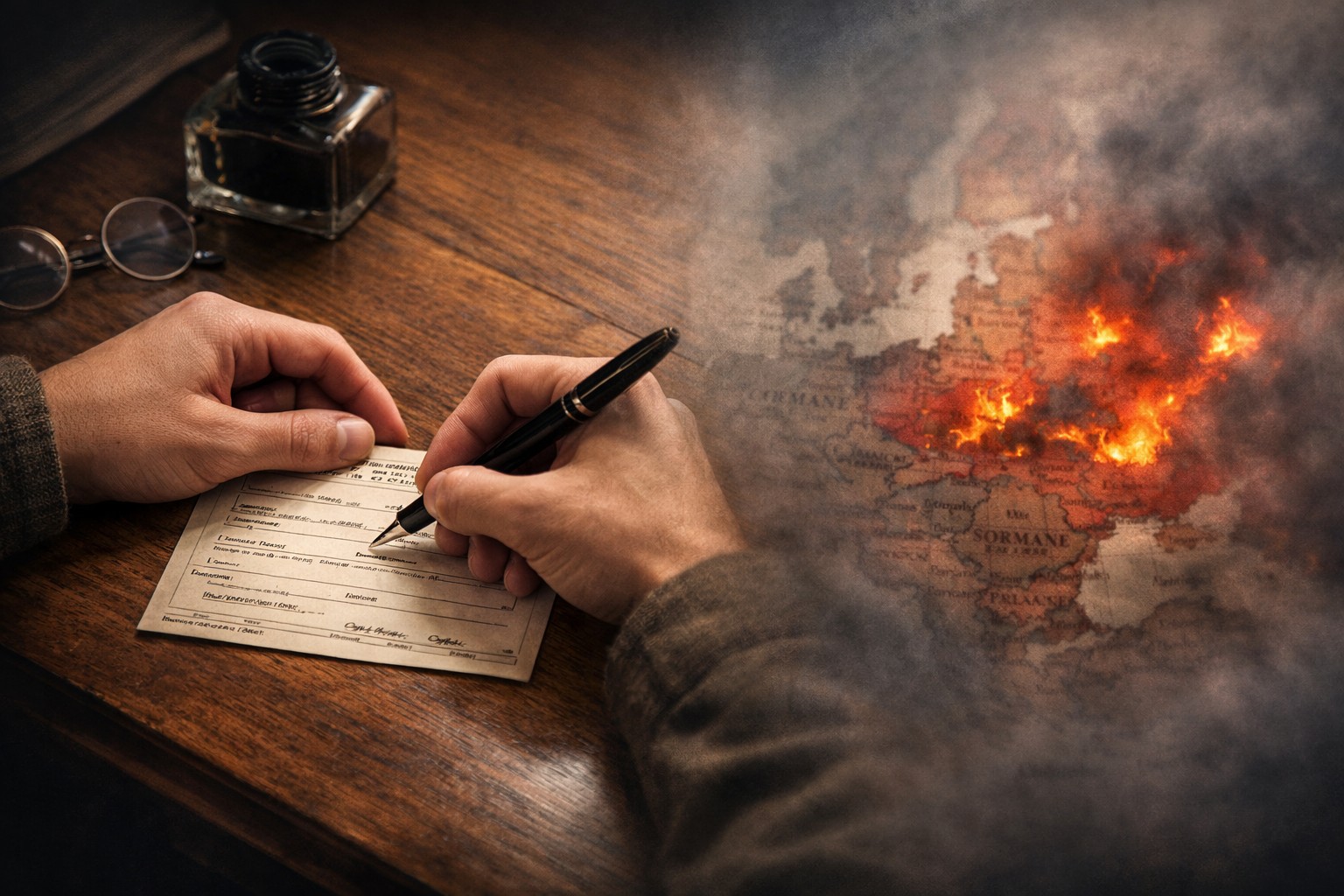
He didn’t think of himself as a soldier.
He was a factory worker, maybe, or a farmer’s son. A kid from Pittsburgh or Peoria or Pascagoula who had grown up during the Depression and knew something about hardship but had never given much thought to military service. The war in Europe was real enough; you couldn’t pick up a newspaper without it. But it was also, in the way of things happening very far away, somebody else’s problem.
America wasn’t in it. America wasn’t going to be in it. That was the prevailing sentiment in the autumn of 1940, and most people believed it with the complete conviction of those who very much want something to be true.
So when the letter came, or when he stood in line at the local post office or firehouse or schoolhouse on registration day, the dominant feeling wasn’t dread. It was inconvenience. Twelve months. That was the deal.
A year of his life, a uniform, some training, and then back to the factory or the farm or the girl he’d been meaning to ask to marry him. The radio said so. The politicians said so. The song said so, right there in the title: Goodbye Dear, I’ll Be Back in a Year.
A year. That’s all it was.
He had no way of knowing that the year would never come. That the world was already in the process of making other arrangements. That the letter in his hand, with its official language and its government stamp, was not the inconvenience he took it for but the first page of a story that would take years to finish, and that for some of the men standing in line alongside him, would never finish at all.
But that was later. In the autumn of 1940, a year seemed like a perfectly manageable thing.
The World on Fire, and an Army That Wasn’t
By the autumn of 1940, Europe had been at war for just over a year, and the news was almost exclusively panicking for anyone hoping it would sort itself out without American involvement.
Poland was gone, carved up between Germany and the Soviet Union in a matter of weeks. Denmark and Norway had fallen in the spring. Then, in May and June of 1940, came the event that changed everything: the fall of France. The country that had held the Western Front for four brutal years in the last war, the country that was supposed to be the bulwark against German expansion, collapsed in six weeks.
The British Expeditionary Force was chased to the beaches at Dunkirk and evacuated by a flotilla of civilian vessels in one of the most desperate improvisations in military history. Britain now stood, battered and alone, with a German army camped on the other side of the English Channel.
And the United States Army, the force theoretically responsible for defending the most powerful industrial nation on earth, had fewer men under arms than the armies of Portugal and Romania.
This was the inheritance of General George Catlett Marshall, who had been sworn in as Army Chief of Staff on September 1, 1939; the same day Germany invaded Poland, a coincidence that Marshall would have found depressingly appropriate. He was a professional of few words, with a mind like a steel trap and a manner that discouraged small talk.
He did not charm people in the usual sense. He impressed them, which is a different and more durable thing. And what impressed those who dealt with him most was the quality of his character and strategic vision; his ability to see not where the Army was, but where it needed to be, and what it would take to get there.
What he saw in 1940 was not encouraging. The United States Army ranked seventeenth in the world in size and capability, somewhere behind Romania and just ahead of Bulgaria.
It was equipped largely with weapons and doctrine left over from the previous war. Its officer corps was talented but thin. Its enlisted ranks were a fraction of what any serious war plan required. Marshall had been pushing for expansion and modernization since before he took the job. He had not been getting very far.
What he needed, what the country needed, though it didn’t yet know it, was a draft.

The Fight Nobody Wanted
The idea of conscripting American men in peacetime was, to put it mildly, not a popular one.
Isolationism in 1940 was not a fringe position held by extremists and cowards. It was the dominant mood of a country that had sent its sons to Europe twenty years earlier, watched 117,000 of them come home in boxes, and had spent the intervening decades wondering what exactly had been accomplished after Europe promptly imploded again.
The answer, by 1940, appeared to be: not much. Europe was at war again, the same players more or less in the same positions, and a significant portion of the American public had arrived at the entirely understandable conclusion that whatever was happening over there was going to have to happen without them.
Charles Lindbergh was the movement’s most celebrated voice. The man who had crossed the Atlantic alone in 1927 and been treated as the living embodiment of American courage and ingenuity was now delivering radio addresses warning against involvement in what he characterized as a European quarrel.
His audiences were enormous and his credibility, at least in 1940, was still largely intact. The America First Committee, formed in September of that year, would eventually claim 800,000 members. These were voters, and their congressmen knew it.
Into this environment, two men introduced a bill that proposed to do something the United States had never done in peacetime: conscript its citizens into military service. Senator Edward Burke of Nebraska and Representative James Wadsworth of New York were both, notably, Republicans in an era when Roosevelt’s Democratic administration was the driving force behind preparedness.
Their bipartisan authorship was important, not to mention deliberate. This could not be allowed to look like a Roosevelt power grab. It needed to look like what it actually was: a straightforward military necessity, arrived at reluctantly and in full view of the public.
Marshall was deployed as the administration’s primary advocate before Congress, a role he accepted with characteristic directness. His testimony before the Senate Military Affairs Committee in July 1940 was not theatrical. Marshall was not a man that participated in political theater. He brought no charts, made no appeals to patriotism, delivered no speeches. He laid out the situation as he understood it, in plain language, and answered questions.
The situation, as he laid it out, was this: the United States Army was incapable of defending the country against a serious adversary. Voluntary enlistment had never and would never produce the numbers required. Without a draft, the problem would not be solved. That was it. No exaggeration necessary.
It was exactly the right approach for the moment and the man. Marshall’s reputation for integrity, for saying what he believed regardless of political consequence, gave his testimony a credibility that a more overtly political figure could not have carried. Senators who disagreed with him believed him anyway, which is a rare and valuable quality for a messenger.
The debate was long and contentious, not to mention outright ugly at times. Opponents called the bill a step toward fascism, reckless, a betrayal of American tradition, a solution in search of a problem. They invoked the memory of the last war and questioned whether the men currently threatening Europe posed any real danger to the United States.
They were not, in the main, dishonest arguments. They were simply going to be wrong, and history was in the process of demonstrating exactly how wrong with an unusual thoroughness.
Roosevelt signed the Selective Training and Service Act into law on September 16, 1940. It was, as he noted in his remarks, the first peacetime draft in American history. The age range was 21 to 35. The term of service was twelve months. The number of men to be inducted initially: 800,000, with a ceiling of 900,000 under arms at any one time.
Twelve months. In, out, done. Nobody thought about what would happen if the world failed to cooperate with that timeline.

October 16, 1940
The government called it Registration Day, which had the ring of something civic and orderly, and in fact that is largely what it was. Given the mood of the country and the scale of the undertaking, that was, in itself, a remarkable thing.
On October 16, 1940, more than 16 million American men between the ages of 21 and 35 walked into post offices, firehouses, schools, churches, and community centers across the country and registered for the draft. In a single day. In a nation that was completely, genuinely divided on the question of whether any of this was necessary or wise.
The lines formed early. In Washington, men lined up in a light rain outside registration stations that had been set up in schools and public buildings throughout the city. In Chicago, nearly half a million men registered before the day was out. In rural counties across the South and Midwest, men drove in from farms and small towns to stand in line at the local courthouse or general store.
In New York City, the lines stretched around blocks in neighborhoods where the names on the draft cards would be Italian and Polish and Jewish and Irish; the sons of immigrants, registering to serve a country their parents had crossed an ocean to reach.
Roosevelt addressed the nation by radio that evening, as he so often did when the moment required a certain explanation.
He framed the draft not as a departure from American tradition but as a continuation of it, invoking what he called the “300-year-old American custom of the muster”; the colonial and revolutionary practice of citizen soldiers answering a community call to arms. It was a shrewd piece of historical framing, connecting something that had never happened before to the oldest instincts of American civic life.
Whether the men standing in those lines found the historical framing comforting is another question. It’s safe to assume that most of them were not thinking about colonial musters. They were thinking about twelve months, about their jobs, about the girls they were leaving behind or the families they were supporting.
They filled out their cards with their name, address, employer, physical description, and went home. The government had their names now. What it did with them would be determined, as it happened, by a blindfold and a fishbowl.

The Reckoning at the Draft Board
Before a man’s number could be called, his body had to be approved through a physical with the draft board. What the examining physicians found, in town after town across the country, was a picture of a nation that had been falling apart for a decade.
The Great Depression had done something to America that the country was only beginning to understand in 1940. It had destroyed the American population, not just financially, but physically.
The evidence was in the bones and teeth and organs of an entire generation of young men who had grown up eating whatever was available, which was frequently not enough and rarely nutritious.
The science of vitamins and minerals was still young, and most American families in the 1930s had never heard of thiamin or riboflavin and wouldn’t have known where to find them if they had. What they knew was that there wasn’t enough money, and that you fed the children what you could, and that you got by.
The draft boards recorded what that decade of getting by had produced. The numbers were horrifying. Over the course of the war, 40 percent of the men who showed up for their physicals were rejected. Four out of every ten.
Before Pearl Harbor changed anything, half of the men who had been drafted had already been turned away for medical deficiencies or illiteracy. The Army had gone looking for soldiers and found, instead, a generation bearing the physical consequences of ten years of poverty.
Of the first million men screened in 1940, at least 130,000 were rejected outright for severe disabilities directly related to malnutrition. Men showed up with rickets, with pellagra, with the permanent frailty of bodies that had been underfed at the ages when bodies are supposed to be building themselves.
They found an epidemic of stunted growth, damaged eyesight, nervous disorders, and deficiency diseases that had hardened into permanent physical limitations while their victims were simply trying to survive the 1930s.
The teeth told the story as plainly as anything else. Draft examiners reported enormous numbers of men who failed to meet the minimum dental standards because the teeth had never had a fighting chance to begin with. Poor nutrition in childhood produces poor dental development, and the examining rooms of 1940 and 1941 were full of young men whose mouths looked decades older.
Over the course of the war, 25,000 Army dentists would pull 15 million bad teeth and fit 2.5 million sets of dentures. Army optometrists fitted another 2.25 million men with eyeglasses. A million men took educational courses simply to learn how to read and write. The Army wasn’t just building soldiers. It was, in many cases, starting from further back than anyone had ever expected.
The three meals a day that the Army provided as a matter of routine were, for a significant number of the men who received them, the first reliable daily nutrition of their lives. Veterans of the era recalled this later with a mixture of dark humor and genuine surprise; that the Army, of all institutions, was the place where they finally had three meals a day. Where they learned what it felt like to go to bed without being hungry.
Some gained ten or fifteen pounds in the first months of service simply by eating regular meals, and the physical transformation was, by multiple accounts, remarkable.
The implications reached well beyond the draft boards and the training camps. What the examination process had revealed was a public health crisis hiding in plain sight, and Washington responded with an urgency that global peace had never managed to produce.
The Food and Nutrition Board was established in 1940. Commercial bakeries began voluntarily fortifying bread with B vitamins and iron. By January 1943 the government had mandated the enrichment of all white bread sold in the United States.
The school lunch program, which would eventually feed generations of American children, traces its federal origins directly to the alarming findings of those draft board examinations. The doctors who rejected hundreds of thousands of men in 1940 had inadvertently launched a nutritional revolution that reshaped American public health policy for the rest of the century.
It was, in its way, a typically American story. The Army needed healthy men. The examination rooms showed that a Depression had made healthy men harder to find than anyone had wanted to admit. And the country, confronted with that fact in shocking terms, decided to do something about it.
The men who passed their physicals and shipped off to training camps had enough food for the first time in their lives, and put on weight and got stronger. The war that awaited them would demand everything they had. At least now, for the first time in years, they had something to give.
A Blindfold and a Fishbowl
Franklin Roosevelt had promised the lottery would be accompanied by no fanfare, no blowing of bugles or beating of drums. He was, at best, partially sincere. What took place in the Departmental Auditorium on Constitution Avenue on the morning of October 29, 1940 had the pageantry of a state occasion dressed up in the language of reluctant necessity.
It was theater, and very deliberate theater at that, which was entirely appropriate, because what was happening was important, and the country needed to feel that it was important.
The preparations alone told the story. Nine thousand blue-tinted celluloid capsules had been prepared, each one containing a number, each number corresponding to a sequence that would determine the order in which America’s registered men would be called to serve.
Those capsules were escorted to the auditorium by a detail of 500 veterans of the First World War; men who had answered a similar call a generation earlier and understood, in a way the young men whose numbers sat inside those capsules perhaps did not yet, exactly what was being asked.
The fishbowl was the same one used in the draft lottery of 1917. It had been brought from Philadelphia with the care of a historical artifact being returned to service, which is exactly what it was.
Beside it sat a wooden spoon, though “spoon” somewhat overstates its refinement. It was a paddle, really, carved from a beam salvaged from Independence Hall. The capsules would be stirred with wood that had once been part of the building where the country itself had been argued into existence.
Secretary of War Henry Stimson stood at the bowl. He was 73 years old, a Wall Street lawyer and former Secretary of State who had come back into government because Marshall and Roosevelt had asked him to and because he believed, as a man who had lived through one world war already, that what was coming was going to require serious people.
He reached up and allowed an aide to tie the blindfold around his eyes. The blindfold was a strip of yellow linen, cut from the upholstery of the chair that had been used at the signing of the Declaration of Independence.
The room was silent.
Stimson reached into the bowl.
The first capsule he drew contained the number 158. Roosevelt, seated at a microphone, read it to the nation. Somewhere across the country, every man who had registered and drawn the number 158 from his local draft board received a very important piece of news. He was first. Whatever happened next, he was going first.
The drawing continued for the better part of the day, with cabinet members, military officers, and members of Congress taking turns reaching into the bowl. Sixteen and a half hours after it began, all 9,000 capsules had been drawn, and America had its order of induction. The fishbowl went back to Philadelphia. The wooden paddle went back into storage. The yellow linen blindfold was folded carefully and put away.
And the men whose numbers had been called began making arrangements for a year away from home.

A Year. That’s All.
The song captured it perfectly, which is what songs are for.
Goodbye Dear, I’ll Be Back in a Year was not a protest song or a lament. It was cheerful, almost jaunty, the musical equivalent of a man waving from a train window with the confidence of someone who is going on an adventure and knows exactly when he’s coming back.
It played on the radio and in dance halls, and people sang it without irony because it expressed what they believed. The draft was an interruption. An inconvenience with a fixed endpoint. Twelve months, a uniform, some training, and then the regular business of life could resume.
The farewell letters of 1940 and early 1941 carry that same tone. Men wrote to their families with a mixture of mild resignation and genuine good humor that is, in retrospect, heartbreaking in its innocence. Some complained about the food. Some described the barracks in the manner of a man on an unusual business trip.
Some wrote about the men they were meeting from other states, other backgrounds, other worlds entirely; the kid from Georgia in the next bunk, the Italian from Brooklyn who could make everyone laugh, the farm boy from Iowa who had never seen a city until the Army showed him one.
There was hardship, and homesickness, and boredom, and the particular misery of basic training in all weather. But there was also, in many of those letters, a stubborn undercurrent of good spirits. It was a year. Men had endured far worse for far longer.
The popular culture of the time reflected and reinforced that mood. Hollywood was still largely in the business of looking away from the war. It wasn’t out of dishonesty, exactly, but out of a genuine uncertainty about what audiences wanted and a commercial instinct that had always favored escapism in hard times.
The draft inductees of 1940 and 1941 went to movies where the war was either absent or distant, listened to radio programs where Jack Benny’s biggest problem was his Maxwell, and read newspapers whose front pages were increasingly alarming but whose sports sections remained reassuringly similar.
Life, in other words, was still recognizably life. The war was something happening over there, to other people, for reasons that remained, to the average American, somewhat abstract. The men in uniform were doing their twelve months, the way their fathers had done their bit in the last one, and when the year was up they would come home and the girl and the factory and the farm would all still be there waiting.
That was the understanding. That was the deal.
Marshall knew better, and the knowledge of it was a weight on his shoulders.
The General’s Other Calendar
While the men in the barracks were marking days off a calendar, Marshall was looking at a different set of numbers.
The twelve-month term had never been, in Marshall’s mind, the point. The point was the cadre; the trained core of officers, noncommissioned officers, and enlisted men who could serve as the institutional skeleton of a mass army if and when the war arrived on America’s doorstep.
Marshall had studied the mobilization of 1917 with an obsession, and was determined not to repeat its mistakes, and the central mistake of 1917 was this: the Army had tried to build a modern fighting force essentially from scratch, in the middle of a war, without an adequate foundation of trained leadership to build it on. The results had been costly in time, money, and lives. Marshall was not going to let that happen again.
What the peacetime draft was giving him, whether the politicians who voted for it understood it or not, was the raw material for something much larger. Every man who went through basic training was a potential NCO. Every junior officer learning his craft in a stateside camp was a potential company commander.
The twelve-month men were not, in Marshall’s concept, serving a year and going home. They were being deliberately transformed into the human infrastructure of an army that did not yet fully exist but that Marshall could see as clearly as if it were already standing in front of him.
He could see something else, too. He could see what happened if those men went home.
The math was simple. If the draft was not extended and the twelve-month men were discharged on schedule, the Army would lose, by Marshall’s own calculation, two thirds of its total strength and three quarters of its officer corps, in a single stroke, in the autumn of 1941.
The carefully assembled cadre, the trained leadership, the institutional knowledge that had taken a year of herculean work to build, gone. Scattered back to the farms and factories and city neighborhoods it had come from, leaving behind an Army that would be, in any practical sense, back exactly where it started.
Marshall had watched Europe burn for two years, Asia for longer. He had read the intelligence reports. He had sat across the table from men who had seen the German war machine in operation and came away shaken by what they had seen.
He did not know when the war was coming to America. He was not certain that it was. But he was absolutely certain of one thing: if it came and the Army was not ready, the consequences would be catastrophic and irreversible, and no amount of industrial capacity or national willpower would be able to compensate quickly enough for the absence of trained men.
He needed an extension. He needed it badly, and he needed it in the summer of 1941, before the discharge dates began arriving like a row of falling dominoes. Which meant he needed to go back to Congress. The same Congress that had passed the original bill by the narrowest of margins, in a political environment that had not improved, and ask for something that the men in the barracks were already expressing their opinion of in language that left little room for interpretation.
They were calling it OHIO.
Over the Hill in October
Nobody knows exactly when or where the first one appeared. Maybe it was scratched into a barracks wall with a nail, or carved into a latrine door with a pocket knife on a slow afternoon. However it started, by the summer of 1941 it was everywhere, on walls, on vehicles, on footlockers, on the backs of mess hall chairs.
Four letters, standing for four words that expressed, with admirable brevity, the prevailing sentiment of a significant portion of the United States Army.
O-H-I-O. Over the Hill in October.
“Over the hill” was military slang for going AWOL; absent without leave, deserting. The men who painted and scratched and chalked those four letters weren’t necessarily announcing a firm intention. They were registering a grievance, loudly and collectively, in the way that men who have no formal avenue of complaint have always registered grievances.
They had been promised twelve months. The twelve months were almost up. And word was filtering down through the ranks, the way word always filtered down, that somebody in Washington was thinking about changing the deal.

The letters to Congress told the same story in more complete sentences. Men wrote to their representatives with a bluntness that indicated both genuine frustration and a citizen soldier’s belief that his congressman worked for him, which was entirely correct. They had farms to get back to, jobs that might not be held forever, families that needed them.
Some of the letters were polite. Some were not. Senator Burton Wheeler of Montana, one of the most committed isolationists in Congress and a reliable recipient of correspondence from unhappy draftees, received enough mail on the subject to fill a library. The 174th Infantry at Fort Dix sent him telegrams of protest with a consistency that indicated someone in the regiment had organizational talent that the Army might have done well to recognize and promote.
The mood in the camps was not mutinous; these were not men who were going to actually walk away from their posts in any significant numbers. But it was sour, and souring further by the week, and Marshall knew it.
He also knew that the mood in the camps, legitimate as it was, was irrelevant to the question of what needed to happen. The Army’s readiness was not a matter to be determined by a poll of the men in the barracks. It was a matter of strategic reality, and the strategic reality was what it was regardless of what anybody painted on a wall.
What concerned Marshall was not the graffiti. It was the congressmen who were reading the same letters Wheeler was reading and drawing the same electoral conclusions.
The extension was going to be a fight. Marshall had known that since before he started lobbying for it. But the fight was shaping up to be harder and closer than even he had anticipated, and the margin for error was, by the summer of 1941, essentially zero.
He put on his uniform, straightened his tie, and went back to Capitol Hill.
One Vote
The Senate passed the extension bill on August 7, 1941, by a vote of 45 to 30. It was not comfortable, but it was done. The House was another matter entirely.
Marshall worked the halls of Congress with a persistence that was entirely consistent with his character and entirely inconsistent with a man that absolutely detested getting involved in political matters. But, in his mind, it was absolutely necessary. He could only persuade, and persuasion in the House of Representatives in the summer of 1941 was a complicated and frequently humbling business.

The isolationist coalition was dug in. The anti-Roosevelt faction, men who would have voted against a resolution declaring the sun likely to rise in the east if the president had proposed it, was a fixed and immovable quantity. And the letters from the constituents back home, the ones with OHIO scratched across the top, were sitting in every mailbox on the Hill.
One Republican congressman told Marshall to his face that he had made his case very well. Then he told him he would be damned if he was going along with Mr. Roosevelt regardless of what the case was.
Marshall, who was not a man given to displays of temper, lost his.
“You are going to let plain hatred of a personality dictate to you,” he said, his voice stripped of its usual calm, “to do something that you realize is very harmful to the interest of the country.”
The congressman voted against the bill anyway. There were others like him.
The debate on the House floor on August 12, 1941 ran for ten hours. The galleries were packed. Attendees included servicemen in uniform, members of the public, and, in one detail that belongs in a movie, delegations of mothers holding small American flags, their presence a reminder that the men whose service was being debated were somebody’s sons.
Majority Leader John McCormack called the White House at one point to deliver the kind of news that no legislative leader enjoys delivering: he was losing control of his own caucus. Men who had been expected to vote for the extension were wobbling. The whip count was unreliable. Nobody knew, going into the final vote, exactly how it was going to come out.
And then it happened.
One vote. A single member of the House of Representatives, changing his position, could have ended it. The extension would have failed. The discharge dates would have stood. By October 1941, two thirds of the United States Army’s strength and three quarters of its officer corps would have been on their way home; back to the farms and factories and city neighborhoods, back to the girl and the job and the life that had been waiting for them since the previous fall.
Speaker Sam Rayburn brought the gavel down and declared the bill passed before the opposition could gather itself for a motion to reconsider, a parliamentary judgment that was itself, by some accounts, a matter of split seconds and creative interpretation. Roosevelt signed the extension, changing the length of service from 12 to 30 months, into law on August 18, 1941. The men whose discharge dates had been approaching were staying put.
In the barracks, the OHIO graffiti didn’t disappear overnight. The mood didn’t instantly improve. Men who had been counting down the days don’t immediately adjust themselves because a vote in Washington went a particular way. The frustration was real and it didn’t evaporate on command.
But the Army held together. The cadre Marshall had spent a year building remained intact. The skeleton of the mass army he had been constructing in his mind since before he took the job was still standing.
Across the Atlantic, the war continued its terrible work. In the Pacific, events were moving toward a conclusion that nobody in the House gallery that August afternoon could have predicted, though Marshall, reading his intelligence reports in the quiet of his office, was less surprised than most when it finally arrived.
It arrived on a Sunday morning, four months later.

The Year That Never Was
December 7, 1941 settled the argument.
The men who had painted OHIO on the barracks walls, who had written their congressmen, who had counted down the days to October with the intensity of men who had somewhere else to be; those men woke up on the morning of December 8th in a different country than the one they had gone to sleep in.
The twelve months were no longer a topic of discussion. The discharge dates were no longer a topic of discussion. The song on the radio, the one about being back in a year, belonged to a world that had existed last week and would not be coming back anytime soon.
They were in it now. All of them. For the duration.
Some of them would be home in two years. Some in three, or four. Many came home changed in ways that took decades to understand, carrying experiences that never entirely left them.
Some came home to exactly the girl and the job and the life they had been promised, and spent the rest of their days grateful for that ordinary miracle in a way that only men who had genuinely wondered whether they would see it again could fully appreciate.
And some did not come home at all; their names ending up on lists and monuments and in telegrams delivered to front doors on quiet streets in towns across the country.
The Army they served in was the one Marshall had built. That is not a small thing. The men who had been inducted in the autumn and winter of 1940, who had been trained through 1941, who had very nearly been sent home in October, those men were the cadre.
When the Army began its massive expansion in the months after Pearl Harbor, swelling from hundreds of thousands to millions, it was built on the foundation those twelve-month men provided.
The sergeants who trained the new inductees, the junior officers who led the new platoons, the institutional knowledge of how an army actually functions in the field, all of it traced back to the draft, the extension that passed by a single vote, and the general who understood what was coming before almost anyone else was willing to admit it.
Marshall never sought credit for it, which was consistent with everything else about him. He was from Uniontown, Pennsylvania. just down the road, as it happened, from Connellsville, from the coal and coke country that had fed the steel mills that had built the ships and tanks and guns that the Army was now in the business of deploying.
He was a product of that same western Pennsylvania tradition of doing the necessary thing without making a production of it. He had seen what needed to be done, done it, and moved on to the next problem.
The next problem, as it turned out, was winning the war. Which they did.
But before the victories – before North Africa and Sicily and Normandy and the island-hopping campaigns of the Pacific, before the factories roared to life and the millions of new soldiers flooded the new training camps and the Arsenal of Democracy began producing at a scale the world had never seen – there was a lottery in a government auditorium.
There was a blindfold cut from the chair of the Founders. There was a fishbowl and a wooden paddle and a room full of men who understood, even if the country at large did not yet, that history was in the process of turning on its axis.
There was a cheerful, confident song on the radio, promising that everything would be back to normal in a year.
And there was a young man, standing in a line at the local post office or firehouse or schoolhouse, filling out a card with his name and his address and his employer, handing it across the counter, and walking back out into the autumn afternoon.
He didn’t think of himself as a soldier.
He was about to become one.
Note: Every story has its instigator. In this case, it was our friends at Commonplace Fun Facts, who suggested I get on the ball and finish my look at this topic, which has always interested me. So, hat tip to them, and if you are in the mood for more interesting (and hilarious!) stories of WWII, and, well, everything else, go take a look!




Leave a Reply