Author’s Note: Most histories of December 1941 follow the same path: the councils in Washington, the naval dispatches, the hurried cables between capitals. Those stories matter, but they leave something out. For millions of Americans, the first week of the war was not lived in strategy rooms or in the halls of government. It unfolded in kitchens and mill towns, in schoolyards and in city streets. It was carried by newspaper extras, overheard on the radio between chores, and felt in the sudden pressures of ordinary routines.
This series looks at December 6–13, 1941 as it was experienced by the country itself—by people who woke up that Sunday still thinking of Christmas, only to find the world changed by nightfall. Their week was marked by confusion, fear, anger, stubborn purpose, and the unexpected adjustments of daily life. It is their story, recalled through the days when America shifted from peace to war not in theory, but at home.
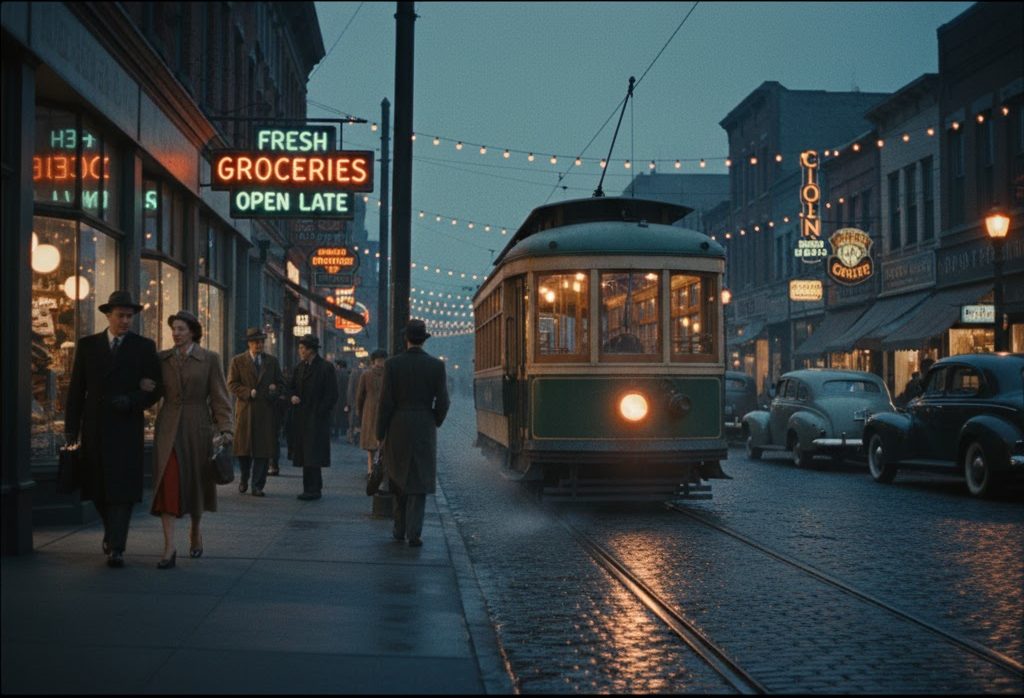
On the evening of December 6, 1941, the United States drifted toward bedtime in the same manner it had drifted through the entire year—uneasily, but not uneasily enough to imagine what waited on the far side of midnight. Nothing suggested history was breathing down the nation’s neck. Streetcars rumbled on schedule, grocery clerks counted coins into registers, families debated movie selections, and shop windows glowed with the confidence of a country that still believed it could arrange the world’s chaos into something manageable simply by staying out of it.
Americans rarely agreed on much in 1941, but they did share one thing on December 6: no one thought the next morning would change the century.
Across the continent, the day carried the feel of any other early-December Saturday. A dusting of snow lay on porch railings from New England to Minnesota, while the South moved through the mild chill of winter that wasn’t quite winter yet. In California, the coastal fog stuck to the early hours before giving way to the soft light that made shop awnings glow along the streets.

College students traveled home for Christmas break. Factory workers handled their shifts with the tired determination that came from a long year of overtime in industries that weren’t officially at war—but were doing everything but admitting it. Even those who followed world news closely felt that the storm abroad was still far away. The carnage in Europe, the German siege lines on the Eastern Front, the Japanese occupation of Asia—these were troubling, yes. But distant. Manageable. Containable.
In living rooms across the country, radios crackled to life with dance bands, college football analysis, and advertisements promising a prosperous Christmas season. If the world was coming undone, it did not say so plainly on the airwaves.
On this day—the last ordinary day—Americans thought they understood where they stood.
The News, Such as It Was
The newspapers of December 6 show a nation peering at the war through a window of denial.
In Chicago, the Tribune ran a brief piece on Japanese envoys in Washington, still “negotiating in earnest.” In Boston, the Globe emphasized the latest updates from Europe—reports of German troop movements, speculation about winter offensives, the grueling phase of a war that had become strangely predictable in its unpredictability. The Pacific, by comparison, appeared quieter. Not calm, but quiet.
In Washington, a small, easily overlooked article noted that peace talks with Japan remained “strained but continuing.” The phrasing could have fit a dozen days that year. It drew no alarm.

Nobody reading their breakfast paper realized the Japanese fleet had been at sea for nearly two weeks.
What they did know, because every paper printed it with pride, was that American factories were producing more planes, more jeeps, and more munitions than ever before—just in case. It was national insurance, nothing more.
At least that’s what people told themselves. It made sense; their elected leaders and officials had spent the past 2 years going to great effort to communicate that message.
Saturday Errands, Wartime Shadows
By late morning, towns and cities settled into the routine of a Saturday.
In Pittsburgh, steelworkers leaving their night shift walked into the pale light of a winter morning, tightening their coats as they stepped into the cold air rolling down the rivers. Many of them had brothers or nephews in the National Guard. Some had worked extra hours that week; overtime was everywhere, and the money helped.
In New Orleans, women carried shopping lists tucked inside their gloves as they browsed department stores decorated for a holiday season that promised to be a little thinner than usual. Rationing hadn’t begun, but for many the Great Depression was still going on.
In Kansas, farm families drove into town for groceries and feed, parking their dusty trucks beside the curb while children pressed their noses to store windows filled with toy trains, baby dolls, and holiday candies. The clouds were low over the plains that day, the kind of overcast that made dusk arrive early.

In Portland, dockworkers ate their lunches on crates stacked along the waterline, the smell of sawdust and brine drifting with the constant gust of salty breeze. The maritime yards had been busier for months, though no one said why out loud.
A country can sense a change in the wind without admitting that a storm is coming.
As dusk fell across the country, the familiar glow of household lamps filled neighborhoods from coast to coast. Kitchens clattered with the sounds of supper—pork chops sizzling in cast-iron pans, potatoes boiling, children arguing about whose turn it was to dry the dishes.
And then came the radio. Every evening, it was always the radio.
Across living rooms, families tuned in to the Saturday night lineup. The laughter of comedy shows, the baritone voices of news broadcasters, the tunes of big-band orchestras filled the air. Radio was a national meeting place, and on this night it was as entertaining and comforting as ever.
In some homes, the evening news played in the background, its updates about Japanese diplomatic maneuvers sounding too technical or too routine to cause increased attention or worry. “Negotiations continue,” the announcers repeated. “No breakthrough yet.” These were familiar phrases. They carried no urgency.

If anything, most Americans were more concerned with Christmas shopping or next week’s weather than foreign diplomacy. The Pacific seemed impossibly far off—half a world, half an ocean, and an entire reality away.
On the West Coast, where proximity should have mattered more, it didn’t. Hawaii existed in the public imagination less as a strategic outpost and more as a postcard: palms, surf, fruity drinks, and the scent of tropical flowers carried on warm breezes. Military men stationed there wrote home about the sunsets.
No one envisioned Japanese bombers arriving from out of that same sky.
Not yet.
Historians often write that America was “sleeping” on the night of December 6. That’s not quite right. The nation wasn’t asleep. It was restless—aware something was coming, but certain it wasn’t coming tomorrow.
People felt tension. They read headlines about convoys attacked in the Atlantic, about London on fire, about the German war machine pressing through Europe, about Japanese expansion in Asia. They knew the world was burning.
They simply believed they could keep the fire at a distance a little longer. Some believed a lot longer.
A mother in Cincinnati ironing shirts for Sunday service might have paused during the news broadcast, frowning silently at a headline about Japanese fleet movements—then shrugging, returning to her work. A shopkeeper in Syracuse might have murmured to a customer that he didn’t like “the look of things overseas” but added, with confidence, that America wouldn’t be dragged into the fighting unless it chose to go.
Even the skeptics—the ones who muttered that war was only months away—didn’t imagine a dawn attack on a quiet naval base thousands of miles across the Pacific.
Imagination failed because America hadn’t yet learned to think in those terms.
The Last Peaceful Night in Honolulu
And while the mainland settled in for the night, Honolulu moved into a warm Saturday evening.
Hotel bars along Waikiki clinked with glasses, the sound heard over the laughter of servicemen on weekend passes. Fresh leis hung from the necks of sailors milling about the sidewalks. Musicians played ukulele and steel-guitar sets to crowds that drifted in and out under strings of decorative bulbs.

The base at Pearl Harbor was quieter. Men returned to ships and barracks, some falling asleep early, others writing letters or reading paperback novels with flashlights. A few milled about and stood outside smoking, the glow of their cigarettes visible in the darkness as they talked about home, about girlfriends, their next leave, or about what they’d do with their next paycheck.
Some wondered aloud whether war was coming. Most assumed they’d have time to prepare for it.
A handful believed it might not come at all.
While they spoke, six Japanese carriers carved a path across the Pacific.
Midnight Without Meaning
When the clock struck midnight on the East Coast, Sunday, December 7 arrived with no fanfare. Frost formed on windows. Furnace grates or fires groaned and crackled in the quiet. In most homes, the only light came from a lamp left on in the hallway for children afraid of the dark.
The nation slept without fear.
Even in Washington, where encrypted cables and diplomatic communiques had been circulating all day, the mood remained calm. Troubled, perhaps, but not frantic. Japanese diplomats had met with American officials earlier; the talks had not gone well, but they had not collapsed. No one left the meetings believing that an attack would occur in a matter of hours.
War, it seemed, still belonged to the distant future.
At least until the phone would ring in the early hours, waking military officers who would rub their eyes, pick up the receiver, and begin hearing snippets of reports that made no sense at first.
But that moment hadn’t come yet.
And so the country slept.
The Last Ordinary Dreams
It is a simple, almost painful truth: the last dreams of peace in the United States were nothing monumental.
In New Jersey, a boy dreamed of snow—real snow, the kind that coated the world and closed schools. In Oklahoma, a man dreamed of the need for profitable wheat fields, or of the long lines his tractor left in the soil. In Oregon, a woman dreamed of her son stationed somewhere far away, hoping he would be home for Christmas.
In California, a young couple asleep in a small bungalow dreamed of nothing at all. The windows were cracked open to the cool coastal air. They expected to wake late the next morning, make coffee, and take a leisurely walk before church.
In Kansas, an elderly widow dreamed of her husband, gone two winters now. She dreamed of their first house, and the tree he planted in their yard in 1901.
Nothing about these dreams hinted at the news that would wake them.
There are moments in history when a nation stands on the hinge of time without any awareness that it is doing so. December 6, 1941, was one of those moments—a day suspended between two eras, appearing at the time to be only a continuation of what had come before.
But the clues were there for those who knew how to look: the long, anxious conversations in Washington, the coded cables, the half-finished communiques, the unscheduled telephone calls between military officers in the Pacific. The Navy knew tensions were extreme; they did not know how extreme. The Army suspected movement in the Pacific; they could not guess the exact shape or timing.
Civilians sensed the pressure only in abstract ways: rising defense production quotas, price shifts, news reports, the hurried pace of government initiatives. But abstraction cannot pierce ordinary life, and so ordinary life continued anyway.
Families planned Christmas menus. Children daydreamed about presents. Couples bickered about money. Radio hosts cracked jokes about politics. Baseball fans argued about next year’s prospects.
The country moved through its last hours of peace with the stubborn assumption that dawn would bring more of the same.
It would not.
The Final Hours of the Old World
Somewhere over the Pacific, not long after midnight in Hawaii, Japanese pilots prepared for sleep in dimly lit carrier cabins. They checked equipment, folded flight suits, wrote letters, or discussed what was to come. Some wrote in diaries. Others simply lay back, eyes open, listening to the engines hum beneath them.
In their minds, they rehearsed the attack that would begin in a matter of hours—an attack meant to stun the United States long enough for Japan to complete its conquests in Asia. They did not know how Americans would react. They knew only that they had their orders.
As the pilots tried to rest, Americans across the continent shifted in their beds, unaware that the world—their world—was already changing.
History had begun its approach.



Leave a Reply