
Author’s Note: Most writing about this week in 1941 focuses on leaders, strategy, and military decisions. This series takes a different angle. It looks at how December 7–13 was felt by ordinary Americans—in their homes, stores, churches, and workplaces—as they tried to make sense of a world that had changed overnight. It’s a look at the first week of the war as most people lived it, far from the headlines but shaped by them all the same. To catch up, check out the stories for December 6th, 7th, 8th, 9th, 10th, and 11th.
Friday, December 12, 1941, was the first morning Americans woke up to the full reality of a declared World War where the ‘front’ could be nearly anywhere. The immediate shock was over, replaced by a growing and fiery determination. This was the moment the country truly understood the conflict would not be a brief sprint for revenge, but a long, grinding effort that would fundamentally change every detail of American life, from the factory floor to the kitchen table.
The previous day’s declarations from Germany and Italy had unified the nation politically, but Friday brought the full psychological weight of that unity. It was the moment Americans had to reconcile the nation’s immense manufacturing power with the sudden, necessary limitations on personal consumption. The calendar, pointing toward Christmas, contrasted with the news, which overwhelmingly pointed toward a sustained global struggle.
Morning: The Contradictory Street and the Headlines
The day began with a jarring juxtaposition on Main Streets across America. Municipal workers were busy putting up traditional Christmas decorations—Christmas trees, wreaths, strings of lights, and banners wishing goodwill. Yet, right alongside them, other crews were hanging massive, hastily printed banners calling for War Bond purchases and posters urging men to “Enlist Now”. The Christmas season had arrived, but it was overshadowed by the immediate demands of war. The smell of fresh pine and the sight of tinsel clashed with the headlines of the newspapers, which were being snapped up as quickly as publishers could create them.

The front pages of the morning papers hammered home the implications of yesterday’s declarations. The headlines were no longer solely about Pearl Harbor, but about the Axis alignment—the political, economic, strategic, and moral consequences of fighting Germany, Italy, and Japan simultaneously. Radio provided rolling updates throughout the day, ensuring no one could escape the scale of the commitment. Dispatches continued to report Japanese landings and actions across the Philippines, including new actions around Legaspi in southern Luzon. The siege of Hong Kong, where a small British and Canadian force was dug in, also began appearing in news copy, signaling the unstoppable, multi-pronged nature of the enemy assault.
The U.S. Postal Service became an immediate wartime choke point and emotional hub. The volume of mail surged to unprecedented levels. Across the country, postal clerks struggled to process the torrent of worried, determined farewells being exchanged between citizens, service members, and families. People rushed to send cards and letters, believing even this most basic method of communication would soon become impossible, or at least agonizingly slow. This burst of activity added to the morning’s atmosphere—a rush of anxious goodbyes wrapped in the language and guise of holiday greetings. The postal worker, shuffling envelopes addressed to Army posts and naval bases, was one of the first logistical casualties of the war’s increased demands.
In the kitchens, this dual reality of Christmas planning versus war news was deeply personal. A housewife sitting down to finish her last batch of Christmas cards in an Indianapolis kitchen, sealed the final envelope and thought, “Maybe next year Christmas will be different, but I’ll send these now while I can.” Families listened for official bulletins on the rumored rationing and other defense measures, realizing the war’s demands had already moved past the distant battlefield and straight into their pantry and car. The question of whether to buy a turkey or save money for the next War Bond drive was now a national dilemma played out on the domestic stage.
Midday: The Factory and the Pivot
On the industrial front, the transition from peace to war was sudden and shocking to the average American. Workers reported for their Friday shift to find their normal routine disrupted. In a massive auto plant in Detroit, Ford River Rouge, the local union meeting, which was scheduled to discuss a new safety measure, was abruptly canceled.
In the foreman’s office, the shop steward told the waiting group that they needed to reconvene that evening, not about safety or wages, but about “possible war orders.” The implication was a hard one, and another tangible change that brought the war out of the headlines and into daily lives: the assembly line that had produced civilian cars yesterday would soon be producing tanks and bombers. Every collective decision, from hours to pay, would now revolve around the immediate needs of the military. The machinery still moved, assembling consumer goods, but the noise was simply marking time, waiting for the massive national retooling to begin.
Beyond the immediate crisis of rubber, the government began signaling the next phase of economic warfare: the end of non-essential manufacturing. Rumors focused on Washington creating a powerful War Production Board (WPB) to replace the Office of Production Management (OPM) and other existing boards, whose job it would be to seize control of all strategic materials—steel, copper, aluminum, and fuel, and their production.
The opportunities of the American peacetime economy—endless supply and choice—was canceled in a day. News reports and government directives made it clear that the production of nearly all consumer appliances, new housing starts, and, most importantly, private vehicles would soon cease. The average family realized the defense effort meant a total freeze on material comfort. A new car, a washing machine, or even a toaster—symbols of American upward mobility—were now instantly recast as military materiel. Saving for a new refrigerator or car was now pointless; every resource was destined for the military. The war was officially transitioning from an act of vengeance to a battle of industrial capacity, where the measure of success was not miles gained, but tons of steel converted to ships and tanks.
The sudden focus on the coming creation of the WPB immediately hit the heart of American industry. In plants that manufactured aluminum pots and pans, foremen were told to prepare to shift to aircraft components. In textile mills, dye orders for vibrant civilian clothes were cancelled, replaced by massive government orders for olive drab and navy blue uniforms. For the common factory worker, this change was often personal and disruptive, not to mention abrupt: the skilled welder who had spent a decade perfecting the chassis for a luxury sedan was suddenly told they would be assigned to a tank hull, the work harder, the margin for error smaller, but the purpose vitally necessary for the war effort. The psychological evolution—from building comfortable lives to building armaments—was the first sacrifice demanded of the home front.
This industrial transition created a massive psychological change for the American worker. The job, labor, was suddenly sanctified. Work was no longer just about the weekly wage; it was a direct, patriotic contribution to the survival of the country. Factory owners and union leaders, often fierce rivals, now found themselves on the same side of the table, discussing how fast they could switch from making chrome trim to making artillery shells.

Afternoon: War Infiltrates the Cinema and the Neighborhood
The movie theater, traditionally the great place of escapism, was now a reluctant auditorium where reality intruded. On Friday afternoon, teenagers who cut class for a matinee found the experience changed. The newsreel, which used to be a short, breezy feature of fashion and society gossip, was now noticeably longer and serious, and completely focused on the war. The earlier news of the massive British naval losses—the sinking of the Prince of Wales and the Repulse—still made its impact, casting a shadow over all military movements shown on screen.
The images flashed on the screen: grainy footage of military bases, official portraits of generals, and maps tracing the collapse of the Pacific defense line. Even as new films like Lon Chaney Jr.’s The Wolf Man premiered that week, the adults, unable to shed the burden of the moment, brought their anxieties into the movie house, making the fantasy on screen feel frivolous and distant. The applause for the hero on screen was often less enthusiastic, reserved instead for the patriotic messages that ran over the closing credits. Studios and media outlets wasted no time in taking up their new wartime role. Their success, through countless mediums and methods would be a remarkable story in the end, but this week was its beginning.

The fear of the enemy also turned inward. With Germany and Italy now declared enemies, the Justice Department had immediately expanded the “enemy alien” policy. While Japanese nationals were the first targeted, registration for all German and Italian non-citizens was now mandated.
The expanded enemy alien policy meant thousands of long-term residents—barbers, shopkeepers, meat cutters, and factory workers—were suddenly required to register their residence, carry special ID cards, and were subject to immediate travel restrictions. This was a major source of sudden stress and resentment for men and women who had often lived in the United States for decades, raising American children and running businesses. They had to present themselves at post offices or police stations, were fingerprinted, their identity documents stamped and their movements tracked. This created friction in neighborhoods, as non-citizen friends and neighbors became marked and tracked as “enemy aliens.”
The social friction created by these new rules was immediate. In cities like New York, Chicago, and Philadelphia, where millions traced their heritage to Italy and Germany, the knowledge or sight of a neighbor carrying the new, government-issued “Enemy Alien” ID card and book—an official ledger detailing their identity and movements—was a mark of suspicion. Children of these non-citizens often faced questions and taunts in school, while adult workers faced pressure in their unions and factories to prove their dedication to the American cause. This legal necessity, born of wartime distrust and need for security, planted seeds of social distrust, forcing entire communities to aggressively demonstrate their loyalty under threat of detention.

Evening: Commitment and the Atlantic
As the country headed into its first true wartime weekend, the sense of national resolve was expressed in thousands of local actions. Recruiting offices across the country remained swamped, with countless towns reporting men still lining up for information and to sign up. The immediate pressure on the system created by the waves of volunteers was immense.
The gravest strategic consequence of the Axis declaration was the immediate pivot of naval attention to the Atlantic. The threat of German U-boats, once considered a distant British problem, was now imminent off the East Coast. The U.S. Navy was forced to divert critical resources from the battered Pacific to establish new convoy routes and patrol zones to protect shipping lanes from New York to the Caribbean. The desperate Anti-Submarine Warfare (ASW) action began that day, shifting the home front’s immediate civil defense focus from Pacific aerial attack to the silent threat lurking just offshore.
The necessity of ASW was immediately clear to coastal communities. Local governments rushed to organize volunteer auxiliary Coast Guard patrols. These were not military ships, but private fishing trawlers and yachts hastily fitted with radios and basic signaling equipment, manned by volunteers who knew the coastal waters better than any Navy officer. The objective and their instructions were simple: spot, report, and warn. These volunteers understood that their work directly protected the massive oil tankers and cargo ships vital to the Allied war machine. A successful U-boat strike on a coastal tanker or cargo ship was an immediate and terrifying danger that brought the war home to the Eastern Seaboard. The Atlantic battle was fought in the cold darkness, and the average citizen’s involvement was immediately necessary. The sight of these converted pleasure craft, usually associated with summer relaxation, now patrolling the frigid December seas was an unmistakable sign that the war had come upon them.
In a small town church in rural Ohio, the message board was updated. A municipal worker climbed the short ladder, erasing the time of a previous meeting and replacing it with a new message: “PRAYER MEETING TONIGHT — FOR PEACE AND FOR OUR SONS IN UNIFORM.” The war was no longer political news from a distant land. More and more, it was an empty chair at the family table, a name on a telegram, a loved one departing the train platform, and a shared reason to gather beneath the steeple. The tradition of blue and gold-star families—visible symbols of the human cost of the growing conflict—began to take hold once again, transforming home windows into visible declarations of sacrifice.

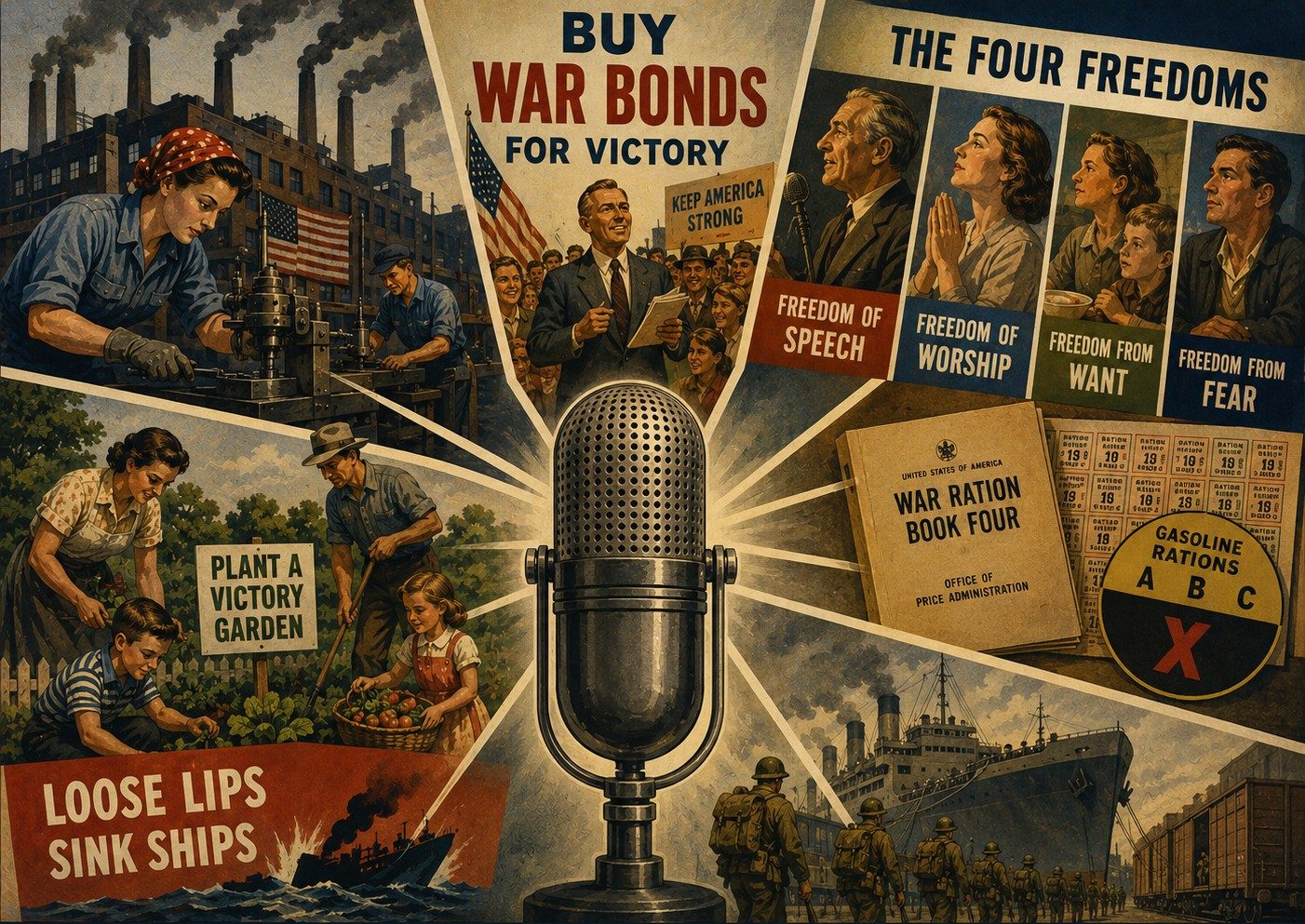
By nightfall, the serious reality was evident: the Pacific front was still collapsing, and shipping losses in the Atlantic hinted at the scale of the fight to come. The United States was shifting its vast industrial base to war footing. This transition was evident not just in Washington’s strategic plans, but in the immediate, practical efforts across the country: workers accelerating production in factories, families practicing strict frugality, and communities organizing air raid defenses and scrap drives. The long haul had begun.




Leave a Reply