Author’s Note: Most writing about this week in 1941 focuses on leaders, strategy, and military decisions. This series takes a different angle. It looks at how December 7–13 was felt by ordinary Americans—in their homes, stores, churches, and workplaces—as they tried to make sense of a world that had changed overnight. It’s a look at the first week of the war as most people lived it, far from the headlines but shaped by them all the same. To catch up, check out the stories for December 6th, 7th, and 8th.
On Tuesday, December 9, 1941, the United States moved past the shock of the attack and the formal declaration of war. This was the first complete day of America’s wartime footing—the moment the abstract conflict became a physical, tangible requirement for resources and commitment. The high-anxiety energy of the previous two days began to be replaced with an introduction to the demanding reality of a sustained global conflict.
The country woke not to disorder, but to a sudden, growing, rigid order. The transformation was occurring quickly, reaching into every corner of life and creating instant confusion. Over breakfast tables across the country, where families gathered with the serious news of the local newspaper, the scope of the new situation began to sink in. It was a day of sharp, and unique contrasts: the bureaucratic swiftness of Washington clashing with the personal fear on West Coast sidewalks; the patriotic call to action tempered by the very real loss of mobility and comfort.
Morning: Loss, Fear, and the False Alarm
The morning papers carried the serious, expected news: the Japanese military was pushing its advantage across the Pacific. “GUAM TO FALL TO JAPS; ENEMY PUSHES ON WAKE; U.S. FREEZES ASSETS.” The headlines were big and bold, often printed over maps of the distant Pacific suddenly made central to American life. America was not just at war; it was losing territory quickly, a fact that emphasized the necessity of the sudden, broad actions being taken on the home front.
The government’s immediate response was both military and financial. The headline regarding the asset freeze pointed to the unseen struggle led by Treasury Secretary Henry Morgenthau, Jr., a financial mobilization of an unprecedented size. All Japanese-owned assets in the United States were seized. This wasn’t merely a policy; for thousands of people, it was an immediate, final break from old commerce, confirming that the divide was absolute. Businesses could no longer access their money; importing silks or toys became instantly impossible. The economic door slammed shut.
This rising stress tested the public’s nerves for the first time. On the West Coast, the anxiety over an enemy attack was showing up in visible changes to the landscape. Air Raid Wardens, quickly appointed from the volunteers who rushed to sign up yesterday, were given their initial official duties. Many were simply neighbors with armbands, navigating a new framework of rules they had barely learned—men who, yesterday, had been accountants or grocers, now had the authority to demand compliance from those living next door.
The Blackout Takes Hold
In coastal cities like Los Angeles, Seattle, and San Francisco, blackouts and dim-outs were finalized and enforced with sudden, near-total strictness. City workers spent the predawn hours painting the tops of streetlights black to aim illumination downward. Neon signs—those vivid, flashing markers of American urban vibrancy—were ordered shut off.
For residents, the new restriction on light was a new, disconcerting challenge. Walking the streets of San Francisco’s Market Street or Hollywood Boulevard felt like traversing an entirely different city—one dark and strange. The familiar, friendly glow of a neighbor’s window or a local watering hole were gone. In the denser neighborhoods, residents often mistook the deep shadows of trees for potential dangers, their nerves and anxiety raw from hours of constant radio bulletins and rumors. Even the act of stepping outside required a new kind of alertness, a constant scanning of surroundings and the obscured edges of buildings.
But worry wasn’t confined to the west coast. In cities like New York, false air-raid alarms rattled nerves in the late afternoon. The city’s civilian defense infrastructure, rapidly throw together, struggled to manage the inevitable confusion and fear. The alarm, sometimes just a glitch in the warning system or a misidentified plane, sent panic through Manhattan. People stared at the sky, some seeking shelter in subway stations, terrified of an enemy they had only just declared war against. Though no aircraft were seen, the brief bout of chaos proved that the war was already affecting minds.

At home, the simplest routine—reaching for a light switch after dark—became a violation of national security. Families hurried, securing heavy blankets or dark paint to windows, turning their homes into strange, shadowy shelters.
These transformations of the environment had a massive impact on the average American. Mothers searched linen closets for the heaviest quilts; fathers nailed cardboard or old blackout curtains across the glass. The smell of fresh paint and saw dust mixed with the familiar smells at breakfast in the homes of many cities. This unusual new chore was a major change: the world outside the window was now treated as hostile territory. The light from a kitchen lamp, which just two days ago was a sign of domestic safety, was now a potential target beacon. The entire surrounding area was now a possible battleground. The shared feeling was that if any light escaped, the fault rested on the household. This small, domestic burden was the first widespread physical compromise asked of American families.

Midday: The Halt of Mobility and the Rubber Panic
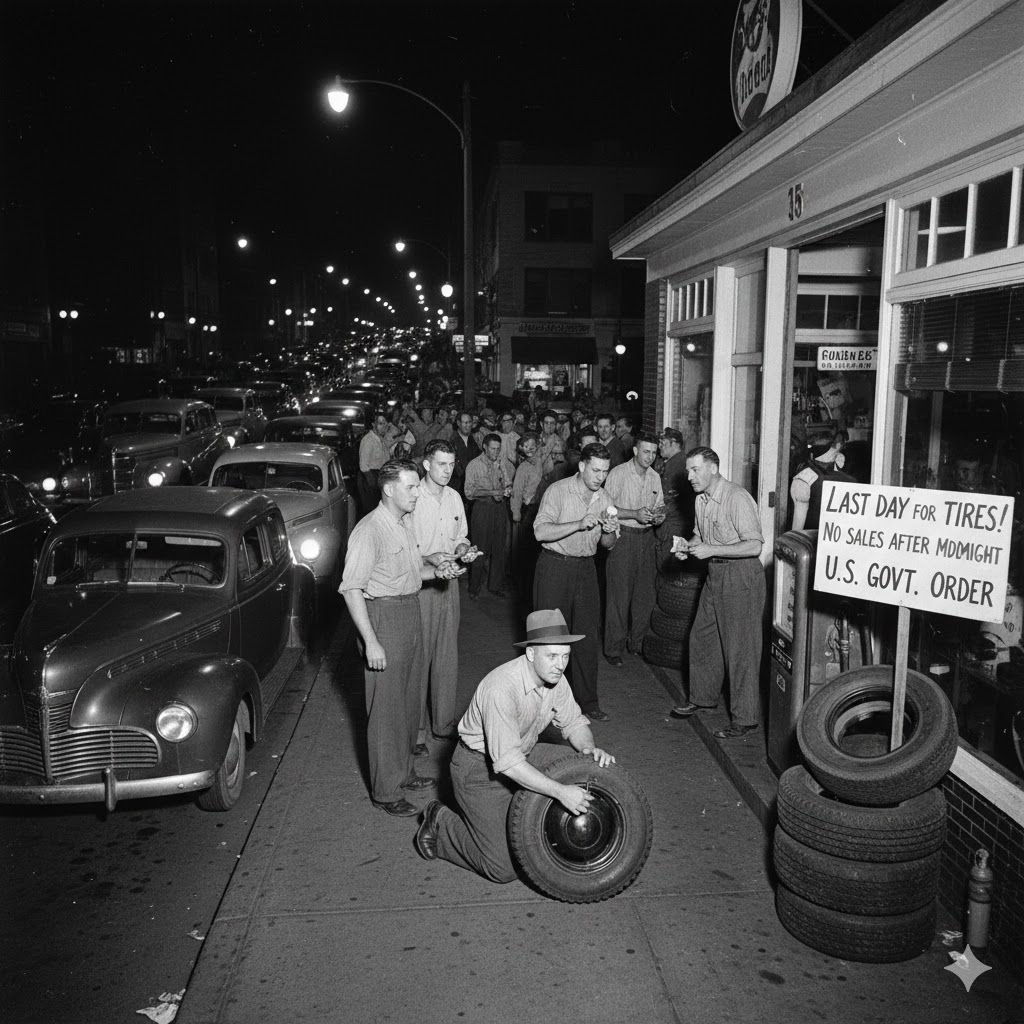
The most sudden and pervasive consequence of the war—though not yet an official order—was about to strike Americans right in their garages: the Tire Freeze.
By December 9th, the government was working with emergency speed to issue one of the most stunning economic controls: a nationwide halt on the sale of all new tires and tubes to consumers. The primary source of rubber, Southeast Asia, was now under immediate threat of Japanese invasion, and officials signaled this crucial material would be classified as a military resource.
As one can imagine, the imminent news immediately created last-minute chaos. Across the nation, gas stations and auto garages were overwhelmed by drivers desperately trying to buy the last available tires before the expected cut-off. People were frantic. Lines of cars stretched down city blocks, often blocking traffic and requiring police direction. Drivers argued with shop owners, pleading, offering high prices, and demanding to be served before the clock expired and the anticipated order made the tires unobtainable.
One Chicago filling station owner reported selling three months’ worth of stock in a single afternoon. The transactions were rushed, cash-fueled bidding wars, and often accompanied by a strong sense of nervousness. People did not view these as optional purchases; they were transactions about maintaining the structure of their daily life. The urgency was personal, rooted in the culture of American life and business, which had been built on the promise, and need, of individual movement and liberty.
Men who had spent years treating their cars as symbols and tools of independence were suddenly faced with the reality that their ability to travel was about to be conditioned by the war effort. The average American car owner realized, with a shock, that the sacrifice required by the war would go far beyond cheering a troop train—it would hit them right where the rubber met the road. The idea of simply buying new tires when the old ones wore out—a normal part of modern life—was about to be instantly cancelled.
The change in behavior was immediate. People began to nervously check the air pressure in their old tires, thinking of every mile driven as the finite, irreplaceable resource that it now was. Carpooling, which had been a minor, money-saving habit, began evolving into an immediate requirement. The national discussion shifted from which new model they might buy to how many miles they could stretch out of their existing rubber.
The government, anticipating the long-term shortage, would quickly begin publicizing methods for tire conservation, including strict adherence to speed limits and proper wheel alignment. The tire gauge, a simple tool, became an unexpected symbol of national security and personal duty. It was the moment Americans understood that the war would not just be fought overseas; it would be won or lost on the home front through the painful lack of everyday goods.
Afternoon: Manpower, Adaptation, and the New Normal
While the recruitment surge continued from the day before, the mood in the long lines outside Army and Navy posts was less frenzied and more determined. The initial wave of emotion was beginning to give way to a more focused sense of duty.
The line wrapped around the corner of the downtown post office, where the Navy recruiting desk had been hastily set up. It was just past dawn. Some men still wore their work clothes—machinists, clerks, a few students in worn varsity jackets. The man ahead, a steelworker from Ohio, told a reporter he hadn’t slept since Sunday. “I got a boy in the Navy, too” he told others. “He’s out there somewhere.” The rush to enlist was now replaced by an organized processing of paperwork and medical exams, and the first quick wartime goodbyes were taking place at train stations across the country.

The Factory Floor Turns to War
The war also entered civilian workspaces and schools with noticeable speed. Factories and offices displayed fresh flags, sometimes quickly hung up by janitorial staff. The massive industrial heartland, particularly the automotive center of Detroit, became a focus of the change. On December 9th, war production meetings began in earnest. Managers and government liaisons convened about retooling the assembly lines.
The scope of the task was immense. General Motors, Ford, and Chrysler were immediately faced with a huge challenge: turning from making millions of cars, which required complex, highly specialized machinery, to building tanks, bombers, and weaponry. This day marked the beginning of what would become the great American production effort in the war. Engineers and foremen, often meeting late into the night over blueprints in smoke-filled rooms, calculated the sheer tonnage of steel, aluminum, and time needed for this transformation. The focus immediately shifted from designing stylish fenders to designing reliable machine gun mounts. The phrase “defense contract” replaced “sales forecast” in every executive discussion.
In offices across the nation, typists wore buttons reading “Remember Pearl Harbor.” Clerks and secretaries began organizing massive scrap drives, starting with their facilities. The atmosphere was one of purpose, where normal office chatter was replaced by serious discussions of war and casualty reports.
Schools became immediate centers of patriotic teaching. Teachers across America read newspaper excerpts aloud in civics classes and led students in the Pledge of Allegiance, adding new, often spontaneous prayers for soldiers in Hawaii and the Philippines. The curriculum, from elementary school to college, was subtly but swiftly redirected toward the war effort. Students were urged to participate in war bond efforts and to save materials.
Daily routines continued, but war now began to run through everything. The grocery circulars carried prominent war-bond messages. The crowds gathering in movie theaters—still a crucial escape—often left early, unwilling to sit through the second feature, eager instead to catch the latest news bulletin flashed onto the screen: “LATEST NEWS: WAR.” Even relaxation, what little there was and would be, was framed by the war effort.

Evening: The First Fireside Chat on War
The final act of the day occurred that evening as tens of millions of Americans gathered around their radios. President Franklin D. Roosevelt delivered his first wartime Fireside Chat, formally titled “On the War with Japan.” The reassuring voice of the President was the comforting guarantee the nation needed after two days of shock and uncertainty.
For many, the radio had been a source of worry since Sunday, delivering fragmented, frightening updates. Now, it was a source of national direction.
For most, the broadcast opened with measured music, then the President was announced, and Roosevelt’s familiar voice was heard:
“My fellow Americans, the sudden criminal attacks perpetrated by the Japanese in the Pacific provide the logical outcome of a decade of international immorality.”
He was masterful, taking the shock and channeling it into righteous anger and, most importantly, a clear path forward. “We are now in this war. We are all in it—all the way.”
Families paused at supper tables and churches opened their doors for group listening sessions. The collective silence that fell over the country during the address was a momentary halt of all activity, replaced by the President’s voice filling the air with the first explanations Americans had heard during the most chaotic week they had ever known.
For millions, those words confirmed what had already settled in since Sunday: the United States was not just avenging Pearl Harbor—it was entering a fight that required total commitment. He spoke directly to the home front, not just the front line, emphasizing the role of the industrial worker, the farmer, and the housewife. He told them that dedication was essential, that rumors were destructive, and that the long, hard effort was now beginning.
After the address, radio commentators offered analysis; in homes and cafes, silence lasted for a few seconds before conversations resumed, injected with a new sense of mission, a shared, necessary destiny. The national soundtrack shifted further away from the easygoing “Chattanooga Choo Choo” toward patriotic themes and news of the day. That night, factory workers, railroad men, plumbers, teachers—maybe even that Navy recruiter at the Post Office who had processed the steelworker from Ohio—would lock up early, go home, and sit with their wives to hear the President’s final words fill their homes. The national anxiety had not vanished, but it had been given structure, a collective mission to focus upon.
Nightfall: The Dark Side of Security
The message of unity delivered by the President carried an unsettling counterpoint that intensified on December 9th. While Roosevelt spoke of the spirit of freedom, federal agents accelerated the immediate and targeted arrest and confinement of Japanese nationals (Issei) and known community leaders on the West Coast, regardless of their citizenship status.
Building on the hostility witnessed the day before—where FBI agents had begun rounding up suspects on pre-existing lists—the scale of the arrests grew rapidly. The legal basis was weak and based on the concept of “enemy alien.” But the practical reality was one of fear and suspicion overwhelming civil liberties.
In neighborhoods from Seattle’s Nihonmachi to the Japantowns of Los Angeles and San Diego, small businesses and grocery stores—often operated by Japanese families—were suddenly dark, locked, and marked with official government notices. New York City Mayor Fiorello LaGuardia had ordered businesses owned by people of Japanese descent closed and all Japanese-Americans confined to their homes since December 7th. These policies and targeted arrests created an atmosphere of terror and resentment for entire communities. Children came home from school to find their fathers gone; neighbors were suddenly suspicious of one another; the vitality of vibrant communities was being drawn away by government cars and orders.
The simple truth was that the first target being subdued was not overseas, but within the country’s own borders. This was the wars first, unsettling instance of civil liberties being jeopardized in the name of national security. The government had drawn a line, declaring that ethnicity—not just loyalty—could disqualify a person from the protections of the state.
As the moon rose, the West Coast remained under strict blackout orders. The panic over tires slowly subsided and began to be accepted as a new fact of life, one of many that would come in time. The President had helped to get the American public prepared for what they would face. Life in America would never be the same again, and the fear of the enemy was only one factor in a enormously complex conflict. December 9, 1941, closed as the day the United States began to understand that the war was not a momentary shock but a lasting reality that would reshape every corner of American life.



Leave a Reply