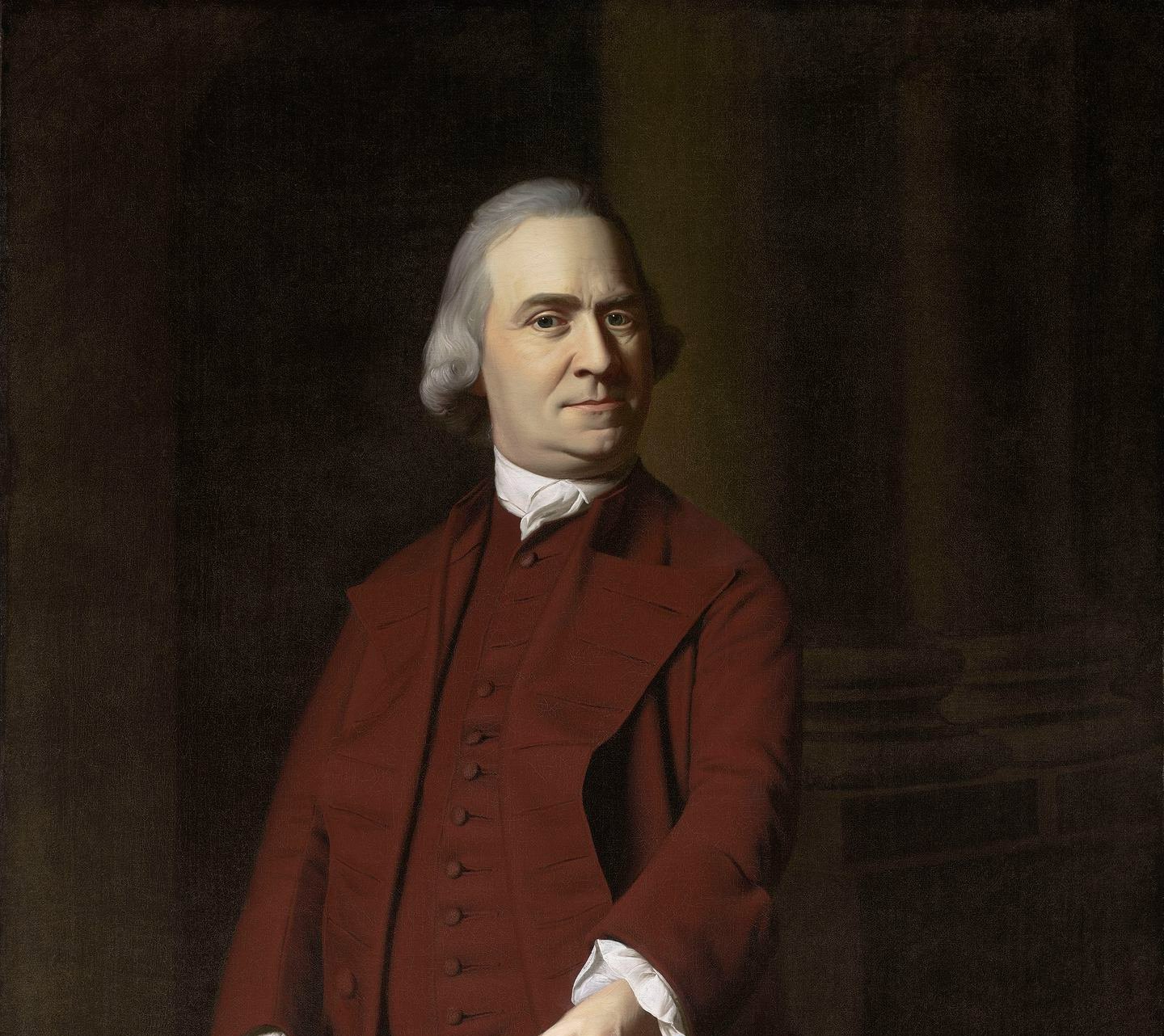
Samuel Adams was not just a revolutionary; he was a fervent champion of liberty who believed in the power of the common people to shape their destiny. With passionate conviction, he ignited the flames of revolution against the British as a man of the people.
From the streets of Boston to the halls of colonial governments, Adams’ relentless dedication to freedom fueled the spark that would ignite a revolution—a revolution for the rights of ordinary men and women to govern themselves, in addition to the idea of independence.
Samuel Adams is often one of the overlooked figures of the American Revolution, overshadowed by more prominent founders such as George Washington and Thomas Jefferson. However, his strategic intelligence in organizing and mobilizing resistance against British rule was vital to the Revolution’s success.
What set Adams apart was his ability to connect with and rally ordinary citizens, turning their anger into action. Through his network of political thinkers and street leaders, Adams helped create the revolutionary spirit that culminated in events like the Boston Tea Party. The Tea Party would be remembered as one of the most defining moments in American history.
A Life Guided By Dissatisfaction
Though largely overlooked now, the spark of the revolution is tied to the type of man that Adams was. Born in 1722, Adams came from a family entrenched in Boston’s political life.
His father, a prosperous brewer and a respected public figure, participated in the early political clubs that were at the root of colonial dissent. Unlike many of his contemporaries who went on to profitable careers in law or commerce, Adams’ early life was largely marked by repeated financial difficulties.
He tried his hand at the malting business—inheriting his father’s trade—and served as a tax collector for the town of Boston, a position in which he was notable for often not collecting taxes.
Far from disqualifying him, these early experiences prepared him for his revolutionary role. His lack of financial success made him less tied to the commercial interests that often favored reconciliation with Britain. More importantly, his work as a tax collector, however flawed, kept him connected to the everyday lives and financial burdens of Boston’s citizens.
Simply, he witnessed firsthand the economic hardship and the building resentment toward distant imperial rule.
While others spoke of philosophical ideals, Adams spoke from a place connected to the common people. This gave his political voice an honest tone that few of his peers could match.
He was a tireless, somewhat threadbare agitator whose greatest strength was his steady commitment to the cause, a dedication that bordered on obsession. He saw the British policies as moral insults to a people with a God-given right to self-governance, not just political issues.
The Pen is Mightier: Mastering the Art of Revolutionary Communication
Samuel Adams was more than just a political thinker; he was a master of public relations in an era when the press was still a new and powerful tool for shaping public opinion.
Adams grasped how important it was to mold the colonies’ scattered complaints into a unified cause that resonated with the masses. He used the press to distribute revolutionary ideas, which became one of his most successful contributions.
As a leader of the Massachusetts patriot movement, Adams worked closely with the Boston Gazette, one of the most widely read newspapers in colonial America. Through articles and pamphlets, Adams succeeded in gathering support for independence, presenting it as a struggle for the liberty of the colonies.
He wrote constantly, often using pen names like “Vindex” or “Candidus,” to encourage resistance against British rule. His articles were carefully designed to wake up the colonial conscience to the dangers of British dominance, particularly through the imposition of taxes such as the Townshend Acts.
His talent lay in the way he constructed stories. He didn’t restrict himself to debating the legality of a tax; he painted vivid scenes of British corruption and the immediate threat of colonial servitude. He used language that was direct and morally loaded, changing abstract political theory into a recognizable and relatable fight between right and wrong.
For Adams, the cause was always portrayed in the simplest terms: liberty or submission. This dramatic framing was key to turning lukewarm discontent into revolutionary passion.
“The liberties of our Country, the freedom of our civil Constitution, are worth defending at all hazards: And it is our duty to defend them against all attacks.”
The Boston Gazette report on the Boston Massacre gave Adams his most powerful material. The confrontation, which resulted in the deaths of five colonists, was instantly renamed by Adams and his associates not as a street incident, but as a “massacre.” He worked with Paul Revere to create a dramatic engraving of the event, which showed well-ordered British soldiers shooting at an innocent crowd.
The famous image, which was widely distributed, was a deliberate piece of political promotion that confirmed the image of the soldier as an executioner and fueled the moral indignation necessary for radicalizing public opinion throughout the colonies, and even in England. Adams understood that people react more strongly to a clear injustice than to a reasoned legal argument.
Another important contribution was his Circular Letter of 1768, which condemned the British imposition of external taxes and called colonists to the cause of resisting what Adams and many others viewed as unconstitutional actions. Through this letter and his other writings, Adams established himself as a prominent voice in the movement for colonial self-rule.
The letter was so successful in encouraging cooperation between colonies that the British Secretary of State demanded that the Massachusetts assembly retract it; a demand the assembly refused under Adams’ influence. In addition to giving information, Adams used the press to build anger and unite the people, preparing the ground for future revolutionary steps.

The Street-Level General: Forging the Sons of Liberty
While Adams’ work with the press helped shape public sentiment, it was his tie to the average citizen that truly set him apart. Adams understood that real change could only be achieved if ordinary citizens—artisans, merchants, laborers, and others—were brought into the resistance. This is where his work with the Loyal Nine and the Sons of Liberty comes into focus.
The Loyal Nine, a forerunner to the Sons of Liberty, was a private group established in 1765 to oppose the Stamp Act, and it would grow into a strong force for colonial rebellion. While it began as a protest group, the Sons soon became important in organizing direct actions against British officials, including the destruction of stamped paper and the burning of effigies.
Under Adams’ direction, the Sons gained influence, bringing together a wide range of colonists—from the educated wealthy to the working class—all united under the banner of resistance to British rule.
This was Adams’s great organizational feat: joining the philosophical discussions of the Assembly with the raw force of the populace. He bridged the gap between the town meeting and the local tavern, making sure the movement was both ideologically sound and physically strong.
Adams knew that peaceful protests alone would not force the British to change their policies. The Sons of Liberty were prepared to take more direct action. In 1770, following the Boston Massacre, Adams used the tragedy as a call to action. His clever use of the press helped turn the incident into a symbol of British oppression, while the Sons went into the streets, organizing public protests and increasing friction with the British government.
This mix of political strategy and street-level engagement was necessary for creating an environment ready for revolution. The Sons acted as the organizing arm behind Adams’s ideological work, ensuring that the dissatisfaction felt by the colonists turned into action.
The Unconventional Alliance: Politics and the Street Gang
To further strengthen his network among the common people, Adams formed bonds with key figures in Boston’s working-class communities. One of the most influential was Ebenezer Mackintosh, the leader of the South End Gang, a notable group of artisans and laborers in the poorer neighborhoods of Boston.
Mackintosh, who had close ties to the street-level politics of the city, was an important collaborator for Adams in turning public feeling into direct action.
Mackintosh and the South End Gang played a central role in organizing protests, especially after the passage of the Townshend Acts and the Tea Act. These laws were widely disliked, and the South End Gang, under Mackintosh’s leadership, was ready to take matters into their own hands.
The gang’s members were largely poor workers; men who had little to lose and much to gain from a revolt against British control. Adams understood that the most dedicated agents of change are often those who feel the burden of oppression most heavily and have the least to fear from confrontation.
Mackintosh and his followers were willing to use violence when they thought it was necessary. In fact, Mackintosh became known for leading forceful protests, including the destruction of property and the targeting of British officials.
While Adams was more careful in his public approach, he saw the value in a figure like Mackintosh; someone who could organize the people on the streets and carry out the sort of actions that would make the British sit up and take notice.
The upper-class revolutionaries provided the legal and philosophical reason; Mackintosh provided the necessary force and visibility.
Adams knew that a revolution required both intellectual justification and physical support. His ability to coordinate with varied leaders showed his grasp of the need for an organized and broad movement that could react quickly to events as they unfolded. Together, they formed a strong partnership of ideas and action, ensuring that the call for liberty would be heard both in the newspapers and in the streets of Boston.

The Committees of Correspondence
As the movement expanded beyond Boston, Adams’ organizational talent proved scalable. He realized that localized protests, while important, would not be enough to challenge an empire. The colonies needed a united voice and a shared strategy. His answer was the creation of the Committees of Correspondence.
In 1772, facing a coming crisis over British plans to pay the salaries of judges directly from the Crown—a move that would end the judges’ financial dependence on the colonial legislature—Adams proposed that Boston set up a committee to outline the rights of the colonists and to communicate with the other towns in Massachusetts.
This move was revolutionary in itself. It bypassed the British-controlled government and created a parallel network for sharing information. The committees became the nerve center of the revolution, a hidden network sending out plans, complaints, news, and calls to action quickly.
The initial Boston Committee soon led to the establishment of more than eighty similar committees across Massachusetts. Within a year, the Virginia House of Burgesses suggested that the other colonies establish similar committees to communicate across colonial borders. Adams’ idea had spread widely, creating the first inter-colonial political alliance.
It was through this system that leaders like Adams could share information, coordinate boycotts, and most importantly, establish a single definition of “American liberty” over great distances.
The Committees ensured that when the inevitable confrontation came, the colonies would react not as separate entities but as one organized political body. This network was key to the eventual formation of the First Continental Congress.
The Grand Finale: The Boston Tea Party
As the 1770s went on, the relationship between the colonies and the British government became increasingly strained. Resentment was growing not just in Boston but throughout the colonies, as British policies continued to impose taxes and restrict trade.
By 1773, the British government had passed the Tea Act, which gave the British East India Company a monopoly on tea sales in the colonies. This was seen as a clear attempt to force the colonists to accept British taxation and control over their trade. The issue at hand was not about the cost of tea; it was about the precedent of British taxation without colonial agreement.
In Boston, Samuel Adams and his network were preparing for what they knew would be a defining confrontation. The British East India Company was sending ships loaded with tea to the colonies, and Adams understood that this would be the flashpoint for colonial rebellion. He and the Sons of Liberty had been carefully watching the situation, knowing that the arrival of the tea would demand a response.
The people of Boston were already stirred up by years of British impositions. Adams, with his established network of newspapers, secret groups, and street organizers like Mackintosh, was ready to turn this moment into an opportunity for action.
When the first tea ship, the Dartmouth, arrived in Boston harbor, Adams organized large meetings to demand that the tea be sent back to England. The British Governor, Thomas Hutchinson, refused to allow the ships to leave without unloading. This created a political deadlock, and Adams used the standoff masterfully.
On December 16, 1773, the night before the deadline that would have legally allowed the British to land the tea, Adams organized a large meeting at the Old South Meeting House. The crowd was enormous and full of anticipation. The goal was to reach a final, public decision on the fate of the tea. Adams intentionally allowed the meeting to continue late into the evening.
It was here that the pretense of a purely legal protest was abandoned. As the meeting proceeded, news arrived that Governor Hutchinson would not give in. Adams, standing before the tense, packed hall, reportedly gave the subtle signal that had been pre-arranged, announcing, “This meeting can do nothing more to save the country.”
This phrase was the signal. Immediately following his statement, a group of men, many lightly disguised as Mohawk Indians, streamed out of the meeting house. These were the Sons of Liberty, led by figures from Adams’ network. They went to Griffin’s Wharf, boarded the three tea ships, and systematically dumped 342 chests of tea into the harbor.
The Boston Tea Party was not spontaneous vandalism. It was a well-planned, theatrical act of political opposition orchestrated by Samuel Adams. It was also an action that could not be ignored.

From Agitator to Architect
The reaction from Great Britain was severe. Parliament passed the Coercive Acts, which the colonists quickly dubbed the “Intolerable Acts,” closing Boston Harbor and stripping Massachusetts of self-governance. Far from isolating the colony, this response unified the others, exactly as Adams intended. His Committees of Correspondence sprang into action, coordinating aid and issuing the call for a united colonial assembly.
Adams was chosen as a Massachusetts delegate to the Continental Congress. In Philadelphia, his role shifted from street organizer to wartime legislator.
While Washington commanded the army, Adams was a core member of the civilian government, driving the political machine that kept the fight alive. He was a champion of the Declaration of Independence, pushing it as both a break from Britain, and as a moral justification for the American cause.
When the Revolutionary War began in 1775, Adams was one of the two men (along with John Hancock) the British specifically ordered to be arrested for treason. The skirmishes at Lexington and Concord were, in part, motivated by the British attempt to capture these two high-profile agitators. Adams’ life, at this point, symbolized the revolution; a flight from tyranny and an unceasing commitment to the cause.
During the long, costly war, Adams focused on maintaining the revolutionary spirit and guarding against any hint of centralized power. He served on committees critical to finance and military supply, ensuring the Congress remained committed to the fight even when news from the battlefields was bad. His work sustained the legislative commitment to the Revolution he had started.
The Final Battle: Governing the New Republic
After the war, the master organizer had to become a statesman, a transition that revealed the complexity of his political beliefs. He served as Lieutenant Governor and later Governor of Massachusetts (1794-1797), where his principles were put to the test.
His deep-seated skepticism of concentrated power led him to oppose the United States Constitution in 1787. He feared the creation of a strong federal government, seeing it as a dangerous echo of the British tyranny he had spent his life fighting.
He only agreed to support the document after leaders committed to adding the Bill of Rights; amendments he viewed as absolutely necessary to protect individual liberty against the new national authority.
Samuel Adams died in 1803, just as the new century began. He had witnessed the full arc of the American experiment, from the whisper of discontent in Boston taverns to the establishment of a continental republic.
Unlike many of his contemporaries who sought prestige and wealth, Adams never quite shed the image of the plain, tireless political operator.
He is not often remembered by grand monuments or the recalling of his soaring rhetoric. However, he is always connected to the effectiveness of his secret networks and the fervor of the crowds he stirred. He was the essential catalyst, the man who knew how to turn philosophical ideas of liberty into very real, and actionable, revolution.
While George Washington is remembered as the Cincinnatus who led the army, and Thomas Jefferson as the visionary who articulated the dream, Samuel Adams stands alone as the Founding Agitator. He was the crucial spark plug, the one who took colonial resentment, and added the accelerant of popular communication. In the end, he lit the fire that consumed the British empire.
His true monument is not a statue, but the enduring spirit of American democracy; a government built upon the fierce, persistent involvement of its ordinary citizens, a legacy he fought his entire life to secure.





Leave a Reply