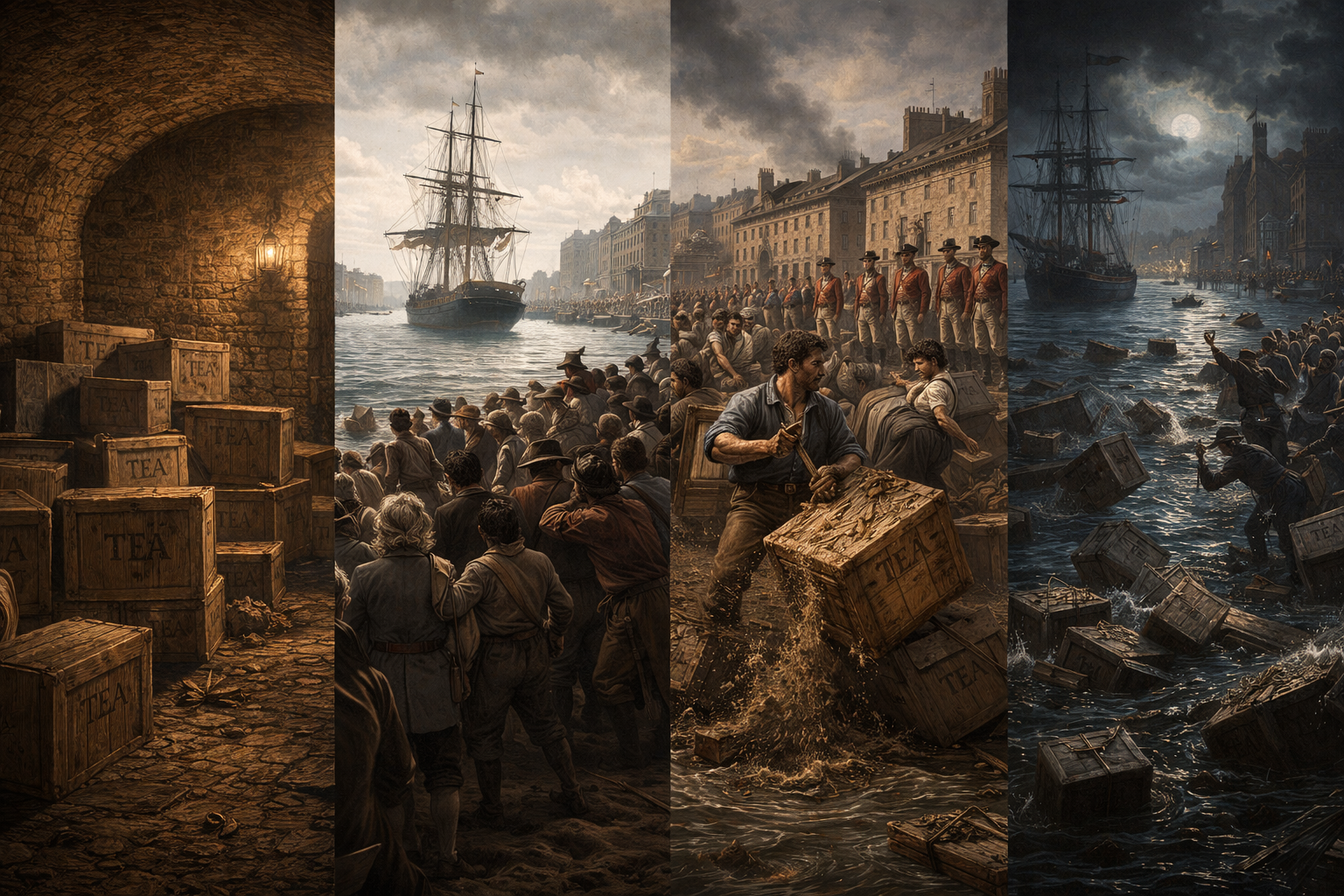
The myth of the American Revolution often presents a clean, monolithic story: a unified people rising up in one coordinated moment of rebellion. We point to the “Tea Party” as the starting point, imagining a single night in Boston where the course of history was miraculously set in stone.
This gross oversimplification does an incredible disservice to the complexity and brilliance of the colonial resistance. The challenges they faced were almost too massive to contemplate.
Today, we take certain societal principles for granted; for those at the beginning of the Revolution, they were developing and popularizing ideas that were foreign to much of the world.
To believe there was only one Tea Party is to miss the true genius of the American rebellion. The resistance to the Tea Act was not a localized event in Massachusetts; it was a national, varied, determined, and adaptive movement that played out across cities throughout the colonies, each offering a different experiment in how to dismantle an empire.
The Revolution did not magically appear from a single dramatic incident. It was built by a collection of diverse responses shaped by local conditions, cultural habits, and economic realities. While Boston provided the fire that eventually consumed British authority, cities like Charleston, Philadelphia, and New York (and others) provided the structural and political foundations that made that fire possible.
By moving beyond the legendary images of Boston Harbor, there are discoveries to be made. There is a story of a people testing their power in real-time, learning through trial and error how to govern themselves before they ever had a formal country to call their own.
The Common Thread: What All Four Cities Agreed On
Despite the wide variety of tactics used from South Carolina to New England, there was a foundational unity that bound these cities together. At the core of every protest was a fundamental rejection of Parliament’s right to tax the colonies without their consent.
By 1773, the debate over “no taxation without representation” had matured from just being a slogan into a deep-seated political conviction. The Tea Act was viewed as an insidious attempt to trick the colonies into accepting a status of permanent political inferiority.
It is easy to get lost in the differences between a legal seizure in Charleston and a midnight raid in Boston, but its important to not lose sight of the fact that every single city agreed on the objective: the tea must not be sold. Not a single ounce of the East India Company’s tea was successfully introduced into the colonial market as Parliament had intended.
That is a shockingly remarkable result.
This continental veto was the first true instance of American union. Before there was a Continental Congress or a Continental Army, there was a continental consensus that the legitimacy of the Crown was no longer absolute. This shared refusal to be “bought” by cheaper tea was the psychological break that preceded the physical one.
Charleston: Resistance Through Procedure
In the South, the city of Charleston demonstrated that revolution could be patient, legalistic, and remarkably restrained despite the patriotic fervor. The resistance here was led by a sophisticated political class that understood how to play the long game.
They began with the same steps as the other cities—public meetings and the forced resignation of the tea consignees—but they added a unique layer of bureaucratic cunning. By allowing the tea to sit on the ships until the twenty-day legal deadline passed, they forced the hand of the customs officials.
The tea was seized for non-payment of duties and moved into the basement of the Old Exchange Building. By ‘losing’ the tea in a state-controlled cellar, Charleston neutralized the threat without ever having to strike a match or break a crate.
This was a triumph of procedural resistance. The lesson of Charleston was that you did not always need to destroy the King’s property to destroy his policy; you could simply trap it in the machinery of his own law. Ironically, this saved tea survived the years of protest and was later sold to fund the revolutionary government that would eventually throw off British rule entirely.

Philadelphia: Resistance Through Organization
Philadelphia, the largest and most prosperous city in the colonies, offered a model of resistance through complete civic order. Known for its Quaker heritage and Enlightenment-era discipline, the city approached the Tea Act with the organization of a sovereign state.
The Philadelphia resistance was an impregnable wall that prevented the crisis from even beginning. Through a massive, unified display of public will, the city convinced the captain of the tea ship Polly that he had no future in their harbor.
There was no violence in Philadelphia because the consensus was so universal that violence was pointless. When eight thousand citizens stood together at the State House, the British administration simply ceased to function. The ship was turned around, and the tea was sent back to London, untouched and untaxed.
The lesson of Philadelphia was that a revolution could function through civic consensus and the power of a unified “No.” They proved that a community could govern its own borders and its own commerce through organizational willpower, setting a precedent for the self-governance that would soon be the hallmark the new nation.

New York: Resistance Through Enforcement
If Philadelphia was a model of consensus, New York was a masterclass in the raw power of the street. New York was a city divided; a place where the merchant elite were often more afraid of the lower classes than they were of the British Parliament.
Because there was no easy agreement, the resistance had to be forged through intimidation and public pressure. When the tea arrived, it was met with a noisy fury that skipped the polite resolutions of the other cities.
The New York experience showed that revolutions are often messy and enforcement-driven. When the ship London was found to be carrying tea under false pretenses, they destroyed the cargo in the middle of the day. They didn’t wait for a committee meeting.
This was a movement driven by the artisans, laborers, and Liberty Boys who filled the vacuum where official authority had failed. The lesson of New York was that popular sovereignty is often seized, not granted. It was a volatile, human rebellion that proved imperial control could be dismantled block-by-block, even in a city where the King’s army had its headquarters.

Boston: Resistance Through Escalation
Finally, we come to Boston; the city that willingly chose to turn a political dispute into a terminal crisis. The leaders of Boston, specifically the Sons of Liberty, recognized that the other cities were engaged in a “holding action.”
While Charleston stored the tea and Philadelphia sent it back, the underlying question of Parliament’s authority remained unresolved. Boston decided to force a definitive answer. Their destruction of the tea was a carefully staged political performance, meant to be seen and meant to be punished.
By choosing to destroy the tea rather than simply turn it away, Boston knowingly invited the wrath of the British Empire. They understood that the King would be forced to respond with a level of severity that would clarify the stakes for the rest of the colonies.
The resulting Intolerable Acts were the intended consequence of the Tea Party; they were the spark that Boston provided to the continental powder keg. The lesson of Boston was that sometimes a revolution requires an unmistakable line in the sand; a moment of no return that makes compromise impossible.

The Four Methods Of One Political Education
If one is to look at these four cities together, we see a people undergoing a high-level political education. Throughout 1773 and 1774, the colonies were not just protesting a tax; they were practicing for independence. They were learning what worked, what didn’t, what provoked, and what unified.
The Tea Act served as a rehearsal for the transition from being British subjects to becoming American citizens. There is a progression in the methods: from the legality of Charleston, to the refusal of Philadelphia, to the enforcement of New York, and finally to the confrontation of Boston.
Each city contributed a different tool to the revolutionary toolkit. Charleston provided the strategy, Philadelphia provided the organization, New York provided the muscle, and Boston provided the spark.
By the time the delegates met for the First Continental Congress, they were not strangers to the concept of self-rule. They were the architects of a resistance that had already successfully neutralized the British Empire on the American waterfront.
The “Tea Party” may be the exact moment that it occurred to the colonies that if they could manage a continental boycott, if they could outmaneuver Britain in multiple ways, they could manage a continental government.
Why Boston Became the Story and the Others Didn’t
It is worth considering why we have allowed the Boston story to eclipse the others so completely. History, as a narrative, favors drama and clear, movie-like action. Boston’s famous names and smashed crates provide a vivid cornerstone for our national identity. It is a story with clear heroes, clear provocation, a clear crime, and a clear punishment…. followed by the ultimate redemption story.
By contrast, the stories of Charleston and Philadelphia are almost subtle by comparison, and definitely more administrative. It is difficult to write a heroic poem or create a dramatic painting about tea sitting in a damp basement or a ship sailing away from a river pier.
Furthermore, the immediate retaliation by the British—the closing of Boston Harbor—gave that city a status of martyrdom that the others did not share. Boston became the poster child for British tyranny, and its story became the shorthand for the entire movement. Notable Founding Fathers like Samuel Adams, John Adams, John Hancock, Paul Revere, and more, made sure of that.
However, by focusing only on Boston, we lose the sense of the scale of the resistance. We forget that the revolution was a broad, continental movement that involved thousands of people acting in different ways for a single goal. The myth of the single Tea Party makes the revolution look like a local Massachusetts affair, rather than the national awakening it really was.
When we restore the other cities to the story, the American Revolution looks more like a deliberate, experimental process. Independence was not a sudden decision made in July 1776; it was a reality that had been being built in the colonies for years. These tea parties were exhibitions of a people learning and testing their own power, seeing how far they could push the empire before it broke.
These varied instances are also case studies in the diversity of the American character. We see a South that was legalistic and patient, a Mid-Atlantic that was organized and consensus-driven, and a North that was radical and confrontational. The United States was born from the combination of all of these traits.
The point being, that our Revolution was not a single event but a varied, collective experience that allowed these very different colonies to find a common ground. The tea was the catalyst that forced these disparate cities to realize they were more alike than they were different.
The Revolution Before the Revolution
The story of the tea protests, the end result, is that the Revolution began long before the first shot was fired at Lexington. It began in the meeting halls where resolutions were drafted, on the wharves where river pilots were threatened, in the streets where officials and soldiers were stared down, and in the business offices where merchants decided to prioritize liberty over profit.
The tea was a mundane commodity, but it was turned into a political weapon that dismantled an empire.
The irony of the “four Tea Parties” is that they all led to the same destination through entirely different routes. Whether the tea was locked away, sent back, or thrown into the harbor, the result was a British policy in ruins and a colonial population that had discovered its own strength.
By the time the Dartmouth, the Polly, the Nancy, and the London had all been dealt with, the British government had already lost America. The people had learned how to govern themselves, how to coordinate across hundreds of miles, and most importantly, they had learned about power deriving from the consent of the governed.
The final line of this chapter is found in the empty harbors of 1773. Before Americans declared independence with a pen, they had already declared it with their actions—in four very different cities, through four very different methods, with one common and unshakable purpose.






Leave a Reply