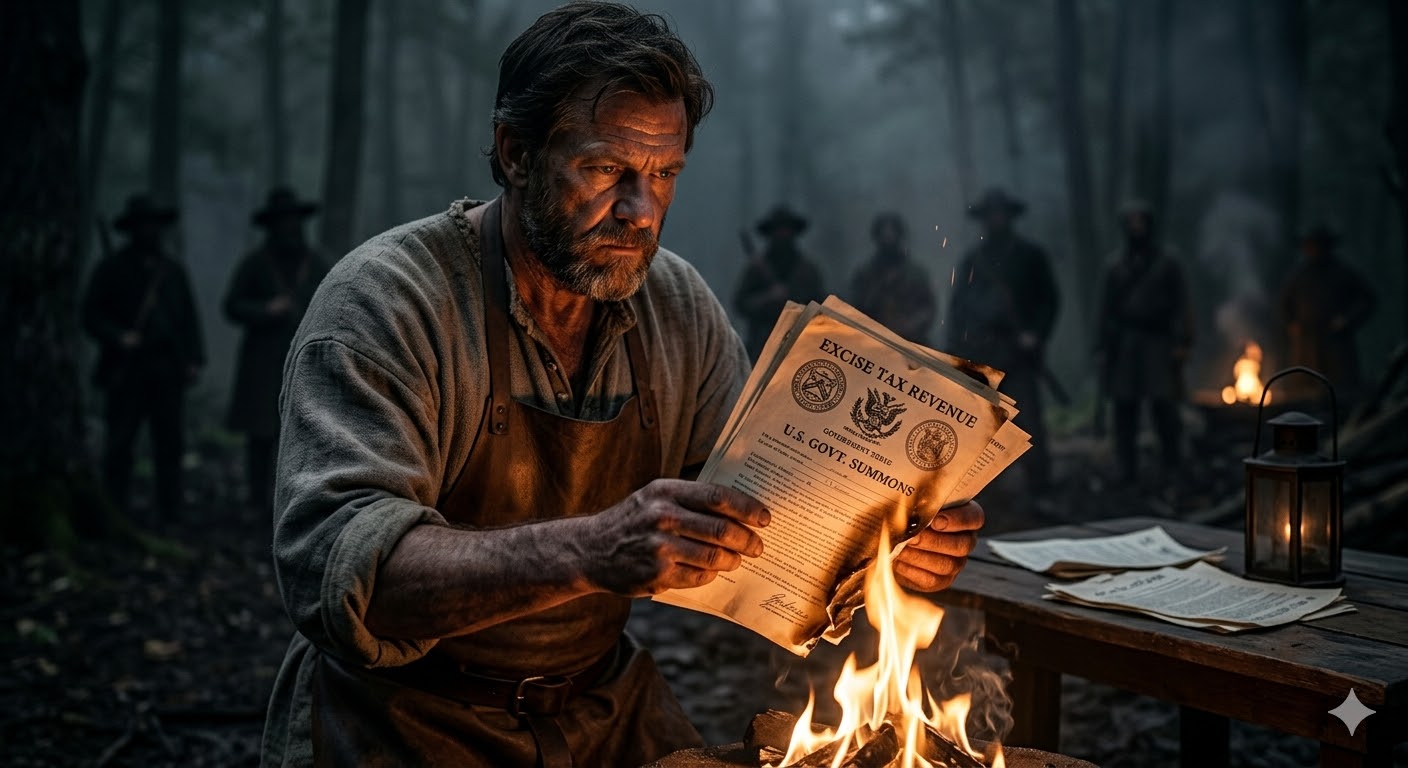
In the late summer of 1794, George Washington did something no American president has done before or since. He put on his uniform, climbed onto a horse, and personally led an army into the American interior to enforce a tax law.
Take a moment with that.
The army numbered around 13,000 men, larger than most of the forces Washington had commanded during the Revolutionary War. The destination was western Pennsylvania.
The enemy was a collection of farmers, distillers, and veterans of that same Revolution who had decided, reasonably enough from their vantage point, that what the new federal government was doing to them looked a great deal like what the old British government had done. So they did what Americans had learned to do. They resisted.
They raised liberty poles. They tarred and feathered tax collectors. They burned the house of a local revenue inspector named John Neville to the ground. They massed thousands of men at a field near Pittsburgh, flew a six-striped flag, and dared the government to answer.
The government answered.
What followed was the Whiskey Rebellion — named for the tax that sparked it — and it is one of the more instructive episodes in American history, not because of what it settled, but because of what it exposed.
The men in the western counties of Pennsylvania were not cranks or outlaws. They were making an argument. It was the same argument Americans had been making for thirty years, about taxation without fair representation, about a distant government imposing financial burdens on people who had no real voice in the matter, about who, exactly, the Revolution had been fought for.
Washington and his Treasury Secretary, Alexander Hamilton, had an answer to that argument too. The Revolution was over. The argument was settled. The United States had a government now, and that government could levy taxes, and those taxes would be paid.
The rebels thought they were continuing the Revolution. The government thought they were threatening it. Both sides believed they were defending the same founding principles, which tells you something important about what those principles actually were — or weren’t.
What They Had Been Taught
To understand why western Pennsylvania exploded the way it did, you have to go back to a lesson the colonists learned well — maybe too well.
In 1765, the British Parliament passed the Stamp Act, a direct tax on paper goods, legal documents, and newspapers across the American colonies. It wasn’t an enormous sum, in the grand scheme of things.
It was the principle that mattered. The colonists had no representation in Parliament. Parliament was taxing them anyway. And the men tasked with collecting those taxes — the royal revenue officers, the stamp distributors — quickly found out how the colonists felt about it.
They were not treated gently.
In Boston, a stamp distributor named Andrew Oliver was hung in effigy from an elm tree that colonists had taken to calling the Liberty Tree. When that didn’t get the message across clearly enough, a mob tore down a building he owned, then ransacked his house. Oliver resigned his commission before the Stamp Act even went into effect.
His colleague Thomas Hutchinson, the colony’s lieutenant governor, had his home demolished by a crowd that scattered his furniture, stripped the walls, and left the structure a shell.
Across the colonies, the story repeated itself. Stamp distributors resigned. Revenue collectors were tarred and feathered — a process that involved hot pine tar applied to bare skin, followed by feathers, followed by a humiliating public parade through the streets. It was painful, degrading, and very much the point.
The colonists also developed more organized forms of resistance.
Committees of correspondence sprang up in town after town, coordinating opposition and spreading information. Liberty poles went up in public squares as rallying points — visible, symbolic, deliberately provocative. The Sons of Liberty operated in the shadows, circulating anonymous pamphlets and threatening anyone who cooperated with the Crown.
Parliament repealed the Stamp Act in 1766, but it kept coming back with new taxes. The Townshend Acts. The Tea Act. Each one produced the same response: petitions, boycotts, committees, liberty poles, and when none of that worked, direct action.
The colonists had a fully developed vocabulary of resistance by the time the shooting started at Lexington and Concord in 1775, and they had learned one lesson above all others: when a distant government imposes unjust taxes on people who have no real say in the matter, you fight back.
That was not just acceptable. It was righteous. It was, in fact, the foundational act of the American republic.
Which is what made 1794 so complicated.
The men of western Pennsylvania had not forgotten any of this. They had lived it. They had raised liberty poles before, had tarred and feathered British revenue men, had signed petitions and organized committees and done everything the patriot tradition said you were supposed to do when your government overstepped.
And now here came a new tax, from a new government, structured in a way that fell hardest on the people least able to pay it, enforced by revenue officers who showed up in their communities demanding compliance.
They reached for the tools they knew. Of course they did. Who taught them those tools in the first place?

Hamilton’s Masterpiece
Alexander Hamilton did not design the whiskey excise by accident. That is the first thing to understand about it.
Hamilton was the first Secretary of the Treasury, the chief architect of American economic policy, and a man who thought about financial systems the way a chess player thinks about the board; several moves ahead, with a clear picture of where he wanted to end up.
What he wanted was a strong central government with the demonstrated authority to raise revenue, pay its debts, and establish beyond any argument that the federal experiment was real and permanent. To get there, he needed a tax. And the tax he chose was not chosen at random.
Congress passed the excise on distilled spirits in 1791. On the surface it was straightforward: a tax on whiskey production, applied nationally, to help retire the enormous debt the new government had inherited from the Revolution. Reasonable enough. But the structure of the tax was where things got interesting.
Large distilleries, the kind operating at scale in Philadelphia and the eastern seaboard cities, could pay a flat annual fee for their stills. The more whiskey they produced under that flat fee, the lower their effective per-gallon tax rate became.
A big operation running full capacity year-round might pay as little as six cents a gallon when the math was worked out. Small producers, the kind running a single copper pot still in western Pennsylvania, paid by the gallon regardless — and the rate was considerably higher. Somewhere between nine and eighteen cents, depending on the proof.
That gap was not an oversight. It was the architecture.
The situation on the Pennsylvania frontier made it worse in ways that someone sitting in Philadelphia might not have fully appreciated, or might have appreciated perfectly well and not cared about.
In the western counties, whiskey wasn’t just a beverage. It was currency. Grain was heavy, bulky, and perishable. A bushel of rye that would rot or cost a fortune to haul to eastern markets over terrible roads could be converted into a jug of whiskey that held its value, traveled light, and was accepted as payment for goods and services throughout the region.
When a farmer paid his cobbler or settled a debt with a neighbor, he might well be doing it in whiskey. The excise tax wasn’t just a tax on a product. It was a tax on the medium of exchange.
And it had to be paid in cash. Specie. Dollars, which were scarce on the frontier and becoming scarcer. A subsistence farmer who produced a modest amount of whiskey each year might owe more in tax than he had handled in hard currency in the past twelve months.
There was also the matter of the courts. The excise law gave federal authorities jurisdiction over violations, which sounds procedurally boring until you learn that the nearest federal court in Pennsylvania was in Philadelphia. Three hundred miles from Pittsburgh, over roads that were generous to call roads.
A farmer accused of evading the whiskey tax faced the prospect of leaving his land, his family, and his livelihood for weeks or months to defend himself in a city most of them had never seen.
The practical effect was that the law was nearly impossible to contest and the financial burden of compliance fell almost entirely on the people least equipped to bear it.
Hamilton knew the western counties would resist. There is some evidence he was counting on it. A letter he wrote during the crisis referred to the rebellion as something that would “do us a great deal of good and add to the solidity of everything in this country.”
He wanted a confrontation. Not because he was cruel, exactly, but because he understood that a government that cannot enforce its laws is not really a government. The point of the tax was never entirely about revenue. The point was the principle; that the federal government’s authority was real, and would be backed up with violence if tested.
This is the nature of government, all government, and Hamilton was about to get his test.

The Old Vocabulary
The people of western Pennsylvania did not take the whiskey excise quietly. They had not been raised to.
Resistance began almost immediately after the law passed in 1791. Tax collectors, or excisemen as they were called, found the work dangerous from the start. A man who accepted a commission to collect the whiskey tax in the western counties was making a statement about his loyalties, and his neighbors noticed.
The mildest response was social ostracism. The more pointed responses were much more severe.
The tarring and feathering started early. It followed the same script as the colonial version, because it was the same script. Some collectors had their horses stolen, their papers destroyed, their houses burned.
One exciseman named Robert Johnston was grabbed by a group of men who cut off his hair and took his horse before sending him on his way. The message in each case was identical to the message colonial mobs had sent to British stamp distributors twenty-five years earlier: this is not a job you want. Find another line of work.
Liberty poles went up across the region. This was not spontaneous folk art. The liberty pole was a specific political symbol with a specific history, associated directly with resistance to British taxation. Putting one up in 1792 or 1793 in western Pennsylvania was a purposeful choice of political communication.
Anyone who saw it knew exactly what it meant and what tradition it was invoking. These people were not making a vague gesture of discontent. They were signing their names to a lineage.
The Mingo Creek Democratic Society, organized in Washington County in 1793, formalized much of this resistance.
Democratic societies had been springing up across the country in the wake of the French Revolution, but the Mingo Creek society had a harder edge than most. It was explicitly connected to opposition against the excise, and it provided organizational structure to what might otherwise have remained scattered individual protests.
Here were committees of correspondence, American style, doing exactly what the committees of correspondence had always done: spreading information, coordinating opposition, building a movement.
In July of 1794, things escalated past the point of return.
John Neville was a Revolutionary War veteran, a substantial landowner, and the regional inspector of revenue for western Pennsylvania; which is to say, the man whose job it was to make the excise work in the counties where it was most despised.
On July 15th, a federal marshal named David Lenox arrived at a farm near Mingo Creek to serve a summons on a distiller who hadn’t registered his still. The farmer’s neighbors gathered. Shots were fired. Lenox escaped; Neville was not so fortunate when the crowd turned toward his estate.
What followed over the next two days has the quality of something that could have fit any number of days of the previous twenty years. A group of roughly thirty men marched on Neville’s house on July 16th. Neville had fortified the place and recruited a handful of soldiers from a nearby garrison. The attackers were driven off, with casualties.
They came back the next day with around five hundred men, commanded by a militia officer named James McFarlane. The soldiers inside negotiated a surrender of the property, then someone — accounts differ on who and why — fired a shot after the white flag went up. McFarlane was killed.
His men burned the house to the ground.
Neville’s estate, called Bower Hill, was one of the finer properties in the region, a visible symbol of the wealth and authority that the excise represented to the people who hated it. Burning it was not random destruction. It was a statement.
Then came Braddock’s Field.
On August 1st, 1794, somewhere between five thousand and seven thousand armed men assembled at a field near the Monongahela River outside Pittsburgh, on the same ground where the British general Edward Braddock had been ambushed and routed by French and Indian forces in 1755.
The choice of location may or may not have been deliberate, but the symbolism landed anyway — this was a place where an army had come to grief trying to impose its will on western Pennsylvania.
The rebels flew a flag with six stripes. There were talks of marching on Pittsburgh. There were talks of secession, of an independent western state, of allying with Spain, which controlled the Mississippi River and had its own interests in destabilizing the American frontier.
Some of the language being used — about the tyranny of the eastern establishment, about the rights of frontier people against a government that served wealthy interests — would not have sounded out of place in a pamphlet from 1775.
Circulating through all of this was a figure known as Tom the Tinker. Nobody knew who Tom the Tinker was — the name was a pseudonym used in threatening letters sent to distillers who had complied with the excise, warning them that their stills would be “mended,” which meant destroyed.
Tom the Tinker was an enforcer and a propagandist, anonymous and untouchable, operating behind a name the way the Sons of Liberty had operated behind pamphlets and the darkness of a Boston night. The colonial playbook, running on schedule.
The federal government had its answer ready. Whether the rebels were prepared for the scale of it is another question.

The General’s Dilemma
George Washington understood the optics. He said so.
The president had spent the summer of 1794 hoping the situation in western Pennsylvania would resolve itself short of military intervention, because he knew exactly what military intervention would look like. He had read the same history everyone else had.
He knew what it meant when a government sent soldiers to collect taxes from its own citizens. He delayed, consulted his cabinet, issued proclamations calling on the rebels to disperse, and waited to see if the machinery of persuasion would do the work so the machinery of force wouldn’t have to.
It didn’t work. The rebels at Braddock’s Field were not dispersing. The state government in Pennsylvania was either unable or unwilling to handle it. And Hamilton, who had wanted this confrontation from the beginning, was pushing hard for a federal response that would settle the question permanently.
Washington made his decision. He called up the militias of Pennsylvania, Virginia, Maryland, and New Jersey, and eventually assembled a force of roughly 13,000 men. Then he did something no president before or since has done: he rode out to join them in the field.
He traveled as far as Bedford, Pennsylvania, before turning command over to General Henry Lee, the governor of Virginia, and returning to Philadelphia. But he had made the point. The president of the United States had personally placed himself at the head of an army marching against American citizens on American soil.
The army that marched into western Pennsylvania in the fall of 1794 was, by the numbers, a serious force. Larger than the army Washington had led to victory at Yorktown. Larger than the force that had crossed the Delaware on Christmas night in 1776.
Hamilton rode with it, which was its own kind of statement; the architect of the tax personally accompanying the army sent to enforce it.
Recruiting that army had produced its own irony. Few men volunteered. A draft had to be used to fill out the ranks. And in several places where the draft was announced, liberty poles went up in protest. The same symbol, the same message, now directed at the same man who had once fought under its meaning.
The rebels, faced with this reality, largely melted away. The movement that had looked like a genuine uprising from the inside did not hold together when 13,000 armed men came over the mountains. There was no battle. The leaders scattered. Some fled west. Some were arrested.
In the end, two men were convicted of treason: Philip Vigol and John Mitchell, both described in the record as minor figures who had participated in the raids. Washington pardoned them both, Vigol for being “insane,” and Mitchell being described as a “simpleton.”
The leaders who had actually organized the rebellion were never brought to trial in any meaningful way. The army found very little to confront when it arrived, and went home.
Hamilton declared victory. The federal government had demonstrated its authority. The principle was established. The whiskey excise remained on the books.
What the government had not done — what it could not do, given the geography and economics involved — was make the tax work in any practical sense. Compliance in western Pennsylvania didn’t improve. Enforcement remained difficult, dangerous, and expensive.
The excise generated far less revenue than Hamilton had projected, in part because the people most affected by it had decades of experience in the art of non-cooperation with tax collectors they considered illegitimate.
That is also the nature of government, or at least the peoples role in it. They had learned that from dealing with the British too.

Who the Revolution Was For
The Whiskey Rebellion lasted, in its active phase, roughly three years from the first organized resistance in 1791 to the army’s march in 1794.
In the longer view it lasted until 1802, when Thomas Jefferson, who had opposed the excise from the start, repealed it shortly after taking office. The rebels lost the confrontation and won the argument.
But the delay mattered, and what happened in between mattered more.
Hamilton’s position was coherent, even if you disagreed with it. A nation that had just fought a revolution partly over the right to govern itself had to actually govern. That meant laws. It meant taxes.
It meant that when people refused to pay those taxes, the government had to respond — not because the tax was necessarily just, but because the alternative was dissolution. You cannot run a country on the principle that any sufficiently aggrieved group can simply opt out of the laws it dislikes.
Hamilton understood that the federal government’s credibility was fragile in 1794 and that fragility had to be addressed forcefully, before it became fatal.
The rebels’ position was equally coherent, and they made it in the language they had been handed.
They were being taxed by a government they had limited power to influence, in a way that was structured to benefit wealthy eastern interests over frontier farmers, enforced by officers sent from a distant capital to extract money from people who had little of it.
They had been told, explicitly and repeatedly, that this was the kind of thing worth fighting about. The Revolution had said so. The Declaration of Independence had said so. Patrick Henry had said so. George Washington had said so. The whole generation had said so, loudly and at great length, for twenty years.
The uncomfortable truth the Whiskey Rebellion surfaces is that both positions cannot be entirely right, which means the Revolution itself contained a contradiction it never resolved.
The men who led the Revolution were not, for the most part, men who believed that all grievances justified all resistance. They believed that their grievances did. Once they were in charge, the calculus changed.
The liberty pole was a symbol of the right kind of resistance when it went up against the British. It became a symbol of disorder and ingratitude when it went up against them.
Washington knew this. You can see it in his hesitation, in the delay before he called up the militia, in the pardons he issued afterward. He was not comfortable with what he was doing.
Hamilton was comfortable with it, because Hamilton was always comfortable with the uses of power. But Washington had been the general of the other army, once. He had commanded the men who tarred and feathered British tax collectors and called it patriotism.
Now he was sending soldiers to protect the men those same communities were tarring and feathering, and calling it the rule of law.
He was right that the rule of law mattered. The rebels were right that the law in question was unjust.
History gave Jefferson the last word when he swept the Federalists from power and repealed the tax in 1802, but history did not go back and compensate the farmers who had been dragged to Philadelphia to face federal charges, or the men who had fled their homes rather than face an army, or the communities that had simply been told their grievance, however legitimate, was beside the point.
The Whiskey Rebellion is remembered, when it is remembered at all, as a footnote; an early test of federal authority, a curiosity from the Washington administration. That undersells it considerably.
It was the first time the new American government looked its own founding principles in the face and blinked. It chose order over consistency, and it was not wrong to do so, and it was not right either.
The liberty poles came down. The army went home. The tax stayed on the books for eight more years, uncollected in most of the places it mattered.
Some arguments take a while to settle. Some never do.



Leave a Reply