History often fills its volumes and builds its grand monuments to the “marble men”—the statesmen, philosophers, and generals whose names are etched into bronze. Yet, the great tides of revolution are rarely turned by visionaries alone. Behind every Declaration and every celebrated figure stood an army of ordinary people whose action turned paper ideals into reality.
To truly understand the beginning of the American Revolution, one must look past John Adams and John Hancock and find Ebenezer Mackintosh, the Boston shoemaker who provided the essential, terrifying force that made imperial law unenforceable on the streets of the colony’s most rebellious city.
Mackintosh wasn’t a lawyer, or an educated Enlightenment Era thinker; he was a gang leader. No statue stands in his honor, and his name is largely absent–erased–from the telling of our national founding. But in the chaotic, working-class streets of colonial Boston, he was the driving, organized force that translated the frustration of the poor into open, aimed political action, igniting the spark of rebellion that the elite would later claim as their own.
The Making of a Street General
Ebenezer Mackintosh was born in Boston in 1737 to impoverished parents. His father, Moses, was an intermittent soldier in the British service, a life of economic instability that defined Mackintosh’s early existence. After his mother died and his father left the city in the early 1750s, the fourteen-year-old was left to apprentice under his shoemaker uncle, Ichibod Jones.
The shoemaker’s trade placed him firmly among the lower classes. It was a life measured by the long hours of cutting leather and the wear on his hands, offering him limited opportunities for upward social mobility. He lived in the South End, an area defined by hard labor and economic depression. The borough had an intense communal loyalty and this environment taught him the value of collective strength and the bitter taste of being subject to the whims of the wealthy merchant class.
Mackintosh was not illiterate or completely without standing. He enlisted in the militia in 1754 and served in the British-colonial mission that culminated in the 1758 Battle of Ticonderoga during the French and Indian War. His military experience exposed him to the disciplined organization of power and the logistics of command. He returned home carrying the valuable, if dangerous, discipline of a soldier—a skill set he would soon deploy against the same authority he had once fought to defend.

Crucially, his standing among his peers was high enough that in 1760 he joined Fire Engine Company No. 9, and, later, he was elected him to the unpaid, but respected, position of Sealer of Leather. This position, requiring him to inspect the quality of leather goods, gave him a small, formal government authority and demonstrated that he commanded a notable degree of respect among the voting populace, despite his low social standing.
The Training Ground: Pope Night
Mackintosh’s political power, however, was not built on town meetings or elected office; it was built on ritualized, annual violence.
Every year on November 5th, Boston celebrated Guy Fawkes Day—or, as it was known in the colonies, Pope Night. This was a rowdy, carnivalesque, and often brutal annual event where the working-class gangs of the North End and the South End competed to parade the largest, most elaborate effigies of the Pope, the Devil, and political figures, culminating in massive brawls.
These were not random street fights; they were highly organized, ritualized displays of mob power. The success of a gang depended on its leader’s ability to mobilize, organize, and strategically control large numbers of men. Mackintosh rose to prominence precisely by mastering this chaotic art, earning him the title of “Captain” of the South End Gang.
You won’t find it in a textbook, and it might sound odd to us now, but the Pope Night rivalries were a vital apprenticeship for the American Revolution. These events taught Mackintosh how to use spectacle and intimidation as political tools, how to manage crowds of thousands, and how to maintain enough internal discipline to win without collapsing into total anarchy. The gangs honed the very skills—the parades, the effigies, the focused destruction—that would later be adapted by the Sons of Liberty.
In 1764, the Pope NIght violence went too far. The severity of the 1764 brawl—which left North End gang leader Henry Swift in a coma and resulted in a young boy’s death—finally compelled the royal government to act. Lieutenant Governor Thomas Hutchinson, serving as Chief Justice of the Superior Court, issued a stern lecture condemning the mob activity as dangerous and anarchic. The court then moved to indict the leaders, including both Mackintosh and Swift, for rioting.
The indictments were intended to neutralize the threat of the street by punishing its organizers. But the legal action failed to do much more than expose how out of touch officials were from the average Bostonian.
The crackdown failed entirely to break Mackintosh’s local power. Just one month after facing the charges, in March 1765, the voters of Boston demonstrated their true allegiance: they elected Mackintosh to his post of Sealer of Leather.
This vote of confidence was a direct rejection of the royal government’s attempt to brand him a criminal and proved that Mackintosh’s authority flowed from the people, not the Crown.
For the wealthy merchant and artisan class of the Loyal Nine, the failure of the crackdown was a critical observation and lesson. The courts and institutions could not control the mob; the only path to safety and political effectiveness was to harness it.
The indictments ultimately served not as a warning to Mackintosh, but as a catalyst for the elite members of the Sons of Liberty and others in the Patriot movement. They realized that their only path forward was through a controlled alliance with the men who had just defied the Chief Justice and Royal Governor himself.
Mackintosh, facing the threat of arrest yet still popular enough to be elected to public office, became the indispensable bridge between respectable political thought and unstoppable street power.
The Necessary Alliance
By 1765, the wealthy, educated leaders of the opposition—particularly men like Sam Adams, James Otis, and the secretive Loyal Nine—had reached a critical impasse. They had the ideas and the legal rationale to oppose the Stamp Act, but they lacked the coercive force to prevent its implementation. No matter how eloquently they wrote, words and pieces of paper were not going to compel royal officials to resign or abandon their duties. Only direct, physical action could do that.
They needed Mackintosh. They needed the brute credibility and mobilizing power of the South End Gang.
The ensuing partnership was an unstable but essential transaction between the gentlemen and the street general. The Loyal Nine provided the money, the political targets, and the philosophical justification; Mackintosh provided the muscle, the strategy, and the fear that made the resistance effective.
The crowd Mackintosh controlled was moved by both politics and pressing economic reality. The post-war depression had led to high unemployment and crushing debt for the working class. The Stamp Act, which threatened to further cripple commerce and directly increase costs for the poor, was the final insult. For Mackintosh’s men, resistance was a matter of survival, not just political theory.
August 14, 1765: Organized Rebellion
The first coordinated blow came on August 14, 1765. The target was Andrew Oliver, the newly appointed stamp distributor for Massachusetts.
The day began beneath the great elm tree (soon to be named the Liberty Tree) with the hanging of Oliver’s effigy. Mackintosh stood in the dirt at the base, directing the growing crowd. The spectacle was not spontaneous; it was choreographed. The effigy was crude, bearing a stamp on its chest and a devil at its feet. The Sons of Liberty needed deniability, but Mackintosh ensured the crowd was orderly and purposeful, projecting disciplined menace.

As the day wore on, Mackintosh marched the growing mob through the city in a theatrical funeral procession, first confronting the Governor’s Council at the Town House.
Then, the target shifted from symbol to substance: the mob descended on Oliver’s newly built warehouse, intended to distribute the hated stamps. Under Mackintosh’s direction, the building was methodically dismantled, ensuring that the infrastructure needed to implement the tax was destroyed before it could even begin operations.
That night, the action escalated. After burning the effigy on Fort Hill, the mob moved to Oliver’s house, tearing down fences and breaking windows. The message was delivered with overwhelming clarity. Oliver, shaking with fear for his life, resigned the following morning.
Mackintosh’s final act of coercion was forcing Oliver to stand under the Liberty Tree and publicly read his resignation before the roaring crowd. If there had been any lingering doubt, it had now been cemented that Mackintosh’s authority was the true sovereign of the streets of Boston.
The Night the Mob Broke Free
The organized action of August 14th was shattered twelve nights later in an outburst of chaos that even the Sons of Liberty could not publicly endorse. The target was Lieutenant Governor Thomas Hutchinson, the symbol of loyalist power, who was rumored to have secretly encouraged the Stamp Act.
The riot of August 26, 1765, was a multi-stage attack that began with the houses of lesser officials, William Story and Benjamin Hallowell, before moving on to the grandest prize. By the time the massive crowd—well fueled by rum and escalating rage—reached Hutchinson’s stately mansion, the violence had reached a fever pitch.
Mackintosh was at the helm, but this mob would not be co-opted by the Sons of Liberty. It was a force barely contained. Hutchinson and his family fled minutes before Mackintosh’s mob arrived.
What followed was not mere vandalism but a focused act of political deconstruction. The rioters used axes to smash down the front door and systematically destroyed everything that represented refinement and loyalist wealth. They tore down walls and wainscoting. They emptied the wine cellar. They smashed every stick of furniture.
Most tragically for Hutchinson, they scattered and destroyed his vast collection of books and historical papers, including manuscripts he had collected for thirty years for his history of Massachusetts. By four in the morning, only “bare walls and floors” remained. Hutchinson himself wrote, “Such ruins were never seen in America.”

The sheer audacity shocked the colonial elite. Sam Adams, though benefitting from the terror, publicly denounced the act as a “lawless attack upon property.” Mackintosh was quickly arrested for leading the riot, but the leaders of the resistance—fearing that locking up their “Captain General” would lead to further, uncontrollable violence—quietly pressured the authorities until Mackintosh was released, conditional on his swearing to maintain peace in the future.
The Gilded Uniform and the Ostracism
The crisis year of 1765 ended with a powerful display of the strange political moment Mackintosh had engineered. In a calculated move by the Loyal Nine to unify the working class and solidify Mackintosh’s control over the gangs, they brokered a truce between the North and South End gangs for Pope Night.
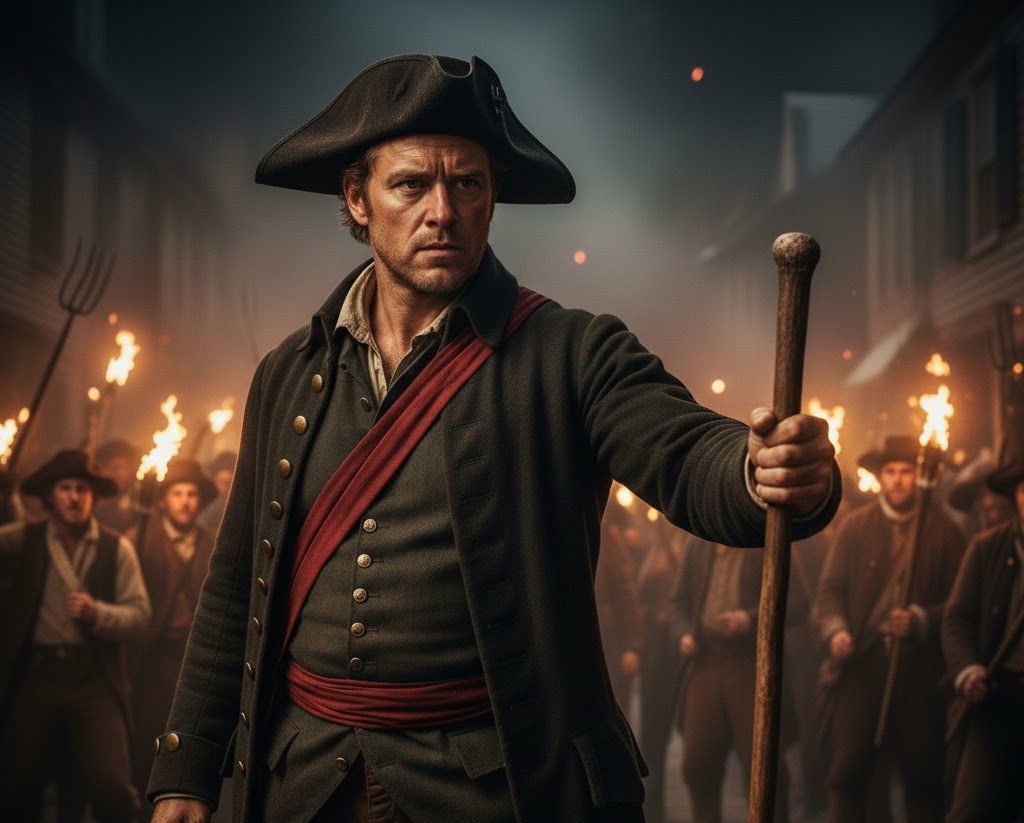
Mackintosh led the unified procession, parading in a newly commissioned blue and red uniform, complete with a gold-laced hat, a rattan cane, and a speaking trumpet provided by the wealthy merchants. He was no longer just a shoemaker; he was “General Mackintosh,” marching alongside Col. William Brattle, an officer of the Massachusetts militia.
This spectacle showed the world that Boston’s opposition was not just unified, but disciplined—a dangerous force capable of mixing revolutionary ideology with organized street power.
Yet, this moment of recognition was fleeting. Once the Stamp Act was repealed in 1766, the wealthy elite quickly sought to restore the social order that Mackintosh’s violence had threatened.
He was too powerful, too close to the levers of uncontrolled democracy, and too vulgar to be accepted into the emerging respectable Patriot establishment. The leaders had needed a weapon to break imperial rule, but they did not want that weapon sitting at their table.
Mackintosh’s temporary political career was over. While he was re-elected as Sealer of Leather for a few years, he was no longer involved in the major protests of the late 1760s. He soon fell prey to the economic conditions that had fueled the riots; debt caught up with him, and he was briefly held in debtors’ prison.
The Forgotten Foundation
Mackintosh’s contribution to the Revolution was essential, yet he remains an obscure footnote, a final demonstration that the Revolution was a complicated, class-driven affair that at times cast aside its least-respectable, yet most effective, leaders.
His connection to the revolutionary cause resurfaced tragically in 1770 during the Boston Massacre. Among the five men killed by British soldiers was Samuel Maverick, Mackintosh’s brother-in-law. The violence that Mackintosh had once controlled and directed now touched him personally.
By 1774, possibly due to his accumulating debts or a desire to escape the increasingly volatile Boston atmosphere, Mackintosh left the city. He settled in Haverhill, New Hampshire, taking his family with him. Though he played a role in the 1773 Boston Tea Party—a targeted, disciplined act of destruction far more in keeping with his style than the spontaneous rage of the Hutchinson riot—he was never recognized for it. He later served a short term in the Continental Army in 1777 under General Gates.
Ebenezer Mackintosh died in Haverhill in 1816, poor and forgotten, at one point having to sell his work to the overseer of the local poor farm to survive. He did not sign the Declaration of Independence; he simply ensured that the path to it was cleared of British enforcement.
The American Revolution was not just built by the eloquent ideas of its founders, but on the dirty, dangerous, and indispensable work of men like the shoemaker and gang leader from the South End.




Leave a Reply