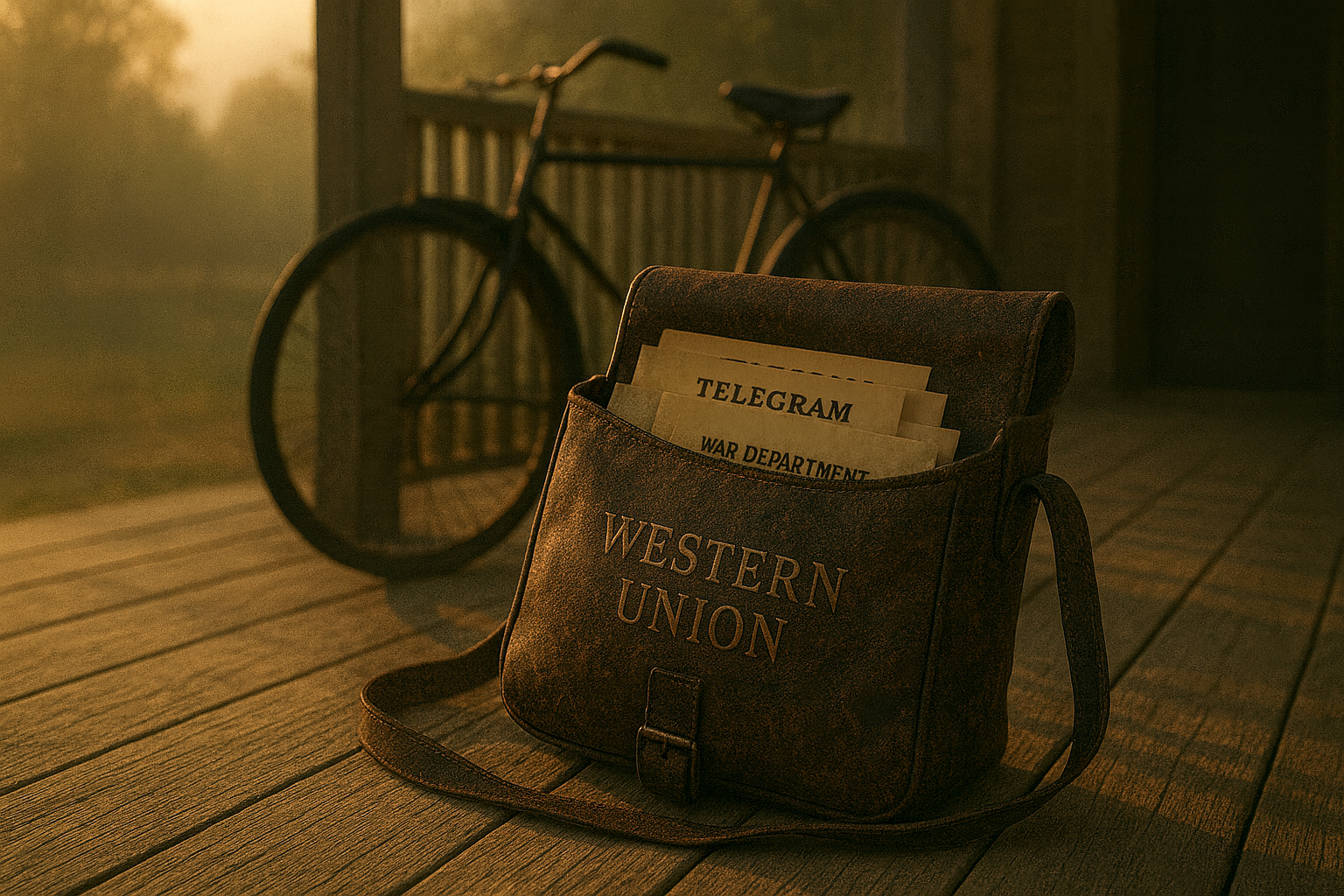
NOTE: During World War II, everyone had a part to play. Millions went off to fight, but the war touched every home, every street, every neighborhood—and the children were no exception. Some of the American youth carried a duty heavier than most could imagine: they were the bearers of grief, tasked with delivering the news no family ever wanted to hear. This is their story.
The alarm clock on the nightstand didn’t tick. It clattered; a frantic, tinny sound that ruined the predawn silence.
It was 5:15 AM.
Joe swung his legs over the side of the bed. The room carried the faint, sulfur-like scent of coal smoke from the few houses already stirring on his block. He was fifteen years old, but the back of his neck and shoulders often felt knotted like an old man’s. He knew why. It wasn’t the hours; it was the weight.
He pulled on his work clothes: the dark blue trousers, the stiff, button-down shirt, and the slightly too-large cap he always shoved into his pocket before leaving the house. The uniform made him look official, like a boy soldier of the home front. It also made him visible, and visibility was a curse in his line of work.
Downstairs, the bicycle leaned against the porch railing. It was a sturdy, heavy thing—a delivery bike, built to last, not to race. He strapped the empty leather satchel across his chest. He needed to get to the office; the morning messages were already waiting for him.
He pushed off the curb and moved past Mrs. Miller’s garden, past the grocery store with the enormous red, white, and blue V painted on the window. Every shop window held a rationing poster, asking for sacrifice, for unity. Loose Lips Sink Ships. When You Ride Alone, You Ride With Hitler. Joe knew the slogans by heart. Today, they weren’t something you could ignore.
He rode toward the center of town, where the telegraph wires hummed and the messages waited, ready to be delivered.
The Unseen Messenger Corps
Few Americans understood, then or now, that the bearers of the nation’s most catastrophic news were not military officers or clergy, but a workforce of teenagers and even pre-teens. These Western Union messengers, overwhelmingly boys aged 14 to 17, formed the critical, final link in the military’s communication chain. In smaller or more rural areas, boys as young as thirteen often took on the duty, the needs of the war effort overriding any concept of child labor laws.
Their duties spanned everything from delivering birthday greetings to collecting cash deposits, all for a modest wage, often around $0.35 an hour. But during WWII, their role elevated: they became the sole official conduit for delivering the War Department’s telegrams announcing a son’s, husband’s, or brother’s death, or his status as missing or wounded. The boys were trained on the mechanics of delivery, but given zero guidance on the emotional fallout. Their only instruction was to deliver the message, wait for a potential reply, and leave.
The bicycle and the uniform were iconic sights of the era, signs of quick connection. But when that uniform arrived on a tragic day, the yellow envelope it carried instantly transformed from a symbol of connection into the cruelest harbinger the home front knew.

Arrival at the Western Union Office
The local office was a cramped space above a dry cleaner, smelling permanently of starch and paper. The lights were already on; in fact, they never went off. The office had been open every hour of every day since the war began.
Mr. Davies, the supervisor, sat hunched over the main desk, sorting. He was a man who looked like he hadn’t slept since Pearl Harbor, his face a road map of lines.
“Morning, Joe,” Mr. Davies mumbled, not looking up. His hands, usually clumsy with the teletype machine, were steady now, dividing the incoming messages.
The room, normally bustling even this early, carried a hushed, anxious energy. Joe saw why. Stacked neatly on the edge of the desk were a half-dozen envelopes: khaki-colored, heavy, sealed with the official stamp. Not the usual canary yellow. They were messages that had been relayed overnight, triple-checked for accuracy, and now waited for their final journey.
The atmosphere in the office grew tense, the silence between the boys and Mr. Davies noticeable, awkward. No one joked about a baseball game or complained about the low pay.
“Start with the West End, Joe,” Mr. Davies finally said, pushing a bundle of routine telegrams toward him. Joe quickly counted them, then slipped them into his satchel. Then Mr. Davies slid two of the khaki envelopes off the tragic pile. “These two are on your route. Hit them on the way. You know the drill.”
Joe took the two heavy envelopes. They were smooth, cool to the touch. He carefully checked the two addresses against his route sheet, confirming the exact numbers, the street names. One of the addresses was just three blocks from the bakery where he bought his rolls.
The routine messages were held together with a rubber band. The casualty notices were always separate, handled with a unspoken reverence that spoke of their destructive power.
They never said, ‘Go deliver death,’ he thought as he tucked the khaki envelopes into the deepest pocket of his satchel. They just said, ‘You know the drill.’

The Processing of Grief
The casualty notification system was designed for speed and accuracy, but the design made it utterly devoid of human empathy. Casualties were cabled from overseas command posts to the Adjutant General’s Office in Washington D.C. There, the message was formatted into a concise, standardized telegram, sometimes as short as two sentences:
REGRET TO INFORM YOU THAT (RANK AND NAME) HAS BEEN KILLED IN ACTION IN (LOCATION) ON (DATE). FURTHER DETAILS WILL BE FURNISHED WHEN RECEIVED.
These messages were then relayed via telegraph wire to the nearest Western Union office. The slightly different color and weight of the often used War Department envelopes instantly signaled their content to anyone involved in the delivery chain.
During peak fighting—like the aftermath of the assault on Tarawa in November 1943 or the grinding casualties following the D-Day landings in June 1944—local Western Union offices could be inundated. A single messenger in a large town might deliver a dozen or more such messages in a tragic week. For the boys, seeing that stack of khaki envelopes on Mr. Davies’ desk wasn’t just a sign of work; it was a direct, localized toll of a battle thousands of miles away.
The First Deliveries: Ordinary Telegrams
Joe pedaled the heavy bicycle out of the downtown rush and into the quieter residential streets of the West End. His satchel was loaded, but for the moment, the burden was light. He was just a messenger boy, a harmless fixture of the neighborhood.
His first dozen stops were the usual run of wartime commerce and home front life.
He delivered a telegram to the foreman at the textile mill—a simple schedule adjustment. He dropped off a wire to a young woman, a “Happy Birthday” message sent from her fiancé training in Texas. He saw her smile as she signed the book, a flash of pure happiness that he knew he would erase from another house later in the day.
At Mrs. Chen’s laundry, he delivered a notice that her replacement iron parts were delayed. “The Army needs the steel, I guess,” she sighed, tipping him a nickel. He had delivered to this location a hundred times. Mrs. Chen only saw a helpful teenager earning his keep.
Joe was used to the routine. Neighbors greeted him warmly. They knew the Western Union boy. He was a piece of the scenery. Sometimes, younger kids—seven or eight years old—would try to follow his bike, their legs struggling to keep up on the sidewalk, fascinated by his uniform and his purpose.
But the children never followed him far. They always peeled away when they saw him slow down, reach into his satchel, and retrieve an envelope whose yellow seemed a bit off somehow, too conspicuous compared to the others. The ordinary yellow of the paper was the color of anxiety now, the color of a message you waited for but dreaded to receive. Today, he had two that weren’t even yellow.
He kept the War Department envelopes tucked deepest, beneath the rest of the mail and his lunch bag, feeling the firm edges through the leather. They were an ominous presence, a growing cloud that overshadowed the birthday wishes and shift changes he was delivering. He was delaying the inevitable, but he couldn’t deliver the good news and the bad news in the same stop. That was the only small control he had over the day.

The Cost and Reach of the Telegram
In the 1940s, the telegram was the dominant form of fast communication, especially over long distances. Unlike a letter, it was nearly instant. Unlike a phone call, it provided a written, official record. A typical 15-word telegram cost about $0.50 to $1.00—a significant expense for a working-class family, making its arrival always a moment of mild anxiety, regardless of the message’s content.
Western Union’s ubiquitous network, with thousands of local offices nationwide, made it the logical contractor for the War Department. The messenger boys were, therefore, the backbone of a vast, private network operating under government mandate. They were a fixture of American life, recognized by their uniform and their signature method of transport. For most of the week, they were friendly, unremarkable faces. But when heavy fighting erupted, the familiar sight of the boy on the bicycle became instantly synonymous with tragedy.

The First War Department Telegram of the Day
Joe made his last routine delivery—a brief message about a shipment arriving at the rail yard—and then checked his route card. The next address was the one he had been dreading since dawn: 712 Ash Street.
He turned the corner onto Ash Street, a block lined with neat, small bungalows and well-kept lawns, the kind of street where everybody knew everybody else. He slowed his bicycle, the sound of the chain rattling suddenly loud in the quiet street.
He found 712. He had passed this house a hundred times. A small American flag was tacked above the front door.
Joe stopped his bike and slowly placed a foot on the curb. His hands, gripping the handlebars, were slick with sweat. He reached into the satchel and pulled out the heavy, sealed envelope. It was official, sterile, and cold, he thought.
He hesitated for only a second, a plea that the front door would remain closed, that no one would be home. He knew that was cowardice, that delaying it only prolonged the suffering. He removed his cap, smoothing down his hair—a habit he’d picked up to try and look older, more respectful.
He walked up the short, four-step path.
As he reached the porch, the living room curtains moved. They saw him. They saw the uniform, and they saw the color of the paper in his hand.
The front door opened before he could raise his fist to knock.
A woman stood there—Mrs. Healy, Joe realized. She was younger than he expected, maybe in her early twenties at the most, her hair pinned up neatly, wearing a floral apron over a simple dress. Her eyes were already wide, filling with the knowledge that had traveled across an ocean and through a wire, delivered finally by a teenage boy.
She didn’t cry. She just stared at the envelope.
Joe cleared his throat, his voice suddenly weak. He offered the envelope with both hands, as if presenting a heavy stone.
“Western Union, ma’am. Telegram for the Healy residence.”
Mrs. Healy didn’t take it immediately. Her hands came up slowly, like she was afraid of the paper. When her fingers finally touched the paper stock, she snatched it back and stumbled one step inside. Joe stood frozen on the threshold. He had to wait. Regulation required the messenger to wait in case a reply was needed, a ludicrous, awful requirement.
She tore the seal, pulling the yellow telegram form out of the cover. She read the two lines of typewritten text. There was no sound for five seconds. Ten. Joe watched the words register on her face, turning her from a young woman into a statue of grief before his eyes.
Then, the scream. It was not loud or hysterical; it was a noise ripped from the depths of her chest, a strangled sound of disbelief. The paper fell from her fingers. She didn’t collapse; she just crumpled inward, sinking to the floor, her hands flying up to cover her mouth, trying to trap the sound inside.
Joe looked at his shoes. He looked at the peeling paint on the door jamb. He looked anywhere but at the grief he had unleashed. He was fifteen, and he was the closest thing to an angel of death this woman would ever see.

The Unbearable Weight of Waiting
For a messenger delivering a casualty notice, the requirement to wait was often the most traumatic part of the duty. Unlike a pastor or doctor who delivers bad news and can offer comfort or medical aid, the messenger was merely an automaton of the telegraph wire—trained to deliver and depart.
Oral histories and memoirs from former messengers consistently describe the impossible position they were in. They were ordered to stay, but they had no words, no training, and no emotional capacity to manage the ensuing emotions and trauma. Reactions from families ranged wildly: some screamed, some fainted, some simply stared in stunned silence. One messenger recalled a father immediately running out to the yard to chop wood, unable to process the news.
Messengers reported trying to make themselves small, focusing on cracks in the sidewalk, or the minute details of the house—anything to avoid looking directly at the unfiltered devastation they had caused.
The telegram, regardless of the family’s reaction, instantly became the object of deepest dread within the community, turning the messenger boy into a temporary, unavoidable symbol of loss.
Leaving the House
Joe stood on the porch for what felt like an hour, though it was likely only a minute or two. He finally managed to whisper, “No reply needed, ma’am,” to the still-crumpled figure inside, though the words felt absurd, insulting. What reply could possibly be given?
He took a step back, turned, and walked slowly down the path, his uniform feeling heavy and conspicuous. He didn’t look back at the door. He didn’t have to.
As he reached his bike, the street, which had been perfectly quiet moments before, was no longer empty. Curtains had shifted in the houses across the way. Two neighbors—an older woman and a man in overalls—were emerging silently from the house next door. They didn’t speak to Joe. The envelope lying on the Healy floor was proof enough of what had happened.
They moved toward the Healy’s porch with purposeful steps, leaving Joe alone on the sidewalk with his bicycle.
As he pushed off the curb, he caught a sudden, sharp glare from the man in overalls. It wasn’t anger directed at Joe as a person, but at the role he embodied. Joe was the face of the impossible loss, the anonymous kid who brought the crushing reality of the war right to their front step.
He didn’t ride fast. He couldn’t. His legs felt heavy, his chest tight. He pedaled slowly, carefully, making sure his bicycle didn’t rattle. He left Ash Street feeling smaller, yet somehow very visible and carrying not just the burden of his job, but the echoes of Mrs. Healy’s soundless scream. The anguish wasn’t his, but it had imprinted itself on him, a stain that wouldn’t wash out.
The Messenger as a “Death Angel”
The psychological burden placed on these boys was immense and completely unacknowledged by the system. Many messengers, years later, recalled the duty as the single most traumatizing experience of their youth. Lacking any emotional training or support, they were forced to absorb the raw grief of strangers repeatedly.
Former messengers often described themselves using dark metaphors: the “Angel of Death,” or the “War’s Grim Reaper.” They learned quickly that their presence could instantly turn a peaceful block silent. For a time, their uniform and bicycle were not symbols of quick communication, but of fear and dread.
They felt themselves become pariahs, briefly reviled by the communities they served. One messenger recalled always having to stop blocks away from an address, hiding the envelope until the last second, just to avoid the agonizing, anxious stares of the neighborhood. This isolation meant the boys had to process the trauma alone, often burying the memories for decades.
Joe delivered two more ordinary telegrams—a business order and a message from a son overseas saying he was being transferred—before Mr. Davies second khaki envelope came due.
The day was heating up now. It was mid-morning, and the sun beat down on the blacktop, making the air shimmer. Joe was sweating, his shirt sticking to his back.He found the second address, a small house set back from the road near the edge of town. This time, there was no hesitation. He was operating on routine, a sort of numbness setting in. He walked up, knocked hard, and waited.
A father opened the door. He was a powerfully built man, wearing a factory jumpsuit. His face was slack with work fatigue, but his eyes immediately locked onto the paper in Joe’s hand.
Joe delivered the line, “Western Union, sir. Telegram for the—”The man cut him off. He didn’t ask what it was. He didn’t need to. He took the envelope, walked two steps back into the hallway, and leaned his massive shoulder against the wall. Joe stood on the porch, waiting.
The man read the message. The movement was almost unnoticeable, a tightening of the jaw, the factory grease smudge on his cheek blurring as a tear carved a track through it. The man folded the telegram neatly, tucking it into the jumpsuit pocket as if it were a grocery list.
He looked at Joe. His expression was not angry, but emptied out. “Thank you, son,” he said, his voice gravelly. “You did your job.”
He closed the door gently. No collapse, no screams, just the slow, complete destruction of a man’s world. Joe preferred the screaming. The quiet ones, the ones who absorbed the blow like a punch they’d been expecting, were far worse.
He returned to his bicycle, his hands shaking slightly, and noticed people were watching. From the shade of a maple tree across the street, an elderly woman sat on a glider swing, staring. She wasn’t watching Joe, exactly; she was watching the house he had just left. She was watching for the subsequent smoke of tragedy.
The streets were changing. As more and more khaki envelopes circulated—propelled by a devastating week of fighting thousands of miles away—the presence of the messenger boy began to feel less like a fixture of the city and more like a mobile catastrophe. Joe’s bicycle ride was charting the emotional map of a community in crisis. The neighborhood knew when he was coming, and they grew quiet. The sight of his uniform, long before he reached a specific address, could genuinely silence a block.
A Visit to the Wrong House
Joe found himself a mile away, pedaling toward the next address on his list. It was another routine delivery—a brief update on a ration book—but the emotion of the last hour had thrown off his concentration. He was running on fumes, his mind replaying the image of the factory worker’s tear.
He stopped at a corner to re-check his route card for the ration delivery. That’s when he saw the other khaki envelope tucked beneath his map. A third one? Mr. Davies hadn’t mentioned a third. Joe looked closer. The routing slip pinned to it was for a delivery made yesterday, a different route. But wait. This was an urgent recall note from Mr. Davies, scrawled in red ink: Address corrected. Deliver 481 Elm now. Urgent.
Joe felt a rush of sickness. He checked the original address scribbled on the envelope: 418 Elm.
Someone had delivered the khaki envelope to 418 Elm yesterday, and it was a mistake.
The previous day, another messenger—maybe Billy, who was new—had delivered death to the wrong home. The telegram was meant for the family at 481, but the number had been transposed. Joe had been tasked with delivering the correction notice today, likely because the other messenger was too shaken to return.
Joe took a deep breath, the hot midday air burning his lungs. He was now cycling toward the family at 481 Elm—the correct family—who were still blissfully ignorant. But the first delivery, the one at 418, had already been made. He had to assume the first family who had already been notified, had already grieved, had already started calling relatives, only to learn—by phone call from a frantic Mr. Davies or, worse, a visit—that their son was still, for now, alive.
He found 418 Elm first, though he wasn’t supposed to. It was silent. The blinds were drawn. It was the silence of shock, of a family reeling from a tragedy that had been cruelly delivered, then confusingly snatched away. They had gone through the worst moment of their lives for nothing.
Joe sped past, pedaling now with a frantic energy. He found 481 Elm. A father was sitting on the porch swing, listening to the radio. He smiled at Joe, a welcoming, easy smile.
Joe stopped. He felt like a coiled spring, ready to snap. He walked up to the porch, gripping the corrected khaki envelope. He delivered the message, his voice flat.
The smile slid off the father’s face. He took the envelope and went inside.
The correct family was devastated, of course. Joe heard the sound of something breaking inside the house.
But as Joe pedaled away, he couldn’t stop thinking about the family at 418. Two families shattered by one message, one by a clerical error, the other by the terrible truth. He was a messenger, but today, he felt like a destroyer, wielding paper instead of a bomb. The system was supposed to be accurate, but the system had wounded an innocent family and forced a teenager to clean up the pieces.
The Reality of Notification Errors
While Western Union strove for absolute accuracy, human error, particularly under the stress and volume of wartime, did occur. Address transposition (mistaking 418 for 481, for instance), misread handwriting from the initial teletype, or simple confusion in routing sometimes led to a telegram being delivered to the wrong residence.
The historical consequence was horrific: an innocent family was subjected to the trauma of believing their loved one had died, only to have the news rescinded minutes, hours, or even a day later. The confusion and disbelief lingered, as did the distrust of any subsequent information, while families grew desperate to know the true condition of their loved ones.
For the messenger, being involved in the correction process—knowing they were responsible for two separate, concurrent tragedies—was agonizing. It reinforced the feeling that they were not helpful agents of communication, but simply unlucky, vulnerable points in an imperfect and overwhelmed machine. The event itself, though rare, was an example of the enormous, uncontrolled emotional power wielded by a small error in the casualty notification chain.

Break Time, Alone at the Office
It was almost 1:00 PM. The sun was still near its zenith, beating down mercilessly. Joe was exhausted, not from the cycling, but from the relentless, concentrated sadness he had absorbed.
He detoured back toward the Western Union office, pulling into the alley behind the dry cleaner. He propped his bike against the brick wall and slid down onto the cracked cement, hidden from the street. While he had lunch, Mr. Daviess would bring him any new dispatches that had arrived that morning.
He opened his satchel and pulled out his lunch: a jam sandwich wrapped in wax paper and an apple. He tried to eat, but his jaw felt locked, and the sandwich tasted like cardboard.
He was shaking. It wasn’t visible, but he felt a persistent internal tremor. He had to force himself to focus on the chipped paint on the fire escape above him, focusing on the ordinariness of the alley to calm himself.
He kept seeing the face of the father at 481 Elm—the slow dawning of despair, followed by the sound of something breaking. He thought about the drawn blinds at 418, the family grieving a lie. He was fifteen. The boys he had just delivered news about—Sergeant Healy, Private Jones—were not much older, maybe nineteen, twenty. Some of them were seventeen, the same age as his older friend, Mark, who had lied about his age and was now somewhere in the Pacific.
Joe felt a confusing contrast. Here he was, safe on the home front, pedaling around his familiar streets. They were dodging machine gun fire and sinking in icy water. Somehow, he felt connected to them through this terrible ritual. He was delivering the final, brutal consequence of their sacrifice. He was safe, but he felt like he was drowning in their memory.
He finished half the apple, tossed the core into a trash, and wiped his sweaty hands on a rag he kept in his bag. He stood up, adjusted his cap, and mentally prepared himself to take on the rest of the route. The afternoon was waiting.
The Two Fronts of Youth
During WWII, American youth bore the burden of the conflict on two entirely separate fronts. For boys aged 17 and up, the war meant combat—brutal and geographically distant. For the boys aged 13 to 17, the war meant a different kind of trauma and burden: shouldering the nation’s emotional weight and responsibilities, and performing the jobs the older men would have normally done.
The messenger boys, despite being safe from bullets, were not safe from the psychological cost. They were too young to fully process the magnitude of the grief they witnessed, and the societal expectation was that they should simply be stoic. There was no support structure. The contrast Joe felt—between his own safety and the finality of the news he carried—was a common source of deep internal conflict, forcing the teenagers to confront mortality and loss decades before they should have.
The Rest of the Afternoon Route
The afternoon dragged, filled with the flat heat and the growing anxiety of the city. Joe had two more hours of work before he could clock out for the day.
His satchel was lighter now, containing mostly ordinary messages and only one remaining khaki envelope. He focused on delivering the routine messages first, treating each simple transaction—a stock market update, a train arrival—as a small, blessed distraction.
The final khaki envelope was addressed to a small apartment complex across the river, a place where many servicemen’s wives lived while their husbands were away. This was a notification for a widow.
He found the apartment and knocked. The door was opened by a young woman with tired eyes. She saw the khaki paper, but she didn’t panic or scream. She simply reached out a steady hand, took the telegram, and sat down on a chair in the tiny entryway.
She read it in silence. Then, she started to weep—a quiet, hopeless sound, her head falling into her hands.
Joe was about to execute his practiced, quick exit when the woman looked up at him, her face streaked with tears.
“He said… he said he was coming home next month,” she whispered, her voice cracking. She wasn’t talking to Joe; she was talking into the air, trying to make sense of the new, terrible geography of her life.
Then, she did something unexpected. “Would you… would you just sit for a minute? My legs won’t work.”
Joe hesitated. Regulation said no. Regulation said deliver and wait for reply. But he stepped inside the cramped, sunny room. He sat carefully on the edge of a stiff armchair, his cap resting on his knee. He felt absurdly formal, a boy in uniform invading the private ruin of this stranger.
A moment later, a neighbor from down the hall, Mrs. Kowalski, hurried in, having heard the strange silence followed by soft crying. Mrs. Kowalski didn’t look at the telegram. She looked at the young woman, then nodded curtly at Joe, understanding everything.
She wrapped the widow in a firm, genuine hug, whispering firm, low words of comfort. Joe sat there, witnessing the community’s response—the immediate, instinctual circle of support closing around the newly bereaved.
Joe stayed until the widow steadied her breathing and the neighbor offered her a glass of water. He slipped away without a word, knowing he had fulfilled his duty not by handing over the paper, but by accompanying the new widow until the community took over.
Social Expectations and Grief
While Western Union regulations dictated a strictly professional interaction (deliver, wait, depart), the reality of the community often demanded more. Messengers were frequently caught between the cold rulebook and the immediate human crisis they triggered.
In many cases, messengers were invited inside, offered water, or simply asked to sit. These requests, though minor, violated the clinical detachment their job required. However, messengers complied, sensing that their presence was, for a moment, a necessary comfort for the grieving person.
More importantly, the messenger’s departure often coincided with the arrival of neighbors. Grief during the 1940s was highly communal; loss was quickly shared, and support networks mobilized instantly. The sight of the messenger’s bicycle often served as the initial call to action, alerting neighbors that a tragedy had struck. This immediate, shared grieving process was a vital part of the home front’s emotional defense mechanism.
The Last Telegram of the Day
The sun was dropping, casting long shadows across the street. Joe had only one more delivery—a regular yellow envelope—before he could clock out.
He checked the address: 122 Poplar Street.
He rode to the door, feeling the usual fatigue, but also the strange relief that the khaki envelopes were all gone. He knocked and waited.
A boy, maybe eight years old, opened the door, bright and curious. “Hi, mister!”
“Telegram for Mrs. Johnson,” Joe said.
Mrs. Johnson came to the door, her hands kneading her apron. Joe handed over the familiar yellow envelope. She signed his book.
But when she opened it, her breath stopped. It wasn’t a Killed In Action (KIA) notice. It was a Missing In Action (MIA) notice.
The text was slightly different, less final, carrying a cruel ambiguity:
REGRET TO INFORM YOU THAT (RANK AND NAME) HAS BEEN REPORTED MISSING IN ACTION IN THE VICINITY OF (LOCATION) AS OF (DATE). WILL ADVISE IMMEDIATELY UPON RECEIPT OF FURTHER INFORMATION.
Mrs. Johnson immediately pulled the eight-year-old boy into her side, holding him tightly. Her eyes were searching Joe’s face, pleading for a different answer, more information.
“Missing,” she whispered, a desperate, thin thread of hope clinging to the word. “That means he’s not—he’s not dead, right, son? He could be a prisoner?”
Joe stood silent, unable to meet her gaze. He felt the crushing weight from the lack of clarity. He knew what every messenger, every supervisor, and every family member had learned through two years of war: MIA was often just a precursor to KIA. It was the government’s way of delaying the absolute finality until no other option remained.
He mumbled, “I… I hope so, ma’am. That’s all the telegram says.”
He left quietly. The hope was painful—a fragile bubble floating above a pit of despair, likely to be popped soon. It was almost worse than the final truth, because it meant the grief would not end tonight. It would linger, infecting every moment until the next, more final, telegram arrived.

The Agony of MIA Notices
The War Department’s notification chain included several stages, and the MIA notice created a unique psychological torment. While it left the door open for survival—capture, rescue, or simply being separated from the unit—statistically, most MIA notices were eventually followed by the dreaded KIA confirmation.
The initial notification was sent to provide information as soon as the military could no longer account for a serviceman. This process meant that the first message often arrived within weeks of the event. For the family, the MIA status meant the indefinite suspension of normal life. They clung to the possibility of a mistake or a miracle, making the waiting period a protracted form of emotional torture that was often harder to bear than the finality of death. And for the messenger, delivering the MIA notice meant he was the one introducing that paralyzing uncertainty into the family’s world, and without answers to the inevitable questions.

Return to the Office
Joe returned to the Western Union office as the streetlights began to turn on, casting the usual glow over the main thoroughfare. He walked his bicycle up the alley and pushed it inside the service entrance.
The office was mostly quiet. Mr. Davies was gone, replaced by the night supervisor, a weary-looking woman named Agnes who manned the teletype. Two other messengers, Tony and Sam, were leaning against the wall, their uniforms rumpled and stained with sweat.
Joe logged his deliveries in the worn ledger. He made a meticulous accounting of the routine messages, the one MIA notice, and the four separate, agonizing stops for the KIA confirmations, including the one that resulted from the address correction chaos.
He glanced at Tony and Sam. They were quiet, their usual teenage banter absent. They had seen the same stack of khaki envelopes this morning. They had navigated their own tragic routes through their own neighborhoods. They didn’t need to ask Joe about his day. The silence was their shared language.
Sam finally spoke. “Hell of a day, huh, Joe?”
It wasn’t really a question.
“Yeah,” Joe replied, stripping off his leather satchel. “Rough.”
They paused. The conversation died, replaced by the steady clack-clack-clack of Agnes typing out an outgoing message. They all avoided looking toward Agnes’s desk, where a fresh stack of sealed envelopes—khaki-colored, heavy—was already building for the morning run. The war never stopped for the night shift, and the grief would only wait until dawn.
Joe nodded to his friends, collected his meager pay for the day, and started toward the door. The emotional camaraderie they shared was simple: they had been through the fire of the day and they didn’t have to talk about it.
The Silent Camaraderie
The culture among the messenger boys who handled casualty notifications was one of shared understanding, unspoken as it often was. They were teenagers navigating adult trauma, and their only peer support system was each other. They apparently understood, instinctively, that describing the anguish they witnessed—the screams, the collapse, the silent, terrible acceptance—was impossible and unnecessary.
Many boys later recalled never telling their own parents or friends the full extent of their daily deliveries. They kept their role as “death angels” a professional secret, at times leading to a lasting emotional isolation.
However, in the Western Union office, the quiet nod, the shared look at the growing stack of envelopes, and the weak, knowing jokes were their only form of counseling. This unspoken understanding was their way of processing the immense, recurring psychological toll of enduring the community’s grief and cold looks.
The Walk Home After Another Day
Joe left the office and stepped out into the evening air. He pushed his bicycle instead of riding it, enjoying the deliberate pace and the quiet. He needed the empty time to gather himself after the day’s fallout.
Streetlights hummed above him, moths circling the glowing bulbs. He heard the distant sound of a train whistle—an echoing cry cutting across the suburbs. He knew what that meant: a troop train, filled with young men, some heading overseas, others perhaps returning from training. He was not much younger than many of them, yet his war was fought on pavement, not in the sand or mud.
He passed houses he had delivered to today. The windows at 712 Ash Street were dark. The house at 481 Elm was also dark, the curtains closed. He passed the corner where the father had tearfully accepted the final news.
He wondered if the families thought about the messenger boy. Did they curse him? Did they forget him? He knew he would never forget them. He had entered their lives for three minutes, delivering the worst possible news, and then vanished.
Tomorrow, the same sun would rise. Mr. Davies would be hunched over the desk again. The khaki envelopes would arrive, relayed from Washington. Joe would put on his uniform, take his satchel, and ride his bike.

The quiet of the streets was the result of a town carrying a deep, collective hurt. That silence, Joe knew, was the sound of the war on the home front, and he, the teenage boy on the bicycle, was the one who had brought it.
The Lasting Toll
For the thousands of teenage boys who served as casualty messengers, the experience was a deep and often unspoken trauma. Many carried the memories of those shattered people in doorways for the rest of their lives, finding it difficult to discuss their role due to the intense emotional nature of the work.
Their presence, though largely anonymous, shaped the home front’s emotional landscape. They were the constant, visible reminder that the global conflict was a local, personal tragedy.
They were the quiet heroes of the American experience, asking for no recognition, tasked with the horrible burden of delivering death and witnessing the subsequent collapse of hope, all before they were old enough to vote or buy a beer.
My Final Thoughts
I didn’t set out to write this story. I was researching an entirely different subject when I came across a passing reference to wartime death notifications I didn’t understand. Like most people, I assumed the movies had it right—that uniformed officers and chaplains traveled the country to deliver those terrible telegrams. It never occurred to me to question it, despite the obvious: those officers were far too few, and far too consumed with operations around the world, to crisscross the country delivering notifications. It never occurred to me that Hollywood, for all its sentiment, had managed to erase one of the most sobering and uncomfortable realities of the American home front.
What I discovered instead was that it wasn’t seasoned officers making those long, painful walks. It was the boys—some only thirteen or fourteen—moving from door to door, knocking again and again as the days blurred together The burden of a nation’s grief was carried by adolescents who had barely begun to understand the world themselves.
Joe’s day, the one you just walked through, wasn’t unique. In fact, all of the incidents in this story are true, and they were repeated, over and over, in every corner of the country. And in telling it, something became clear to me: war reaches far beyond the battlefield. Its cost is not paid only by the men who fall, but by the ordinary Americans—the anonymous ones—who shoulder the pieces, the wreckage, left behind.
There were thousands of Joes. They held no rank and earned no medals. They weren’t saluted on the street, and far too often were met with a hard edge or hostility from adults, as though the boys themselves bore the blame for the grief and devastation they delivered. Their courage wasn’t the kind written into scripts or symbolized by uniforms. It was overlooked, and in many ways, far heavier: the courage to knock on a door, to stand at the threshold of someone else’s worst moment, and to do it again the next day. They weren’t under direct fire from Axis guns, but they had their duty all the same, and they stood to it—alone, and with little support from either the system they served or the adults around them.
Remembering them—and the countless other overlooked stories that make up the real story of our history—matters. Not because they were heroes in the usual sense, but because they reveal the fuller truth of the home front, a truth easy to miss when our attention settles only on the battles overseas. These boys, none old enough to vote and most barely old enough to shave, carried the final mile of the war. They became the point where the global conflict touched the lives of ordinary people.
Their story deserves to be told. And if we’re willing to look closely at lives like theirs, we begin to understand the real weight of that era—the way an entire nation, from its generals to its schoolboys, held its breath and bore the cost together.




Leave a Reply