A train pulled into Connellsville sometime in 1921, and inside one of its cars sat a house.
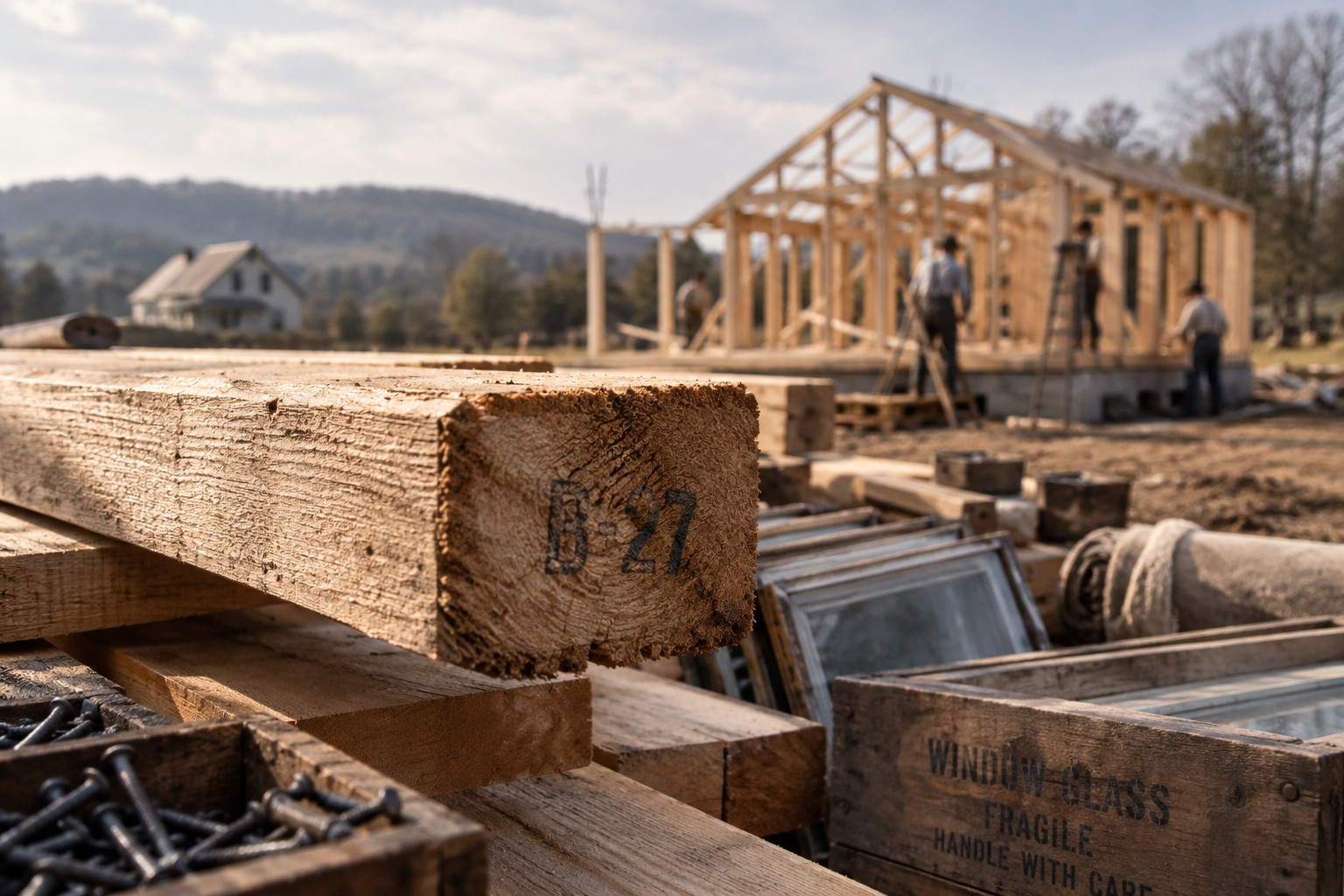
Granted, it was not a finished house. Pieces of one: cut lumber stacked and bundled, crates of nails and hinges and window glass, rolls of flooring, everything a family would need to build a home from the ground up, all of it shipped by rail from a factory more than four hundred miles away in Chicago.
A grandfather and his sons met that train at the station, loaded the lumber onto whatever they had to haul it with, and carried it back to a plot of land in Lemont Furnace, a small community a few miles outside Uniontown in Fayette County.
Then they built the house themselves, by hand, board by numbered board.
That’s the story of how this particular house came to exist. A descendant of that family posted the account decades later on a blog dedicated to tracking down houses just like it, mentioning a farm-style home built in 1921 and the grandfather and uncles who hauled the lumber off the train.
Unfortunately, no blueprint survives. There’s no model name and no photograph of the finished house next to a catalog page showing what it was supposed to look like. Just a hand built farmhouse still standing in Lemont Furnace, and one family’s memory of the day the materials for it arrived.
What that family bought wasn’t a custom job from a local carpenter, and it wasn’t an unusual purchase for the era, either, strange as that sounds today.
They’d ordered a house from a catalog. The same kind of catalog that sold shoes, sewing machines, tools, and rifles also sold, for a stretch of more than thirty years, entire houses, delivered in pieces and built by whoever was willing to do the work.
Sears, Roebuck and Company ran that program, and the house in Lemont Furnace was one of tens of thousands just like it that Sears shipped across the country in the decades before the Second World War.
How a company that made its name selling watches and dry goods ended up in the business of selling houses is its own story, and it starts with a much smaller idea: what to do with a warehouse full of lumber nobody wanted to buy.

The former B&O depot in Connellsville, PA. The railroad was the connection that made a mail-order house from Chicago possible in southwestern Pennsylvania. In 1921, a family in nearby Lemont Furnace could receive thousands of pounds of building materials by rail rather than having to source every piece locally.
How a House Came in a Box
In 1906, Sears had a problem sitting in its warehouses: too much building material nobody wanted, and a building supplies department bleeding money every year it stayed open.
The company had drifted into selling lumber, roofing, hardware, and doors back in the 1890s, almost as an afterthought to its main catalog business, and by the middle of the next decade the whole operation looked like a candidate for the chopping block.
Sears assigned a manager named Frank Kushel to shut it down.
Kushel had a different idea. Instead of liquidating the leftover materials piece by piece, he proposed bundling everything a family needed into complete kits and selling those kits by mail, the same way Sears already sold everything else.
Buy the lumber, the nails, the shingles, and the windows as one package, ship them together, and let the customer put it all to use building an actual house. Sears issued its first house catalog in 1908, offering 22 designs ranging from about $650 to $2,500.
Within a few years, the program that almost got shut down was turning a real profit, and it kept growing for more than three decades.
It wasn’t a complicated transaction, if you’d never encountered anything like it before. A customer paged through a Sears catalog devoted entirely to house designs, more than 370 of them over the life of the program, everything from tiny summer cottages to large multistory homes.
Whatever design a family chose, Sears cut the lumber for that specific house to exact length at the factory, stamped or numbered each piece, and packed the whole kit for shipment.
A typical house arrived in a railroad boxcar carrying roughly 25 tons of material and more than 30,000 individual parts: framing lumber, flooring, roofing, plumbing fixtures, light fixtures, kitchen cabinets, even the nails and paint.
An instruction book walked the builder through assembly, piece by numbered piece, the same way a modern furniture kit works, just built to the scale of an entire house instead of a bookshelf.
Sears didn’t build any of these houses. That part fell to whoever received the shipment; sometimes a hired local contractor, but often the family that ordered it, working alongside relatives, neighbors, or coworkers in an arrangement that resembled the barn raisings rural communities had relied on for generations.
A family bought the materials from Chicago and supplied the labor themselves, and that combination, mail order materials plus hands on assembly, was what made a $2,000 house achievable for families who couldn’t have afforded to hire an architect and a construction crew.
Between 1908 and 1940, Sears sold somewhere between 70,000 and 75,000 of these kit houses across North America, shipped as far as Florida, California, Alaska, and Canada. The company kept almost no organized record of where they went.
When Sears finally closed the Modern Homes program, the sales records documenting which house went to which family were destroyed during a later corporate house cleaning.
Today, researchers have pieced together the history of these houses one discovery at a time: a stamped number on a rafter, a family’s memory, an old catalog page that finally matches a floor plan somebody’s been living inside for a hundred years without knowing it.
That’s exactly the position the house in Lemont Furnace sits in now.

Why Fayette County, Why 1921
The county that family was building in sat on top of one of the richest deposits of coal in the country, and by 1921, that deposit had already shaped everything about how people there lived.
The Pittsburgh coal seam ran underneath Fayette and Westmoreland counties, and the portion of it near Connellsville produced a unique kind of coal, ideal for turning into coke, the fuel that powered the iron and steel furnaces driving American industry through the turn of the century.
Geologists and industrialists both recognized what they had: a seam nearly 147 square miles wide, close enough to the surface to mine efficiently, chemically suited to coking in a way few other coal deposits in the country could match.
Henry Clay Frick built his first coke works near Connellsville in 1870, and by the time his company merged into U.S. Steel decades later, the region held the largest complex of coking ovens in the world.
That industry needed workers, more of them than the existing local population could supply.
Beginning in the 1880s, thousands of immigrants arrived from southern and eastern Europe, Poles, Slovaks, Croatians, Italians, drawn by mining and coke oven jobs that paid more than anything available back home.
Black families migrated up from the South for the same work. Fayette County’s population reflected the scale of that influx: roughly 43,000 residents in 1870, climbing past 110,000 by 1900, and reaching more than 200,000 by 1940, a nearly fivefold increase inside seventy years, almost entirely driven by coal and coke.
Most of those workers didn’t own the ground they lived on. Coal and coke companies built entire towns from scratch to house their workforces, more than sixty of them scattered across the Connellsville coalfield, and locals called them patches.
A patch town belonged to the company that built it: company houses, laid out on a company grid, rented to families for as long as they kept working the mines.
Frick’s operation, one of the region’s largest, kept wages steady and rents low enough that the company reportedly kept every man employed through parts of the Depression, but low rent still meant a family was renting, tied to a job and a landlord who happened to be the same company.
Ethnic and religious lines ran through these towns too. Immigrant families in the patches tended toward Catholic and Orthodox churches, in Slovak, Polish, and Croatian congregations, while longer settled Protestant families in the established towns nearby often kept their distance, both socially and politically.
Against that backdrop, a family that built its own house, on its own land, paid for with cash sent to Chicago rather than rent handed to a coal company, stood apart from how the vast majority of Fayette County’s working population actually lived in 1921.
The house didn’t need to be large or fancy to represent that. It just needed to belong to the people living in it.
To drive the point home, one need only look at the name of the place where that family built.
Lemont Furnace takes its name from the Lemont Furnace Company, one of the iron and coke operations that once worked that same patch of ground decades earlier, alongside names like the Fairchance Furnace Company and the Dunbar Furnace Company scattered through county industrial records from the era.
The community grew up around an industrial operation built to extract value from that land and ship it elsewhere. Nearly half a century later, a family used the same rail lines that carried coke out of the region to bring a house in instead.

The Pittsburgh Surprise
Pittsburgh has more documented Sears kit homes than anywhere else in the country, roughly 1,000 of them by the U.S. Department of Housing and Urban Development’s count, more than Chicago, where Sears ran the whole operation, and more than any of the big Midwestern rail hubs that got first pick of every shipment.
Cincinnati trails a distant second at just over 700. Pennsylvania as a whole was closing in on 2,000 documented houses statewide as of 2021, and Pittsburgh alone accounts for roughly half that total.
Nobody at Sears noticed this happening. The company never tracked which cities bought the most kits, never bragged about Pittsburgh, never had any reason to look. The discovery belongs entirely to a handful of people who went digging decades after Sears stopped keeping records at all.
Karen DeJeet is one of them. She lives in a Sears Hamilton in Pittsburgh’s Forest Hills neighborhood, and she started out just noticing what other people walked past.
A porch column. A window arrangement. Eventually, a number stamped into a rafter that matched a code from a hundred year old catalog. One house led to another. Then another.
Researchers like DeJeet have built a national database tracking nearly 7,200 identified Sears houses across the country, one attic crawl at a time.
That kind of stubborn curiosity is the entire reason anybody knows about the Lemont Furnace house at all. A descendant of the family that built it left a comment on a blog run by researchers doing exactly what DeJeet does: a grandfather, some uncles, a train station in Connellsville, a house built by hand in 1921.
That comment is the whole paper trail. No historical society flagged it. No preservation group put up a marker. Multiply that one comment by the roughly 1,000 houses found around Pittsburgh alone, and that’s how much of this history survives on nothing but somebody remembering, and happening to mention it somewhere a stranger could find it.

What’s Still Standing
The house in Lemont Furnace is still there.
A hundred years of Pennsylvania winters have gone by since that boxcar pulled into Connellsville, and the family that built it still owns it.
Unfortunately, no blueprint has turned up. No model name has been matched to it, the way DeJeet matched a rafter stamp to a Hamilton or a Wilmore.
Whoever eventually tracks it down will have to do it the same way every other Sears house gets identified: crawling through an attic, checking for a stamped number on a piece of framing lumber, cross-referencing it against a catalog scanned and posted online by someone who cared enough to do the work.
Most of what built this county is gone now. The coke ovens that drew that family’s neighbors to Fayette County by the tens of thousands went cold decades ago. The patch towns that housed the miners and mill workers have mostly been absorbed into the small towns around them or abandoned outright.
Frick’s company, the mines, the beehive ovens stretching across a hundred and forty-seven square miles of hillside: all of it belongs to a history most people driving through the area today wouldn’t recognize if they saw it.
What survives is a house nobody would look at twice, sitting on a piece of land that used to be worth something for the coal underneath it rather than the family living on top of it.
That family didn’t order a name brand or a landmark.
They ordered lumber, hardware, and a set of instructions, and they turned it into a home with their own hands over however many weekends it took. A hundred years later, the fact that it’s still standing says more than any blueprint could.
Sears stopped keeping track of these houses before the people living in them were even born. The families who built them didn’t need Sears to keep track.
They just needed the house to hold up, and this one did.




Leave a Reply