
The Connellsville coke region didn’t sleep. It couldn’t. There were roughly 35,000 beehive ovens burning at any given time across the hills above the Youghiogheny River, and coke took two to three days to make. You didn’t shut that down for the night.
Charles Van Hise, the president of the University of Wisconsin, passed through on a train around the turn of the century and felt compelled to write about what he saw:
“Long rows of beehive ovens from which flame is bursting and dense clouds of smoke issuing, making the sky dark. By night the scene is rendered indescribably vivid by these numerous burning pits.”
He was underselling it.
Each oven was a stone or brick dome, four to five feet high, packed with a two-foot charge of coal baked slow and hot until it shed everything that wasn’t carbon. The smoke from tens of thousands of ovens built up overhead into something that looked permanent, a ceiling between the valley and the sky.
Locals said the glow was bright enough to work by at two in the morning. Visitors found this extraordinary. The people who lived there found it ordinary, which tells you something about what it means to grow up inside a world that runs on fire.
Down in the valley, the Baltimore and Ohio Railroad yard kept the same hours. Classification cuts rolled through the hump. Engines coupled and decoupled. Long trains of coke cars were assembled for the run to Pittsburgh.
Crews changed at any hour, because the railroad makes no distinction between two in the afternoon and two in the morning. Connellsville was a division point on the B&O’s Pittsburgh Division, which meant it was where the work got reorganized before the next leg.
Engines were inspected and serviced here. The massive steam locomotives that pushed heavy freight over the mountain grades were based here. If you worked the railroad in this part of Pennsylvania, you knew Connellsville’s yard.
The men doing this work would have been puzzled by the idea that any of it was remarkable. The ovens burned. The trains ran. The mines were worked. Countless supporting facilities ran around the clock. It had always been this way, and as far as anyone could tell, the evidence supported the assumption that it always would be.
They were wrong. But the evidence really did support it.

The Seam
To understand why any of this happened in Connellsville specifically, you have to start underground.
The Pittsburgh coal seam runs beneath southwestern Pennsylvania in a wide band across Fayette and Westmoreland Counties. Coal exists in a lot of places. The section of that seam centered on Connellsville, known locally as the Connellsville seam, or sometimes the “Nine Foot seam” for its depth, was different.
It was nearly pure carbon, low in sulfur and phosphorus, almost entirely free of the slate and impurities that plagued competing deposits. It didn’t need to be washed before coking. It didn’t need to be sorted or crushed.
You pulled it out of the ground and put it in the oven, and what came out the other end was metallurgical coke of a quality no other region in the world could match. The iron and steel industry didn’t just prefer Connellsville coal and coke. It was built around it.
The beehive oven process turned that coal into something close to a pure carbon skeleton; hard, porous, capable of burning hot enough to drive a blast furnace. Pittsburgh’s ironmasters understood this early.
By the time Andrew Carnegie and Henry Clay Frick were consolidating their empires in the 1880s, Connellsville coke wasn’t one option among several. It was the standard. When Henry Clay Frick locked up the coalfield, he wasn’t being opportunistic. He was acquiring the one thing the entire steel industry ran on, and he knew it.
The numbers that came out of this region are almost hard to take seriously. By 1910, 44,252 of Pennsylvania’s 55,166 coke ovens sat in the Connellsville area. At peak output in 1916, roughly 46,000 beehive ovens were converting the seam’s coal into coke.
One observer estimated that if a single year’s production were loaded into one train, the locomotive up front would travel to San Francisco and back to Connellsville before the caboose cleared the yard.
That is a lot of coke. And every ton of it was going somewhere specific: to the blast furnaces of Pittsburgh and the mill towns strung along the Monongahela and Ohio Rivers, where it was burned to produce the steel that built American bridges, skyscrapers, and warships.
The country’s industrial infrastructure wasn’t built on Pittsburgh steel in any abstract sense. It was built on Connellsville coke, which made Pittsburgh steel possible in the first place.
People in the region understood this, even if the rest of the country didn’t. The title “Coke Capital of the World” wasn’t boosterism. It was accurate.
For roughly four decades, from the 1880s through World War I, there was no substitute for what came out of these hills. The seam was unique. The chemistry was irreplaceable. The men who owned the land and the ovens and the railroads that hauled the product believed this would remain true indefinitely.
That belief was well-founded; right up until it wasn’t.

The Fire and the Men
The beehive oven was exactly what it sounds like: a dome of stone or brick, roughly the diameter of a large dining table, with an opening in the front and a hole at the top called the trunnel head.
Workers loaded coal through the top, packed it to a depth of about two feet, then bricked and sealed up the front opening to control the burn. Heat from the previous charge ignited the new one.
Two to three days later, the coking process was complete. Workers opened the oven’s door, sprayed the red-hot mass with water, and raked the steaming coke into waiting railroad cars with fourteen-tine forks. Then they started again.
The smoke and chemical byproducts went straight into the air. A government survey from 1911 noted dryly that “the smoke and gas from some ovens destroy all vegetation around the small mining communities.” This was considered the cost of doing business.
The beehive oven was a crude and effective machine, and what it required from the men who worked it was mostly endurance.
A contemporary observer described coke work as requiring “little handicraft skill or trained intelligence.” He meant it as an explanation for the kind of men the work attracted. It reads more like an indictment of the men making that observation.
Who it attracted was the world’s poor. Slovaks and Hungarians arrived first, followed by Poles and Italians; wave after wave of men who had crossed the Atlantic with whatever they could carry and ended up in southwestern Pennsylvania because word had gone out that the seam needed labor and was willing to pay for it.
By the early 1900s, close to half a million Slovaks alone had emigrated to the United States, with a substantial share landing in the Connellsville region.
The Slovak Colonization Society at one point organized roughly 300 Connellsville Slovaks to leave the region and establish a colony in Arkansas. That’s how many of them there were, and also how difficult the conditions were.
They lived where the company put them. At least 60 coal patches were built across the Connellsville coalfield. They were company constructed towns of identical duplexes climbing the hillsides, with a company store at the center where miners ran up bills settled against their wages before they ever saw a dollar.
The hierarchy was visible in the architecture design. Workers’ duplexes in long identical rows at the bottom, and up on the hill, slightly larger houses for the foremen; what locals called “boss’s row.” You could tell where you stood by where you lived.
These were hard communities, and also real ones. Men from different countries and languages built parishes together, founded beneficial societies, and buried their dead in the same Catholic cemeteries.
The patches produced a unique kind of loyalty; to the community, to the church, to each other, that had nothing to do with the coal operators and everything to do with the people sharing the hillside.
That loyalty was tested regularly. In 1891, roughly 16,000 workers across the coke region went on strike for higher wages against the H.C. Frick Coke Company. Before dawn on April 2, more than a thousand of them marched on the Morewood mine.

Sheriff’s deputies opened fire. Nine men were killed and buried in a mass grave at St. John’s Cemetery in Scottdale. The strike collapsed by May. Frick’s explanation was characteristically direct:
“We concluded that we would end this thing once for all, and determine whether we had a right to employ who we pleased and discharge whom we pleased.”
The Morewood Massacre is less well known than the Homestead Strike that followed it the next year, which is a peculiar outcome given that more people died at Morewood. Most of the dead were immigrants whose names the local papers mangled or skipped over entirely. That, too, was considered acceptable.
What the patches and the ovens and the strikes add up to is a world in which the men doing the most essential work were regarded as the most replaceable. The coke region ran on their labor. It did not run for their benefit.
They understood this, and most of them stayed anyway, because the alternative was worse; and because the hills above the Youghiogheny had become home.

The Line
The coke had to get somewhere. That’s where the Baltimore and Ohio Railroad came in.
Connellsville sat at a junction that the B&O’s planners understood was worth controlling. The railroad’s main line ran east to Cumberland and then on to Baltimore and Washington, which meant everything coming from or going to the Atlantic seaboard passed through here.
The Pittsburgh Division, the B&O’s primary route into the steel capital, ran directly through Connellsville’s yard. And fanning out from town, a series of branch lines snaked up into the surrounding hills to collect coke from the patches at places like Leisenring, Trotter, and Fairchance and bring it down to be classified for the run to Pittsburgh.
This made Connellsville a division point, which in railroad terms meant it was where the work got reorganized. Crews changed here. Engines were inspected and serviced here. Trains coming in from the east had just survived Sand Patch, one of the steepest grades in the Allegheny Mountains, and needed to be checked before the next leg.
The B&O kept a fleet of helper locomotives in Connellsville specifically to push heavy freight over the mountain grades; at peak operation, the roundhouse ran around the clock.
The B&O dominated the east bank of the Youghiogheny. The Pittsburgh and Lake Erie worked the west side. The Western Maryland came in from Cumberland on its own line and connected with both. The Pennsylvania Railroad had it’s own line and interchange. At one point, five separate railroads served a town that never had more than about 13,000 people.
That ratio, five major railroads for 13,000 residents, tells you what the rest of the country needed from this place.
The men who worked the mechanism fell into two categories that railroaders everywhere recognized.
The “home guards” were locals, men who had worked the same territory for twenty years and intended to work it twenty more, whose families had grown up within earshot of the yard and who measured their lives in seniority and pension.
The “boomers” were the opposite; itinerant railroaders who followed work wherever the work was, moving from division point to division point as assignments came and went, living out of a bag and sleeping wherever the company provided.
What the company provided, in Connellsville as in most major division points, was the Railroad YMCA.
The B&O’s facility was the social and logistical center of the railroader’s world in town; dormitory rooms for men waiting on their next run, a cafeteria that served at any hour because the trains didn’t stop for mealtimes, a reading room, and classes in the practical sciences of railroad work: air brake mechanics, basic engineering, the math of train handling on grades.
Management backed the YMCA concept partly out of genuine concern and partly because they understood what happened when railroaders with time between runs had nothing to do but find a saloon. The YMCA kept men rested, sober, and employable. It was paternalism, but it was effective paternalism.
The town ran on the yard’s tempo. When the B&O was moving freight, Connellsville’s hotels and restaurants and shops along Pittsburgh Street and Crawford Avenue had customers.
Coal was 40 to 48 percent of the B&O’s total freight tonnage throughout its history; not a commodity the railroad hauled, but the commodity the railroad was built around. A slow week in the yard meant a slow week downtown. A strike in the patches meant empty classification tracks and idle crews at the YMCA.
The connection between what happened on the hillsides above town and what happened in the streets below was a direct line. Connellsville’s economy wasn’t diversified. It was integrated; every part of it dependent on every other part, all of it dependent on the seam.
That kind of integration is efficient. It is also fragile in ways that are easy to miss when everything is working.

Built to Last
The men who ran the B&O and the men who ran the coal and coke operations shared one conviction: this was permanent. You can tell because of what they built.
The concrete coal tipple that stood over the Davidson Mine in the Connellsville field was engineered so heavily it bordered on absurd. Concrete tipples of that era were built to last decades. This one was built as though the engineers didn’t fully trust the concept of decades and decided to aim for something longer.
It became a landmark not because anyone intended it as one but because it was simply too substantial to ignore. When you build something that way, you are making a statement about the future; that you have looked at it carefully and found it reliable.
The B&O’s roundhouse operated on the same logic. At its peak it ran continuously, housing the helper locomotives that pushed heavy freight up the mountain grades and servicing the engines that came through the division point around the clock.
The investment in that facility, the turntable, the service pits, the infrastructure for keeping steam locomotives operational, represented a bet on Connellsville’s role in the system that had to be renewed every year in maintenance costs. The B&O renewed it without apparent hesitation.
Then, in the 1950s, something happened that could have ended Connellsville’s railroad identity and instead looked, from the inside, like confirmation of it. Steam was dying, and quickly. Diesel-electric locomotives were taking over, and division points built around steam infrastructure faced an uncertain future.
The roundhouse model — massive and labor-intensive, built for a technology that was being retired — seemed like it might become obsolete along with the engines it serviced.
The B&O’s answer was to build one of its most modern diesel-electric servicing facilities in Connellsville. New equipment, new procedures, built for the EMD and Alco locomotives that were replacing the steam fleet.
Men who might have worried about their jobs found them converted rather than eliminated. From where they stood in 1955, this looked like more positive evidence. The railroad had looked at Connellsville, weighed what it was worth, and decided to invest again. That is not what you do in a place you are planning to leave.
This is the part of the story that gets lost when people talk about industrial decline as though it were inevitable and obvious to anyone paying attention. It was obvious to no one paying attention.
The people making these decisions had access to the best information available. They were not sentimental and they were not careless; these were hard-nosed operators who did not spend money without reason. They spent it in Connellsville because Connellsville made sense.
The concrete tipple. The diesel facility. The roundhouse rebuilt for a new generation of power. Each one a reasonable decision made by a reasonable man who turned out to be wrong, not because he failed to think it through, but because the thing that would kill Connellsville was still too far away to see.

The Two Deaths
Connellsville didn’t collapse. It was killed twice, in sequence, by forces that had nothing to do with anything the town did wrong.
The first death came from technology, and it arrived the same year the beehive ovens hit their peak. In 1916, the year 46,000 ovens were burning across the region and the Connellsville seam was producing 40 million tons of coal, U.S. Steel opened the Clairton Coke Works on the Monongahela River, 15 miles south of Pittsburgh.
Clairton was a byproduct plant, which meant it operated on an entirely different principle than the beehive oven. Instead of venting the chemical output of coking directly into the air, it captured ammonia, coal tar, and coke oven gas and sold them. The process was cleaner and more profitable.
It was also, importantly, less particular about its coal.
The beehive oven’s one irreplaceable requirement was Connellsville coal. The chemistry of the seam was precisely what made beehive coking work at the quality the steel industry demanded.
Byproduct ovens were less demanding. They could use coal sourced from West Virginia, Kentucky, or anywhere else the seam was adequate. Clairton’s position on the Monongahela gave it access to both rail and barge transportation, which meant it could pull coal from a wide geography and deliver coke directly to the mills upriver.
U.S. Steel grasped the implications immediately. By the 1920s, it had abandoned its beehive operations and centralized coke production at Clairton. The patches didn’t die all at once — some ovens kept burning for decades — but the seam had lost its monopoly on the industry it had built.
The last beehive ovens in the region stopped operating in 1972. By then, their end was a formality.

The second death came from the market, and it was slower and more noticeable. American steel production peaked at 111 million tons in 1973 and fell to 70 million tons by 1984.
The causes stacked on top of each other: foreign competition from rebuilt postwar industries in Japan and Germany, oil shocks driving up energy costs across the entire production chain, and a domestic industry that had spent decades avoiding the capital investment its competitors were making.
The mills along the Monongahela, which had consumed Connellsville coke and Connellsville railroad capacity for the better part of a century, began closing. Between 1980 and 1983, roughly 95,000 manufacturing jobs vanished from the Pittsburgh area alone.
The railroad felt it in direct proportion. The B&O had been in financial distress since the early 1960s; the C&O took control in 1963, absorbing a railroad weighed down by debt and aging equipment. The Chessie System consolidated the B&O, C&O, and Western Maryland under a single banner in 1973.
CSX came out of the absorption of the Chessie System in 1980. The B&O as a corporate identity dissolved in 1987, 160 years after its founding, merged quietly into the Chesapeake and Ohio.
The Western Maryland, which had competed with the B&O through Connellsville’s valley for decades, saw its coal business declining as early as the 1950s; CSX abandoned most of its trackage within three years of gaining control.
What this meant for Connellsville was the systematic removal of everything the town had been built to support. The coke runs stopped. The classification yard thinned out. The crews that had changed shifts around the clock at the B&O YMCA had less reason to be there and then no reason.
The roundhouse that had run continuously for decades went quiet. The diesel facility that had looked like a vote of confidence in the 1950s became, within a generation, a monument to a bet that didn’t pay.
The concrete tipple stood over all of it, seemingly built for a thousand years, watching the rest come down.

What the River Kept
Connellsville’s population was 7,031 at the 2020 census. At its peak, the town held about 13,000. The difference lives in the empty lots where the Victorian houses used to stand, the shuttered storefronts on Pittsburgh Street, and the overgrown hillsides where the patches and banks of ovens used to be.
CSX still runs a line through town on the old B&O main, and freight still moves through the valley.
But a through freight is a different thing than a division point. The roundhouse footprint is open space now. The YMCA that once kept hundreds of railroaders fed and rested between runs is gone.
The yard that classified thousands of coke cars a week handles a fraction of that traffic, and what it handles doesn’t require the army of men it once did. The diesel facility that looked like the future in 1955 is a memory.
The Great Allegheny Passage follows the former Pittsburgh and Lake Erie and Western Maryland right-of-way through the river valley; 150 miles of trail running from Pittsburgh to Cumberland, Maryland, built on the bones of the railroads that competed for the coke traffic a century ago.
It is a genuinely wonderful trail, and it brings money into Connellsville that the town needs. Cyclists pass through what was once a roaring industrial area and find it peaceful and scenic. The Youghiogheny is clean enough to paddle now, which would have been an unthinkable statement a century ago.
Along the trail outside of town, the beehive oven ruins sit in the brush; stone domes going slowly back to the hillside, the trunnel heads open to the sky. There are nearly 38,000 of them scattered across the region in various states of collapse.

Some have been swallowed by vegetation entirely. Others are intact enough that you can walk inside and look up through the opening and understand, in a very real way, what the men who worked them were dealing with.
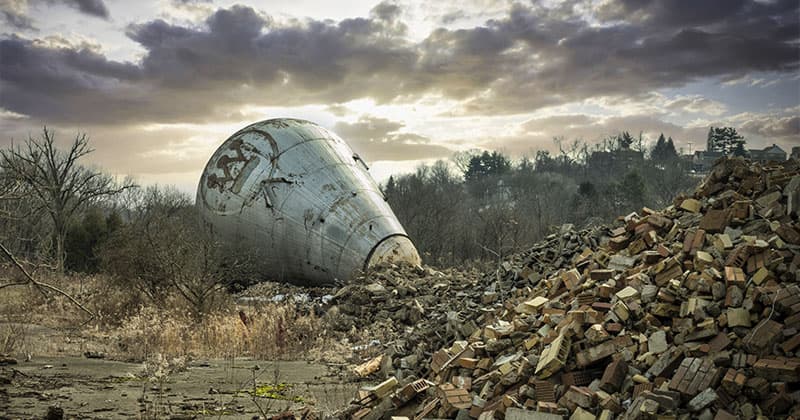
The concrete tipple came down in 1979 or 1980, depending on who you ask. It had stood for decades, built to outlast everything around it.
In the end it outlasted the industry by about a decade, which is not nothing, but is also not a thousand years. They took it down and left the ground flat, and now there is nothing there to tell you what the confidence of an earlier age looked like in physical form.
The ovens on the hillside are cold and dark. The yard below them runs a ghost of its former schedule. The Youghiogheny moves north toward the Monongahela the same way it always has, carrying whatever the valley gives it, indifferent to what that used to be and what it is now.
Some things get built to last. Some things last. The river doesn’t distinguish between them.



Leave a Reply