NOTE: I’ve covered a lot of western Pennsylvania history on this blog; coal and steel, Carnegie and Frick. There’s more. The same corner of the state also took aim at the oil industry and the most powerful monopoly the world had ever seen.
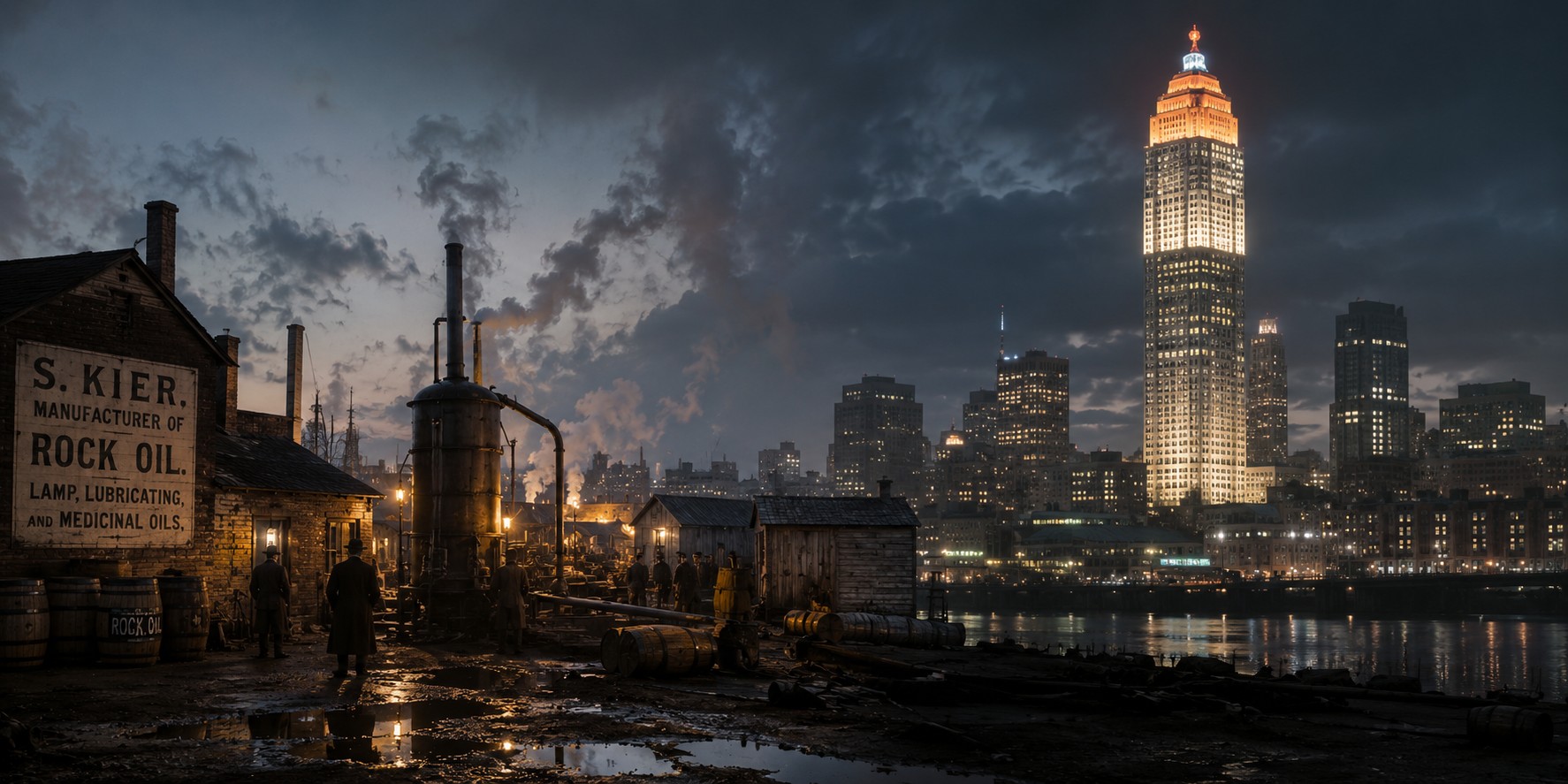
In 1853, a Pittsburgh druggist named Samuel Kier built the first commercial oil refinery in the United States on a lot along Seventh Avenue.
The process was imperfect, to be kind. Kier had been refining crude skimmed from his family’s salt wells and bottling it as patent medicine before he worked out that the same material could replace whale oil in lamps, but the infrastructure was real.
Pittsburgh had the first oil refinery in America before Edwin Drake drilled his well in Titusville, before the Oil Creek boom, before John D. Rockefeller had formed any influence on the industry whatsoever.
Seventy-nine years later, Gulf Oil Corporation completed its headquarters at 707 Grant Street in Pittsburgh. Forty-four floors. Five hundred and eighty-two feet of Indiana limestone and New England granite, Art Deco from the foundation to the crown, with a stepped pyramid at the top.
In 1956, Gulf fitted the building’s crown with a neon illumination system that color-coded the weather for anyone who looked up: orange for fair skies, blue for rain or snow, and temperature codes. On a clear night, you could read the forecast from anywhere in the city.
The Gulf Tower was the tallest building in Pennsylvania from the day it opened until 1971, and Pittsburgh treats the beacon on its roof like a public institution.
The Gulf Tower stands on the same block as Samuel Kier’s refinery.
That is Pittsburgh’s oil story on one city block; the country’s first commercial refinery, then the headquarters of one of the largest oil companies in the world, on the same ground, seventy years apart.
What happened between those two buildings, and what the men behind the second one built along the Gulf Coast and on Baum Boulevard, is what this article is about.
The first piece in this series followed Ida Tarbell, the Titusville woman who took Standard Oil apart with documentation and nineteen issues of a magazine. That is the story of the legal and political assault on Rockefeller’s monopoly, the paper trail that ended in a federal courtroom in 1911.
This article follows the other attack; the commercial one, conducted in oil fields and shipping lanes instead of courtrooms. The attack that bypassed Rockefeller’s railroad network by building an infrastructure he had no answer for, on a playing field his own behavior had already gotten him banned from.
Pittsburgh money and Westmoreland County grit were dismantling Standard Oil from the outside while Tarbell was dismantling it from within. By the time the Supreme Court issued its ruling, the monopoly had already lost significant ground in the American market.
The men responsible for that were managing their operation out of Pittsburgh, moving Oklahoma crude through four hundred miles of pipeline to waiting tankers on the Gulf Coast.
Standard Oil had spent thirty years building leverage over every railroad that mattered. Pittsburgh had a different idea about how oil ought to travel.

The Pittsburgh Men Who Went to Texas
The money behind Gulf Oil came from Pittsburgh. So did the men.
James McClurg Guffey was born in Sewickley Township, Westmoreland County, in 1839. It’s the kind of western Pennsylvania pedigree that frequent readers of this blog will recognize immediately.
He grew up on a farm, attended the Iron City Commercial College in Pittsburgh, and spent his early career as a railroad clerk in Louisville before returning to Pennsylvania in 1872 to work in the oil business.
He picked it up quickly. By the 1880s, he was probably the largest individual oil and gas producer in the country. He also served as president of the Southwest Natural Gas Company, the operation that supplied natural gas to the Connellsville coke region. The same beehive ovens and coke works that Andrew Carnegie and Henry Clay Frick depended on ran partly on Guffey’s gas.
Guffey was a Democratic Party power in a state where Republicans ran everything in sight, which made him a perpetual underdog in Harrisburg. He lost Senate races to Matthew Quay in 1901 and Boies Penrose in 1903.
He was a Duquesne Club man and a trustee of Washington and Jefferson College. The town of Guffey, Colorado, was named after him. He had a partner named John H. Galey, another Pennsylvania oil man, and the firm of Guffey and Galey was one of the most storied drilling operations in the industry.
They had worked the Pennsylvania fields and West Virginia, then moved west to Kansas and Oklahoma, then to California. By 1899, they were looking at a salt dome hill outside Beaumont, Texas, called Spindletop. The geology looked promising. Guffey needed capital.
He went to Pittsburgh and found it.

William Larimer (W.L.) Mellon was born in Pittsburgh in 1868, the son of James Ross Mellon and nephew of Andrew Mellon; the banker who would eventually run the U.S. Treasury under three consecutive presidents.
In the 1880s, W.L. developed an interest in the Pennsylvania oil fields and built a small oil company of his own. Standard Oil bought it out from under him in 1895. He moved on to railway construction, but he did not forget.
When Guffey came looking for backing, the Mellon family committed $400,000 from Mellon Bank. Andrew and W.L. were the largest investors. The remaining backers were Mellon banking clients and Texas wildcatters, but the center of gravity was Pittsburgh.
The money that would drill the most consequential oil well in American history came from the same bank that had made Andrew Mellon the dominant financial force in western Pennsylvania.
It is worth considering what these men brought beyond capital. Guffey had spent thirty years in oil fields that Standard had systematically moved to control. He understood the mechanism in detail; the railroad rebates and rate wars, the quiet buyouts and the not-so-quiet pipeline pressure.
Mellon had watched Standard absorb his own company. These were not naive investors chasing a Texas rumor. They were men with personal experience of what Rockefeller’s monopoly did to competitors, and they were placing their money in a state where Standard’s conduct couldn’t touch it.
That context matters. Spindletop was more than just a geological opportunity. For the Pittsburgh men who backed it, it was a chance to build something in an area where Standard Oil’s playbook couldn’t take the field.

Spindletop
At roughly ten thirty in the morning on January 10, 1901, a drill at Spindletop Hill outside Beaumont, Texas, hit a pressurized pocket of oil and gas at 1,139 feet and produced something the industry had never seen.
The well came in at an estimated 100,000 barrels a day, more crude than all the other producing wells in the United States combined. The gusher blew for nine days before the crew capped it. The column of oil rose 150 feet above the derrick. People came from across the state to watch.
John D. Rockefeller was not among them. Standard Oil’s marketing arm had been banned from Texas under state antitrust law, and its attempts to build refinery capacity in the region had run into the same legal resistance.
The playing field that had just produced the largest gusher in history was one where Rockefeller’s central weapon, the railroad rebate, the freight manipulation that had made him dominant everywhere else, was already illegal.
The Pittsburgh men had not planned it quite that way. They had come for the geology. The legal environment was a considerable bonus.
Guffey moved quickly. By May 1901, he had organized the J.M. Guffey Petroleum Company, buying out Galey’s quarter interest and Lucas’s eighth, consolidating control with Mellon money behind him.
By fall, the operation had a pipeline running eleven miles from Spindletop to a new refinery at Port Arthur, and Guffey had started building what would prove essential: a tanker fleet. Five ships, commissioned to carry crude from Port Arthur to East Coast refineries and ports.
Standard’s railroad network ran from one end of the country to the other. Guffey’s ships didn’t need any of it.
Then Spindletop started to decline.
It happened faster than anyone expected. The field had been over-drilled. Hundreds of producers had rushed in after the Lucas gusher, sinking wells so close together that reservoir pressure collapsed, and by late 1902, production had fallen dramatically from its peak.
The Guffey Petroleum Company and its affiliated Gulf Refining operation had $6 million invested and revenues that could not sustain that commitment. W.L. Mellon, dispatched to Texas by the family to investigate why the well was underperforming, found a company running on improvisation and diminishing returns.
He stayed.
Mellon took active charge in the fall of 1902 and spent the next five years doing what the historical record describes with clinical understatement: keeping the companies from going bankrupt.
Guffey was a brilliant wildcatter and deal-maker, not an operations man, and the Spindletop field was no longer the miracle it had appeared in January 1901.
The operation needed new crude supply and a fundamental restructuring of how it was run; the kind of work that required someone willing to stay in Texas and manage rather than drill and move on.
Guffey remained nominally in charge. Mellon ran things. It was an arrangement that satisfied neither man but kept the enterprise alive long enough to matter.
The difficult middle, the five years between Spindletop’s peak and Gulf Oil’s incorporation, tends to disappear from the historical telling of the story.
The popular version compresses this into a clean arc: Pittsburgh money, Texas oil, Rockefeller defeated. The actual version has a near-bankruptcy in the middle, a field in rapid decline, and a man from Pittsburgh spending half a decade holding together a company that could easily have folded before it became anything.
The Gulf Oil that emerged from those five years was something more sustainable than what had rushed to Spindletop in 1901: a vertically integrated operation with a refinery and a pipeline, a tanker fleet and a Pittsburgh banker running the day-to-day.
What it needed next was a new source of crude. Oklahoma had one.

Go Around It
The tanker fleet was the first move, and it predated the Glenn Pool pipeline by five years.
While Mellon was reorganizing the Guffey operation in 1902, the ships were already running. Five vessels, carrying Texas crude from Port Arthur around the Florida coast and up to East Coast refineries and ports.
Standard Oil’s railroad rebates, the secret rate agreements and freight manipulation that had been the backbone of Rockefeller’s monopoly, were irrelevant to a ship. You cannot offer a favorable rebate to a vessel that doesn’t use your tracks. You cannot squeeze a tanker the way you squeeze a refinery dependent on rail freight to stay competitive.
This was the logic of the maritime bypass: Standard had built its dominance on controlling the roads that oil traveled. Guffey and Mellon had simply chosen different roads.
The inland version of the same logic came later, and bigger. In 1905, drillers working the Ida Glenn farm near Tulsa, Oklahoma, opened what became known as the Glenn Pool; one of the largest oil strikes in the country’s history to that point, producing high-quality crude in volumes that immediately attracted every major operator in the region.
Standard tried to move on it. Standard’s pipeline network ran east and north, toward Ohio and the established refining centers it already controlled. Moving Oklahoma crude to the Gulf Coast refinery at Port Arthur meant building something Standard had no interest in building.
Gulf built it.
The Glenn Pool pipeline ran four hundred miles from the Oklahoma fields to Port Arthur, Texas. Construction began in early 1907 and moved fast. By September of that year, Oklahoma crude was flowing through the line to Port Arthur and onto waiting tankers.
The inland pipeline and the maritime fleet now operated as a single integrated system — crude from the mid-continent fields moving south by pipe to the coast, then east by ship to refineries and markets that Standard had assumed it controlled.
The timing was not accidental. The Elkins Act of 1903 had already made railroad rebates illegal, stripping Standard of its primary weapon. The Hepburn Act of 1906 gave the Interstate Commerce Commission authority to set railroad rates, closing the legal space that Rockefeller had operated in for thirty years. The federal antitrust suit was already working through the courts by the time Gulf’s pipeline reached Port Arthur.
Standard was being dismantled from two directions simultaneously; the legal case attacking the structure of the monopoly, and the pipeline and tanker fleet attacking the market position that structure had created.
Neither effort was coordinating with the other. Both were responding to the same decades-long abuse of the same instrument: a railroad system that Rockefeller had converted into a private toll booth on the entire American oil industry.
What the Pittsburgh men had grasped, and what the Tidewater Pipeline’s founders had grasped twenty years earlier in Pennsylvania, over the Allegheny Mountains, was that the toll booth only worked if you used the road.
Build your own road and the toll collector has nothing to sell. The tanker fleet was one road. The Glenn Pool pipeline was another. Together, they moved enough volume to establish Gulf as a genuine national competitor before the Supreme Court had entered the picture.
By 1911, when the Court issued its ruling, Standard’s share of the American refining market had already fallen from its peak of roughly ninety percent to somewhere around sixty-four. The dissolution order broke up a monopoly that had spent a decade losing its grip on the market. Gulf was a significant reason why.
Rockefeller’s fortune tripled in the aftermath of the breakup, as the stock of thirty-four independent successor companies appreciated dramatically. The man the Pittsburgh men had outmaneuvered in the oil fields of Texas and Oklahoma ended the decade wealthier than when he started it.
That is the kind of irony that deserves a moment’s consideration before moving on.

Colonel Guffey’s Exit
In January 1907, the Mellons moved to formalize what had been true in practice for five years. The Guffey Petroleum and Gulf Refining companies, along with the pipeline operation between them, were amalgamated into a single entity: Gulf Oil Corporation.
William Larimer Mellon was named president. The operation that had started with a wildcatter from Westmoreland County and a $400,000 loan from Mellon Bank was now a properly organized Pittsburgh corporation, vertically integrated from wellhead to tanker.
James Guffey sold his interest, seven-fifteenths of the combined operation, for $3 million.
Three million dollars was a significant sum in 1907. It was not a significant fraction of what Gulf Oil would become. Guffey had co-founded the company, drilled the well, organized the initial operation, and built the tanker fleet that first bypassed Standard’s railroad network.
He received a transaction payment and his name removed from the letterhead. The Westmoreland County man who had carried Pittsburgh money to Texas and turned it into one of the largest oil operations on the Gulf Coast walked away with considerably less than he had built.
It got worse. The Panic of 1907 hit Guffey’s other investments hard. By 1910, his properties were in receivership; his receiver noted assets of over $15 million but ready cash insufficient to cover $7 million in liabilities.
He spent his later years trying to recover what the panic had taken. He died in Pittsburgh in 1930, at ninety-one, a Democratic Party elder and a figure of genuine historical significance who had watched the company he founded become one of the largest oil corporations in the world from a position of considerable financial difficulty.
None of that diminishes what he built. Guffey had done the essential early work; identified the play, assembled the partners, organized the capital, and kept the operation moving through the chaotic years after Spindletop’s initial production collapsed.
The fact that the Mellons had the resources and organizational capacity to consolidate what he assembled is a function of who had the deeper capital, not who had the vision. Guffey had both. He ran out of one of them at the wrong moment.
Gulf Oil Corporation, managed from Pittsburgh under W.L. Mellon, expanded steadily through the subsequent decade. New fields in Oklahoma and Texas, new refinery capacity, new pipeline infrastructure pushing further into the mid-continent oil country that Standard had never managed to fully control.
Andrew Mellon — whose biography credits him as the single most significant individual in the economic life of western Pennsylvania in the first decade of the twentieth century — had added a major oil company to a portfolio that already included Alcoa and Westinghouse, and the dominant banking operation in the region.
Gulf would eventually operate on six continents. It would enter into a joint venture with British Petroleum to develop the Kuwait oil fields, a deal Andrew Mellon helped arrange from his post as U.S. Ambassador to the Court of St. James’s in the early 1930s.
The company that Guffey and Galey had drilled into existence on a Texas salt dome with Mellon Bank money would become one of the defining energy companies of the twentieth century.
The name on the building was Gulf. The address was Pittsburgh. It had always been Pittsburgh.

The Long Game
Gulf Oil was not the only Pittsburgh story at Spindletop.
Joseph Newton Pew had made his name running Peoples Natural Gas, one of the major natural gas operations serving Pittsburgh and the surrounding region.
He had co-founded what became the Sun Oil Company (Sunoco), and in 1901, the same year Guffey drilled his gusher, Pew went to Spindletop independently. He bought wells, built a pipeline to the Neches River, and arranged to ship crude north by water to a refinery he was building at Marcus Hook, Pennsylvania, on the Delaware River south of Philadelphia.
Sun’s first tanker of Texas crude arrived at Marcus Hook in March 1902. Same strategy as Gulf; bypass the railroad, move the oil by ship, executed by a different Pittsburgh family operating on a parallel timeline.
The operational geography mattered then, and it matters to how you tell the story now.
Gulf’s headquarters stayed Pittsburgh; its production was Texas and Oklahoma. Sun Oil’s operational center moved east to Marcus Hook, making it an eastern Pennsylvania company in practice even though its founding energy came from the western half of the state.
The Pew family’s business roots were in Pittsburgh. The refinery that processed their crude was two hundred and fifty miles away, on the other side of the state.
What brought Sunoco back to southwestern Pennsylvania was infrastructure. Joseph N. Pew Jr. persuaded the company to run gasoline pipelines from the Marcus Hook refinery to distribution points in Ohio and New York, negotiating right-of-way agreements with more than a thousand landholders in four states.
Those pipelines crossed southwestern Pennsylvania to reach Ohio markets, cutting through townships and counties that Guffey had once supplied with natural gas from his Connellsville operation.
Western Pennsylvania was, for the second time in a generation, a corridor for energy moving between the fields that produced it and the markets that consumed it.
This is why Sunoco signs felt permanent in that corner of the state in a way that outlasted the brand’s active marketing presence.
Gulf built its western Pennsylvania identity through service stations and the Gulf Tower. Sunoco built its identity through the literal plumbing of the region; pipelines running under fields and woodlots, crossing river valleys, supplying the distribution terminals that fed the stations.
You can rebrand a service station overnight. Pipeline infrastructure takes decades to replace, if it gets replaced at all.
The rights-of-way are still out there. In the townships southwest of Pittsburgh, in Fayette and Washington counties, in the hollows between the ridges, you can find the cleared easements cutting through the woods and the valve housings above the pipelines running below.
That is Sunoco’s Pennsylvania shadow: the infrastructure underneath the logo, not the orange diamond above the pump.
The distinction between the Gulf story and the Sunoco story is worth maintaining because they are so often collapsed into one. They share a starting point: Spindletop and Pittsburgh capital, and the bypass of Standard’s railroad network — and they share a landscape.
What they built with those common elements ran in different directions. Gulf went national and then global, managed from Grant Street. Sun Oil became the pipeline the mid-Atlantic and Ohio markets depended on, managed from Marcus Hook. Both are legitimate western Pennsylvania stories. They are not the same story.

Baum Boulevard
Nineteen years before Gulf completed its tower on Grant Street, it built something smaller and considerably more consequential on the other side of Pittsburgh.
The corner of Baum Boulevard and St. Clair Street in East Liberty, December 1, 1913. Baum Boulevard had earned an identity by then: Automobile Row, in the local shorthand, named for the concentration of dealerships that had taken up positions along the street.
Gulf’s strategists put the first purpose designed drive-in filling station where people had just bought their cars, before the novelty of ownership had worn off and before anyone had established a competing habit about where to fuel the thing.
The building was not improvised. An architect designed it; pagoda-style brick, built for receiving a motor vehicle, dispensing gasoline, and sending the driver on his way with a full tank and functional tires.
It was a dedicated facility, distinct from the hardware store selling cans of Standard Oil gas or the blacksmith shop selling fuel by the barrel. The lot was designed around the automobile. You pulled completely off the road. It sounds silly now, but this was a seismic shift.
Gulf offered free air, water, crankcase service, and tire installation. Thirty gallons sold on opening day at twenty-seven cents a gallon. By the first Saturday, 350 gallons. The model worked.
Before December 1, 1913, buying gasoline in America meant stopping at a hardware store or a general merchant and purchasing fuel in cans. You found somewhere to pour it. The transaction was inconvenient, the supply unreliable, and the experience designed for everything except the automobile.
After Baum Boulevard, there was a better way: a dedicated building, a trained attendant, services a general merchant could not provide, on a lot designed to accommodate the vehicle specifically.
A precise claim is the defensible one: Baum Boulevard was the first purpose-designed, architect-built drive-in filling station in the United States. The Pennsylvania Historical and Museum Commission marker uses exactly that language.
Some other filling stations existed before it; curbside operations, converted storefronts with pump attachments on existing buildings. A facility built from the ground up for the purpose, with the automobile as the design premise rather than the afterthought, had not existed before Gulf built one on Baum Boulevard.

The model spread. Gulf opened additional drive-in stations across western Pennsylvania and then across the country, and competitors followed with their own versions of the same concept. The canopy replaced the pagoda roof, the self-serve pump replaced the attendant. The organizing logic did not change.
Every gas station you have ever pulled into is a copy of a building that stood at the corner of Baum Boulevard and St. Clair Street in Pittsburgh.
The ESSO signs that appeared on the roads of southwestern Pennsylvania for decades after — faded on old station walls, holding on in corners of service areas that had converted to other brands — were the remnants of Standard Oil of New Jersey, one of thirty-four successor companies that emerged from the 1911 dissolution.
Rockefeller’s monopoly, broken into pieces by a federal court and a woman from Titusville, still had a presence in the landscape long after the corporation that created it was gone. History leaves marks that outlast the institutions that made them.
So does Pittsburgh. The Gulf Tower still watches over Grant Street, its beacon reading the weather for a city that has been in the energy business since Samuel Kier built his refinery on that block in 1853.
The pipeline rights-of-way still cut through the townships of Fayette and Washington counties, marking the routes that Sunoco’s infrastructure runs beneath.
And the organizing principle of every gas station in the country — the drive-in on a dedicated lot, the purpose-built facility — was worked out on a street in East Liberty in December of 1913, by a company that traced its money to Mellon Bank and its origins to a salt dome in Texas.
Standard Oil was broken by a pen and a pipeline. What western Pennsylvania built in its place is so thoroughly woven into American daily life that it disappeared into the ordinary. The highest compliment the country ever paid to Baum Boulevard was forgetting where it came from.
In the end, what Pittsburgh left behind was everywhere you looked.



Leave a Reply