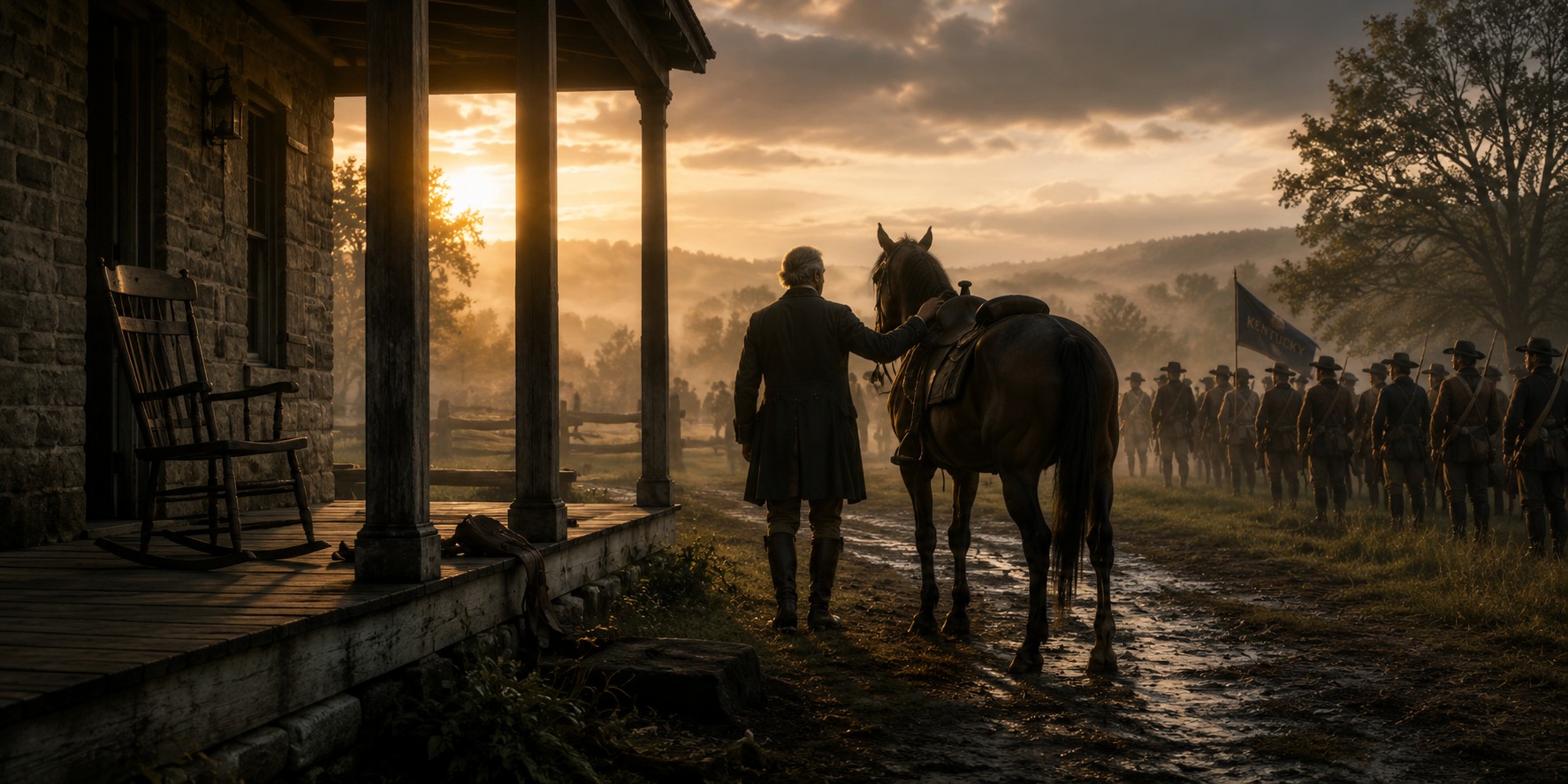
In the summer of 1813, the governor of Kentucky saddled his horse and went to war.
He was 63 years old. He had a stone house in Lincoln County that he’d built with his own hands, a wife he’d loved since before the Revolution, and eleven children who needed their father more than the United States Army did.
He had already served as governor, already helped win a revolution, already done his part. By any reasonable standard, Isaac Shelby was done.
He went anyway.
At the head of more than 3,500 Kentucky volunteers, men from 48 of the state’s 56 counties, Shelby rode north toward Canada. He went because Kentucky asked him to, and because Isaac Shelby had never once in his life been able to tell Kentucky no.
It is worth being clear on that. The history of American warfare is full of presidents and generals who managed their wars from offices and drawing rooms. Shelby was the only sitting governor in American history to personally lead his state’s troops into battle. He did it at an age when most men of his era were already in the ground.
Which raises the obvious question: what kind of man does this?
The answer is a long one. It begins forty years earlier, on the banks of the Ohio River, where a 23-year-old lieutenant from western Virginia learned what it meant to stand your ground.
The Making: Maryland to the Frontier, 1750–1773
Isaac Shelby was born in Hagerstown, Maryland, in 1750, the son of a Welsh immigrant who had spent his adult life chasing the American frontier west. Evan Shelby, a fur trader and militia captain, was the kind of man who saw wilderness as opportunity. He built a business and raised a family on the edge of colonial civilization.
Then Pontiac’s Rebellion arrived in 1763 and burned most of it down. Native American raids across the frontier devastated the fur trade, and a house fire destroyed what remained of the family’s records and livelihood.
Evan Shelby moved the family deeper into the frontier; south and west, to the Holston River region of western Virginia, near present day Bristol, Tennessee. The lesson young Isaac absorbed from watching his father: when things fall apart, you ride toward the problem.
Growing up on the Virginia frontier meant growing up fast. Isaac surveyed land, worked the farm, and became what the region required; capable with a rifle and comfortable in the wilderness, the kind of young man who treated danger as a neighbor.
At eighteen, he was already serving as deputy sheriff of Frederick County. At twenty three, he was his father’s second-in-command in the county militia.
The Shelby family had arrived at exactly the right moment to be useful, and exactly the wrong moment to be comfortable. The frontier was where America was being decided, and the Shelbys were squarely in the middle of it.
First Blood: Point Pleasant, 1774
Lord Dunmore’s War was the kind of conflict that gets a footnote in most history books; a single-season fight between Virginia militia and a Shawnee confederation over who controlled the Ohio Valley.
It lasted from spring to fall of 1774. It had one major battle. And it produced, almost incidentally, a generation of frontier officers who would go on to change the course of the American Revolution.
Isaac Shelby was among them.
On October 10, 1774, roughly 800 Virginia militiamen marched into the triangle of land where the Kanawha River meets the Ohio, near what is today Point Pleasant, West Virginia. Waiting for them, or rather, already moving toward them, was an equal force of Shawnee warriors under the chief Cornstalk.
The battle that followed ran from sunup to sunset, a grinding, close-range fight in the timber along the riverbank. These were men who knew how to use trees.
When the fighting reached its critical point, it was the 23-year-old Shelby who broke it open. Leading a flanking column along Crooked Creek, he maneuvered his men into position behind the Shawnee line.
Cornstalk, believing reinforcements had arrived, broke off the attack and pulled his warriors back across the river, dumping the bodies of his dead into the current as he went. The battle was over. Shelby earned a commendation for skill and gallantry, helped garrison Fort Blair on the site of the fight, and went home.
The war ended that fall. A peace treaty was signed. The frontier went quiet — for a little while.
What Shelby took from Point Pleasant was more significant than a commendation. He had learned how to read a battle from the inside and how to stay calm when the plan dissolved under fire. And he had done it alongside men he would see again: John Sevier was there. William Campbell was there. The frontier officer class of western Virginia was a small world, and its members knew each other well.
Within a year, the first shots of the American Revolution had been fired at Lexington and Concord. The quiet was over.

The Southern War: Musgrove Mill, 1780
The Revolutionary War in the South was a different animal from the organized campaigns in the North. There were no clean lines, no gentlemen exchanging notes about prisoner arrangements.
The backcountry of the Carolinas was a civil war, Patriot against Loyalist, neighbor against neighbor, fought with rifles and tomahawks against men the fighters often knew by name. Quarter was rarely asked. It was rarely given.
Shelby came back from Point Pleasant and spent the early war years building his reputation in the Virginia and Carolina militia.
By the summer of 1780, he was operating in the Carolina backcountry at the head of roughly 200 mounted Overmountain Men; frontiersmen who had crossed the Appalachians from the west and who fought, as the British were fond of noting with some exasperation, like Indians. They moved fast and hit hard before a conventional force could respond.
On the night of August 18, Shelby rode south with Colonels Elijah Clarke and James Williams toward Musgrove Mill on the Enoree River. The plan was a surprise attack on the Loyalist camp there before dawn.
It was a good plan, right up until a Loyalist patrol spotted them on the approach. The surprise was gone. When Shelby’s scouts crept close enough to get a count, the news was worse than expected; the camp held better than 500 men, including a detachment of British regulars.
Shelby’s force was outnumbered more than two to one, and their horses had been ridden through the night and couldn’t outrun a pursuit.
With surprise gone and the horses too spent to run, they had one option left. They dug in.
Working fast in the early morning dark, the three commanders threw up a breastwork of brush and branches on a ridge above the ford. Then they sent a small decoy party across the river with orders to pick a fight and run; draw the Loyalists across the water and up the slope directly into the waiting rifles.
It was a trap built out of desperation, and it worked almost perfectly.
The Loyalists came across the ford and charged up the ridge. Shelby’s men cut them apart. Then the British regulars fixed bayonets and slammed into the Patriot right flank, and for a moment the whole improvised defense threatened to come apart.
Shelby released his reserve, Overmountain Men who hit the British line screaming, and the flank held. The Loyalists broke. When it was over, the British and Loyalist force had taken 137 casualties. Shelby’s men had lost 16.
They had about an hour to feel good about it. Then a rider arrived with word from Camden: General Gates had been routed and Cornwallis was moving through the Carolinas largely unopposed.
Ferguson’s cavalry was already riding hard toward Musgrove Mill. Shelby ordered his men into the saddle. They rode through the night, 60 miles before they stopped, with Ferguson’s force somewhere behind them in the dark.
The battle had lasted minutes. The ride home lasted forever. And somewhere in those hours, Shelby understood something important: the war in the South was going to be won or lost by men like him, in fights like this one, because there was nobody else left to do it.

The Threat and the Answer: Kings Mountain, October 7, 1780
Patrick Ferguson was a British officer who had made a mistake that certain kinds of men should never make: he had underestimated the people on the other side of the mountain.
Ferguson had spent the summer recruiting Loyalists and harassing Patriots across the Carolina backcountry, and he had developed a low opinion of the frontiersmen who kept materializing out of the tree line to shoot at his men and vanish.
In September 1780, he sent a message to the Overmountain settlements: submit, or he would cross the mountains and put their towns to the torch.
The message reached Isaac Shelby on a September afternoon. He read it, saddled his horse, and rode 40 miles to John Sevier’s house before nightfall.
The two men talked through what needed to happen. Ferguson had made this personal, which was a miscalculation. Men who spend their lives on the frontier understand threats differently than men who make them from a position of comfort. Ferguson had assumed the message would intimidate. It had issued an invitation instead.
The muster was set for Sycamore Shoals on the Watauga River, in late September. What assembled there was roughly 1,100 men — Shelby’s 240, Sevier’s 240, Campbell’s 400 Virginians, and McDowell’s Carolina militia — riding on their own horses, at their own expense, with no Continental Army paymaster at the end of it.
Ferguson, who had dismissed them publicly as “mongrels” and “the dregs of mankind,” had accidentally gathered the best light infantry in North America.
They moved out in early October, tracking Ferguson east through the mountains in cold rain. Ferguson, for his part, had finally realized something was wrong.
He sent riders to Cornwallis requesting reinforcements and chose his ground on a rocky, wooded ridge called Kings Mountain, just inside South Carolina, where he declared that God Almighty Himself could not drive him off.
These are the kinds of statements that sound better before the battle than after.
On the afternoon of October 7, the Overmountain Men encircled the ridge and started climbing.
The fight that followed was brutal. Ferguson’s men held the high ground and the bayonets; the Overmountain Men held the trees and the rifles, and they used both.
Every time the British charged down the slope and drove the Patriots back into the timber, the Patriots regrouped and came up again from a different angle. The ridge was a trap. Ferguson had chosen it himself.
Shelby commanded the left side of the encirclement alongside Colonel Benjamin Cleveland, pushing up through two bayonet charges and holding his men in the fight each time the British drove them back.
Ferguson rode back and forth along the crest, blowing a silver whistle to rally his men, slashing with a sword at rifles he judged to be surrendering too early. He was shot from his horse, caught his foot in the stirrup, and was dragged before finally going down. His men raised a white flag. The battle had lasted 65 minutes.
What came next was ugly. Some of the Patriots, remembering Tarleton’s massacre of surrendering Americans at Waxhaws, were in no mood for formal surrender. Nine Loyalist prisoners were convicted in improvised courts-martial and hanged from a tree before Shelby stepped in and put an end to it. He had called the attack. He called it off too.
The British and Loyalist force suffered over 900 casualties against 90 American. British commander Henry Clinton later wrote that Kings Mountain was “the first Link of a Chain of Evils” that ended in the total loss of America. He was right.
The southern campaign turned from that ridge. Cornwallis retreated back into South Carolina. The momentum that had carried the British to the edge of victory in the South shifted slowly, and then decisively, toward the Patriots.
Isaac Shelby was 29 years old. He rode home to the Holston River settlements and went back to farming. He had done what needed doing.
For now.

Building: Kentucky, 1783–1812
Kentucky was not yet a state when Shelby first laid eyes on it. It was a county of Virginia, ungoverned and dangerous, being settled by men who understood those conditions as an opportunity.
Shelby was among them. He had surveyed land there during the war, knew what he was looking for, and in 1783 he found it: a stretch of rolling country in Lincoln County, near the small settlement of Danville, that struck him as about as fine a piece of ground as he had ever seen.
He built a two-story limestone house there and called it Traveler’s Rest. It was one of the finest homes in Kentucky when it was finished; 1783, so the competition was thin, but Shelby cleared it with room to spare.
He married Susannah Hart at Boonesborough that same year. Together they would have eleven children, and Traveler’s Rest, over the decades, became the kind of place where soldiers and travelers showed up at the door and were fed.
Shelby spent the years after the Revolution doing what the frontier demanded: farming and arguing about politics.
Kentucky was ready to be its own state, and he knew it. He worked ten statehood conventions in Danville, pushing for separation from Virginia, and when Kentucky was finally admitted to the Union on June 1, 1792, he was the obvious choice to lead it. The electors made it unanimous.
What he inherited as governor was mostly a set of problems. Kentucky had a court system to build and a frontier still being contested by Northwestern tribes who had not signed away their claims to the land the settlers were living in. Shelby handled both.
He pestered George Washington until Washington sent Anthony Wayne north to settle the frontier question by force, which Wayne did, at the Battle of Fallen Timbers in 1794.
He widened the Wilderness Road through Cumberland Gap, making the main artery into Kentucky passable by wagon for the first time. He governed the way he fought: directly and without ceremony, with a firm focus on what needed doing next.
His term ended in 1796. He went home to Traveler’s Rest and meant it. He was 46 years old; a former governor and Revolutionary War hero with a limestone house and more children than most men could keep track of. He had built a state more or less from scratch. He was done.
Sixteen years passed. They were good years.
Then the United States declared war on Great Britain in June 1812, and the frontier Shelby thought he had secured began to come apart. Kentucky sent men north in large numbers; more, as it turned out, than every other state would send across the whole of the war. The results, in the early going, were catastrophic.
Shelby had been elected to a second term as governor in 1812, largely because Kentucky wanted a man it trusted in the chair while its sons were marching north. He was 62 years old and had planned to manage the crisis from Frankfort.
Then the news from the River Raisin arrived, and managing it from Frankfort stopped being an option.

Remember the Raisin!: January 1813
On January 22, 1813, somewhere between 40 and 65 wounded American soldiers were murdered on the banks of the River Raisin in present-day Monroe, Michigan.
They had already surrendered. The battle was over. British General Henry Procter had accepted their capitulation the day before and promised them protection; then marched his regulars away and left the wounded in the care of his Native American allies, who had not agreed to any such terms.
The men on the ground were Kentuckians. Nearly all of them were Kentuckians.
General James Winchester had led roughly 1,000 Kentucky militia north to Frenchtown earlier that month, pushed the British back from the settlement in a sharp fight on January 18, and held the position while waiting for reinforcements that didn’t come.
Procter returned four days later with a larger force and artillery. Winchester was captured trying to rally his retreating men and, in British custody, was persuaded to order his remaining troops to lay down their arms. Procter promised the wounded would be transported safely to British lines.
The next morning, Procter’s forces left. The wounded were still there. What happened after is not disputed, though the exact numbers are: the natives left behind killed the wounded they found and burned the buildings others had taken shelter in, leaving the bodies in the road.
When word reached Kentucky, people collected the details the way you collect evidence, because they wanted to remember exactly what had been done to their people.
“Remember the Raisin” was not a slogan invented by a committee. It was what people said to each other.
Kentucky’s losses at the Raisin were staggering on their own. In the broader context of the war, they were almost incomprehensible.
By the time the fighting was over, Kentucky would account for more than 60 percent of all American casualties; more than every other state combined. The war in the Northwest was, in a very real sense, a Kentucky war. And Kentucky was losing it.
The state legislature did not want a manager. They wanted Shelby. They appealed to the 62-year-old governor directly, asking him to take personal command of the volunteer forces being raised as reinforcements for General Harrison’s army.
It was an extraordinary request — a sitting governor, leading troops in the field — and Shelby accepted without apparent deliberation.
The response from Kentucky’s counties was its own kind of answer. Men volunteered from 48 of the state’s 56 counties. Shelby raised over 3,500 troops. He was 63 years old by the time they moved out, riding at the head of a force large enough to constitute a small army, heading north toward a British general who had left Kentucky’s wounded to die in the road.
He had farmed for sixteen years. He was done farming.

Old Kings Mountain Rides Again: The Thames, October 5, 1813
The march north took weeks.
Shelby commanded five brigades of Kentucky militia under the overall authority of General William Henry Harrison, moving through country that grew less familiar and more hostile the farther they went.
The men called him “Old Kings Mountain”, as a title, not a taunt, the way soldiers name the thing they trust. He was more than three decades older than the men riding beside him. He didn’t appear to notice.
The British had been retreating up the Thames River into Upper Canada since Harrison’s forces recaptured Detroit in late September, and the retreat had become a bit of an argument.
Tecumseh, the Shawnee leader whose alliance with Britain had made the Northwestern frontier genuinely dangerous, was furious with Procter’s refusal to stand and fight.
He told Procter’s officers, through an interpreter, that the British had been running like frightened animals, and that if they would not stop and face Harrison’s army, the warriors would go home and leave them to it. Procter chose a position on the Thames and stopped.
On the morning of October 5, Harrison’s force caught up with them.
The British regular line broke first, and quickly, almost before the engagement had properly begun. Harrison ordered a cavalry charge against the British infantry, and the redcoats, exhausted and demoralized from weeks of retreat, collapsed after a single pass.
The harder fight was in the swamp to the right of the road, where Tecumseh’s warriors held their ground with considerably more determination than their British allies had managed. The fighting in the timber was brutal, at ranges where the outcome came down to who reloaded faster.
Tecumseh was killed somewhere in that swamp. The exact circumstances remain disputed. Richard Mentor Johnson, commanding the Kentucky mounted riflemen, was wounded five times in the fighting and is most commonly credited with the shot, though the historical record is genuinely unclear on the point.
What is clear is that Tecumseh went into the battle and did not come out of it, and that when he fell, the fighting stopped. His warriors withdrew. His confederation, the most formidable indigenous military alliance the United States had ever faced, dissolved within months.
It was the first decisive American land victory of the War of 1812. Congress voted Shelby its formal thanks and struck a gold medal in his honor. President Monroe offered him the position of Secretary of War.
Shelby said no. He went home to Traveler’s Rest.
He had a limestone house and a farm that had gotten along without him before and would again. He grew things. He received visitors. His home, he had always said, was open to any soldier who passed by it, and he kept that promise until he had no more promises left to keep.
On July 18, 1826, Isaac Shelby died while sitting on his front porch with Susannah. He was 75 years old. He had fought British soldiers for forty years and built a state from a county in between; all without, as far as the record suggests, ever believing he was doing anything particularly remarkable.
He thought he was just answering when called.

What He Left Behind
Nine states have a county named after Isaac Shelby. The list runs from Kentucky to Texas, a geography of gratitude spread across most of the country he helped build.
Kentucky’s state motto, “United we stand, divided we fall,” traces to a song he loved, a line he repeated often enough that it became, eventually, the official creed of the state he founded. These are the kinds of honors that get chiseled into stone and forgotten.
The limestone house at Traveler’s Rest burned in 1905. The cemetery survived. Shelby had chosen the spot himself and marked it before he died, which is exactly the kind of thing you’d expect from a man who spent his life making sure things were taken care of before he moved on.
What the monuments and the county names don’t quite capture is the totality of the life. He fought three wars and gave the same answer every time his people needed him. He never sought the fights. He finished them.
He went home afterward, every time, with what appears to have been genuine relief. Traveler’s Rest was the point. The wars were the interruptions.
The men who answer when war finds them are a different species from the men who go looking for it. Shelby was the first kind; methodical and completely uninterested in what any of it said about him.
He wanted the farm and the front porch. He got those things, eventually, after a lifetime of being the man people called when they had run out of other options.
Kentucky called. He always answered.



Leave a Reply