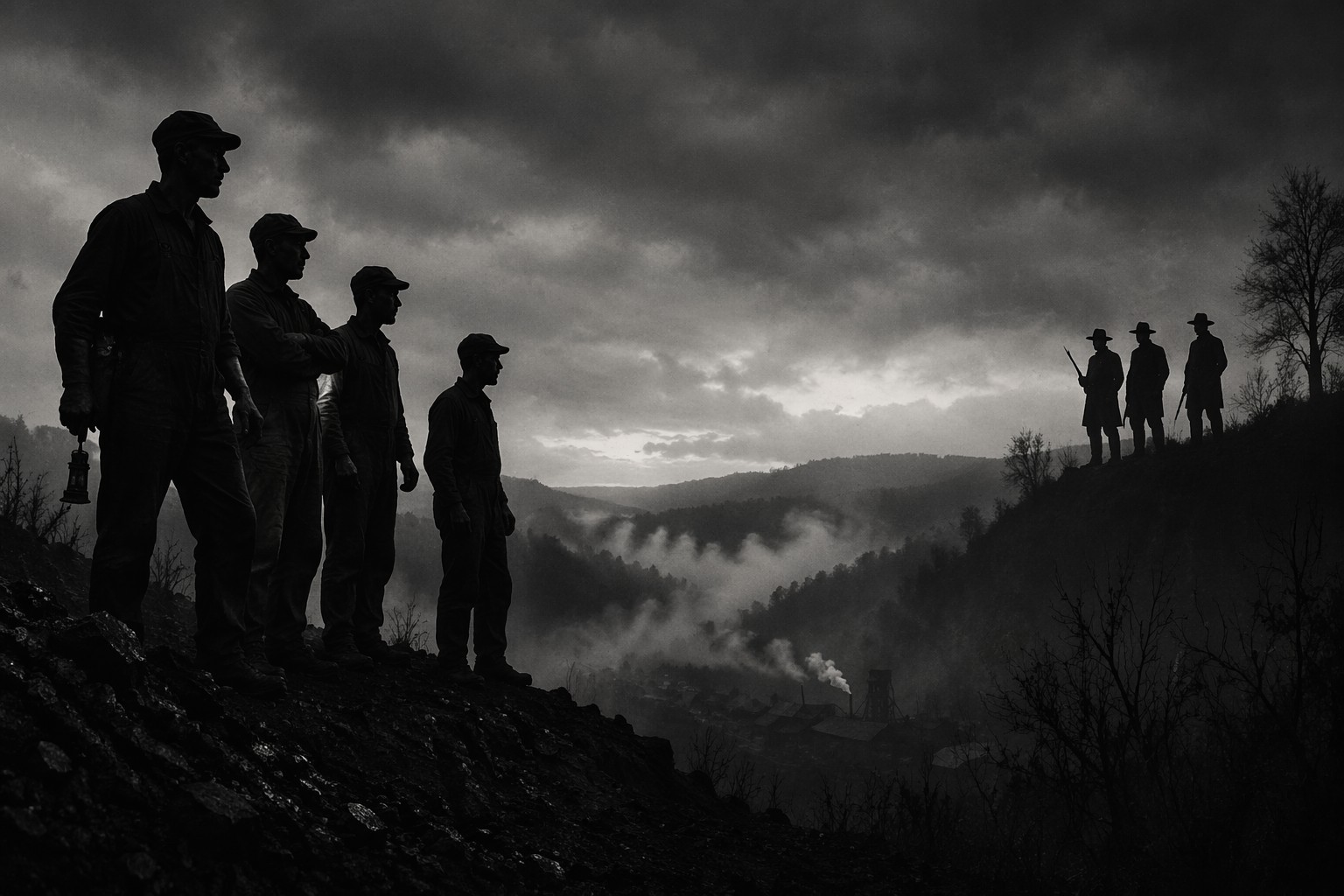
Harlan County, Kentucky sits deep in the Cumberland Mountains, tucked into the far southeastern corner of the state, about as far from Frankfort as you can get without crossing into Virginia or Tennessee.
The mountains aren’t gentle there. The ridgelines are sharp and the hollows narrow, and the creeks cut through the gaps. It’s the kind of country that made large-scale farming nearly impossible and outside investment slow to arrive — until someone figured out what was sitting underneath it.
Coal. Enormous quantities of it.
By the late 1920s, Harlan County was producing roughly 15 million tons of coal a year; about a quarter of Kentucky’s entire output. The mines ran day and night. Thousands of men went underground every morning and came back up, if they came back up, covered in black dust.
It was hard, dangerous work, and the people who did it had little say in how it was done, what they were paid, or where they spent their money. That last part was by design.
The coal operators — and it’s worth knowing that most of them weren’t local men; they were subsidiaries of companies like U.S. Steel, International Harvester, and Ford Motor Company, operating from boardrooms up north — had built a system of total economic control that was, in its way, almost elegant in its efficiency.
They owned the land the miners lived on. They owned the houses the miners rented. They owned the stores where the miners bought their groceries, their tools, their children’s clothing. They even owned the funeral homes that would bury a miner if the mountain decided to close in on him.
In some operations, miners weren’t paid in U.S. currency at all; they were paid in company scrip, which was only redeemable at the company store. Step out of line, and you didn’t just lose your job. You lost your house, your access to food, and any standing you had in the community, all at once.
The operators called this paternalism. They fancied themselves as benevolent landlords, providing for their workers in exchange for loyalty and hard labor. The miners had other words for it.
And before anyone gets the idea that Harlan County was a peaceable place that the mine war disrupted, understand this: it was already one of the most violent counties in the United States before the war ever started.
Throughout the 1920s, Harlan’s homicide rate ran seven times higher than Chicago’s; and Chicago, during that particular decade, was not exactly a model of civic tranquility. The mountains had their own codes, their own grievances, their own way of settling things. Grudges were long.
The culture that would eventually produce one of the most sustained labor conflicts in American history was not a docile one waiting to be radicalized. It was already combustible thanks to outside influence. The coal operators simply handed it a match.
What made Harlan different from other coal counties wasn’t the poverty alone, or even the danger underground, where miners died in cave-ins and explosions with horrifying regularity, breathing air thick with the dust that would eventually kill many of them through silicosis and black lung disease.
What made Harlan different was the completeness of the control. In most of the county, there was no civic life that existed outside the company’s reach. Three incorporated towns in all of Harlan County were not owned by the mines. Three. Everywhere else, the company was the landlord, the grocer, the employer, and, as things would turn out, the law.
That last part, the law, is the part that matters most to this story. Because when the men of Harlan County finally decided they’d had enough, they didn’t just find themselves fighting their employers. They found themselves fighting the sheriff, the courts, the National Guard, and the full apparatus of the state of Kentucky.
The operators had purchased all of it, more or less openly. Nobody was pretending otherwise.
The reckoning began in the winter of 1931, when the operators decided the arrangement wasn’t profitable enough. This is Bloody Harlan.

February 16, 1931
The coal industry had been sliding for years before anyone in Harlan County felt it directly. The late 1920s brought overproduction, competition from oil and natural gas, and a domestic market that was slowly softening.
Then the Depression hit, and the bottom dropped out entirely. Coal prices fell. Demand fell. Operators who had been squeezing margins for years looked around for something else to cut, and they landed, as they always did, on the same answer.
On February 16, 1931, the Harlan County Coal Operators’ Association announced a 10 percent wage cut across the county’s mines.
For a miner already living in a company house, buying food at a company store, and earning wages that left little margin under the best of circumstances, a 10 percent cut was a crisis.
The average annual income in Harlan County’s mines had already dropped from $1,235 to $749 over the preceding years. There was no cushion. There were no savings. There was no safety net of any kind; no state unemployment insurance, no federal relief program, nothing.
A man who lost his wages lost everything that came with them, and in Harlan County, everything came with them.
Miners began reaching out to the United Mine Workers of America almost immediately. The UMW was not, at that moment, a particularly powerful organization. Years of failed campaigns and dwindling membership had left it fragile, but it was what the men of Harlan had.
Local organizers started holding meetings in February and March. Word spread through the hollows. Men who had never spoken the word “union” out loud began signing cards.
The operators’ response came quickly. Miners known to have attended union meetings were fired. Fired miners were evicted from their company houses, often with no notice. Families hauled their furniture out into the road and looked for somewhere to go.
The three towns in the county not owned by the coal companies — Evarts chief among them — filled up with displaced miners and their families, hungry and angry and increasingly organized in the way that people get organized when they have nothing left to protect.
By spring, roughly 5,800 miners had walked off the job. Only about 900 were still working.
The operators brought in strikebreakers and surrounded them with private mine guards; men who carried deputy sheriff credentials, courtesy of Harlan County Sheriff John Henry Blair, and whose salaries were paid directly by the coal companies.
Blair himself didn’t bother to hide where he stood. He would later say, “I did all in my power to aid the operators.”
That was an understatement.
Blair’s deputy force was something to behold. At its peak, he had nearly 200 men on the payroll; armed and operating with the full legal authority of the county sheriff’s office.
A later review of their records found that out of 169 deputies, 64 had previously been indicted for crimes and 27 had been convicted — including eight for manslaughter and three for murder.
One particularly notable addition to the force was a man named Bill Randolph, who was, at the time of his hiring, awaiting trial on a fourth murder charge in another Kentucky county. The operators posted his bond and put a badge on him.
Shortly after joining the force, Randolph walked into a lunch counter known to host union meetings and shot the proprietor.
Nobody was indicted.
That was the machinery of law enforcement in Harlan County in 1931. To be clear, this was not a system that had been corrupted so much as one that had been purpose-built.
The judges who approved deputy appointments had family members with financial interests in the mines. The sheriff was on the operators’ side by his own admission. The legal apparatus of Harlan County was not a neutral institution that failed the miners. It was an instrument aimed directly at them.
The striking miners found this out quickly. Union organizers were run out of the county, their meetings broken up, their families harassed. Reporters who came in from out of state to cover the story were followed, threatened, and in some cases beaten.
The operators also launched a propaganda effort through a company-backed weekly tabloid called the Harlan Torch, distributed free at company stores and courthouse steps, which took the position that unionism and communism were the same thing and that outside investigators were agents of Moscow.
It was a crude message, but it didn’t need to be sophisticated. It only needed to give the deputies and the courts a vocabulary.
Meanwhile, the families in Evarts and the other free towns were running out of food. The Red Cross, deciding this was a labor dispute rather than a natural disaster, declined to provide relief.
The UMW, overwhelmed and underfunded, told the miners they were largely on their own. Men who had worked underground for decades stood in lines hoping for handouts. Children went hungry. And the company guards patrolled the roads.
The match that had been lit in February was burning toward something. Everyone in Harlan County knew it. The only question was where it would go off first.

The Battle of Evarts
The morning of May 5, 1931 started the way most mornings did in Harlan County; quiet, the kind of stillness that isn’t peaceful so much as held. Along the Poor Fork road near the town of Evarts, several dozen armed union miners had positioned themselves before dawn.
They had gotten word the night before that a small motorcade of deputies was coming through, escorting a truck carrying the household goods of a strikebreaker; a man brought in to take a fired union miner’s job. The union men decided they would be waiting.
The motorcade was three cars, each carrying sheriff’s deputies, with the truck behind them. It wasn’t a large operation. It moved through the gap in the hills and into the stretch of road below Evarts, and then it stopped.
Exactly what happened next depends entirely on who you ask, because both sides spent considerable energy afterward insisting the other fired first. What nobody disputed was that once the shooting started, it lasted for roughly fifteen minutes.
When it was done, four men were dead. Three were company deputies. One was a union miner named James Daniels. Several more on both sides were wounded. The Kentucky National Guard was called in within hours, and the miners who had gathered along that road scattered back into the hollows.
They had reason to expect that the Guard’s arrival meant some measure of protection, or at least neutrality. They were wrong.
The Guard moved in, replaced the deputized mine guards on the picket lines, and then, in what would become one of the defining gestures of the entire Harlan County conflict, broke the picket lines instead of holding them.
The institution sent to restore order did so entirely on the operators’ terms. On May 24, Sheriff Blair went a step further and rescinded the county’s right of assembly, then tear-gassed a union rally for good measure. By June 17, the last mine had gone back to work. The strike was over, at least on paper. No concessions had been offered. Not one.
The legal aftermath was, if anything, uglier than the battle itself. A circuit court judge named D.C. Jones — whose family held financial interests in the mines, a detail that apparently did not strike anyone in authority as a problem — convened a hand-picked grand jury within a day of the shooting.
The jury returned thirty triple murder indictments against miners, thirty indictments for “banding and confederating,” and one charge of criminal syndicalism.
Eight miners eventually received life sentences. The charge was conspiracy to murder. The men who had fired on union families, raided organizers’ homes, and shot a lunch counter owner received no indictments at all.
The Battle of Evarts made national news almost immediately. Wire services picked it up, and the language they used — “reign of terror,” “strife-torn mining community,” “labor war” — turned a fifteen-minute gunfight on a gravel road into a national symbol.
For people far from eastern Kentucky, Harlan County became shorthand for something: the question of how far a company could go in using the law as a private weapon, and how long workers could be expected to absorb it.
The answer, as the rest of the decade would demonstrate, was that the operators had badly miscalculated.
They had broken the first strike. What they had not done was break the miners. The evictions, the deputy raids, the rigged grand jury, the life sentences handed to men for the crime of organizing; none of it produced the submission the operators were counting on.
What it produced instead was fury, and fury of a particular Appalachian variety that does not dissipate quickly.
It also produced a song.
Florence Reece was 27 years old in 1931, the wife of Sam Reece, a union organizer in Harlan County.
One night that year — the accounts vary on the exact date, but the circumstances don’t — Sheriff Blair and a group of deputies came to the Reece home looking for Sam. He wasn’t there.
Florence was, along with their seven children. The deputies searched the house, went through their belongings, and then waited outside in the dark for Sam to come home so they could kill him. He didn’t come home that night.
After they left, Florence Reece tore a page from the wall calendar and wrote on the back of it, borrowing the tune from an old Baptist hymn. The song was “Which Side Are You On?”
Its message was simple, and intended for the county that produced it: there were two sides, everybody knew which side they were on, and the only question worth asking was whether you’d admit it.
They say in Harlan County, there are no neutrals there. You’ll either be a union man or a thug for J.H. Blair.
It became the anthem of the Harlan County miners and, eventually, of the American labor and civil rights movements broadly. Not bad for something written on the back of a calendar page by a woman whose house had just been searched by armed men waiting to murder her husband.
The Battle of Evarts had ended in defeat for the miners, at least in the immediate sense. The strike was broken, the leaders indicted, the union driven out. But the name had stuck. Bloody Harlan. And the country, slowly, was starting to pay attention.

Sheriff Blair and His Deputies
If the Harlan County Coal War had a face, it was John Henry Blair’s.
As Harlan County Sheriff from 1930 to 1933, Blair was the hinge on which the entire system swung. Without a compliant sheriff, the operators’ control was incomplete. With Blair, it was nearly total.
He was not a subtle man, and he didn’t pretend to be. He said out loud what most corrupt officials have the instinct to deny: that he was there to serve the operators, that the miners could expect nothing from him, and that anyone who thought otherwise was welcome to find out the hard way.
Blair’s deputy force was the mechanism. At its peak he commanded nearly 200 men, their appointments rubber-stamped by friendly judges and their salaries drawn from operator funds rather than the county treasury. This was not a secret.
The arrangement was open and understood by everyone in Harlan County, including the men who ran it. What the operators had done, in practical terms, was purchase a private army and dress it in the clothing of legitimate law enforcement. The badges were real. The legal authority was real. The allegiance was entirely to the coal companies.
The men Blair recruited to fill those deputy slots were not, as a general matter, pillars of the community. A review of their records turned up a remarkable concentration of prior criminal histories — indictments for assault, convictions for manslaughter, men who had done time and been handed a badge on the other side of it.
One operator arrangement involved having a convict pardoned out of prison specifically to serve as a mine guard. The reasoning, such as it was, appears to have been that men with records made more effective instruments of intimidation than men without them. They were not wrong about that.
What these deputies did in Harlan County between 1931 and 1939 fills a long and ugly ledger. They raided union meetings, sometimes with tear gas and sometimes with rifle fire.
They visited the homes of known organizers at night, searching for “union material” — a phrase that could mean anything from a membership card to a copy of a pamphlet.
They followed reporters who came in from out of state, ran some of them to the county line, and beat others.
They shot into houses. They killed men and were not charged. One miner’s account described a car being run off the road, a man shot through the head with his wife and children watching, and no indictment following.
The governor of Kentucky would eventually describe conditions in Harlan County as “the worst reign of terror in the history of the county.” That was in 1935, four years in, which suggests either that the governor was slow to notice or slow to say anything about it. Probably both.
The operators supplemented Blair’s deputies with their own private guards, recruited from further afield — Chicago, West Virginia, the prison systems of multiple states.
These men operated in the company towns where the deputies’ writ was thinnest, which is to say everywhere the operators owned property, which was nearly everywhere.
Between the sheriff’s office and the private guard forces, Harlan County had constructed something that looked, from the outside, like law enforcement, and functioned, from the inside, like organized crime.
As mentioned, The Harlan Torch was the propaganda arm of this operation.
Backed by the Coal Operators’ Association and distributed free at company stores and train depots, it was a small weekly tabloid whose editorial position could be summarized in a single equation: union organizer equals communist, communist equals enemy of America, enemy of America equals someone the deputies were justified in handling however they saw fit.
Its recurring feature, “Red Terror in the Hills,” took the global fear of Bolshevism — genuine and widespread in 1931 — and applied it to men who mostly just wanted to be paid in actual currency and not get shot on their way to work.
The Torch faded out by 1933, when the New Deal began shifting the federal government’s posture toward labor. By then it had served its purpose, which was to give the violence a vocabulary that respectable people could repeat without embarrassment.
What the operators had not counted on — what this entire apparatus of sheriffs, deputies, company guards, rigged courts, and propaganda sheets had failed to account for — was that the outside world had newspapers too. And in the fall of 1931, some of the people who wrote for them decided to come to Harlan County and see for themselves.

Which Side Are You On?
By the fall of 1931, word of what was happening in Harlan County had reached the kind of people who, when sufficiently agitated, tend to do something about it.
Writers, intellectuals, civil libertarians — the circles that overlapped, in that era, with labor activism and leftist politics in ways that seem almost quaint now. A committee was organized under the auspices of the National Committee for the Defense of Political Prisoners, which was affiliated with the American Communist Party, a detail the operators would make considerable use of.
The committee that arrived in Harlan County in late 1931 included Theodore Dreiser, John Dos Passos, and Sherwood Anderson, among others.
These were not obscure figures. Dreiser was one of the most celebrated novelists in the country. Dos Passos had published three novels and was at work on the U.S.A. trilogy. Anderson had written Winesburg, Ohio. The operators had beaten reporters and run organizers to the county line. Now they had a more complicated problem.
The committee held hearings. Miners, preachers, and local businessmen testified about evictions, beatings, raids, and the Battle of Evarts. The testimony was detailed and, in many cases, harrowing.
A miner’s wife described the law as “a gun thug in a big automobile.” Others described deputies firing into homes, men killed in front of their families, organizers whose houses were riddled with bullets while their children slept inside.
The committee listened, took notes, and prepared to leave with a documented record of what the coal operators and Sheriff Blair had built in eastern Kentucky.
The operators’ response to Dreiser specifically was to charge him with adultery, based on the fact that he was sharing a hotel with a woman who was not his wife. This was, even by the standards of Harlan County in 1931, a creative application of the law.
Dreiser was, in fact, notoriously and openly unfaithful throughout his adult life, so the charge wasn’t entirely fabricated — but the timing made the intention obvious. The goal was to discredit him before his report could be published, to turn the story from conditions in the coalfields to the personal conduct of the man documenting them.
It was the same instinct that produced the Harlan Torch: when you can’t refute the message, go after the messenger.
It didn’t work. In 1932, the committee published Harlan Miners Speak: Report on Terrorism in the Kentucky Coal Fields, a document built from the testimony taken during their visit, supplemented with affidavits, press accounts, and reproductions of the operators’ own propaganda.
The report landed in the national conversation at a time when the country was already reckoning with the Depression and the question of what the government owed its working people. Harlan County became, for a significant portion of the American public, Exhibit A in that argument.
The committee also encountered, during their time in Harlan, two people who would carry the story further than any written report could.
The first was Aunt Molly Jackson, a midwife and folk singer who had been organizing miners in Harlan County for years. She was, by most accounts, a force of nature — loud, funny, relentless, and possessed of a musical gift that translated the specific misery of the Kentucky coalfields into something universal.
Dreiser’s committee put her on a tour of 38 states, raising funds for the striking miners and singing to audiences who had never heard of Harlan County and came away unable to forget it.
The second was Florence Reece, whose song had already begun circulating through the coalfields by the time the Dreiser committee arrived. “Which Side Are You On?” spread the way songs spread before radio saturation and commercial distribution — person to person, meeting to meeting, on picket lines and in union halls.
Pete Seeger would eventually record it, and from there it passed into the permanent catalog of American protest music. But its origins were specific: one woman, one night, seven children asleep in a house that had just been searched by men with guns, a calendar page, and a hymn tune she already knew.
The cultural record that came out of Harlan County — the songs, the testimony, the Dreiser report — did something the miners themselves, for all their toughness, could not do alone. It made Bloody Harlan a national issue.
Senators began asking questions. The governor of Kentucky, who had been studiously looking the other way, found himself under pressure to acknowledge what his own state police already knew was happening.
The apparatus that the operators had constructed — legal, extralegal, and propagandistic — was durable against miners with rifles. It was less durable against novelists with publishers and folk singers with audiences in 38 states.
Sheriff Blair was voted out of office in 1933. He died the following year. His departure didn’t end the conflict — the operators simply found other instruments — but it marked something. The man who had said out loud that he did all in his power to aid the operators was gone, replaced by a sheriff who had run on a pro-union platform.
Harlan County was still Bloody Harlan. The war wasn’t over. But the terms of it were beginning to change.

The Long War and What It Cost
The departure of Sheriff Blair did not soften the operators much.
They were not men who took instruction easily, least of all from the federal government, and the 1930s gave them several opportunities to demonstrate that. When Franklin Roosevelt’s National Industrial Recovery Act arrived in 1933, carrying Section 7(a) — the provision guaranteeing workers the right to organize — roughly half of Harlan’s mines nominally complied. The other half didn’t bother.
When the Supreme Court struck down the NIRA in 1935, the half that had complied stopped complying. The operators had never accepted the premise that Washington had any business telling them how to run Harlan County, and they treated each federal intervention as a temporary inconvenience to be waited out rather than a law to be followed.
The Wagner Act of 1935 — the National Labor Relations Act — was harder to ignore.
It outlawed yellow-dog contracts, which required workers to pledge as a condition of employment that they would never join a union. It outlawed company unions, blacklists, and retaliation against workers for union activity. It had teeth that the NIRA had lacked, and a federal board to enforce them.
Most coal operators across the country fell into line, however grudgingly. Harlan’s operators did not. On July 7, 1935 — weeks after the Wagner Act’s passage — a group of deputies in Harlan County dispersed a crowd of miners who were publicly celebrating the new law. They dispersed them by beating them.
The message was clear enough. Federal law was one thing. Harlan County was another.
The troops came and went throughout the middle years of the decade — called in six times in total, deployed sometimes on behalf of the operators, occasionally on behalf of the miners, and reliably ineffective at resolving anything permanently.
The violence continued in its grinding, episodic way. Organizers were threatened and beaten. Homes were shot into. A bomb killed the county attorney in 1935.
The governor dispatched investigators, who confirmed what everyone already knew: that a reign of terror existed in Harlan County, financed by the operators and carried out through the sheriff’s office and the private guard forces. The investigators’ report was thorough and damning. The operators ignored it.
What finally broke the operators’ hold was not a single dramatic confrontation but an accumulation of pressure from several directions at once.
The federal government’s posture toward labor had shifted fundamentally under Roosevelt, and the legal architecture the operators had relied on — the bought judges, the compliant sheriffs, the criminal syndicalism statutes deployed against organizers — was increasingly exposed to federal scrutiny.
A Senate subcommittee investigation in the late 1930s put Harlan County’s coal operators and law enforcement officials under oath and made their methods a matter of public congressional record.
The operators who testified did not come across well. Men who had presided over a decade of beatings, murders, and constitutional violations sat before United States senators and tried to explain themselves. They could not.
By 1939, the last of Harlan County’s intransigent operators signed contracts with the United Mine Workers. It had taken eight years, an unknown number of dead, federal troops deployed more than half a dozen times, a Senate investigation, and the sustained attention of the national press to compel a group of coal company executives to allow their workers to join a union.
The miners had won. It was worth saying so loudly, because it had cost enough to be worth saying.
What they won was important. Union representation brought wage increases, safer working conditions, and the basic dignity of a grievance process — the ability to complain about something without losing your house or your life over it.
The UMWA in its peak years was one of the most powerful labor organizations in the country, and the men of Harlan County were part of the reason it got there. They had held on in conditions designed specifically to make holding on impossible, and they had outlasted the people who designed those conditions.
But history rarely delivers clean endings, and Harlan County’s is no exception. The UMWA that had fought so hard for the miners made its own accommodation with capital in the postwar years.
John L. Lewis, the union’s autocratic and long-serving president, agreed in the 1950s to allow the operators a free hand in mechanizing the mines, trading thousands of jobs for higher wages for the men who remained.
It was a rational calculation from where Lewis sat, and a catastrophic one for eastern Kentucky. The jobs didn’t come back. The mechanization hollowed out the workforce, and the communities that had been built around coal employment began their long contraction.

The story came around again in 1973, at the Brookside Mine, when Duke Power Company refused to sign a UMWA contract and another strike began.
Another year of picket lines, another shooting — a 22-year-old miner named Lawrence Jones was killed — another round of state intervention. Barbara Kopple filmed it, and her documentary, Harlan County, USA, won the Academy Award for Best Documentary in 1977.
Forty years after the original mine war ended, Harlan County was still Harlan County.
And then, in the summer of 2019, a coal company called Blackjewel LLC filed for bankruptcy.
A federal judge ruled that the company could walk away from its obligations — including the wages it owed the men who had been mining its coal.
For nearly two months, Harlan County miners and their families blockaded the railroad, sitting on the tracks to stop coal trains from moving until they were paid what they had earned. They had no union. They had no legal mechanism that had worked. They had the tracks, and they sat on them.
It was, in its way, a very Harlan County solution to a very Harlan County problem.
The operators of the 1930s had believed that a county so remote, so controlled, so thoroughly owned could be kept quiet indefinitely. They had the sheriff. They had the judges. They had the company store and the company house and the company scrip and two hundred deputized men with criminal records and badges.
They had every institutional advantage available to them, and they used all of it, openly and without apology.
It wasn’t enough. It was never going to be enough. The men who went underground in Harlan County every morning, in the dark, breathing coal dust, had a stubbornness that outlasted everything the operators could build or buy.
Call it what you want. In Harlan County, they just called it being a Harlan man.
Which side are you on?



Leave a Reply