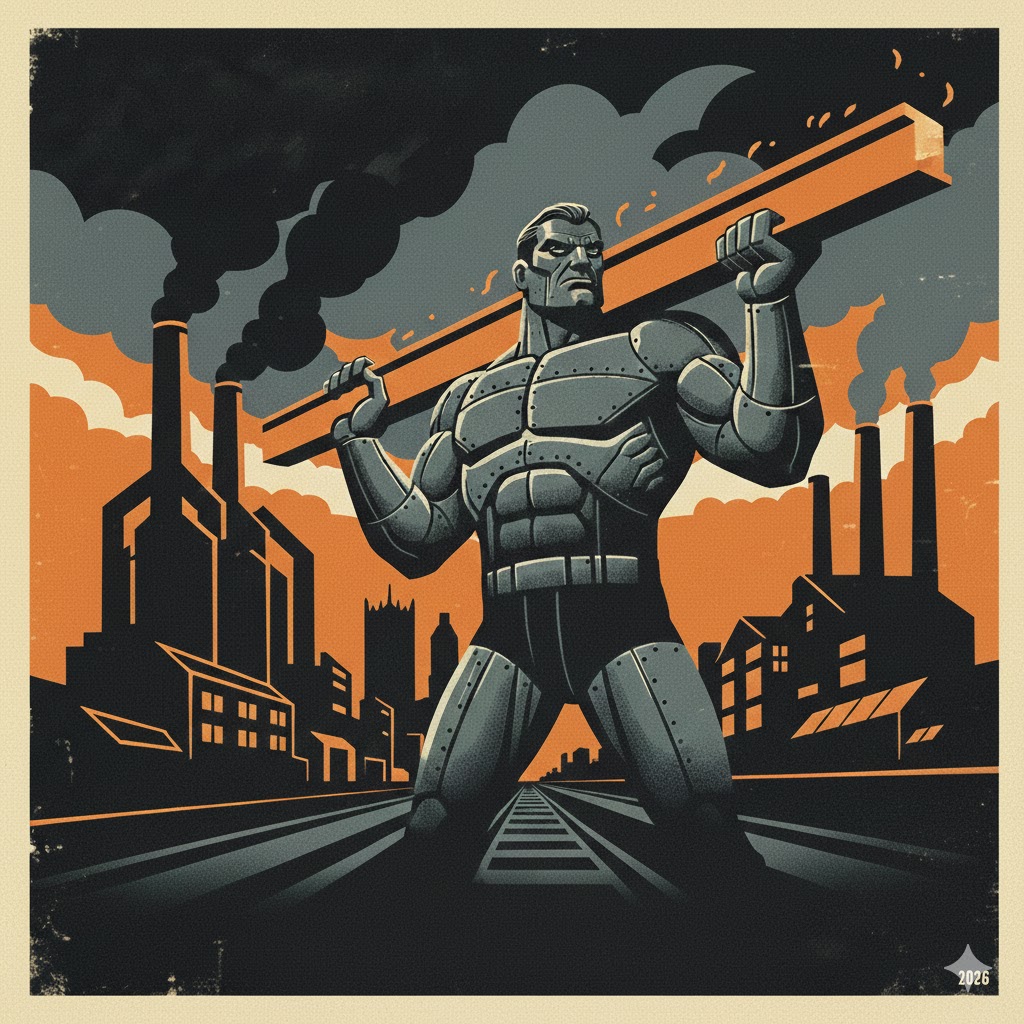
If you grew up around Pittsburgh or the mill towns down the river, you probably didn’t find out about Joe Magarac from a teacher. You probably found him because you were sitting in the backseat of a car and saw a statue or painting of a guy who looked like he could lift a house.
That was my experience. I saw the figure, asked my grandfather who it was, and he just told me it was Joe Magarac, the “Steel Man.” There was no big explanation. It was just a fact of life. Joe was part of the landscape, like the yellow bridges or the rivers of the city.
In Western Pennsylvania, Joe isn’t a character you study to pass a test. He’s something you just pick up as you go. Everyone has heard the name, but most people can’t really tell you where he came from. He’s a local mystery that nobody bothers to solve because, honestly, the point of the story is pretty clear the moment you see him.
A Hero Nobody Else Knows
Most American folk heroes are about getting away. Paul Bunyan had the woods. Pecos Bill had the desert. Those stories are about having enough space to do whatever you want.
Joe Magarac never had space. He lived and died in places like Braddock, Homestead, and McKeesport. He stayed in the river valleys where the hills are so steep the houses look like they’re stacked on top of each other.
That’s probably why Joe never became a national name. His story is about being stuck. It’s about immigration and the kind of heavy labor that most people in this country would rather not think about. While other legends were out West, Joe was in a mill in Pennsylvania, finishing a double shift. It’s a story that stayed local because it only makes sense to the people who lived in his shadow.
The Legend as It’s Told
The name tells the whole story. In a few different Slavic languages, magarac means a donkey. People sometimes say it means “jackass,” but that sounds like a joke. In the mills, the real meaning was beast of burden. It was a name for something that exists just to pull a heavy weight until it wears out.
According to the old stories, Joe Magarac was born at the bottom of an ore pile or crawled out of a furnace. He was seven feet tall (though some say “tall as a smokestack”) and his skin was solid steel. He didn’t just work at the mill; he was better than any machine the company could buy.
The story goes that he could squeeze hot steel into railroad rails with his bare fingers. He could catch a falling crane. If a furnace started to leak, he’d just lean his body against the crack to plug it.
But the weirdest part of the story isn’t his strength; it’s that he didn’t want anything for it. He didn’t want to be the boss. He didn’t want more money. He just wanted to work. He’d stay in the mill twenty-four hours a day, seven days a week, because he didn’t have a home and didn’t want one. He was the perfect employee for a company that didn’t want to treat its workers like people.
A Man Built for the Mill
If you want to understand why a story like this exists, you have to look at what the Monongahela Valley was like at the end of the 1800s. It wasn’t just a place to work; it was a grinder. The mills ran on a schedule that didn’t care about the sun or the seasons.
Most guys were working 12-hour shifts, six or seven days a week. Every two weeks, they’d hit the “swing shift,” which meant working 24 hours straight just to switch from days to nights.
The environment was brutal. It was loud enough to rattle your teeth and hot enough that men would pass out just from standing around the furnace. There were no safety railings, no earplugs, no OSHA, and definitely no HR department to complain to if you got burned. If you died on the floor, they’d often have your replacement standing at your station before your body was even moved.
This is where the idea of the “beast of burden” comes from. The companies didn’t want men with opinions or tired muscles. They wanted tools. Joe Magarac is the literal version of that desire. He is a man who can’t feel the heat and doesn’t need to sleep. He represents the “ideal worker” from the perspective of a foreman who just wants to hit his tonnage quota.
In a way, the legend of Joe Magarac was a way for the workers to make sense of their own lives. If you have to work like a dog in a place that treats you like a machine, maybe you tell stories about a guy who actually is a machine. It makes the ability to endure the exhaustion feel a little more like a superpower and a little less like a slow death.

Flesh, Bone, and Iron
In the stories, Joe is often described as being more metal than muscle. He’d stir a pot of boiling iron with his bare hand like he was getting his coffee just right. There’s a blurring there between the human being and the industrial equipment.
Back then, the line between a man and the machinery was pretty thin anyway. Men lost fingers to the rollers and lungs to the soot. You gave your body to the mill piece by piece. Joe just did it all at once. He represents the process where labor stops being something you do and starts being what you are.
For the guys in the mill towns, being valued for your output was the only way to survive. If you could move more ore than the guy next to you, you kept your job. If you were the strongest, you were the hero of the block. Joe Magarac took that local pride and dialed it up until it hit a breaking point. He was the ultimate expression of what the industrial age demanded: total devotion to the product.
The Ending That Defines Him
The way Joe’s story wraps up is the part that usually sticks with people, mainly because it’s so bleak. Most legends end with the hero winning a big fight or riding off into the sunset. Joe doesn’t do either.
The story goes that the mill was falling behind, or they needed to produce a specific, high-quality batch of steel for a new project to keep the mill open. Joe looked at the situation and realized that even his strength wasn’t enough to make the steel perfect.
He didn’t make a big speech about workers’ rights. He didn’t demand a raise or go on vacation. He just walked up to the edge of a ladle full of molten iron and jumped in.
He let himself be melted down so his steel skin would mix with the batch. The result was the best steel ever made, unbreakable and pure. Joe didn’t just work for the mill; he became the mill’s inventory. He turned himself into the raw material. He was used up completely, which is the most honest ending a story about American industry of the time could probably have.

Folk Hero or Corporate Ploy?
Here is where the story of Joe Magarac gets complicated. If you look at most folk legends, they grow slowly over a hundred years. They get passed down through families until nobody remembers who told the first version. But Joe Magarac didn’t show up in any books or newspapers until 1931.
A writer named Owen Francis published a story in Scribner’s Magazine saying he’d spent time with Croatian steelworkers who told him all about Joe. Francis wrote that the guys in the mills loved Joe because he was “the biggest, strongest, and best steel man” ever. But a lot of people who study folklore have their doubts.
Some historians think Francis made the whole thing up, or at least polished it so much that it stopped being a real folk story and became “fakelore.” The main piece of evidence is the name itself.
Like we talked about, magarac means donkey or beast of burden. It’s hard to imagine a group of proud, tough immigrant workers sitting around and naming their greatest hero “The Jackass.” That sounds more like something a boss would call a worker, not something a worker would call himself.
There’s a theory that Joe Magarac was encouraged, or even invented, by the steel companies. If you’re a mill owner, you want your guys to believe that the greatest thing a man can do is work until he drops and then sacrifice himself for the company’s profit.
Joe is a “safe” hero. He doesn’t start unions. He doesn’t complain about the pay. He just jumps into the ladle when the company needs more steel.
Whether he was invented by a writer or dreamed up by the guys on the floor, the story served a purpose. It glorified the idea of being a tool. It made the crushing burden of the job seem like something noble instead of something that was just breaking people’s backs.

Why Joe Never Wins
If you look at the other big legends from that era, they usually feature some kind of victory. Even John Henry, who dies at the end, wins his race against the steam drill. He proves that a human being is better than a machine. He dies with his dignity intact because he went down fighting, and victorious.
Joe Magarac doesn’t fight anything. He doesn’t race a machine; he tries to be the machine. He doesn’t go down fighting the system; he goes down feeding it.
This is a big reason why Joe never became a national icon like Paul Bunyan. Americans like stories about rugged individuals who outsmart the boss or find freedom on the frontier. We don’t really know what to do with a story about a guy who likes being a beast of burden and then turns himself into a bridge.
Joe’s story is a tragedy that tries to pass itself off as a tall tale. He doesn’t escape the mill town. He doesn’t get the girl (there’s a version of the story where he wins a weightlifting contest for a girl’s hand in marriage, but he turns her down because she loved someone else, and, well, he’d rather work). He doesn’t have a life outside of his production numbers. He is the only American folk hero whose “happy ending” is literal self-destruction for the sake of the industrial output.

The Mill Towns Remember
Even if the story was cooked up by a magazine writer or a PR department, it eventually became real. You can’t tell a whole region for a century that Joe Magarac is their hero and not have it stick.
Today, you can still find him if you know where to look. There was the big statue at Kennywood Park, the amusement park where generations of Pittsburgh families have gone for a break from the reality of the valleys, that now sits at the Edgar Thomson Works.
There are murals in places like Homestead and Braddock. His presence is seen at the University of Pittsburgh, the Carnegie Museums; there’s even a colorful statue of him at the iconic US Steel building downtown.
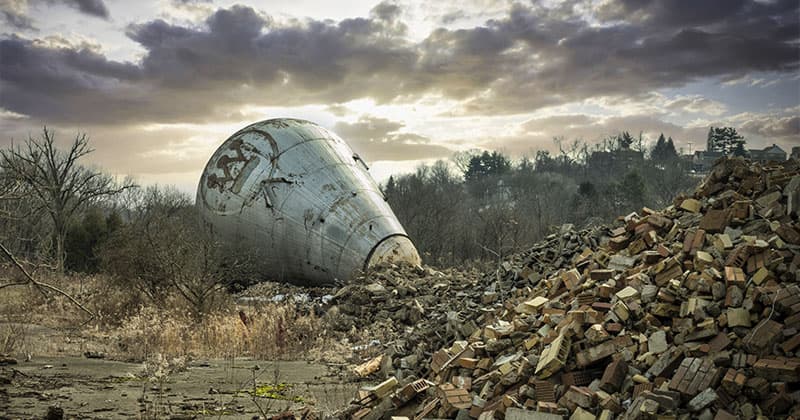
But the real memory of Joe isn’t in the statues. It’s in the towns themselves. If you walk through places like Connellsville or Duquesne, you see the remnants of the world that Joe was built for. You see the massive concrete foundations where the mills used to sit and the rows of company houses built into the hillsides.
For the people living there now, Joe Magarac is a shorthand for an era that is gone but still defines them, and their region. He’s a symbol of a time when the work was backbreaking, but at least the work was there. He represents the pride of being “made of steel,” even if that pride came with a very high price tag.
It is impossible to talk about Joe Magarac’s “perfect worker” attitude without looking at the real blood that was spilled in these same towns. If Joe is the dream of a peaceful, obedient workforce, the reality was a nightmare of strikes and armed standoffs.
Take the Homestead Strike of 1892. While the legends of Joe portray a man who would happily melt himself down for the company, the actual men of Homestead were willing to fight the company to the death.
They didn’t just walk off the job; they took over the town. When Henry Clay Frick sent in 300 Pinkerton detectives on barges to take the mill back by force, the workers met them at the riverbank with rifles and a literal cannon.
There is a massive disconnect there. The folklore tells us about a man who only asked to work, but history tells us about men who asked for a fair wage, an eight-hour day, and the right to have a say in their own safety.
When you look at the Joe Magarac story through that lens, it starts to look less like a tribute to the workers and more like a way to erase their struggle. If the “ideal” worker is a guy who never complains and jumps into the furnace when the boss says so, then the guy standing on the picket line looks like a villain.
By making Joe the hero of the region, the industry was subtly telling the workforce that their value came from their silence, not their strength as labor.

He Wanted Nothing
The most haunting thing about Joe Magarac is that line: “He wanted nothing.”
In American culture, we are taught to ask for everything. We are told to strive, to move up, to “get ours.” But Joe is the opposite. He is the guy who does the work and then disappears. He doesn’t have a house or a bank account. He doesn’t even have a grave, since his body was rolled out into rails and sold off to build the country.
There’s something admirable in that kind of selflessness, sure. There is a deep-rooted pride in the Mon Valley about being “the people who get it done.” People there don’t like a whiner. But there is also a warning in Joe’s story that we are still dealing with today.
When you give everything to an industry—when you make your work your entire identity—what happens when that industry decides it doesn’t need you anymore?
When the mills started closing in the 1970s and 80s, thousands of men who had lived like Joe Magarac found themselves in a world that had no use for their “steel.” They had been loyal “beasts of burden,” but the companies they served didn’t melt down with them. The companies moved on, and the workers were left with nothing but the soot in their lungs and a few stories about a giant who wasn’t real.

Why Joe Still Matters
So why do we still have the statues? Why do we still tell our kids and grandkids about the guy made of steel?
I think it’s because, even if the story could have been invented by a corporate PR guy, the people of Western Pennsylvania breathed life into it anyway. They took a name that was meant to be an insult—magarac, the jackass—and they turned it into a symbol of the kind of strength that nobody else understands.
Joe matters because he represents the “Old World” work ethic that built the modern world. Every time you cross a bridge or look at a skyscraper, you’re looking at the result of a million Joe Magaracs who didn’t get a statue. They were the men who worked the swing shifts, who breathed the smoke, and who did the heavy lifting so their kids could have a better life.
Even if the legend is a dark one, it is real, and it’s ours.
The next time you’re driving through the valley and you see one of those old steel skeletons or a fading mural of a seven-foot giant, don’t just see a cartoon. Think about the man my grandfather was talking about.
Joe Magarac is a remnant of a time when men and machines were basically the same thing. He is a ghost of the Industrial Age, standing at the edge of the river, waiting for a shift that ended forty years ago.
He didn’t ask for anything, and in the end, that’s exactly what the system gave him back. But for those of us who grew up there, he gave us a way to remember the people who were actually made of steel; not because they jumped into a furnace, but because they survived the heat every single day.



Leave a Reply