Author’s Note: Most writing about this week in 1941 focuses on leaders, strategy, and military decisions. This series takes a different angle. It looks at how December 7–13 was felt by ordinary Americans—in their homes, stores, churches, and workplaces—as they tried to make sense of a world that had changed overnight. It’s a look at the first week of the war as most people lived it, far from the headlines but shaped by them all the same. To catch up, check out the stories for December 6th, 7th, 8th, 9th, 10th, 11th, and 12th.
Saturday, December 13, 1941, marked the end of the first full week of war—a week that had changed American life more fundamentally than any seven-day period since the Civil War. The initial shock was over. The nation had accepted the facts of Pearl Harbor and the Axis declarations. This Saturday was marked by the sobering realization that sustained commitment—not panic—was now required. The conflict had moved from a distant threat to an immediate fixture in every American home and community, demanding sacrifice and a complete reordering of domestic priorities.
Morning: The Global Cascade and the Pacific Losses
The morning newspapers of December 13th provided another depressing, continued education in strategic loss, driving home the reality that the war was not just being fought over there in the way it used to mean; it was being fought on U.S. territory, and the conflict was still expanding.
The headlines revealed that the diplomatic cascade triggered by the Axis war declarations was not yet complete. The biggest news from the European front was a formal announcement: Hungary and Bulgaria had declared war on the United States, joining Romania the previous evening. While not possessing the industrial or military weight of Germany or Japan, this move confirmed the full alignment of the Axis powers and their allies. For the average American, they were more names to add to the enemies list, confirming that the entire world order had fractured.
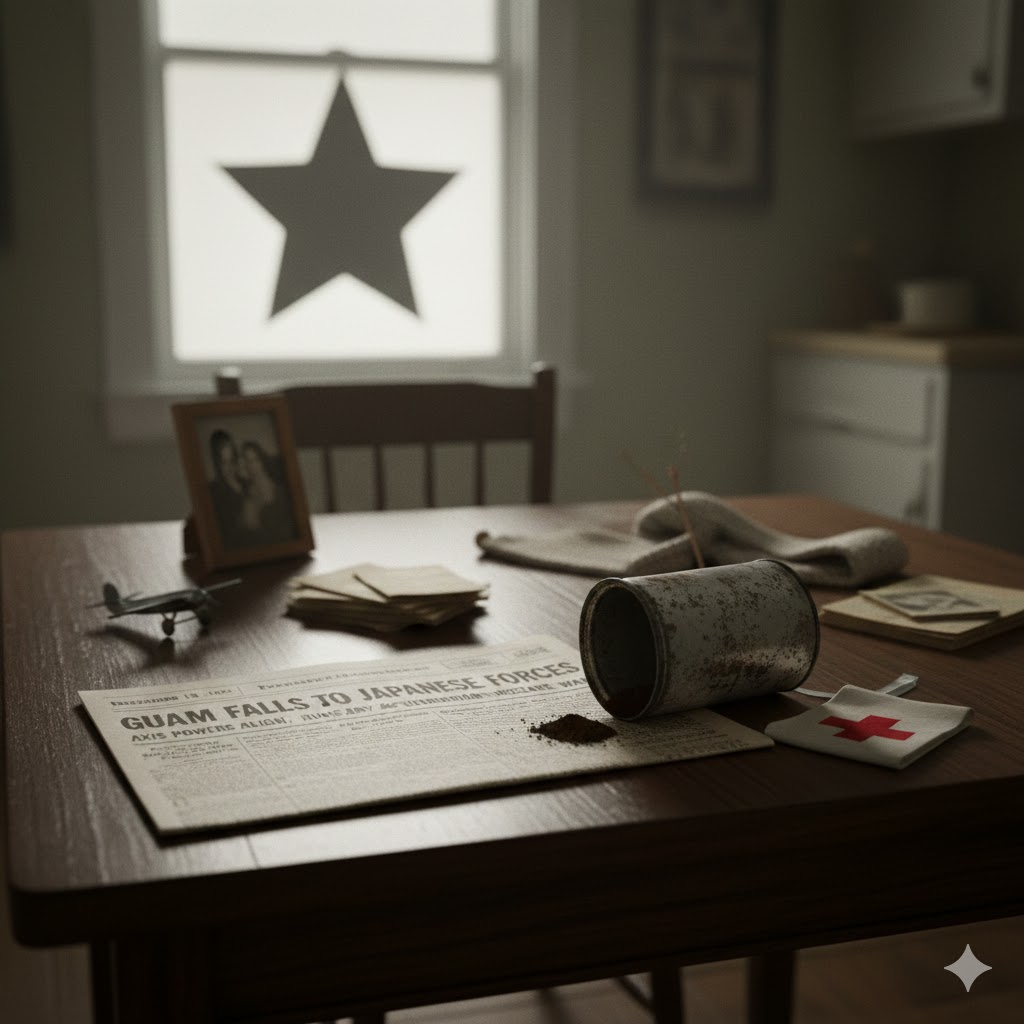
From the Pacific, the news remained uniformly bad. The fragmented reports confirmed a shattering loss: Guam, a small, historic American outpost, had been seized by Japanese forces, making it the first U.S. territory to fall. This wasn’t merely a strategic defeat; it was an important psychological blow that cemented the image of an unstoppable enemy sweeping across the ocean in the minds of Americans. The loss of this distant, small piece of U.S. territory served as foreshadowing of the difficult, protracted struggle to reclaim the region.
Bad as it was, that wasn’t all the depressing news to reach Americans that day. Dispatches began to arrive, providing details of the continued campaign in the Philippines. While the disastrous attack on Clark Field had occurred earlier in the week, the news filtered to the public on the 13th confirmed the effective destruction of much of the remaining U.S. air strength, particularly around Nichols Field and other Luzon airfields. The repeated, relentless Japanese air attacks had crippled General MacArthur’s ability to defend the islands, giving the Japanese full air superiority. This massive failure to protect air assets meant that the defense of the Philippines was now essentially a desperate, unsupportable ground campaign.
This somber news was balanced a bit by the continued, desperate holdout at Wake Island. The island’s small garrison, comprised of a small number of Marines and a contingent of civilian contractors, though completely surrounded and outnumbered, was still offering stiff resistance. Wake became a vital point of national focus—the Alamo in the Pacific, a source of defiant hope that briefly allowed Americans to visualize courage and success amid the collapsing defense line. It gave the public a desperately needed story of American grit to counter the constant stream of morale-crushing reports.
Meanwhile, behind the closed doors of Washington, the strategic foundation of the war was rapidly being poured. President Roosevelt and his military advisors spent the weekend in intense meetings with British envoys, effectively confirming the previously agreed “Germany First” strategy. Although the public was focused on revenge against Japan, the leadership recognized that defeating Nazi Germany and securing the Atlantic supply lines was the priority for Allied survival. Implementing this doctrine meant that crucial resources, including a newly authorized $10 billion aid bill, were being earmarked immediately for Britain, ensuring that ships, planes, food, fuel, and materiel were rushed to the Atlantic coast—a necessary trade-off between vengeance and survival that only the highest levels of military and government officials were willing to consider.
Midday: The Economic Front and the Scarcity Panic
Saturday, traditionally a major shopping day, exposed the direct consequences of the global conflict on the American pocketbook and pantry. The threat of U-boats in the Atlantic and the seizure of supply routes in the Pacific immediately created a widespread scarcity mentality and panic buying.

The first major items to feel the impact were sugar and coffee. The Pacific front threatened sugar supplies from the Philippines and Hawaii, while German U-boats targeted the routes carrying coffee from South America. In grocery stores across the country, shopkeepers—who had spent the week fielding calls from frantic suppliers—were now on the front line of the scarcity panic.
In a store in Cleveland, a grocery owner stood behind the counter, a hand-written sign posted next to the coffee grinder: “Limit One Pound Per Customer.” A customer, who had tried to buy three pounds of sugar, argued heatedly, claiming she needed it for Christmas baking. The owner, exhausted, simply pointed to the newspaper report about the U-boat threat, muttering, “It isn’t me, ma’am. It’s the Atlantic.”
The exchange, or something like it, was repeated in thousands of stores, and showed the public that the war wasn’t just about distant battles; it was about the immediate and very real loss of familiar comforts. The fear of impending rationing became the new driver of consumer behavior, leading to local runs on staples like flour, dried beans, and canned goods, despite government pleas against hoarding.
Beyond food, the textile market saw its own sudden crisis: silk and nylon. With Japan controlling nearly 90% of the world’s raw silk and the government seizing nylon for parachutes and cordage, women realized their long-coveted silk stockings were now relics of peacetime. The last few pairs of nylon stockings became objects of high value, a small but potent symbol of the end of consumer luxuries.
Patriotism, however, also became an economic force. The government launched a major appeal for scrap aluminum, a vital material for aircraft production. Saturday quickly became a day for neighborhood scrap drives. Children were enlisted by local defense councils to scour alleys, garages, and attics. Aluminum pots, old car parts, and worn-out odds and ends were hauled to collection points, often to the cheerful clanking of metal being tossed into trucks. For many families, sacrificing an aluminum kettle was the first tangible act of war service, a small moment of contribution that symbolized the transition from consumption to sacrifice.

Afternoon: Mobilizing Manpower and Bureaucracy

The national focus shifted dramatically from the volunteer stampede of the past week to the administrative machinery of the draft. While thousands of men were still lining up to enlist, the bottleneck was no longer patriotism, but logistics. The Army and Navy were overwhelmed by the volume of volunteers, forcing a shift in focus to the controlled, orderly call-up of the Selective Service System.
Local draft boards spent their Saturday working overtime. These boards, made up of community elders and civic leaders, were the physical nexus where civilian life met military necessity. They sorted files, updated addresses, and prepared the massive administrative tasks necessary to process the men who would soon receive their induction notices. For young men across the country, the anxious anticipation of a polite letter from the local draft board began to replace the urgency of the volunteer line.

The military, meanwhile, was undergoing internal upheaval to meet the demand. A telling detail of this rapid institutional churn was documented on this day: the War Department issued a letter from the Adjutant General that officially changed the Corps of Intelligence Police (CIP)—a small, pre-war investigative unit—into the Counterintelligence Corps (CIC). This immediate bureaucratic upgrade signaled that military intelligence, focused on rooting out internal threats and conducting aggressive field security, was now seen as a paramount necessity. The enemy was not just overseas; the institutional change showed that the enemy could be lurking within.

Simultaneously, the civilian home defense effort exploded. The Red Cross became the epicenter of organized action. Enrollment for first-aid courses, fire warden training, and nursing classes surged. In high school auditoriums and church basements, dozens of civilians—men and women, young and old—sat in chairs, learning to apply splints and tourniquets. This massive volunteer effort was immediately directed toward the coastal regions, preparing for the very real threat of German U-boat attacks following the diplomatic expansion of the war.

Evening: Fear, Restrictions, and Defiance on the Home Front
The evening brought the inevitable change to American leisure. The radio, the nation’s hearth and primary source of entertainment, completely altered its programming schedule. Variety shows, comedies, and light dramas had been drastically cut back this week, replaced by government public service announcements (PSAs), news analysis, and the beginning of officially sanctioned morale programs. The entertainment industry was already realizing its primary new role was to boost national involvement and dedication. The popular music of the day shifted from escapist romance to patriotic anthems, played alongside constant bulletins. With time, a middle ground would be created, but that’s a story for a different day.
Movie theaters, though still drawing crowds, offered a mixed experience. While a new film like The Wolf Man provided fantasy, the feature was often preceded by a ten-minute short from the Treasury Department urging War Bond purchases, or a heavy-handed newsreel that ended with a direct, stern message from a Washington official. The boundary between art and propaganda was quickly dissolving, making it nearly impossible for anyone to fully escape the war, even for two hours in the dark of a theater.
Furthermore, the initial paranoia surrounding the Pacific attack became tragically localized on this day. The unusual skirmish known as the Niihau Incident, which involved a downed Japanese pilot attempting to secure aid from local residents in Hawaii, was reported to have concluded around December 13th. While geographically distant, the sensationalized reports of this incident fueled a burgeoning national paranoia that non-citizens and even Japanese American citizens could pose an immediate, violent threat. This small, localized event was later cited as a reason to justify the wide-scale internment policies that would follow.

Desire a week of devastating news and frightening outcomes, fear didn’t stop Americans that Saturday night. People simply rolled up their sleeves and got to work, transforming anxiety into a unified purpose.
The Church Basement Meeting
The church basement was brightly lit but missing the warmth and easy chatter that usually followed a service. Instead, people kept their heads down, working in a haze of cigarette smoke, fueled by coffee.
The bake sale planning was abandoned the moment the group sat down. Delores Miller, the woman with the ledger, didn’t ask for pledges; she informed them of the new War Bond quotas expected from the county office and started assigning weekly dollar amounts to individuals.
In a corner, two men were comparing two different printouts—the town’s street map and a new, lengthy list of air raid instructions from the state. They used a pencil to mark the town’s most prominent structures: a grain elevator, the water tower, city hall, and the high school gymnasium.
In another group, no one spoke much, at least not loudly. Their focus was entirely on the physical material. They were calculating how many square yards of heavy black cloth they could get from the mill downtown to cover the large classroom windows. Others were counting every person available for the scrap metal push.
The minister stood near the door, watching. The work was no longer strictly about prayer or national feeling. His church now hosted groups sorting figures, measuring fabric, planning drives, and reckoning with the fact that the war was now their burden, too. The war had reached beyond the ocean, and spurred the formation of new volunteer rosters and prayer lists. What lay ahead was a long, uncertain effort, and places like these church basements and kitchen tables had suddenly become its headquarters.
By the end of the day, America had completed its transition from a nation in shock to a nation at war. The home front was being militarized, the economy was being rewired, and every family knew, with a quiet certainty, that the sacrifices of this first wartime Christmas were only the beginning of the long haul.

The Seven-Day Transformation: A Nation Remade
In the span of seven days, the United States was pulled from hesitant peace into total global war. The week beginning with the surprise attack on Pearl Harbor on December 7th and concluding with the angry determination of Saturday, December 13th, represents one of the most monumental and rapid periods of transformation in American history. It was a societal and political metamorphosis that fundamentally rewrote the country’s laws, economy, consciousness, and purpose.
The End of Isolation: On December 7th, America was an isolationist power, heavily divided on entering the European conflict. By December 13th, after declarations of war from Japan, Germany, Italy, and others, the political debate was dead. Isolationism vanished, replaced by a unanimous and fierce commitment to fighting on two global fronts. This diplomatic expansion required the immediate implementation of the “Germany First” strategy, committing vast resources to the Atlantic battle against the German U-boat threat even while the Pacific front was collapsing.
The Economic Pivot: The nation’s peacetime economy collapsed into wartime logistics in less than 72 hours. The initial shock of the Tire Freeze was followed by shortages and rumors that would bear out in time: a General Price Freeze, placing a comprehensive cap on consumer goods and eliminating market speculation; the economy ceasing to be driven by consumption and instead directed entirely by the War Production Board (WPB). The average citizen’s life was instantly dictated by scarcity, as evidenced by the aluminum scrap drives and the panic buying of coffee and sugar. The luxury of the pre-war era ended, and the period of total economic mobilization began.
The Militarization of the Home Front: The shift from a peacetime army to a mass conscription force began immediately. Long lines of volunteers gave way to the frantic administrative work of the Selective Service System and the internal reorganization of the military, such as the creation of the Counterintelligence Corps (CIC). Simultaneously, millions of civilians mobilized, volunteering for the Red Cross and Civil Defense duty. From the mandatory blackouts on the West Coast to the first mass first-aid classes further east, the nation’s interior became a landscape preparing for potential attack.
Domestic Security and the Turn Inward: Perhaps the most noticeable change was the immediate turn inward psychologically. The declarations of war led to the swift expansion of the “enemy alien” policy to include German and Italian non-citizens, mandating their registration and restricting their movement. Compounding this, the Niihau Incident, in combination with the surprise nature of the attack at Pearl Harbor, fueled a broader national paranoia, providing a pretext for the mass curtailment of civil liberties that would define the coming year.
By the close of December 13, 1941, the United States had transformed from a country that could go to war into a country that was completely at war. Every aspect of American life—the way people shopped, worked, listened to the radio, and said goodbye to their sons—had been fundamentally and irrevocably altered in the space of a single, world-changing week. The long haul had begun, and the nation was ready to endure it.
As we know, they did endure it. It is difficult for people living today to understand how a global event could impact and dictate almost every aspect of their lives. Not only that, but that everyone involved understood the need for it and supported it.
It was a collective effort where victory was the only important political discussion. The job you had, the food you ate, your ability to travel, the entertainment you consumed, how you spent your free time—all of these were suddenly restructured. Curfews, blackouts, air raid drills, social pressures, war bond deductions from paychecks, and the location of your loved ones in the world; all of these, and more, were dictated by the greatest global catastrophe the world has ever experienced. For the next four years, this was the life Americans led. In other countries, the struggle began earlier, and some aspects would last much longer.
At the end of it all, the world would be forever changed. The years following victory would rebuild the world, leading to a period of recovery and prosperity never before seen in human history. But, before that could happen, the effort had to begin, and for Americans, it began during this week. I hope that this series has been able to provide a glimpse into the realities of a life that isn’t that far past. While they are fewer each day, there are many people alive today who lived through it. For others, our parents and grandparents were our direct links to this incredible generation and period in history.
Before there could be a victory, the war demanded that everyday people make simple, difficult personal choices. By doing so, their efforts showed that the greatest acts of history often start anonymously, at the kitchen table.





Leave a Reply