
Author’s Note: Most writing about this week in 1941 focuses on leaders, strategy, and military decisions. This series takes a different angle. It looks at how December 7–13 was felt by ordinary Americans—in their homes, stores, churches, and workplaces—as they tried to make sense of a world that had changed overnight. It’s a look at the first week of the war as most people lived it, far from the headlines but shaped by them all the same. To catch up, check out the stories for December 6th and 7th.
On Monday, December 8, 1941, the country did not wake up in quite the state of confused shock that had so consumed it the previous Sunday afternoon. The initial blow had settled overnight. The news was no longer frantic rumor; it was the lead story, printed on the front pages of the morning papers in bold headlines: an attack had occurred, and the national response was coming. This was the day America moved from disbelief to determination, the day the country finally and formally stepped into the war that had already existed.
The Morning Ink and the Immediate Truth
The anxiety-ridden relative quiet of Sunday night gave way to the appearance of fresh newspaper headlines and the noise of a nation demanding confirmation. Across the country, Americans woke up to morning extra editions rushed into print, and given to newsboys shouting words not heard in a generation: “WAR! JAPAN ATTACKS!”
For the millions of Americans who had only heard bulletins over the radio—or, in some cases, who had merely heard a neighbor shout the news—the newspaper was the essential, tangible proof. It was the physical object that verified the world had truly caught fire. In New York, the front page of the Daily News screamed, “HONOLULU BOMBED BY JAP PLANES.” The Los Angeles Times confirmed the expansion of the front: “JAPS ATTACK HAWAII, PHILIPPINES.”
For the first time that morning, readers could visually grasp the chaos. Grainy, blurred wire photos of burning ships and massive columns of smoke over Pearl Harbor filled the inside pages, offering the first gut-wrenching visual evidence of the terror they’d only heard on the radio. These pictures confirmed the disaster: the U.S. fleet was burning, and Americans were dead.

The Rush for the News
In Louisville, fifteen-year-old Paul Jensen’s fingers were black with ink by dawn. He sold out his stack of Courier-Journals in twenty minutes. “They didn’t even read the headline before paying,” he recalled. “They just grabbed the paper and ran.” This desperate purchase of the papers was a physical reaction—an overwhelming need to hold and see the evidence on a paper that could confirm the world had actually changed, to check the casualty lists, and to find assurance that the government had a plan. With the shock slowly fading, the question of “What now? What do we do?” was at the top of millions of minds.
The demand was so great that presses in major cities ran all night and throughout the morning. In Chicago, the Tribune‘s presses printed 800,000 extra copies. The papers weren’t just read; they were spread out on kitchen tables, passed hand-to-hand in trolley cars, and studied on shop floors and in diners.

The radio chatter was continuous; regular programs were almost entirely replaced by news and analysis of sparse official government statements, accompanied by worried local reporting. Talk over breakfast was no longer about whether the attacks were real, but what the President would demand next. The frantic pace of the radio from the night before had steadied into a more measured tone, punctuated by increasing reports of coordinated strikes across the Pacific—at Wake Island, Guam, and the Philippines—confirming this was a wide, expanding conflict.
The country’s mood had shifted instantly. The day before, it had been a holiday schedule. Now, millions of Americans poured into the cities and factories, clocking in for their Monday shifts, but their focus was elsewhere. The ordinary tasks of a December morning—buying groceries and other supplies, boarding a streetcar, manning the factory floor—were carried out with a new urgency.
In an office building in Boston, a typist stopped mid-sentence to listen to a wire report about a strike in the Philippines. In a Detroit factory, a foreman stood silently, holding a wrench, staring at the radio perched on a shelf until a line worker cleared his throat. The machines were running, but the national mind was absorbed by the news.
Midday: The Nation Stops
Officially, the national decision came at 12:30 PM Eastern Time.
Across the country, the work of ordinary American life stopped simultaneously. In offices, the clatter of typewriters ceased. Factories paused production lines, the noise of machinery dying down. Barbers turned off their clippers; store clerks stopped mid-sale. Long-distance telephone lines, which had been jammed all morning with families trying to reach relatives in Hawaii or the West Coast, momentarily cleared as everyone tuned in.
President Franklin D. Roosevelt, speaking to a joint session of Congress, delivered what would instantly be known as the “Day of Infamy” speech. His steady voice filled the nation’s airwaves. He didn’t ask Congress to consider war; he told them war had already been launched against the United States by a “sudden and deliberate attack.”
“Yesterday, December 7th, 1941—a date which will live in infamy—the United States of America was suddenly and deliberately attacked by naval and air forces of the Empire of Japan.”
The impact of the speech, the sheer drama, created a moment of intense, unified national focus. Roosevelt used direct language that stripped away any ambiguity: “unprovoked,” “dastardly,” “treachery.” He established the official story of the attack as a betrayal, a violation of trust, and a wound to the nation’s honor that demanded a forceful, total response.
Listening In
The response in local settings was overwhelming. Each American citizen was involved in this global calamity, and because of that, it was personal. In a high school in Des Moines, Iowa, Clara Allen stopped her history lecture when the janitor brought a radio into the classroom. The students sat at their wooden desks, listening to Roosevelt’s voice as he spoke to Congress. When he finished, she recalled, that no one spoke for nearly a minute.
In a small Kansas diner, the cook turned up the volume on the counter radio, wiping his hands on a stained apron. He and his handful of customers—a truck driver, a traveling salesman, a farmhand, and an elderly couple—listened as FDR laid out the situation they were facing. Though far from Hawaii and Washington, D.C., and not in uniform, they were not outsiders. They were individuals—regular people—suddenly made central to a global event. At this early stage, the act of listening was an act of participation.
Roosevelt’s conclusion, a request for a declaration of war, was a national mandate:
“I ask that the Congress declare that since the unprovoked and dastardly attack by Japan on Sunday, December 7th, a state of war has existed between the United States and the Japanese Empire.”
The response from the Capitol was overwhelming. Following the President’s address, Congress did not pause for debate; it raced straight to a vote. The formality of the declaration was required—it was the country’s legal, constitutional response to an act of war. The atmosphere in the Capitol was electric. Lawmakers, many of whom had been isolationists just days prior, now felt the weight of history and the undeniable anger of their constituents. The Senate voted 82 to 0 in favor of the declaration of war, and in the House of Representatives, the tally was 388 to 1. The single “no” vote came from Representative Jeannette Rankin of Montana, a lifelong pacifist who had also cast a “no” vote against entering World War I in 1917. Rankin’s was an incredibly unpopular position.
Outside the Capitol, crowds cheered when the vote was announced, the news flashing instantly across ticker tapes nationwide. In some towns, bells began to ring in churches, a call to pray in the midst of a crisis. Before sunset, people across America began hanging flags in their windows, pulling folded banners out of attics and storage rooms. It was an instant and spontaneous unified national gesture.
The flag suddenly meant more than patriotism. It flew over a country that had been hit, a symbol that people were refusing to be shaken and were holding together.
The official declaration was signed by President Roosevelt at 4:10 PM Eastern Time. That signature did not start the war, but it formalized the national commitment to finish it.
The Home Front Shifts: From Shock to Action
Out in the towns and cities, the official response triggered an immediate, personal one. The chaotic uncertainty of the day before was rapidly replaced by organized activity. The decision to fight was made in Washington; the effort of fighting began everywhere else.
Lines at the Recruitment Offices
Local recruitment offices were deluged by a sudden surge; the telephones began ringing within moments of the President’s speech, and by the following dawn, lines of men stretched down sidewalks outside Army and Navy posts. These weren’t the confused observers of the night before; these were men who had made a decision.

In Philadelphia, the line outside the Navy yard wrapped around the block. In the rural South, farmers drove into the county seat, leaving their homes and farms untended for a day, determined to sign up before their local quotas were filled. The lines were full of committed enthusiasm; the decision was already settled. The men waiting did not talk about glory; they talked about duty and revenge. For many, the idea of being called a “draftee”—peacetime conscription over the past year had been controversial—was suddenly less appealing than being a “volunteer.”
Women and the Red Cross
In community centers and church basements, the first steps toward civilian mobilization were being taken. Local Red Cross chapters opened their doors, their meeting rooms almost instantly becoming hubs of activity. Women who had been folding laundry yesterday were now organizing sewing rooms to create bandages, transforming domestic tasks into acts of war support.
The Red Cross immediately began training volunteers in first aid and emergency nursing, reacting to the immediate fear of a follow-up attack on the mainland. In every small town, the first official war duty for thousands of women was simply to organize: to list supplies, and to find the nearest bolt of clean, white cloth.
The Industrial Pivot
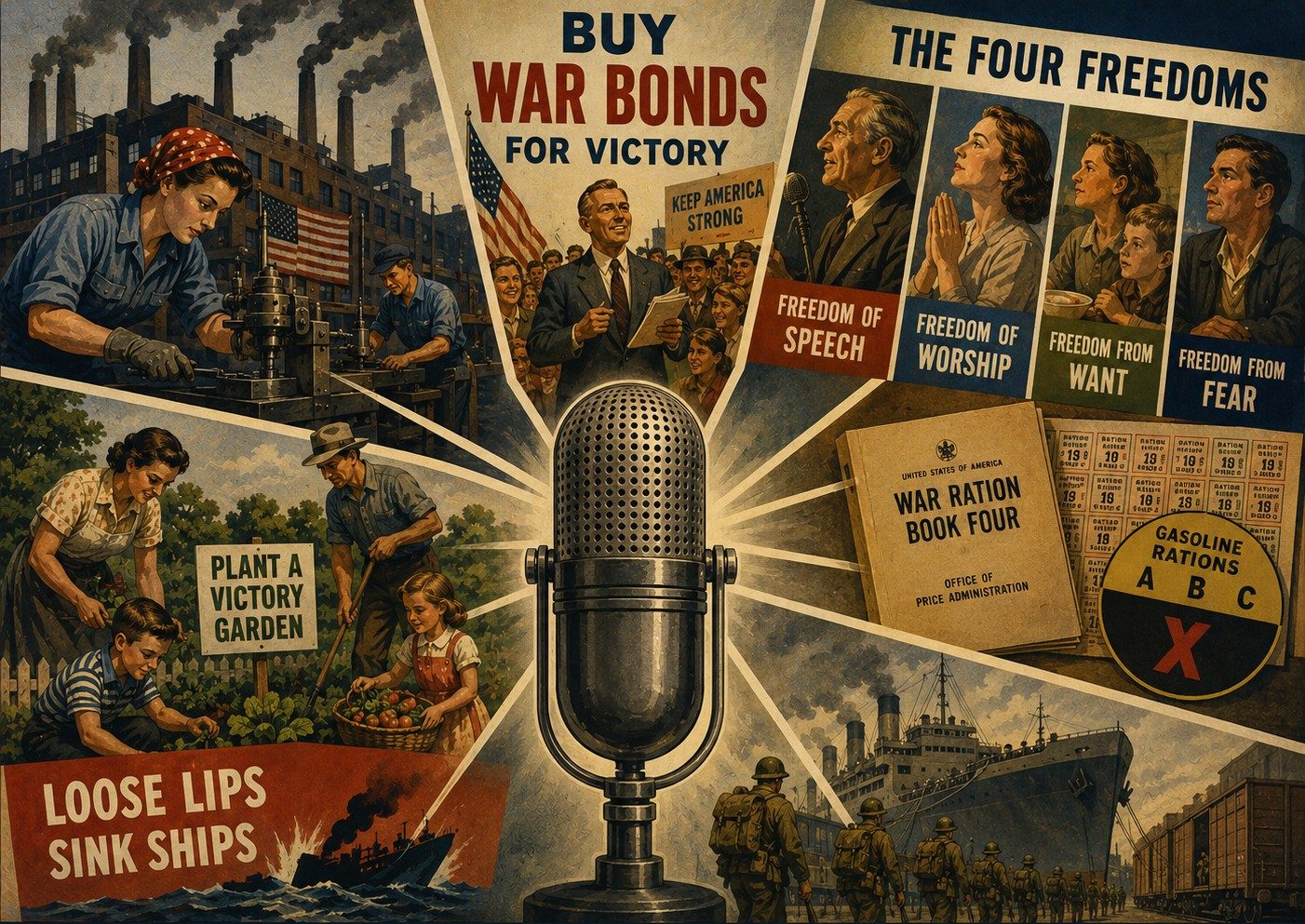
The financial front opened as well. Bank windows posted information on War Bond sales, giving ordinary citizens a tangible way to financially support the fight. The slogans that had appeared overnight were blunt: “Buy Bonds—Beat the Japs.”
In the factories, the sense of national urgency was equally acute. In Detroit, auto workers listened to bulletins about Japanese raids in the Philippines from radios turned up full volume in the foremen’s offices. “Nobody said a word about cars that day,” one auto worker remembered. “All we could talk about was war.” They knew their labor would soon shift from consumer goods to weapons of war.
The pivot was almost instantaneous. Though it would take time for the official, mandatory change orders to arrive, auto giants like Ford and General Motors began canceling orders for civilian chrome and rubber, starting the planning process of retooling their lines to produce tanks, planes, and artillery instead of sedans. The assembly line, the defining American innovation of the century, was being officially dedicated to war production.
West Coast Nightfall: Fear, Loyalty, and Prejudice
While the East Coast focused on Washington’s official acts, the West Coast dealt with a terrifying sense of closeness to the enemy. The fear of a follow-up strike was widespread. Rumors of ships sunk and submarines off California, and paratroopers in Oregon swept through towns—almost all false, but reflecting a genuine, common anxiety.
Blackouts and Air-Raid Wardens

Seattle enforced its first official, complete blackout the night of December 8, and other coastal cities followed with dim-outs and air-raid drills in the days that followed. The instructions were crude and often confusing: car headlights were masked with strips of tape, leaving only a slit of light; windows had to be covered with blankets or newspaper.
Volunteers registered as air-raid wardens, often men who had just retired, preparing for a threat that felt terrifyingly close. They patrolled streets, tapping on windows, telling families to turn off lights. This was the first inconvenience, the first practical sign that the war had moved from the newsreel to the street corner.
A mix of fear and dedication sometimes led to overzealous enforcement. Fistfights sometimes broke out between gung-ho blackout wardens and citizens whose non-compliance ranged from ignorance to outright refusal. At times, failure to comply fully and promptly could lead to vigilante-style reprisals. Americans were learning as they went, and mistakes were made.
The atmosphere also carried a darker edge. The shock of the attack was the impetus to intensified prejudice and granting it a target. Suspicion fell instantly upon Americans of Japanese descent.
In a diner outside Portland, waitress Mabel Collins poured coffee for two men who muttered insults about a Japanese-American regular named Kenji Sato, a local grocer. Without a word, she poured the rest of their coffee—then placed Kenji’s meal in front of him and said, “You eat up, honey.”
But the kindness of individuals was quickly overwhelmed by ingrained cultural and institutional fear. Of the approximately 127,000 people of Japanese ancestry in the continental U.S. in 1941, over 80,000 were Nisei (second-generation, American-born citizens), and an additional 40,000 were Issei (first-generation immigrants, barred from naturalization). For Japanese American families, the day ended with rising hostility and the first warnings from community leaders and officials to stay home after dark, a clear indicator of the internment policies that would soon follow.

The Evening Voice and The New Soundtrack
The final act of the day belonged to the radio. Stations replaced the swing music of the previous day—the carefree sound of “Chattanooga Choo Choo”—with patriotic standards like “God Bless America” and “The Star-Spangled Banner.”
The radio was no longer a provider of distraction; it was the voice of the home front, a direct line to the world beyond the kitchen. Regular programming, like soap operas and comedy shows, was almost entirely preempted for war coverage. Others, like the popular Lux Radio Theatre had a decidedly different tone.
NBC’s Gabriel Heatter, the popular news analyst, opened his evening broadcast with only one line: “There is war in the Pacific—and our country is in it.” Heatter’s job, and the job of every newscaster that night, was not just to report facts but to help steady the country. They spoke with a measured, somber tone, and tried to encourage where they could.
Letters and Lessons
In rural Pennsylvania, nine-year-old Tom Miller sat at the kitchen table as his mother wrote a letter to his uncle, a Navy mechanic stationed at Pearl Harbor. She paused between sentences to listen to the radio.
“Tommy,” she said, “you remember where you were today. You’ll tell your children about this someday.”
This was the task of millions of parents that night: to explain the war to their children not as the history lesson that we know, but as the sudden, unwelcome beginning of their own lives. They wrote letters to absent sons, husbands, and brothers, and they sat up late, mending clothes and balancing budgets, already preparing for the inevitable ration books and the anxieties of an absent loved one.
By midnight, the country had completed its first full day under the yoke of global conflict. The shock was being replaced, slowly, by clarity. The chaos of Sunday had given way to the budding structure of Monday. The declaration of war was a legal act, but the true declaration—the personal resolution to fight, work, sacrifice, and endure—had been personal decisions made in countless places across the country when millions of Americans stood up from their desks, stepped out of their homes, and began to work for a war that had been delivered directly to their shores. The attacks of December 7th closed the chapter of American peace. With the declaration of war on December 8th, the nation’s fight for its future had formally begun.




Leave a Reply