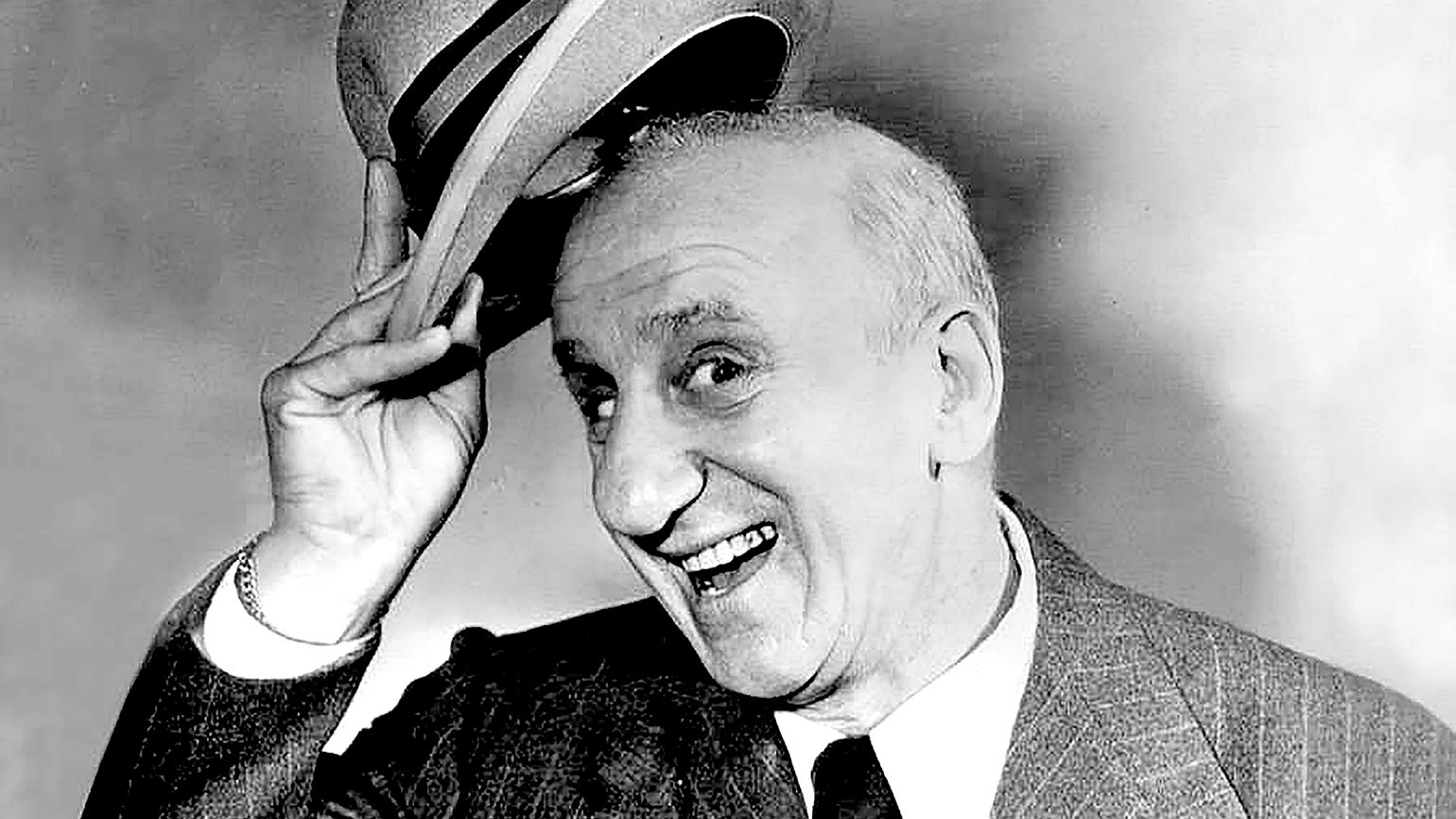
Jimmy Durante is hard to figure using modern ideas about celebrity. His appeal seemed to be that he was genuine (in addition to funny). He never worried about being a leading man or cultivating controversy, and he stayed out of the gossip columns by doing something unfashionable: he lived the same way in public that he did in private. He was just Jimmy Durante.
From his early days on vaudeville stages in the 1910s through his last television appearances decades later, Durante occupied a familiar place in American life. He was the performer who never seemed to be putting on airs—because he wasn’t.
In a professional environment like Hollywood or New York theater—places almost entirely made up of manufactured personas—Durante was an outlier. Most stars of his era worked hard to project an image of perfection or an air of being untouchable.
Durante did the opposite. He showed up with a battered hat, a messy pile of sheet music, and a smile to pair with a physical appearance that he made the butt of his own jokes. This wasn’t a calculated move to rebrand himself for the public; it was simply who he was.
His importance comes from his character, which remained unchanged despite decades of massive success. People trusted him.
When he walked onto a stage, there was an immediate sense of ease in the room. The audience felt they knew him because he never gave them a reason to doubt his sincerity. In the history of American entertainment, fame usually fades when the act gets old, but Durante’s career lasted sixty years because his personality was the attraction.

The Kid Who Had to Make It Work
James Francis Durante was born in New York on February 10, 1893. His parents, Bartolomeo and Rosa, were Italian immigrants who lived in a tenement on Catherine Street. Like many immigrant families of the era, the Durantes had to work hard, and still barely got by.
Bartolomeo Durante earned his living as a barber, working long days for the neighborhood’s working men. It was steady work, but they had to make each dollar stretch, and there was no safety net, and no real notion of leisure.
Jimmy’s schooling ended about the 7th grade. It wasn’t an early bid for show business; the family simply needed the income, and Jimmy went to work.
He spent his youth working as a newsboy, a delivery boy, and a helper in his father’s barber shop. He was a product of the New York streets, and his worldview was shaped by the practical reality of the working class: if you didn’t work, you didn’t eat.
His entry into music was equally practical. His parents had saved enough to provide him with piano lessons as a child—a huge sacrifice given their income—and Jimmy realized that playing the piano was a viable trade. By the age of sixteen, he was working in the beer halls and saloons of Coney Island.
These were not venues for the faint of heart. The pianos were often out of tune. The noise never died down, and the threat of trouble was always nearby. A performer kept playing for hours because the music was the only thing holding the place together and preventing a brawl. When the playing slipped, the room had a way of turning on you.
This was Durante’s real apprenticeship. In these bars, he became “Ragtime Jimmy.” The job left no room for sensitivity. He had to keep the tempo moving, drawing the attention of sailors and laborers who were quick to lose interest. The style that emerged was largely created by that pressure, and it stayed with him long after he left the rowdy bars behind.
He quickly learned that his appearance—especially his nose—gave audiences an easy target. Rather than fight it, he leaned into it, turning the jokes on himself before anyone else could. What started as a way to survive a tough room eventually became one of the most recognizable parts of his act, and a remarkably valuable one.
Vaudeville, to Durante, wasn’t about chasing fame. It was simply better than the saloons he’d come up in. He treated the stage the way his father treated the barber chair: you show up on time, you do the work, and you respect the person paying for the service.
His lack of ego allowed him to make the transition from the streets to the stage without becoming cynical. He was a laborer whose tools happened to be a piano and a sense of humor.
Throughout his life, Jimmy Durante wore a necklace with a few pendants to remind him of the lessons he’d learned and the people who had helped him along the way. In 1955, he explained what it meant to him:
Jimmy Durante on his father: One of these gifts is a medal of the Madonna. My pop give me that. He was a barber, and when I’m a kid he lets me lather up the faces of his customers. It’s his hard-earned dollars, and there were never a lot of them, that learns me how to play the piano. Bartolomeo Durante, the barber, the kindest, gentlest man I ever know. In giving me the medal he teaches me the art of giving. If his customers don’t have the price, he’d cut their hair anyway. To the day he died he wants to give away everything he has. When he gets too old to barber he lives with my sister Lillian in Brooklyn, and he walks down the streets and passes out all the money he has to anyone who needs it. It gets so bad he can’t carry any money with him. So I send it to Lillian and make her his banker. You know, I don’t think I ever see him mad a minute in his whole life. I’d like to be like him.
And his Mother: Before my mother dies over 25 years ago she gives me a little beat-up cross. That’s the fourth gift on my chain. She wore it all her life, and when she gives it to me she says: “Never take it off, and God will always be with you.” It isn’t true that I start each day with a song. That’s second. I start each day with a prayer. That I get from Mom. She teaches me the art of believing. That’s probably the greatest of the four commandments on my chain. Oh, she teaches me all the commandments, all right, my mother. A saint. God have mercy on her soul. One time, I think I’m about five years old, I’m walking down the street with her, and we pass a vegetable pushcart. I just snitch a piece of corn; all the kids do. Two blocks later Mona turns around and sees the corn and asks me: “Where did you get it?” “Off the pushcart,” I says. She hauls me by the ear for two blocks all the way back to the pushcart and makes me explain to the peddler and give it back. I am highly mortified. But that’s her way of teaching me the commandments. As a kid she tells us: “Without believing, you’re nothing.” And she points to one of the tough guys on the block: “He hasn’t got God in his heart,” she says. And she turns to a good guy like my father and says: “This one, he has God in his heart.” And we always follow her to church, without her asking, to find where God is. Even after she dies I still follow her.
Being Funny Without Being Beautiful
For most performers, a noticeable feature was something to hide or fix. For Jimmy Durante, his nose became part of the act.
It was bulbous, impossible to miss. In an era when the stage prized conventional looks, Durante was a misfit. Back then, the entertainment world was even more obsessed with appearances than it is today. Leading men had sculpted features, and even comedians tended toward a kind of polished appearance. Durante had none of that—and it worked in his favor.
From the start, Durante knew his nose would announce him before he even said a word. New York’s club audiences were ruthless, always ready to target any flaw. Too small, too heavy, too thin, too plain—a performer’s appearance could become a club to use against him.
Durante got ahead of it. He christened his nose “The Schnozzola” and made it the centerpiece of his act. If the audience wanted to laugh, they’d have to laugh with him.
Durante made his nose the joke, but it wasn’t self-doubt that drove him; it was a way to connect. Walk onto the stage, point at that nose, and suddenly the audience knew he was one of them. Ordinary, human, relatable, a little ridiculous—and fine with it.
That made his humor feel different. People laughed with him, not at him. In a world passing judgment, he was the guy who embraced what everyone else tried to hide.
He never tried to seem glamorous, never tried to polish himself into something he wasn’t. That honesty made him impossible to disappoint. What could have been a weakness became the core of who he was—and why audiences loved him.

Vaudeville Falls, But Jimmy Durante Doesn’t
The peak of Durante’s stage career came during the heyday of the comedy trio Clayton, Jackson & Durante.
They were a high-energy act that specialized in what was known as “rowdy” comedy. They would wreck pianos, throw hats, cause chaos, and engage in fast-paced banter that kept the audience in a state of constant excitement. They were one of the most popular acts in Vaudeville, but the world was changing rapidly by the late 1920s.
The arrival of synchronized sound in motion pictures, the growing popularity of radio, and the onset of the Great Depression effectively killed Vaudeville. Thousands of performers who had spent their entire lives on the circuit found themselves out of work.
Many of them tried to transition to film or radio but failed because their acts were too dependent on the live atmosphere of a theater. They couldn’t figure out how to be funny without the immediate feedback of a laughing crowd in front of them.
Durante found a way forward. While his partners, Lou Clayton and Eddie Jackson, eventually moved into different roles—Clayton became Jimmy’s manager—Durante found a way to translate his energy into new formats. He signed with MGM and began appearing in films, where he discovered that the camera liked his face just as much as the live audiences did.
Durante didn’t try to remake himself for the studios. He kept the Brooklyn accent. He skipped the acting lessons meant to sand off his rough edges. What changed wasn’t who he was, but how much of him he gave. Onstage, everything had to reach the back row. On radio or film, it only had to reach the microphone.
Because of that, he stayed recognizable as entertainment moved forward. He brought his habits of the stage into movies and radio without pretending they were something else. His success in the new mediums wasn’t accidental. He had a clear understanding of himself, and a refusal to chase whatever happened to be fashionable at the moment.
Jimmy on friendship: To me it’s the art of friendship. Through the years I learn it from my friends Eddie Jackson and Lou Clayton. Lou is around us still even though he died. But a stranger I still don’t know and the St. Christopher medal keep reminding me of what friendship means.
I get the medal about six years ago. I’m ready to start a 17-day grind of one night stands across the country on a bond drive tour when Lou Clayton takes me to the doctor for a check-up. The last X-ray shows a polyp in my lower stomach. So I’m elected for surgery. No tour. No radio. Nothing.
But Al Jolson, Bob Hope, Red Skelton, and Frank Morgan took turns doing the radio show for me. That’s what success really is, to have friends of that sort. Do the best you can. Stick with your friends. Pray they’ll stick with you. The rest is in God’s hands. If I don’t have that operation, that polyp could have gone malignant and I am in real trouble. God is really with me. When they give me that shot in the arm, right before I go into the surgery, and I’m just about getting subconscious I feel someone touching my neck.
When I wake up from the antiseptic I see this St. Christopher medal around my neck and I ask the nurse: “Where does this come from?” And she says: “Right before we took you up a nice lady with grey hair, dressed very nice, comes in, and kneels down, and says a prayer, and then slips this around your neck, and then she begs the doctor: ‘Please doc, take good care of him,’ and then she runs out.” Anyway I can never forget this stranger with the St. Christopher medal.
Radio’s Human Voice
Radio arrived at exactly the right moment for Durante. By the 1930s and ’40s, Americans were gathering around their sets every night, and once the visuals fell away, all that mattered was the voice. Jimmy had a voice all his own—an everyman from New York, a little rough around the edges, oddly comforting, and always himself.
Radio helped Jimmy refine his timing. He was a hit, and his pairing with Garry Moore only magnified him. Moore was smooth and measured. Durante stumbled, spoke Brooklyn-ese, digressed, and sounded…..human. The contrast clicked, and audiences loved it.

During these years, listeners came to expect the same sign-off every night: “Good night, Mrs. Calabash, wherever you are.” Durante never explained it, and for a long time no one knew who she was. The line lingered until he eventually revealed it to be a reference to his first wife, Jeanne Olson, who had died years earlier.
It seems a meaningless hook, but it was indicative of something: his loyalty and his willingness to share a piece of his private heart with millions of strangers. Trust was the true currency of the radio era, and Durante earned it by sounding like a human being, like one of the people, rather than a broadcaster.
Jimmy on how he met his wife, Jeanne: The second gift on the chain around my neck is a medal of the Crucifixion. My wife, Jeanne, give it to me when we was married in 1921. We was married for 22 years. She died in 1943. Lord have mercy on her. Her medal of the Crucifixion always reminds me of the art of forgetting and forgiving. Even how I met her reminds me of forgiving.
She came from Toledo, Ohio, and she’s a very pretty girl. Pretty inside as well as outside. And she’s a great singer. What a pair of pipes she has. I’m working in an uptown joint in Harlem then, the Alamo, and she drops in looking for a job. The boss eyes her, and says: “Let’s hear you sing. Go ahead, Jimmy, play the piano for her.”
I resent that because I’m busy—I don’t know what I’m busy about. But I feel busy. So I play a few blue notes and clinkers. She stops, and she’s real angry, and she says: “You are probably the worst piano player in the world.”
“Them are the conditions that pervails,” I say.
First she busts out laughing, and then she lights up the room with the shiningest smile I ever see. So what do I do? I marry her. Jeanne knows people and how weak-minded they get, and watching her heart work I learn what forgiveness is. One day she entrusts an acquaintance with some money. A slight loan, you might say. And when it’s time to return it, the money isn’t there. So the guy says he’s sorry and tells her why he hasn’t got it. Jeanne never asks him again. “I feel resentment when I ask and he refuses,” Jeanne says. “I don’t want to feel resentment, so I’ll never ask him.”
I never want to feel resentment, so if anyone owes me anything I never ask either. Jeanne is always telling me: “If anyone does something wrong to you they’ll be more unhappy about it than you will. So forget and forgive.”
I’m not proud—it takes a lot of time and trouble to keep even the smallest nose in the air.
Hollywood Without Illusions
Durante’s move into film was successful, but he never approached Hollywood with the typical illusions of a big-time movie star. He appeared in dozens of films, including The Man Who Came to Dinner and It Happened in Brooklyn, usually playing a character very much like himself.
He was the character who provided the warmth and humor in a story. While leading men like Frank Sinatra or Billy Abbott handled the plot, Durante handled the heart and the moral of the movie.
He never chased leading-man status, and he didn’t seem to mind being the supporting player. His lack of vanity made him a favorite of directors and studios. He was reliable, unique, knew his lines, and he didn’t demand the spotlight at the expense of the story.
By the time of It Happened in Brooklyn, Durante had no need to change how he presented himself. He brought the same persona to film that audiences had seen onstage and on radio. The role required no adjustment because it was, well, him.

A Peer Among Peers
In the entertainment industry, professional jealousy is the standard condition. Comedians, in particular, are known for being protective of their material and deeply competitive regarding their standing on a bill.
That said, if you look through the memoirs and interviews of the giants of the era, there is a complete lack of drama when the subject of Jimmy Durante comes up.
The consensus among his peers was that “what you saw was what you got.” Jack Benny—whose own act depended on flawless timing—once said that Jimmy was the only performer who could make him laugh simply by stepping onto the stage. Most comics, Benny observed, had to win an audience over. Durante had them the moment he showed up.
George Burns saw the same thing. Audiences usually spent the first few minutes deciding whether they liked the person onstage, he said, but with Jimmy that decision came instantly. There was no distance to close.
That same quality carried offstage. Frank Sinatra, who famously had little patience for celebrity phoniness, remained a devoted admirer after working with Durante on It Happened in Brooklyn. What Sinatra respected was his genuine nature. Jimmy was the same man on the street that he was at a premiere.
There are no stories of bitter rivalries or decades-long grudges involving Durante. This lack of bitterness is likely what allowed him to remain relevant for so long. They respected Durante not just because he was funny, but because he was a professional who treated the smallest bit player with the same courtesy he extended to the headliners.
That made him different. While his colleagues guarded their territory, Durante wanted everyone on stage to succeed because he viewed comedy as a collective effort rather than a solo competition.

Aging in Public, and Doing It Well
One of the most difficult things for an entertainer to do is age in front of an audience. Many performers become bitter as they lose their speed or their looks, and they often try to compensate, usually in less-than-dignified ways.
Durante took the opposite path. As he grew older, he transitioned from a high-energy “rowdy” comic into a sort of elder statesman of comedy.
He didn’t fight the passage of time. His humor softened, and the spirit remained. What’s more, the audience aged with him. People who had seen him in the saloons of the 1920s were now watching him on television in the 1960s with their grandchildren.
He became a bridge between generations. Because he never relied on some artificial, disingenuous persona, he never had to worry about the image cracking. He was just Jimmy. In his later years, his performances were almost an emotional culmination of a life lived in public. He showed America how to grow old without losing your sense of humor or your dignity.
The Man Offstage
Away from the bright lights of Hollywood, Jimmy Durante led a quiet life. He was a man of habit who valued long-term relationships over the fleeting connections of the Hollywood social circuit.
His reputation for kindness was not a creation of a press agent. Those who worked with him—from the highest-paid directors to the stagehands who moved the pianos—noted his consistent professionalism. He was known for remembering the names of crew members and for treating the lowliest assistant with the same respect he gave a network executive.
This loyalty extended to his professional circle as well. He worked with many of the same people for decades, including his longtime pianist and friend Jack Roth. He remained close with his former Vaudeville partners long after their act had officially ended.
The lack of scandals or bitter feuds made him an anomaly in show business. He didn’t have a “dark side” that fed the tabloids. Decency, for Durante, was not a performance he put on for the public; it was who he was.

Danny Thomas, St. Jude, and the Measure of a Life
Perhaps the most significant aspect of Durante’s later years was his involvement with St. Jude Children’s Research Hospital. His friendship with fellow entertainer Danny Thomas was a strong one, and when Thomas set out to build a hospital that would treat children regardless of their family’s ability to pay, Durante was one of the first to step up.
His commitment to the cause was not limited to a few appearances at fundraisers. He became a fixture of the hospital’s efforts, using his fame to bring attention to the plight of sick children. He did this without the modern fanfare of “celebrity activism.”
He genuinely cared about the mission, and he put his own resources behind it. When he passed away, it was revealed that he had left most of his estate to the hospital.
Durante kept his generosity quiet. He didn’t use his charity work to bolster his image; in fact, much of his personal giving was done without any public announcement at all, and was only discovered after his death.
He felt a genuine responsibility to use his success to help those who were starting life with the same lack of a safety net that he had experienced as a child in New York City. For Durante, the measure of a life was found in the help he provided to others, not the applause he received.

Why People Felt Like They Knew Him
There is a difference between being admired and being liked. We admire many stars for their talent or their beauty, but we don’t necessarily feel a personal connection to them. With Durante, the feeling was always one of affection. He always seemed like a national uncle rather than some distant movie star.
Jimmy Durante didn’t put on a show for the sake of being famous. He was honest about who he was, proud of where he came from, and treated his audiences, and everyone else, with respect. Night after night, he did his job—bringing joy and laughs—and that’s why people still remember him. He embodied a certain kind of American decency—one that was kind, warm and full of life, instead of dull or self-righteous.
If you had met him on the street, you wouldn’t have felt the need to ask for an autograph; he’d have chatted you up right there on the corner like you were a pal. He was a man who performed with the audience, not at them. He took the rough edges of his New York upbringing and smoothed them out with humor and grace.
Jimmy Durante proved that you can reach the top of the entertainment world without stepping on anyone else to get there. He showed everyone that being a good guy wasn’t a liability in a tough business—it was his greatest strength.
He left the world a little brighter than he found it, and he did it with a battered hat, a piano, a wide grin, and a nose that everyone loved. Not bad for a kid from Brooklyn who never forgot where he came from. Good night, Mr. Durante, wherever you are.






Leave a Reply