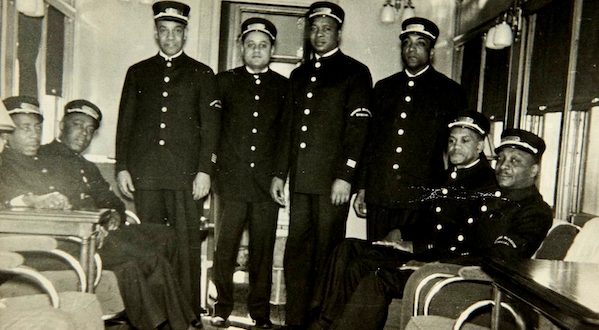
The train glided into the station, its gleaming Pullman cars promising luxury and ease. Inside, passengers settled into their sleeping berths, unaware of the men who made their journey comfortable—the Pullman porters, black men in crisp uniforms, moving quicky through the aisles.
They carried luggage, shined shoes, pressed suits, and tended to every need, all while following strict rules that demanded perfect politeness and an ever-present smile.
For decades, being a Pullman porter was one of the best jobs a black man could get, but it came at a cost. The long hours, low wages, and constant scrutiny made the work exhausting. Still, thousands of men took up the role, seeing it as a path to economic stability and a future beyond the fields and kitchens where so many others were relegated.
Thomas Burrell knew what it meant to work himself to the bone. For 40 years, he rode the rails, often putting in 400-hour months, serving passengers who barely acknowledged him. His grandson, KDKA reporter Harold Hayes, later recalled that Burrell rarely spoke about his experiences. But he did share his love of trains, a passion that stayed with Hayes for life.
For thirteen years, Burrell made the run from Pittsburgh to Detroit on the Pennsylvania Railroad. In 1950, he earned about $3,200 in wages, with another $700 in tips. It was enough to build a house in Beltzhoover and send his daughter to Howard University. It wasn’t an easy living, but it was a step up from what most black men in America had at the time.
The porters were expected to be always available, always pleasant, and never political. They weren’t even allowed to frown. Some passengers called them “George,” a habit left over from the days of slavery when enslaved workers were called by their master’s name. Harold Tardy Sr. refused to accept that. When passengers called him George, he’d gesture to his name tag and politely correct them: “My name is Harold.”
Where Did the Pullman Porters Come From?
The story of the Pullman porter service is inseparable from the history of American post-Civil War racial dynamics. The Pullman Palace Car Company was founded by George M. Pullman in 1867, at a time when the nation was grappling with Reconstruction. Pullman had a massive labor need, and he recognized an available, highly motivated, and underpaid labor pool in the newly freed black population.
After the Civil War, black men were largely excluded from industrial and skilled labor jobs due to pervasive racism and exclusionary union practices. They were often relegated to agricultural work or domestic service. Pullman shrewdly positioned the porter job as a respectable, stable occupation, even though the wages and conditions were exploitative. The first porters were often former enslaved people who had worked as servants for wealthy white families, meaning they already possessed the skills and demeanor the company desired for luxury service.
The company benefited immensely from this arrangement. By hiring black men, Pullman could pay them significantly less than their white counterparts in comparable roles (like conductors or trainmen). In the early 20th century, porters were often paid a fraction of a white trainman’s salary.
This large wage disparity, combined with the fact that porters were required to perform many tasks—like setting up and dismantling the sleeping berths, or “making down” the beds—on their own time and without extra pay, amounted to an enormous cost saving for the company.
At its peak, The Pullman Company was the largest employer of black men in the United States, utilizing the deeply embedded racial hierarchy for its economic success.

Exploitation and the Economics of Service
While the average annual wage for a white skilled industrial worker in the early 1900s might hover around $1,000 to $1,500, a Pullman porter’s wage was often less than $30 a month, or around $360 a year, before the union’s successful negotiations. This meant that for decades, porters relied almost entirely on tips to survive. In a way, the passengers, not the company, were paying the majority of the porter’s income. This system further disempowered the porters, forcing them to tolerate poor treatment and even outright abuse from passengers to ensure they received a respectable gratuity.
The Role of the “Tipple” and the “Double Over”
The workload was far more extensive than simple service. A porter’s trip, or “run,” was officially counted as a fixed period, regardless of the actual hours worked. For example, a trip from Chicago to San Francisco might be considered 72 hours of work, even if the porter was on duty, awake, and serving for much longer.
The infamous “tipple” refers to the long, exhausting stretch where a porter was on duty, sometimes for 18 to 20 hours straight, waiting for passengers to retire before he could even attempt to rest in a small, cramped space, often near the restrooms.
A common practice was the “double over,” where a porter would finish a lengthy run, only to be required to turn right around for the return trip, sometimes with only a few hours of rest. Prior to the union contract, it was common for a porter to log 400 hours or more in a month, exceeding the typical working hours of nearly any other industry.
Despite this physical and mental strain, the porter had to maintain a polished appearance and a cheerful disposition. The company supplied the uniform but expected the porters to pay for their own shoe polish, cleaning supplies, and meals on the road—another drain on their meager income. Their commitment to impeccable service, however, built a reputation that made the Pullman service a national standard for luxury travel.
Fighting for Their Rights
The Pullman Company depended on porters but refused to treat them as equals. They were paid little, worked exhausting shifts, and had no job security. A. Philip Randolph saw this and organized the Brotherhood of Sleeping Car Porters in 1925. It was the first black labor union to successfully negotiate with a major company. The battle was long, but in 1937, the Pullman Company finally recognized the union. Wages increased, working hours were capped at 240 a month, and job conditions improved.
The formation of the BSCP was a monumental feat against a powerful corporation and a hostile political climate. George M. Pullman and his successors aggressively fought any unionization attempt, creating company-sponsored “unions” that had no real power and firing any porter suspected of organizing.
A. Philip Randolph, an influential socialist and editor of The Messenger magazine, provided the intellectual force and leadership the porters needed.
The struggle for recognition took twelve years. The BSCP faced constant surveillance, financial hardship, and the risk of being blacklisted. What ultimately gave the union its leverage was the passage of the Railway Labor Act in 1926, and subsequent amendments, which provided federal protection for the rights of railway workers to organize. The union also leveraged the growing national profile of Randolph and the unique position of the porters as respected members of the black community.
The 1937 contract was a massive victory. It secured an estimated $2 million in wage increases, set the 240-hour limit, established an eight-hour workday, and, perhaps most importantly, created a grievance procedure, giving the porters some protection against arbitrary firing.
Randolph’s fight didn’t stop there. In 1963, he stood at the forefront of the March on Washington. As young Harold Hayes watched the television with his family, his grandfather pointed at the screen. That man, he told him, had changed their family’s life.
Secret Messengers
Beyond the sleeping cars and polished shoes, Pullman porters played a role in the spread of information. Newspapers like The Pittsburgh Courier and The Chicago Defender struggled to reach black readers in the South, where white authorities often intercepted and burned them.
But the porters had access. They carried stacks of papers onto trains and delivered them to ministers, barbershops, and community leaders. Thanks to them, news of racial injustices and civil rights efforts reached black communities that otherwise would have been left in the dark.
It was subtle, but it had an impact. By the 1940s, The Pittsburgh Courier became the most widely distributed black newspaper in the country, peaking at 450,000 copies in circulation.

The “Itinerant Intellectuals” and the Great Migration
The porters became known as “Itinerant Intellectuals” because of their mobility and their role as a vital communication network. They traveled regularly between the North and the South, seeing firsthand the contrast in opportunities and conditions. This unique perspective made them invaluable sources of information. They carried more than just newspapers; they carried personal letters, financial aid, and, crucially, stories. Porters were often among the first to bring news of northern job opportunities back to their southern communities, thereby serving as de facto recruiters for the massive social shift known as the Great Migration.
Historians credit the porters with helping to foster a national black identity and a shared sense of struggle and purpose. They were the thread connecting disparate black communities across a segregated nation, turning the symbol of American luxury travel (the train) into an engine of political and social progress.
A Legacy That Endures
Porters like Thomas Burrell and Wister Adams spent their lives walking the length of trains, crossing the country again and again. They knew every route, every station, and every unwritten rule of survival in a world that often treated them as invisible. The work was hard, but it gave them something few other jobs could—an income that allowed them to buy homes, send their children to college, and build something lasting.
The age of the Pullman porter began to fade in the mid-20th century. The rise of the automobile and the expansion of the interstate highway system, combined with the increasing popularity and affordability of air travel, led to a sharp decline in long-distance passenger rail service. The Pullman Company, facing mounting financial losses, finally ended its passenger operations in 1969, a pivotal moment that coincided with the consolidation of remaining rail travel under Amtrak in 1971.
This decline meant the end of the porter as a widespread, visible figure. The once-coveted job became obsolete. For the men who had poured their lives into the service, this transition was bittersweet. They had fought so hard to improve the job, only to see the job itself disappear.
Despite the decline, the influence of the porters remained. The BSCP, under Randolph’s continued leadership, did not just advocate for its members; it was a foundational pillar of the 20th-century Civil Rights Movement. The union’s structure and financial resources helped bankroll early Civil Rights efforts, and its leaders—men like E.D. Nixon, a BSCP organizer—were key figures in local struggles, such as the Montgomery Bus Boycott.
As train travel declined, so did the Pullman porter. By the time Amtrak honored surviving porters in ceremonies across the country a few years ago, they were few in number. Finding them became harder each year.
Still, their impact lingers. They were more than service workers—they were part of a civil rights revolution, moving through the country as labor leaders and points of information, trailblazing a path for others. The stations, and the porters, are now gone, but the impact they had in igniting a movement for civil rights remains.






Leave a Reply