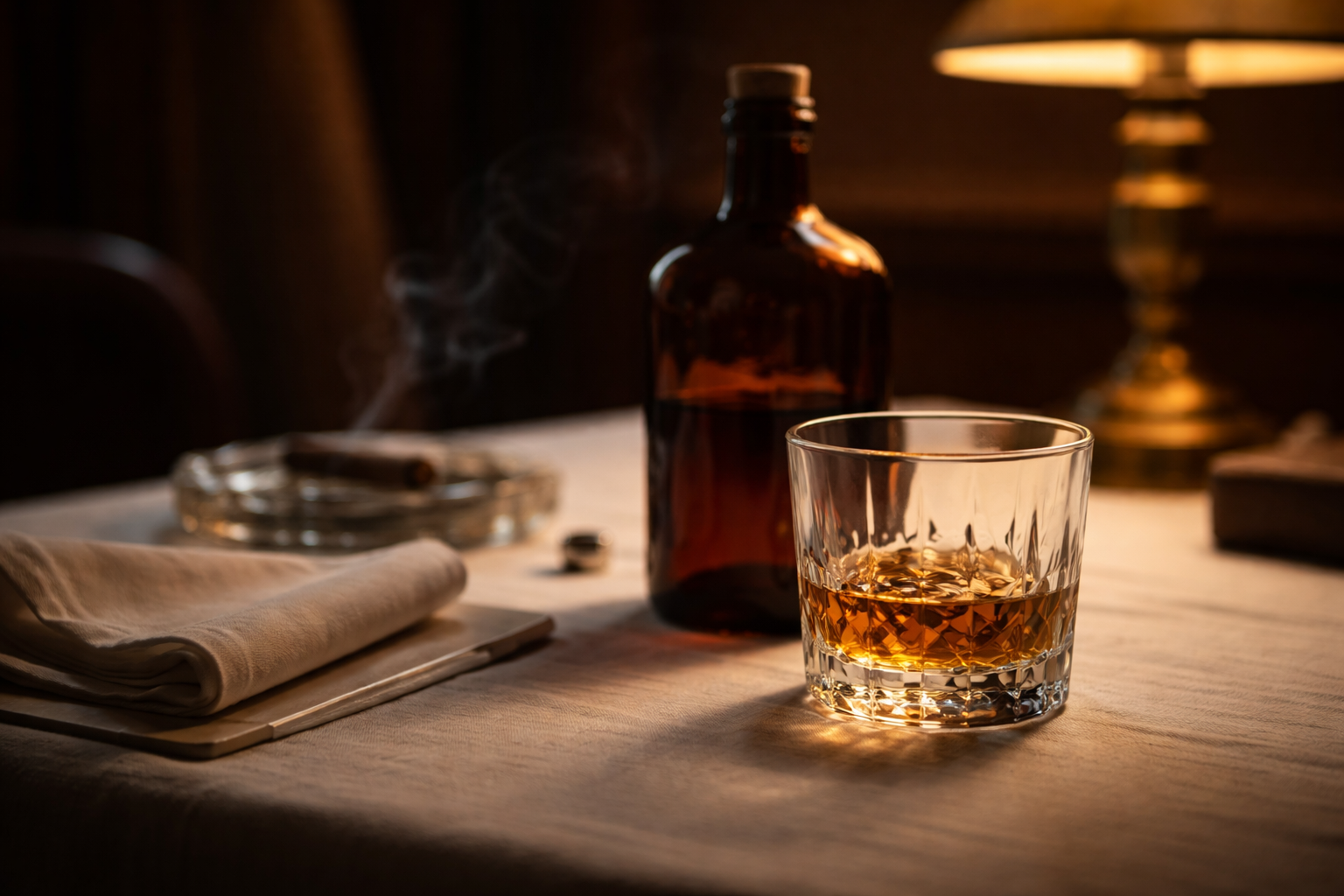
Note: This is the start of a handful of pieces on Prohibition, a complicated and damaging chapter in our history. It didn’t begin or end with a bang. It started with a law promising moral order, and almost immediately, Americans found ways around it—scheming in back rooms, slipping a bottle into a coat, making a toast behind closed doors, or just making their own. Some did it out of habit, some because they enjoyed it. This series explores what really happened: ordinary citizens breaking the rules, the larger-than-life George Remus, the agents chasing violators, and the years when the law’s authority unraveled. It’s a story of ingenuity, hypocrisy, corruption, and the small, everyday choices that reshaped a nation long before the headlines and politicians caught up.
It was sometime after eleven. The back dining room of a downtown hotel was closed to the public, but not empty. A long table had been set for about a dozen men. Dinner was finished, but the plates were still there.
They were not gangsters. One was a well-known attorney. Another ran a local bank. At the head of the table sat a state legislator who, back home, was a prominent voice in favor of the dry cause.
The waiter stopped beside the table for the last request of the evening.
“Another round of the usual, gentlemen?”
The attorney slid his glass forward. The banker gave a slight nod. A signal was passed toward the service door, and within minutes a fresh bottle appeared—brown, unlabeled. The whiskey was poured without ceremony.
The conversation, talk of railroad bonds and committee business, resumed as though nothing unusual had happened.
The most telling detail was the total absence of fear. There were no nervous looks over shoulders, no anxious whispering about the law. By the spring of 1921, just over a year after the Eighteenth Amendment became law, this casual violation was simply how things were done.
This routine situation in a respectable place had no jazz music, no gunfire, wasn’t a Gatsby-esque soiree, and didn’t have a single gangster. It was just a group of professional men, drinking a beverage they had collectively decided they were still entitled to, despite the federal decree.
Violating Prohibition had lost the thrill of defying the law. It had settled into the accepted status of a necessary routine. It didn’t feel like a rebellion; it had become a common feature of urban life.
The Purpose Still Presented
While countless instances of illicit drinking were unfolding across the nation, official America and the earnest reform movements that had driven the law maintained a stern, confident face.
The law was simple in its core demand: the Eighteenth Amendment prohibited the manufacture, sale, or transportation of intoxicating liquors. The Volstead Act provided the legal mechanism, defining “intoxicating” as anything above 0.5% alcohol by volume and setting the rules for enforcement.
In pulpits across the country, in the editorials of moralistic newspapers, and from the platforms of groups like the Women’s Christian Temperance Union, the language used to describe the ‘Great Experiment’ was of unwavering certainty. Prohibition, they claimed, was a cleansing agent for the nation.
It was a guardrail for the family, a pathway to moral uplift, a remedy to crime, and a direct route to national health. Temperance rhetoric spoke of empty jails, of happier children, and of full factory payrolls secured because wages were no longer spent at the corner saloon. The words portrayed a grand vision, built on the absolute conviction that a nation made forcibly sober would be a nation perfected.

This was the defining contrast of 1921: Official America still spoke with utter confidence about a dry nation, but the reality on the street was already moving entirely independent of the moral sermonizing. The foundation of the grand pronouncements was giving way.
One Year In: What It Actually Looked Like
The true history of 1921 is found in the ingenious ways the average citizen adjusted their daily habits, not in the speeches or court records. The real story is that the law did not actually stop drinking; it just rerouted the entire social landscape of consumption.
Drinking Didn’t Stop; It Moved
The saloon vanished almost overnight. The brass rail, the swinging doors, the loud, public world of workingmen at the bar—gone.
The drinking didn’t vanish with it. It just moved.
Behind closed doors, alcohol became a household matter. Brewing and winemaking, once hobbies for a few, turned into common practice. The law banned manufacture and sale, but it left room for personal production, whether by design or oversight.
People noticed.
Barrels and malt syrup began appearing in grocery ads. Hardware stores stocked cider presses. Yeast could be ordered and delivered like anything else. No one said outright what it was for, but no one needed to. “Near beer” kits were sold with straight faces. What happened in the kitchen afterward was understood.
In neighborhoods across the country, basements took on a new purpose. Fermenting mash sat in crocks and kegs. For many families, making their own supply was cheaper than buying drinks had ever been. The tax was gone. The middleman was gone. All that remained was the process.
Respectable restaurants easily turned the service of alcohol into a matter of trust and discretion, perhaps serving a customer’s own smuggled bottle or pouring illegal liquor from a discreet teapot.
Private clubs and fraternal organizations that offered exclusive membership provided the perfect cover. Only members could enter, and a club’s financial records were generally its own business. In these private settings, drinking continued almost as it always had.
The Middle Class Joins In
The real change was who was doing the drinking.
Before Prohibition, reformers liked to describe alcohol as a workingman’s vice, a problem amongst the lower class. After the saloons closed, that picture no longer held. Drinking moved into private homes, and the people who had those homes were not day laborers.
The middle and upper classes had space, privacy, money, and connections. They could buy better liquor. They could host quietly. A lawyer or business owner having friends over for an evening was not a target for a raid.
Police might storm a corner bar in a poorer neighborhood. They were far less eager to batter down the door of a well-appointed house with a state senator inside. Discretion—and reputation—went a long way.
By 1921, status mattered as much as sobriety. If you had enough of the first, the second was negotiable.
Medicinal Liquor and Legal Fictions
Among the most widespread and open subversions of the law was the use of medicinal alcohol. The Volstead Act contained a provision allowing doctors to prescribe pure alcohol for therapeutic purposes, usually limited to one pint every ten days. This provision was immediately abused.
Doctors’ prescription pads became extremely valuable. A diagnosis of vague “nerve tonic” or “heart trouble” was generally sufficient. Pharmacies, particularly the national chains, became liquor dispensaries in all but name. They were the only legal outlets, and the sale of “prescription whiskey” became an enormous, legitimate source of profit.
For the average citizen who wasn’t keen on home brewing, the doctor’s visit was often the easiest way to acquire a standardized product. They paid the doctor a small fee, paid the pharmacist a high price for the pint, and were reassured that they were operating within a gray area of legality.
This system created widespread complicity. Everyone involved understood the fiction. The patient was not ill, the pharmacist knew the ailment was fabricated, and the doctor, often discreetly compensated, was willing to look the other way.
This was perhaps the most damaging of all the early failures, as it introduced institutionalized hypocrisy and deliberate blindness to illegality into the medical profession.
The core idea running through all these adjustments was simple circumvention: the law existed, but daily life, through a thousand small, knowing maneuvers, simply moved around it.

Speakeasies: From Daring to Routine
When people picture Prohibition, they picture the speakeasy—dim rooms, a locked door, excitement, the feeling that something illicit is happening inside. That image has stuck. But by 1921, much of the uncertainty was already gone.
In the first months after the law took effect, finding a place to drink required asking the right person and keeping your voice down. You didn’t advertise your plans.
A year later, most city regulars knew where to go. The locations were hardly secret. If you worked near the business district, you knew which former saloon had its windows painted over or which restaurant kept a back room open after hours. The ritual of the password remained, but often as a formality. The man at the door recognized the faces. A brief exchange—“You’re expected?”—and you were inside.
What had started as something uncertain was becoming ordinary.
For people who lived in the city, the speakeasy filled a gap the law had created. The saloon was gone. There were few public places left where a man could meet friends after work and stay awhile.
Most speakeasies were not hidden caves. They were storefronts. Many were former saloons with the windows painted over and a partition built just inside the door. From the sidewalk they looked closed. Inside, they looked familiar.
The drinks cost more, and the quality was often worse. A shot might run two or three times what it had before the war. That alone kept some laborers away. The clientele tilted toward clerks, salesmen, managers—people who could afford the markup.
Where you drank mattered. In poorer neighborhoods, raids were frequent and hard to miss. Doors were kicked in. Names went into the paper. In wealthier districts, places operated with far less interruption. The understanding was rarely spoken, but it was clear enough.
It is easy to romanticize these clubs now. A few were elegant and catered to prominent names. Many more were ordinary rooms with locked doors and mediocre liquor. By 1921, there was little drama in them. They were part of the routine.
And once breaking the law becomes routine for the respectable, enforcement is already on borrowed time.

The Hypocrisy Everyone Sees
Prohibition was a moral law, and it was bound to fail the moment the moral authority of its proponents fractured. That fracture became impossible to ignore in 1921.
The public figures who had passionately supported the Volstead Act, who gave stirring speeches about the sanctity of the home, were often the same men who maintained well-stocked private cellars. Politicians attended closed-door legislative dinners where fine wine flowed freely, and judges who sentenced violators often returned home to a glass of illegal sherry.
Police officers frequently became the primary agents of corruption, accepting bribes to ignore an operation one block over while zealously enforcing the law against a hapless bootlegger on their beat.
This hypocrisy was magnified by the blatant class bias in enforcement. The law did not apply equally. Working-class drinking was visible, and therefore easy to target, leading to frequent raids in poorer neighborhoods.
Private homes, particularly those belonging to the wealthy and socially connected, were insulated. The sanctity of the home, a cherished American value, became an effective legal shield. The toxic message was that breaking the law was acceptable so long as one did so discreetly and had the social standing to avoid consequences.
This system of double standards led to a common cultural agreement. Everyone knew the situation. The police knew the judges drank. The dry politician knew his campaign manager had a reliable source. The average citizen, who had a prescription for “nerve tonic,” knew his neighbor did too. Despite that, everyone participated in the charade.
Whether anyone at the time knew it or not, these dynamics show the true failure of the law. Prohibition didn’t collapse in an explosion of public outrage; it began a long, slow death, poisoned by the collective knowledge that the only difference between an upright citizen and a criminal was social status and preferential treatment by legal authorities.

Enforcement Comes Apart at the Seams
Cultural resistance was a powerful force, but the structural failure of the enforcement apparatus was equally critical to the law’s practical demise in 1921. The task was simply impossible.
The people charged with enforcing the national ban were the federal Prohibition Agents. There were too few of them to cover a country of more than 100 million people. Many had been hired for their enthusiasm, not their experience. Some were political appointees, others former temperance workers. Pay was low. Bribes were common, sometimes higher in a week than an agent could make in a year.
Even when arrests happened, the courts were a bottleneck. Cases piled up, and juries often refused to convict neighbors for something they did themselves. Convictions that did happen usually brought only small fines or short jail terms. Everyone quickly learned how little the law actually mattered.
Corruption became an industry in itself. Confiscated liquor, seized as evidence, had a habit of vanishing from federal warehouses, often to be sold by the agents who had seized it. Raids against major operations became little more than theater; agents would stage a highly publicized raid on a small, disposable operation while deliberately ignoring a larger, more lucrative one that had paid protection money.
Agents burned out, frustrated by their under-resourced fight against a deeply entrenched public habit, or they quit to join the vastly more profitable side of the business. The law cannot survive without belief—not just the belief of the citizens, but the belief of the people charged with upholding it. By 1921, that belief, faced with overwhelming odds and an epidemic of hypocrisy, had evaporated.

America Starts Laughing
By 1921, Americans were starting to laugh at Prohibition. People didn’t fear the law so much as shrug at it. Newspapers printed cartoons of skinny agents (derisively called “Prohis”) chasing clever violators. Vaudeville routines joked about bathtub gin and blind pigs.
Even those who didn’t drink found it hard to take the law seriously. How could the government ban something nearly everyone had grown up with, and then fail so completely to enforce it? The absurdity was everywhere. Prohibition had become a running joke, and the joke was on the law.
A popular joke of the time was about a man who goes to his doctor for a case of “shingles,” only to have the doctor prescribe a pint of rye whiskey with the instruction to “take it internally.” The jokes weren’t just amusing; it was a shared laughter that originated from the national understanding that the official narrative was ridiculous.
Newspaper stories about raids and arrests began to carry a particular tone—a wink that suggested the journalists and their readers were in agreement about the government’s futile efforts. New songs and slang were quickly popularized, with speakeasy and scofflaw entering the common vernacular.
When Americans laugh at a law, they no longer fear it, and critically, they no longer respect it. Laughter is the sound of authority draining away. By making the law a joke, the nation signaled that the ‘Great Experiment’ was not a noble effort at moral reform, but an embarrassing inconvenience.
The Year Faith In Prohibition Dies
This is the central argument: Prohibition did not fail in 1933 when it was officially repealed. It failed twelve years earlier, in 1921, when Americans stopped believing it deserved their obedience.
The mechanical operation of the law was still running, and repeal was not politically imaginable yet. But the core relationship between the governed and the government had been fatally wounded.
The nation had learned critical lessons in the course of this year. First, obedience was entirely selective: if the law caused enough inconvenience, people could and would ignore it without serious consequence, especially if they had money.
Second, the belief was gone: the institutional hypocrisy of the enforcers and the judiciary had completely stripped the law of any moral mandate.
Finally, hypocrisy was normalized: the system now required everyone, from the doctor to the politician, to pretend the law was working, creating an atmosphere of institutional dishonesty that was devastatingly corrosive to public trust.
The law can endure incompetence and it can endure resistance, but it cannot survive without the voluntary consent of the governed. In 1921, that consent was collectively withdrawn.
The failure of Prohibition was already an established fact in the daily life of the country. The average person’s outlook had changed from “This is the law” to “This is what we have to get around.”

Why Americans Didn’t Admit It Yet
If the law was already functionally dying in 1921, why did it take twelve more years for the government to admit it and formally repeal the Eighteenth Amendment?
The answer can be found in an eternal political reality: to avoid admitting a colossal failure. Reformers, having invested decades of moral and political capital into the cause, saw every failure not as a sign of defeat, but as a justification for stricter enforcement. They defended their position with religious fervor. We can all relate to that reality, even today.
For politicians, to vote for repeal was to admit they had been disastrously wrong, that they had supported a damaging constitutional amendment, and that they had wasted the national will. Protecting one’s political reputation, not principle, became the primary force driving the delay.
Furthermore, the federal machinery—the Prohibition Bureau, the courts, and the customs service—continued to operate, because large bureaucracies rarely volunteer to dismantle themselves.
Laws often outlive their use or legitimacy. The political machine, once set in motion, is enormously difficult to stop. 1921 marks the public realization of failure, but the machinery, grinding slowly and pointlessly, kept running.
When Laws Lose the Room
The story of 1921 is a overlooked drama about the nature of authority and belief. Prohibition’s real collapse was invisible. There was no public announcement of its defeat, no official vote taken on the matter. The law simply began losing the room.
It began to fade with every speakeasy lock, prescription for “medicinal” liquor, bribe of a judge or police officer, and discreet signal to a waiter with a bottle. This was not a dramatic explosion of moral outrage.
In 1921, Americans quietly stopped taking Prohibition seriously. People still followed the law in name, but in practice, they found ways around it—at home, at clubs, with doctors’ prescriptions. There was no dramatic revolt, just thousands of small choices that ignored the rules.
It wasn’t the end of Prohibition. The country would spend the next decade pretending the law worked, even as it failed at nearly every level. But 1921 was when the pretense began in earnest. The law was still on the books, but respect for it had already faded. Unfortunately, the United States was settling into a corrupt and violent stretch of its history that would have to be endured before failure could be admitted.



Leave a Reply