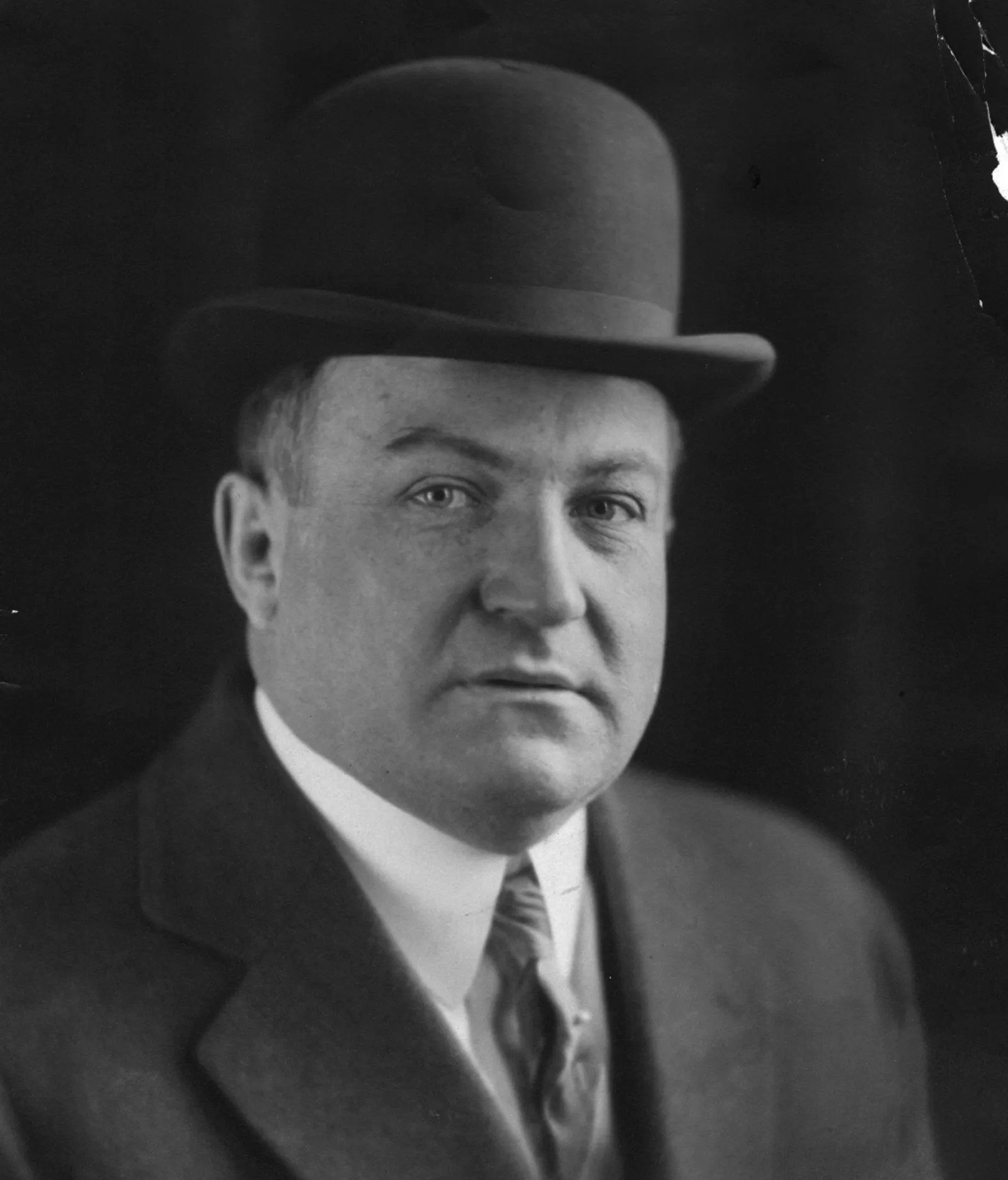
In the tumultuous world of the Roaring Twenties, George Remus stood as a larger-than-life figure; a man whose rise to power and subsequent scandalous downfall epitomized the excesses of the Prohibition era.
The era from 1920 to 1933, known simply as Prohibition, was set in motion by the ratification of the 18th Amendment and its enforcement arm, the National Prohibition Act, commonly called the Volstead Act.
This legislative attempt to eliminate the manufacturing, sale, and transportation of intoxicating liquors arose from decades of social and religious temperance movements. The proponents argued it would reduce crime, abuse, corruption, poverty, and disease.
However, in reality, the paradoxical effect of the law was the creation of a massive and very lucrative black market. It transformed respectable citizens into scofflaws and—more importantly for men like Remus—turned low-level criminals into multi-millionaire magnates.
The scale of the public’s demand for alcohol, combined with a relative lack of enforcement resources, created the perfect economic vacuum for an entrepreneurial mind to exploit, and George Remus was uniquely positioned to answer that call.
Known as the “King of the Bootleggers,” Remus’s career, exploits, extravagant lifestyle, and dramatic end have immortalized him in American history.
Born on November 13, 1876, in Landsberg, Germany, Remus immigrated to the United States with his family in 1882. Settling in Chicago, his early life was marked by hardship. His father’s inability to work, ironically due to his alcoholism, forced the young Remus to work in his uncle’s pharmacy.
By the age of 19, he had earned his pharmacy certification and later pursued a law degree, working in criminal defense. He advocated for social causes and became a reputable and admired member of his community. His unique combination of skills and standing—legal expertise and pharmaceutical knowledge—would later become the foundation of his bootlegging empire.

The Transition to Bootlegging
By the early 1920s, Prohibition had turned the liquor industry into a lucrative underground business. While defending clients in liquor-related cases, Remus recognized a legal loophole: the Volstead Act allowed the sale of bonded liquor for medicinal purposes.
Seizing on this opportunity, he moved to Cincinnati, which just so happened to be located near numerous bonded whiskey warehouses. There, he established his empire, purchasing distilleries and pharmacies to funnel massive quantities of alcohol into the black market.
Remus’s operations were nothing short of genius. He created a massive network that controlled nearly 35% of America’s bonded liquor, amassing an estimated $40 million—over $600,000,000 today–within three years. His organization’s efficiency and scale dwarfed most competitors, earning him the title “King of the Bootleggers.”
The Structure of the Remus System
Remus’s genius wasn’t in just selling illegal liquor; it was the intricate, quasi-legal supply chain he constructed—a sophisticated enterprise that came to be known as the “Remus System.”
He exploited a deliberate ambiguity in the Volstead Act: liquor that had been made before the law took effect could be held in bonded government warehouses and withdrawn for non-beverage purposes, such as medicine.
Remus would purchase small, legitimate distilleries and a portfolio of drug companies. Using forged prescriptions and legitimate permits, his employees would legally withdraw massive shipments of alcohol, which were then diverted in transit.
The key part of this system was the ‘hijack and sale’ model. He organized ‘hi-jackings’ of his own legitimately permitted truck shipments—a spectacle of armed guards and dramatic seizures—which gave the illusion that the liquor had been stolen.
This approach served two purposes: it created a paper trail that obscured the alcohol’s true destination, and it shielded him from direct prosecution for illegal transport.
Once ‘stolen,’ the product was sold through a network of carefully managed speakeasies and distributors across the Midwest, ensuring a controlled price and minimal competition.
With his newfound wealth, Remus adopted a lifestyle befitting his moniker. He purchased a sprawling mansion in Price Hill, Cincinnati, which he called the “Marble Palace.” The estate boasted luxurious features, including opulent furnishings and elaborate gardens.
Remus became famous for hosting legendary parties rivaling the most extravagant celebrations of the Jazz Age. Guests often left with extravagant gifts, such as diamond stickpins, gold watches, or even cars.
The Price Hill estate, more than just a home, served as a headquarters for his public image. The moniker, the “Marble Palace,” was no exaggeration; Remus imported materials and hired artisans to create a showpiece of American excess. The swimming pool alone was legendary, featuring a mosaic bottom and a hidden grotto.
These parties were a deliberate performance, a calculated effort to project unassailable power. He cultivated relationships not just with the wealthy, but with the necessary cogs of the machine: politicians, police chiefs, and journalists, many of whom were guests themselves.
The gifts were not just generous; they were a form of insurance, a way of buying silence, loyalty, and influence. His brazenness was a shield; he operated with the confidence of a man who believed himself above the law, protected by the very officials sworn to uphold it. This high-wire act of public ostentation made his eventual arrest all the more sensational.
George Remus’s larger-than-life persona was central to his mystique during the Prohibition era. George Remus was one of the most successful men of the period, and his behavior and lifestyle drew both admiration and envy–but they also made him a prime target for federal authorities.
Ultimate Betrayal and Revenge
In 1925, George Remus was convicted of violating Prohibition laws and sentenced to two years in the Atlanta Federal Penitentiary. His incarceration marked the beginning of a personal tragedy that eclipsed even his criminal exploits.
While he was imprisoned, his wife, Imogene, began an affair with Franklin Dodge, a federal agent who had previously been involved in investigating Remus. Dodge resigned from his position, and together, he and Imogene conspired to strip Remus of his assets, leaving him nearly penniless. The pair flaunted their betrayal, using Remus’s own wealth to fund their opulent lifestyle.

After his release from prison, George Remus’s personal heartbreak turned to fury. On the morning of October 6, 1927, he confronted his estranged wife, Imogene, in Cincinnati’s Eden Park as she was on her way to finalize their divorce.
In a fit of rage, he shot and killed her in broad daylight. The shocking crime and subsequent trial captivated the nation. The dramatic court proceedings, widely covered in sensational headlines, cemented his notoriety in American history.
Remus’s murder trial was a masterclass in courtroom theater and legal manipulation. Having spent years as a prominent criminal defense attorney—he boasted that he had defended over a thousand murderers before turning to bootlegging—Remus felt that he was uniquely qualified to represent himself.
His defense of “temporary insanity” was highly controversial at the time. Remus claimed that the combination of his wife’s betrayal, the theft of his life savings, and the stress of his imprisonment induced a momentary frenzy that rendered him incapable of distinguishing right from wrong at the moment of the crime.
By all accounts, he thoroughly cross-examined witnesses, leveraged his knowledge of the law of evidence, and used his own tragic story to sway the jury.
Though the temporary insanity defense had existed, Remus’s case popularized it in the American legal landscape, and prompted widespread debate about the nature of criminal responsibility and the power of emotional distress as a legal defense. His acquittal was viewed by many as an example of how wealth and legal acumen could circumvent justice.

The Connection to Jay Gatsby
Speculation persists that F. Scott Fitzgerald drew inspiration for Jay Gatsby from George Remus. Both men shared a penchant for high living, mystery, and wealth tied to illicit activities.
Some historians suggest Fitzgerald encountered Remus during a visit to the Seelbach Hotel in Louisville, Kentucky, where Remus often conducted business. Others point to the thematic similarities between Gatsby’s doomed love for Daisy and Remus’s destructive relationship with Imogene.
While Fitzgerald never explicitly acknowledged Remus as a source, the periods of their time in Louisville match up, as do some striking parallels. Both men lived during a time of economic excess and social upheaval, embodying the pursuit of the American Dream—and its potential to turn into a nightmare. Remus’s grandiose parties and larger-than-life persona make him a compelling real-life counterpart to Fitzgerald’s fictional character.

The parallels extend beyond a shared love of ostentatious parties and a mysterious, illicit source of wealth. Both Remus and Gatsby were largely defined by their singular, all-consuming devotion to an unattainable past—a past embodied by the woman they loved.
Gatsby’s entire criminal enterprise is a mechanism to recapture Daisy, while Remus’s murder of Imogene was the final, desperate act of a man trying to reclaim what he felt was stolen from him: his fortune, his honor, his freedom, and his wife.
In The Great Gatsby, the phrase “he was a bootlegger” is present in the story as the ultimate explanation for his fortune, matching the public’s understanding of Remus. Further, the Seelbach Hotel in Louisville, where Fitzgerald is said to have crossed paths with Remus, features as the location where Daisy marries Tom in the novel.
The connection suggests that Remus was more than just a template for a character; he was a living symbol of the dark, corrupting shadow beneath the surface of the Jazz Age’s dazzling promise. He embodied the fundamental premise of much of Fitzgerald’s work: that the American Dream, when pursued through illegal means and blinding obsession, inevitably leads to self-destruction.
The Cultural Impact of George Remus
Remus’s story is more than a tale of crime and punishment; it is a snapshot of an era defined by contradiction. Prohibition was meant to restore moral order. Instead, it minted millionaires in the shadows and turned men like George Remus into unlikely kings. His empire rose, was made possible, because of the law, not in spite of it.
For a time, he lived as extravagantly as any industrial titan of the age—mansion, servants, imported luxuries—proof that the “noble experiment” had created a marketplace more lucrative than anything it replaced.
And when that empire collapsed, it did so just as dramatically, in gunshots on a Cincinnati street and a courtroom spectacle.
After his acquittal, Remus retreated to Covington, Kentucky. The parties were over. The crowds were gone. He lived quietly until his death in 1952, a far cry from the self-styled “King of the Bootleggers” who once commanded a fortune and a private army of associates.
But Remus did not disappear entirely. His life can be a great topic for examination because it captures something essential about the 1920s: the appetite for excess, the willingness to bend rules, the uneasy dance between law and liberty. Prohibition was meant to dry out the nation. Instead, it revealed how stubbornly human nature resists reform by decree.
In the end, George Remus was neither popular hero nor pure villain. He was a creature of his moment—ambitious, opportunistic, brilliant, reckless. His rise and fall is a case study that when government attempts to legislate morality, it often creates exactly the kind of empire it claims to oppose.
And when the music finally stops, even the king of the bootleggers must step down from the throne.






Leave a Reply