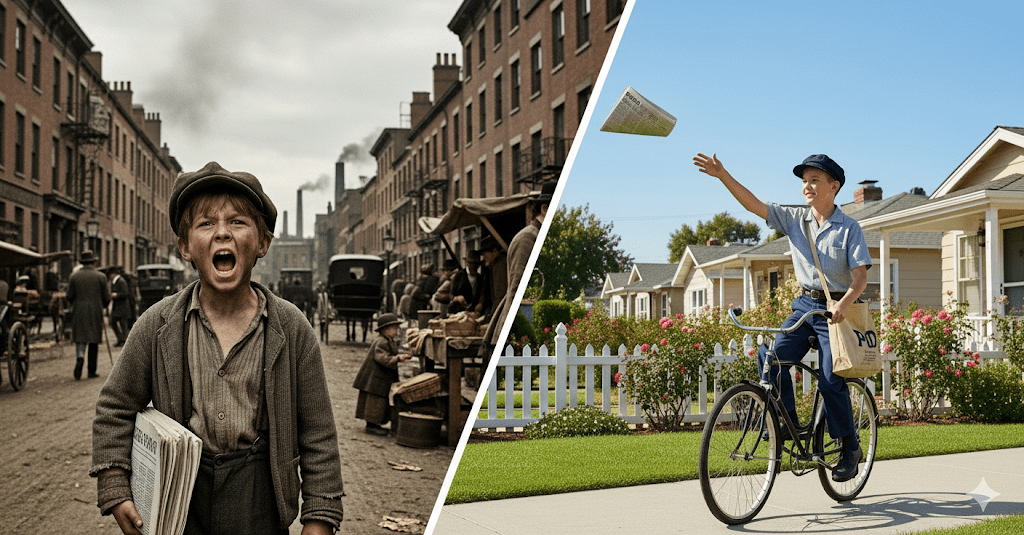
On a crowded, chaotic street in late 19th-century New York, a loud, raspy voice cuts through the clatter of horse-drawn carriages and the noise of the city. “Extra! Extra! Read all about it!” A young, ragged boy, perhaps no older than ten and maybe younger, waves a paper over his head, his face smudged with ink. He’s a newsboy, one of hundreds who made the city streets their office, their voices part of the unofficial urban soundtrack.
A few decades later, the image changes. The sound of a bicycle bell rings on a quiet suburban street, and a clean-cut boy with a canvas bag slung over his shoulder expertly tosses a folded paper onto a porch. He’s the paperboy, and his world is a universe away from the newsie’s.
These two images, the newsboy and the paperboy, are more than just historical footnotes; they are figures that tell a compelling story about the great social and cultural shifts that reshaped America.

The story of the newsboy begins with a revolution in media: the “Penny Press” of the 1830s. Before this time, newspapers were expensive, catering to a small, elite readership of politicians and merchants. But innovations in printing, like the steam-powered press, made mass production cheap, and publishers like Benjamin Day, with his groundbreaking New York Sun, began selling papers for just one cent. This created a new market for news, one that relied on high-volume, single-copy sales to a new, working-class audience.
The task of getting these millions of papers to the masses fell to the newsboys. They were not employees in the traditional sense; they were independent contractors. They bought their bundles from the publishers upfront at a steep discount, usually around 50 cents per 100 papers. If they didn’t sell them, they lost their money. This system put all the financial risk on the backs of children, most of whom were orphans, runaways, or the children of poor immigrants.

Their existence was a daily struggle for survival. The street corner was their territory, a place of fierce competition for the best spots, where colorful slang and sharp wits were as important as a loud voice. They worked from dawn until late at night, often sleeping on sidewalks or in alleys to be close to the newspaper offices when the new editions came out.
They were a subculture unto themselves, with their own hierarchies, their own rules of the road, and their own slang. A “kid” was a younger boy just starting out, while a “boss” was an experienced veteran with the prime corner.

The Newsboy Subculture: Slang and the City
To truly grasp the newsboy’s world is to understand the language and logistics of his daily survival. The boys operated within a highly localized economy, complete with its own rich vocabulary and set of operational rituals. When a newsboy shouted “Fresh off the griddle!” he was not just announcing a new edition; he was using industry slang that referred to the steaming hot plates of the newly invented steam presses. They used terms to define their work and territory: a “route” was not just a path but a fiercely guarded turf, and a “bundle stiff” was a derogatory term for a boy who sold only entire bundles rather than individual papers, thus undercutting single-copy sellers.
The paper itself was often called “the sheet” or “the rag.” This specialized language created a barrier between the street children and the customers they served, reinforcing their identity as an independent, street-wise fraternity.
The start of the newsboy’s day was a chaotic, high-stakes sprint known as the “race for the sheet.” Before dawn, hundreds of boys would gather outside the “Newspaper Row” offices, particularly those of the New York World and the New York Journal, located in the lower Manhattan area. Their lives revolved around the presses in the basements and hauling the massive, freshly printed bundles onto the street.
The first papers off the press held the most value, ensuring the newsboy could reach his prime corner with the newest headlines, often leading to literal fights to be closest to the delivery wagons. The paper offices were not just distribution points; they were often places of temporary shelter, serving as rough-and-ready banks where boys might entrust their earnings to a trusted adult, or even as informal dormitories where the youngest children might sleep on piles of discarded paper to stay warm. This proximity to the source of the news was an ever present example of their place at the bottom of a powerful industrial machine.
While the public sometimes viewed these kids with a sort of sentimental pity, romanticizing them as scrappy, self-made entrepreneurs, the reality was usually brutal. They faced not only poverty but also exploitation, long hours, and the constant threat of violence from older boys, rough customers, and criminals. Their plight caught the attention of social reformers and child welfare advocates.
The situation came to a head in the summer of 1899, in a dramatic showdown that became one of the first successful child labor actions in American history. When publishing titans Joseph Pulitzer and William Randolph Hearst—locked in a vicious “circulation war”—raised the wholesale price of their papers during the Spanish-American War, the newsboys’ already razor-thin profit margins vanished.

The boys organized in opposition. They formed a union, held rallies, and marched through the streets, refusing to sell the boycotted papers. They were a motley crew, with leaders named “Kid Blink” and “Race Track Higgins,” but they were organized and determined. Their strike, which lasted for two weeks, captured the public’s imagination and forced the powerful publishers to compromise. The 1899 strike was not just a victory for the newsboys; it showed that even the most vulnerable workers had power when they stood together.
A New Chapter: The Paperboy and Suburban America
The newsboys’ world, however, was already on borrowed time. The Progressive Era brought a growing awareness of child labor and a push for social reform. Sociologists and journalists, often referred to as “muckrakers,” documented the harsh lives of these children, casting a light on the street economy that exploited them.
Simultaneously, newspapers began to look for more stable and predictable ways to reach their readers. The chaotic, cash-and-carry model of the newsie gave way to a new system that better suited the changing American landscape. As cities reformed and expanded, and as the great wave of post-war suburbanization began, the home delivery model took hold. The shouting newsboy on the street corner faded into the past, replaced by the quieter mobility of a bicycle.
The shift from the newsboy to the paperboy was not just a matter of convenience; it was a direct and necessary response to a monumental change in American geography. In the first half of the 20th century, cities were compact and dense, with people, businesses, and news all packed closely together. The newsboy’s street corner was a perfect hub for this kind of urban living.

But after World War II, America began to sprawl. Fueled by the rise of the automobile and new federal programs like the GI Bill, millions of families moved to the suburbs, exchanging city blocks for sprawling developments of identical houses on tidy lawns.
This new suburban landscape, while a dream for many families, was a logistical nightmare for a newspaper. The old model of cash-and-carry sales was now obsolete. Publishers couldn’t rely on people to drive miles to a street corner to buy a paper. To stay in business, they had to deliver the news directly to their readers’ front doors. This led to a complete overhaul of their distribution and revenue models.

The single-copy sales of the newsboy era were replaced by the reliable, predictable income from subscriptions. The paperboy, with his bicycle and route, became the perfect solution to this “last-mile” delivery problem. He could efficiently cover the wide-open spaces of a suburban neighborhood, ensuring that the paper reached every subscriber on time. The paper route was not just a job; it was an essential piece of a new, sprawling economy.
The paperboy was a different person entirely from the newsie. He was not a street urchin fighting for survival, but typically a boy from a stable, working or middle-class family. The paper route was not a matter of life or death, but a way to earn pocket money for movies, comic books, and candy.
Newspapers, eager to distance themselves from the image of child exploitation, began marketing the job as a “character-building” experience. They promoted it as a way for a boy to learn responsibility, work ethic, punctuality, and financial management. He was responsible for a specific route, for collecting money from his customers, and for making sure every paper landed in the right place, regardless of the weather.

The paperboy became an icon of 20th-century Americana. He appeared in Norman Rockwell paintings, a wholesome figure on a bike, the very image of suburban order and innocence. The paper route was seen as a rite of passage for generations of boys, a first taste of independence and work. It was a physical job—early mornings, long routes, and the occasional threat of a territorial dog—but it was wrapped in a sense of service and responsibility, even nostalgia for the parents of the boys, which was a significant contrast to the newsboy’s desperate hustle.
The sound of a paper thudding on a front porch became the morning soundtrack of suburban neighborhoods across the country. The job taught boys about responsibility and the value of a dollar. They had to wake up before dawn, roll the papers, and navigate their routes in all kinds of weather, from sweltering heat to pouring rain and freezing snow. They learned to deal with cranky customers, manage their collections, and handle their money. It was a genuine first lesson in the world of work and business.
The Last Mile: The Paperboy’s Decline and the Digital Shift
The paperboy, too, eventually became a figure of the past. The same forces that had created him began to push him aside. Routes grew larger as suburbs sprawled, making them too big to be covered by a boy on a bike before school. The rise of car culture meant that adult drivers could cover far more ground in a fraction of the time. Stricter child labor laws and legal and liability concerns for newspaper companies also made it more practical to hire adult carriers.

Even as the paper route began to shrink in practicality, the paperboy’s image flourished during the 1960s and 1970s. The wholesome, predictable image became a powerful tool of nostalgia, even for people who had never lived in a suburb. This figure appeared frequently in American cinema and television, almost always serving as a supporting character who injected a dose of mundane reality or moral innocence into the plot. He was often the neighborhood’s silent observer, the first to spot a mystery, a crime, or a new neighbor, providing a simple, reliable touchstone against which complex adult drama played out. This media portrayal created a romanticized memory of the job that survived long after the actual logistics of delivery had changed.
This period saw the creation of specific tools and routines that defined the paperboy’s life. The canvas shoulder bag, custom-designed to distribute the weight of the bundles and allow easy access while riding a bicycle, was part of the uniform of the job. Furthermore, the art of “the toss,” the practiced flick of the wrist necessary to send a tightly rolled paper accurately onto a porch or into a mailbox while keeping momentum on the bike, became a source of pride and competition among the boys. The disappearance of the paperboy wasn’t just a loss of a job; it was the loss of these small, shared physical rituals that had connected millions of American boys to their first experience of responsibility.
Today, the few remaining adult carriers often drive, and the thud of the paper on the porch—a sound once as familiar as a morning rooster—is nearly extinct, replaced by the silent delivery of digital packets of data.
Most importantly, the rise of the internet and digital news outlets began to dry up demand for the printed paper itself. The job, once so common, is now a rarity, surviving mostly as a nostalgic reference in movies and books. The digital age has largely replaced the physical product. The shared experience of reading the morning paper over coffee has given way to the solitary act of scrolling through a news feed on a phone. The tangible, ink-and-paper connection to the day’s events has been replaced by a constant, fleeting stream of information.
In the end, the stories of the newsboy and the paperboy tell a much larger story about America itself. The newsboy represents an older America—one of raw industry, crowded immigrant cities, and the harsh reality of abject poverty. The paperboy represents a more recent one—of suburban stability, middle-class aspiration, and a certain kind of wholesome innocence.
They are two distinct portraits of how a nation changed—the shout of a child on a grimy street corner and the gentle thud of a newspaper on a quiet front porch. Both are gone, but their images linger, symbols of a world where headlines arrived not by scrolling, but with the voices and footsteps that carried them.




Leave a Reply