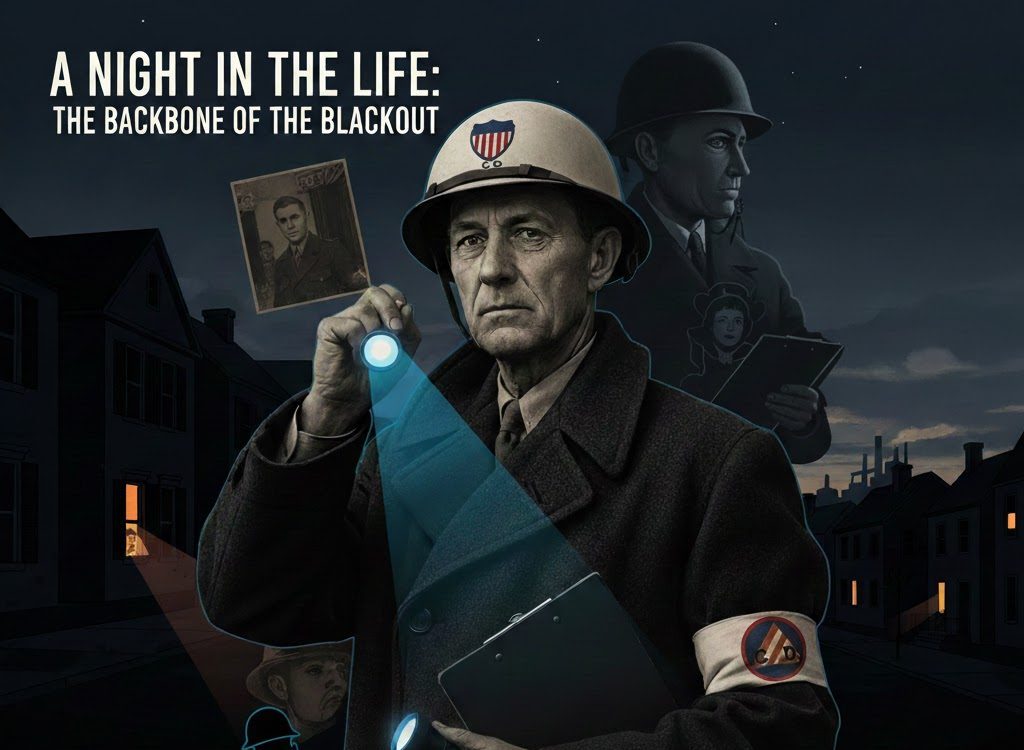
NOTE: In the days after Pearl Harbor, the shock that swept the country was felt most sharply in America’s coastal cities. Rumors of incoming raids, attacks, submarine sightings, and sabotage spread faster than official information could keep up. Entire neighborhoods changed almost instantly from ordinary routines to blackout drills, curfews, and civil-defense alerts. In that sudden, disorienting transition, the air warden became the familiar face at the door—the person who explained new rules, enforced them when needed, and tried to steady communities still reeling from the first week of war. This piece is my attempt to tell their story in those first chaotic days.
Hank Miller pulled the knot of his heavy wool overcoat tight against the evening chill, a habit that felt suddenly necessary in this December darkness. His neighborhood, a stretch of modest bungalows near the shipbuilding yards in California, had always settled into a predictable routine after dinner. Tonight, the routine was broken.
He reached into his pocket and pulled out the newly issued armband, sliding it onto his left sleeve. The band, emblazoned with the bold black letters “A.W.” for Air Warden, felt flimsy, almost too small, like a child’s badge on his arm. At fifty-six, Hank’s frame was wider than it had been when he last wore a uniform, but the habit of pulling a sleeve straight was muscle memory. He’d been a foreman at the municipal waterworks since 1928, a job that kept him on the city’s payroll and in the company of men who appreciated organization. Before that, he’d run a small corner grocery for eight years, getting to know every face and back porch on this block. He knew the sector map drawn on his clipboard by heart—he had practically walked it into the earth for two decades.
He stood just outside the double doors of the local elementary school, which had been pressed into service as the Sector Headquarters for Sector 3. The air smelled of the salt water not far off, but Hank noticed the chill it gave him. It was the sort of duty he always expected to volunteer for someday—perhaps a neighborhood cleanup or a drive for the Red Cross—but never under this sky. Never under the threat of attack.
He checked the rest of his gear. In one pocket, a nickel-plated whistle, bought for him years ago by his late wife as a joke about him being too bossy. In the other, a standard flashlight with a blue filter clipped over the lens, casting a dim, nearly useless halo on the pavement. The clipboard, secured with a rubber band, held the crudely drawn sector map—hand-lettered street names and penciled-in arrows pointing to “First Aid Cache” and “Wardens Post”—and a pamphlet titled What To Do In An Air Raid. He’d skimmed the section on Incendiaries but found the matter-of-fact tone hard to accept.
From inside the temporary post, the radio crackled. It wasn’t the usual music or familiar voice of a local newsman. It was a terse, military tone.
“Sector Three Wardens, be advised. This order comes from the Mayor’s Office via Police Command. Effective 19:30 hours. Blackout in thirty minutes. Repeat: Blackout in thirty minutes. Compliance is mandatory. Report all non-compliance to post coordinator. This is not a drill.”
Hank took a deep, deliberate breath. Outside, his neighbors were moving differently. Their steps were hesitant, their voices low. Mrs. Peterson from three doors down was rushing in from her back yard, and Mr. Cohen, the tailor, was wrestling a heavy sheet of cardboard over his shop window.
A teenage boy, perhaps sixteen, lingered by the school’s main doors, watching Hank. The boy’s face seemed to show contradictory emotions: a curiosity at the sight of the official armband and the quiet command in Hank’s posture. He was waiting for a word, or maybe a sign that everything was actually alright. Hank gave him a short nod, a quiet acknowledgement.
Habit, forged in the confounding disorder of the trenches twenty-three years before, asserted itself. Order. That was the primary thing. Formation. The mind needed something to hold onto when the sky offered only fear. He needed to be steady because everyone else was looking to him to be.
The Older Man’s Duty
The shock of Pearl Harbor on December 7th, 1941, instantly galvanized the nation, but it was felt with a particular, visceral immediacy on the West Coast. The need for a cohesive Civilian Defense structure became critical overnight, especially in communities near ports, factories, and military installations—exactly the types of targets an enemy attack would aim for.
While news of the declaration of war sent young men surging to recruiting offices, the immediate burden of securing the home front fell squarely on the shoulders of men like Hank Miller. The military draft had already been underway, with the oldest registrants generally capped at age forty-five. Furthermore, other men were given draft deferments because they held what were deemed vital civilian jobs in infrastructure, defense manufacturing, or skilled trades.
This system dictated the typical profile of the early Air Warden. They were often men in their late forties, fifties, and sixties. Many were WWI veterans, offering an essential combination of prior military experience, a knack for authority and order, and, importantly, the emotional experience of having already lived through a World War. They were also often retired policemen, firemen, small-business owners, or long-time municipal employees—men whose professional and civic lives had given them an intimate knowledge of their local networks, available resources, the layout of their streets, and the personalities of their neighbors.
These were the men communities trusted. They were familiar faces, known quantities, and they possessed the prior leadership experience necessary to manage panic and obtain compliance.
The Office of Civilian Defense (OCD), established hastily before the attack, had to rapidly recruit and train block wardens. The training was patchy, often consisting of a few evening lectures on basic first aid, fire suppression, and the rules of blackout enforcement. Armed with little more than an armband and a pamphlet, these older volunteers were entrusted with transforming a fearful, disorganized civilian population into an ordered line of defense. They were expected to be, within the space of a few days, both the enforcers of the law and the trusted caregiver of the block.

Reporting to the Civil Defense Post
Hank stepped into the main corridor of the schoolhouse, shedding the cold of the evening air. The space felt less like a classroom and more like the hurriedly organized command center it was. The room had filled with the unmistakable odor of old army blankets.
The room he reported to was the converted sixth-grade science lab. A scatter of older men, all in various stages of buttoning coats milled about. A few others were younger, likely men with family deferments or skilled trade exemptions, their faces a mix of self-consciousness and eagerness. They were swapping small comforts: a crumpled pack of cigarettes passing from hand to hand, a mug of coffee, a sandwich someone had brought from home. It was the air of reluctant camaraderie—men preparing for a duty that felt less like an official job and more like a kind of demanding, necessary service.
Maps were tacked to the portable blackboard. Not the precise city maps of the municipal engineer’s office, but large sheets of butcher paper on which someone had traced the neighborhood streets with charcoal. One corner showed the layout of the old trolley loop, and another, more urgently, had “SHELTER” scrawled next to the boiler room in shaky handwriting. Someone had attempted to indicate the main water valve locations, but the red pencil lines were nearly illegible.
A coordinator—a nervous looking man in his late thirties named Mr. Henderson, who Hank knew as a junior accountant from the bank—rushed over, rubbing his hands together in a gesture of frantic energy. He handed Hank a rudimentary identification card, a piece of thin cardstock with a mimeographed photo, and apologized for the disorganization. “Sorry, Mr. Miller, we just printed these this afternoon. The official city printer is swamped,” Henderson said, his breath catching. “Here’s your ID, please keep it on you. Remember the protocols: firm, but neighborly. We don’t want any friction tonight. The main thing is compliance.”
Hank simply nodded, tucking the card into his coat pocket where it wouldn’t fall out. His eyes scanned the room and settled on a stout man with gray hair arguing quietly with a younger volunteer about the proper way to tie a tourniquet. It was George Wilcox, the owner of the hardware store on the next street over. Hank recognized George not just as a neighbor, but from the 1918 army recruiting drive; they had stood side-by-side in a recruiting line, signing up for that last war shortly before shipping out.
They exchanged a quick nod. There was no need for talk. Both men knew the silent language of having signed up when they didn’t have to, and of being the age that made you the default choice when the kids were leaving, or already gone. They were all here, gathered in the schoolhouse classroom, preparing to shepherd a frightened city through an unpredictable darkness.
Organization and Demographics of Early Posts
The sudden, all-consuming need for civil defense meant that local posts were organized with astonishing speed and necessary ad hoc methods. Across the West Coast, mayors’ offices and police departments quickly designated existing public buildings—fire stations, schoolhouses, libraries, and sometimes even the back room of a large community business—as official Sector Headquarters. This rapid deployment resulted in significant shortages. The government had not been prepared to equip millions of volunteers. Printed instructions were often rudimentary, maps were hand-drawn, and essential equipment like helmets and proper gas masks were either in short supply or entirely unavailable. What defined the early Civil Defense Corps was its self-reliance and the quick deployment of existing community leaders.
The demographics of the early warden corps were dictated by experience and necessity. In the first days after Pearl Harbor, before the massive national organizational efforts ramped up, the posts were heavily represented by older, experienced men, particularly WWI veterans. They had the emotional stability to manage fear, a trait invaluable when addressing panicking neighbors. Their knowledge of organizational procedure, however rudimentary, allowed them to step into leadership roles instantly.
Furthermore, a number of retired firemen, ex-policemen, and union foremen often formed the core of the post leadership, their previous careers giving them both the authority and the practical knowledge needed for emergency response. Their role, as they stood ready that night, was not just to carry out orders, but to serve as a psychological bulwark for their neighborhoods. They had to be the proof that the community structure still held, even when the lights and events around them did not.

The Blackout Order: “Lights Out”
The city dispatcher’s voice, amplified by the radio in the corner of the post, cut through the murmur of the volunteers. “Attention all sectors. Official blackout order issued. Implement immediately. Repeat, lights out now.”
A change went through the room. The casual camaraderie vanished, replaced by purposeful movement. Cigarettes were stubbed out, coffee cups set down. Hank pulled his helmet on, the rough liner a familiar feeling on his head, and adjusted the strap under his chin. His whistle, cold against his lips, was ready. He looked at George Wilcox, who adjusted his own helmet, and headed for the door.
Hank stepped out of the schoolhouse and onto the street. The transformation happened quickly. The familiar glow of the corner lamppost, usually a comforting fixture, died with an audible thwumph, plunging the immediate intersection into darkness. Streetlights across the neighborhood, one by one, cut off in a slow slide, like stars blinking out. The people of the city began holding its breath.
Inside the houses, families fumbled to draw curtains. He could see their hurried shadows through the lace, a silhouette of hands pulling drapes, blankets being pinned over windows. But some lights still glowed stubbornly, squares of yellow behind net curtains or a thin, pulled shade. These were the spots Hank needed to address.
He stepped forward, his boots making a soft crunch on the gravel. His experienced voice carried both command and a neighborly tone. “Lights out, folks! All lights out now. This is the blackout.” His patrol had begun.

Mechanics and Hazards of a Blackout
An official blackout was a dramatic, disorienting event for any city, especially one unaccustomed to enforced darkness. It required every household and business to extinguish or heavily mask all light sources visible from the outside. The goal was to make coastal cities invisible from the air, effectively preventing enemy aircraft from using ground lights for navigation or targeting. The logic was sound, though the efficacy against determined, high-altitude bombing was debatable, especially as navigational technology improved. However, in December 1941, the fear of an immediate, low-level attack or reconnaissance flights was very real.
The hazards it presented to a city unused to such darkness were widespread and serious. Streets and sidewalks became treacherous, especially for pedestrians unfamiliar with every crack in the pavement or every misplaced trash can. Traffic, with mandated hooded or taped headlights that cast only a dim beam downward, became a crawl, increasing the risk of accidents.
Wardens were the front line of enforcement. Their instructions were simple: identify non-compliant homes or businesses and ensure lights were extinguished. They were expected to be polite but firm, balancing their authority as representatives of the Civil Defense with their existing roles as neighbors. While they had no power of arrest, they were to report non-compliance to the police. The true power of the wardens, however, lay in their presence. By moving through the streets, whistling, calling out, and engaging with their citizens to ensure compliance, they projected an image of civic order onto a situation that could otherwise easily descend into chaos. They were the visible guarantors that the community was taking the threat seriously, together.

First Rounds: Order vs. Real People
Hank’s boots carried him down Elm Street, the blue filter of his flashlight casting a small, nearly useless circle of light directly at his feet. The sudden darkness made the neighborhood feel alien, a collection of shapes and low noises where before there had been familiar and clear colors and sounds.
He noticed a glow emanating from the window of Mr. Petrov’s small grocer shop. Hank knew Mr. Petrov well; the man had been supplying him with dried apricots and canned beans for years. He moved up to the doorway and tapped gently on the glass.
Mr. Petrov opened the door just a crack. Inside, a single kerosene lamp sat on the counter, casting light on the cash register. “Mr. Miller,” Petrov whispered, his voice clearly worried. “I can’t put it all out. If I leave the register in complete darkness, someone will slip in and take the day’s earnings. I’ll lose my livelihood if I’m robbed.”
Hank kept his voice low and steady. “I understand, Nick. But we’re under full order. You can’t have any light visible from the street or the sky.” He didn’t argue the point about the risks of robbery; he acknowledged the man’s fear. “Can you move the lamp to the back room, or set it inside a cabinet with the door cracked, just enough for you to see the floor? The light must be blocked from the street.” Petrov nodded, and quickly retreated to find a heavier drape for his small front window. Hank marked the location on his clipboard—Petrov, Grocer. Compliance secured. Check back.
A few doors down, he encountered Mrs. Schmidt, a retired schoolteacher whose house boasted large, beautiful bay windows that were now a severe security risk. She was distraught, trying futilely to pin a thin woolen blanket over a wide pane of glass. Hank saw her trembling. “It’s no use, Henry, I don’t have enough pins, and the glass is too wide.”
He stepped up immediately. “Ma’am, let’s get a few chairs.” He instructed her to hold the blanket high while he found heavy books from her shelf to anchor the bottom edge, using coat hangers he straightened out to secure the fabric at the top corners. His movements showed he was a man used to organizing tasks under pressure. When the last gap was covered, he patted her shoulder.
His most difficult encounter was near the end of his sector. A anxious young man with a military deferment named Timmy, whose wife was recovering from pneumonia, stood on his porch. A porch light, its bulb barely visible through a thick towel taped around it, was still glowing. “I need it, Mr. Miller,” Timmy insisted, standing defensively in the doorway. “My wife is sick. The doctor said if she needs to call an ambulance, I need to keep some light on so they can find the house. I can’t leave her in the pitch black.”
Hank didn’t resort to threats or rules. He negotiated, acknowledging the mans fear. “Tim, no ambulance is moving fast tonight, light or no light. And if a single spot of light gets out, it puts every house on this street in danger.” He looked directly at the young man. “You have your first-aid packet? Get your red cloth and drape it over the lamp inside. I’ll make sure the post knows your wife is ill. But this light, it has to go. Do it for her, not for the rule.” The porch light went out.
Hank continued his rounds, offering short, declarative sentences of reassurance he’d learned in trenches years ago: “Cover the glass. Snuff the light. We’ll see you through.” Neighbors looked to him, the older man in the coat and helmet, for reassurance. To them, Hank wasn’t just enforcing rules; he was embodying the necessary continuity of life.
Authority, Care, and Community Conflict
The role of the air warden, particularly in the initial days of the war, demanded a nuanced application of authority. Wardens were tasked with enforcing a rule that often ran counter to the immediate needs and fears of their neighbors. This required balancing the mandate of Civil Defense with basic care and empathy to avoid alienating the community they were meant to protect.
The conflicts Hank faced were common across all sectors: small-business owners fearing crime or loss of commerce, health concerns that required visibility for emergency services, and general disorientation or lack of resources, which led to mistakes in compliance. The wardens could not simply shout orders; they had to act as impromptu problem solvers. Helping an elderly resident hang a blanket, suggesting a creative solution for a shopkeeper to retain minimal lighting, or calming a distressed family were regular parts of the job, not exceptions.
The social expectations placed on these volunteers were immense. They were seen as both enforcers of the state’s emergency rules and as caregivers for their portion of the city. This required drawing on the capital they had built over years of living and working in the community.
Their authority was not rooted in the armband, but in the fact that they were known, trusted men. When Hank spoke, his neighbors heard the foreman, the business owner, or the former service member—a man who knew their lives and was dedicated to their safety. This duality of command and care was essential to securing compliance and building the necessary social structure for the long war ahead.
Dark Streets and Practical Danger
The complete darkness, intended as a shield against threats from the sky, became a clumsy, dangerous obstacle on the ground. Everything was suddenly awkward.
Hank was halfway down a quiet residential lane when he heard the clatter. A local delivery cart, pulled by a startled horse, had stopped completely in the middle of the street. The driver, a young man who relied on the glow from house lights to navigate his route, was cursing under his breath. The cart’s wheel had caught on a low, unseen obstacle.
It wasn’t a catastrophic event, but it was an immediate obstruction in a neighborhood where emergency traffic might soon need to pass. Hank directed the driver to unhitch the horse and, with the help of two neighbors who emerged from the darkness, they muscled the cart to the curb. It was a tedious, muscle-straining job, performed without proper light.
Moments later, a cry was heard through the stillness. A woman, Mrs. Jenkins from the laundry service, had tripped on the curb while rushing to draw her last window shade. Hank’s blue-filtered flashlight found her on the ground having twisted her ankle. She was more stunned than seriously injured, but she couldn’t stand.
Immediately, Hank mustered the closest neighbors. He organized two men to form a careful seat with their hands and carry her inside from the porch, where the inside light was properly shuttered. He then called in a brief report to the post coordinator on the schoolhouse phone: “Sector 3-A. Sprain or fracture. Local transport required. No rush, but please advise the log.”
He knew the reality: there was no ambulance coming fast. The emergency services were stretched thin, prioritized for the waterfront or the industrial sector. The immediate triage and transport had to be arranged locally. He organized a neighbor with a vehicle to take her, driving slowly, the headlights taped and hooded according to the new law.
He directed a few more motorists, confused by the absent street signs and landmarks, to safe turning points, ensuring they didn’t wander toward the main thoroughfares where official, restricted military and police traffic was moving.
Hank was methodical, calm. He didn’t rush or raise his voice. It was the steadiness of his voice—the clear instruction, the lack of panic—that was the most useful thing in the disorienting dark. It kept people moving instead of freezing in fear, reminding them that their city was still functioning.
Limitations and Improvised Triage
The practical consequences of the mandatory blackout began immediately. Blackouts invariably led to an increase in accidents, falls, and medical emergencies. People were not trained for perpetual darkness, and even familiar surroundings became hazardous.
These early nights of the war showed the limitations of the city’s emergency services. The police, fire departments, and nascent ambulance corps were completely overwhelmed, unable to respond to every injury or domestic incident. This is why the older, experienced men like Hank were so essential. Their utility lay not just in enforcement, but in their ability to organize improvised rescues and triage on the spot.

A WWI veteran, particularly, understood how to assess a sudden crisis, delegate tasks, and maintain a functional chain of command with untrained personnel. They knew how to make do with what they had: knowledge of first aid, finding a makeshift stretcher, using a neighbor’s car as an emergency transport, or securing a site until official help might arrive. The burden of immediate first response fell heavily on the volunteer wardens. They were the essential bridge between a frightened, injured populace and the overtaxed official city services, acting as de facto paramedics and traffic controllers while fulfilling their primary duty of ensuring the lights stayed off.
Personal Confrontation: Authority Tested
The longer Hank walked in the blackout, the more resistance seemed to gather. He found it waiting for him near the main intersection, at a large, brightly lit shop window belonging to the local jeweler, Mr. Harrison. The display, showcasing silver rings and watches, was illuminated by a prominent fixture, blatantly disrupting the surrounding dark.
Hank approached and knocked firmly. Harrison, a man in his mid-forties, opened the door just enough to speak. “Miller, I can’t. Absolutely not,” he hissed. “If I turn out this light, I might as well leave a sign that says, ‘Rob me now.’ The war is far away. We’re safe here.” He attempted to slam the door shut, insisting, “I’ll protect my goods.”
Hank caught the door, his foot preventing it from closing. His voice, usually warm with neighborliness, hardened. He didn’t shout, but the low register carried an authority that surprised. “You will put the light out, Harrison. Now.”
The jeweler leaned in, his face contorted in a sneer of resentment. “Who are you, Miller? You’re just the waterworks foreman in a silly helmet. This is not Europe. You can’t tell me what to do with my property.”
Hank stared at the bright bulbs inside the shop, a symbol of selfishness and potential danger to his neighbors. The argument wasn’t about the jewelry; it was about the line between private interest and communal survival. Hank had seen that line clearly drawn in mud and blood years before.
He spoke, his words measured and quiet, referencing a past he rarely spoke of. “I fought before, Harrison. I’ve seen what happens when one man’s light brings ruin to everyone else.” Hank had been a sergeant in the infantry in 1918. He hadn’t been a hero, just a man ordered to hold a line, but he knew the cost of careless actions. “This is different than protecting your shop window. This is about making sure that if a plane flies over tonight, it sees nothing. If they see your light, they might drop a flare, or worse, and then this entire block burns. Your goods won’t matter then.”
The confrontation defused with the unblinking force of Hank’s sincerity. Harrison saw not just a neighbor in a coat, but man whose eyes held a knowledge he lacked. The jeweler’s face flushed, and he stepped back. “Fine,” he mumbled, and quickly flipped the switch. The window went black.
Later, alone on his rounds, Hank thought of the younger men he knew—sons and nephews who were already shipping out or heading to basic training. They were the future army. He, George, and the others were the immediate guard. His duty here felt complicated: pride in his ability to keep order, sorrow for the reasons they needed him, and a steadfast sense of duty to keep the home front steady while the young went away.
The Emotional Burden of Veteran Wardens
For older men who had served in the first World War, taking up a Civil Defense role in 1941 was an emotionally complex position. They were too old or deemed essential to their current jobs to re-enlist for combat, yet they possessed the exact experience—the organizational skills, commitment to duty, the capacity to stay calm under threat, and the familiarity with command structure—that the home front desperately needed.
They carried the emotional scars of a previous global conflict, and that knowledge was now their tool for civic leadership. When an older warden used his past to enforce the blackout, it carried significant social influence, lending a seriousness to the rules that a younger, untrained person could not replicate.
These veterans did not need to prove anything. Men like Hank were simply the ones who were there—old enough to remember the last war, young enough to still handle responsibility, and familiar enough to the neighborhood to be trusted. No one resented them for serving on the home front instead of in uniform; people took comfort in their presence. Communities understood that different ages carried different duties, and the blackout made those distinctions practical rather than moral.
False Alarm, Real Fear
The silence of the blackout was broken not by the distant city noise, but by a sound Hank knew in his bones: the heavy groan of engines. Low. Too low.
The sound started as a low vibration, growing quickly into an unmistakable rumble overhead. Neighbors, who had retreated behind their curtains, rushed to their doorways and spilled onto the dark sidewalk, craning their necks. Whispers escalated into panicked talk. They were coming.
For a terrifying, adrenaline-fueled moment, Hank felt the sharp, cold rush he hadn’t experienced since the artillery fell short of the wire in France. His old, learned combat reflexes took over. He pulled his whistle to his lips and blew two short, loud blasts—the signal to take cover.
He moved quickly to guide the growing crowd indoors, his voice rising in measured, authoritative phrases. “Inside! Stay calm. Go back to your shelter points.” He didn’t use the word “enemy,” but the fear was palpable.
Then, just as quickly as the fear peaked, the terror began to fade away. The planes didn’t dive; they simply continued their steady path along the coast, their engines suggesting a larger, familiar type of aircraft. A few more knowledgeable neighbors, former mechanics or aviation enthusiasts, started to speak. “Patrol craft,” one man said. “Ours.” The sound faded into the dark and empty sky.
The planes were naval patrol aircraft, likely returning to base or beginning their coastal sweeps. But the shock remained. It was a phantom attack, but the emotional damage was real. People whispered about invasion, exchanging baseless rumors of landings and sabotage they’d heard on the radio or in the newspaper.
Hank stayed on the street for another fifteen minutes, his breathing slowed back to normal. He reminded them of their instructions, speaking softly now: “The all-clear hasn’t sounded. We hold the line.” He didn’t allow them to dwell on the scare. Instead, he gave out small tasks—someone to check the gas valve at the end of the block, another to watch a specific, darkened corner. By giving them small pieces of responsibility, he channeled their residual panic into controlled action. The act of working, even on a small task, was an antidote to the fear of the unknown.
Psychological Residue and Composure
In the early weeks of the war, the coastal cities experienced numerous documented false alarms. These were caused by everything from misinterpreted weather phenomena to the simple inability of civilians to correctly identify friendly military aircraft in the middle of a blackout. Every unusual sound from the sky became a potential threat, and mass hysteria was a constant danger.
This is where the warden’s composure was mission essential. The core instruction given to wardens was to prevent mass stampedes and larger crises that could arise from collective panic. An individual warden, like Hank, became the focal point for the neighborhood’s stability. By reacting to the genuine fear with measured phrases and decisive, non-panicked action, he managed the crowd’s emotional state, preventing a surge of uncontrolled panic or chaos.
The psychological impact of these repeated scares was significant. For the wardens, every incident compounded the stress of their job. They had to internalize their own fear—the old, remembered battlefield adrenaline—and project nothing but calm competence.
The fact that Hank immediately gave out small, practical tasks to his neighbors wasn’t just organizational; it was a psychological tool. It allowed people to regain a sense of control and purpose, giving them something tangible to focus on rather than the terrifying possibility of what might be flying above them. This disciplined routine became the only reliable defense against the mounting shock.
A Domestic Emergency: The Warden as Caregiver
Hours passed, the quiet broken only by the sound of Hank’s breathing and the tap of his flashlight as he checked the remaining houses. He had just finished a sector sweep when a frantic whisper stopped him.
“Mr. Miller! Please, help!”
It was Mrs. Rodriguez, a young mother who lived two blocks over. She stood at her doorway, her face covered with tears. Her youngest child, four-year-old Tomás, was feverish. The blackout had sealed them in, amplifying her fear.
“He’s burning up, Mr. Miller. I gave him the aspirin, but he’s getting worse, and the telephone line is busy. I can’t leave him; I can’t see anything.” Her distress was near total; the national crisis was momentarily reduced to the immediate case of a sick child in the dark.
Hank immediately stepped into the home, his role now a function of practical capability rather than rule-enforcement. He checked the child, his hand resting briefly on the hot, damp forehead. The fever was high, but the child was breathing regularly. He knew the limits of his own basic first-aid training.
He quickly acted, his voice gentle but decisive in the manner of someone who has been in charge before. “Mrs. Rodriguez, we need to keep his fever from spiking. Can you get a clean cloth and some cool water?” While she collected the cold compress, he organized the situation. He remembered seeing Mrs. Allen, an older woman with a steady temperament, just three houses down. He stepped out and quickly fetched her, explaining the situation.
“Mrs. Allen, I need you to stay here. Calm her down. I’m going to the post. The coordinator has a list of doctors who are available tonight.”
Hank returned to the post, navigating the dark streets and quickly secured the number of Dr. Jensen, a retired physician whose name was scribbled in the back of the post’s logbook. He then asked Mrs. Allen to take the child to the doctor’s house.
When he returned to the Rodriguez home to confirm the arrangements, the mother watched him with exhausted eyes. In her moment of deepest fear, this man—the waterworks foreman wearing a military helmet—had provided not just help, but efficient care when needed. He represented the backbone of the neighborhood. His care wasn’t dramatic, but it was effective. In that moment, Hank Miller was exactly what the home front required.

The Warden as Domestic Support
The duties of air wardens routinely extended beyond simply enforcing the blackout or directing traffic. In the confusion of the initial days, and with official emergency services overwhelmed, wardens frequently stepped into domestic and medical support roles. They were the most readily available resource, stationed right in the neighborhood.
This required them to leverage that earned community trust. A neighbor would ask a known shopkeeper or foreman for help in a way they often wouldn’t ask a policeman they didn’t know. This trust was built through these small instances: fetching a doctor’s number, arranging transport, or simply comforting a distraught parent.
For communities, the warden became an essential link in the social fabric. His function required him to maintain order on the street and inside the homes, blurring the line between civic authority and neighborly care. The ability of these men, drawing on decades of experience raising families, managing employees, or running businesses, to handle these varied crises showed why they were entrusted with custody of the block. Their competence in these moments cemented their role as the true local leaders during the hours of darkness.
The Long First Night
The middle hours of the blackout are the hardest. The immediate adrenaline has long gone, replaced by a grinding fatigue. The cold had seeped past Hank’s thick overcoat and was settling in his knees and the small of his back. He walked his sector again, his steps the only sound in the quiet city. He checked the windows—Petrov’s Grocer, Harrison’s Jewelry, the Rodriguez house—ensuring no sliver of light had escaped as families settled in for the night.
He paused near the small granite plaque cemented into the wall of the public library, a memorial dedicated to the local boys lost in the Great War. He didn’t need to read the names; he knew most of them. The sudden change of the day made the past feel unexpectedly close. He had been twenty-two then, holding a rifle in the muddy darkness outside a French wood. The terror was different then—loud and chaotic. This terror was silent, widespread. Instead of being a continent away, this threat was at home.
An image of WWI flashed in his mind: the sound of a gas alarm, the desperate scrambling for his mask. That image was quickly overlaid by the memory of the two heavy, unused gas masks sitting in a cabinet in his hall closet at home, issued by the city last week. He hadn’t even opened the boxes. He moved on, shaking the memory off.
He was tired, but he kept moving. Routine was his armor against the fear and fatigue. As a foreman, he knew the importance of the shift change, the inspection, the continuous movement that prevented complacency and error.
He thought of the sons, husbands, nephews, and neighborhood boys now at training camps in Texas and the Carolinas. Young, eager, and wholly unprepared for the reality of war. He was here because they would not be. His work was their surety; his pacing was a guarantee that the home they would eventually return to remained whole and functioning. His work tonight, he thought, felt less like a new job and more like the continuation of a previous one.
War Memory and Therapeutic Routine
For men of Hank’s generation, the events of December 1941 were strongly evocative of the first World War. The immediate need for home-front defense, the separation from young men going to the front, and the civic language of “duty” and “service” all were familiar remnants of their past. The sudden requirement to wear a uniform and enforce order was not a wholly new experience, but a strangely familiar one.
For many older men, the structure and routine of wardening became a therapeutic mechanism. When faced with national shock and fear, the practical requirements of patrolling a sector, checking lights, and organizing neighbors provided a focus. It was a tangible way to process the massive, overwhelming crisis. Like the neighbors he would task with small responsibilities, the methodical action served as a psychological defense, channeling anxiety into useful labor.
The interlink of the two wars was a powerful motivator. By serving on the home front, they felt they were applying lessons learned long ago to protect a new generation. They understood that the physical labor of keeping the community functioning—managing small crises and keeping the peace—was a critical starting point before any action could be taken thousands of miles away. The long night’s routine became a way for the old soldier to again secure the stability of his world.

A Child Found, A Rescue Managed
The long night was wearing thin, closer now to the pre-dawn hours than midnight. Hank was making his final, methodical pass along the quieter, unlit alleys between the row houses when he heard it—a soft cry from somewhere nearby.
He stopped, listened for signs of trouble in the dark. He angled his dim, blue beam toward a gap between Mrs. O’Connell’s fence and Mr. Rossi’s detached garage. There, curled near a collection of trash cans, was a small boy, perhaps five or six, shivering and crying. He must have wandered out while his parents were asleep or distracted, lost in the confusing, total darkness.
Hank approached slowly, his voice dropping to a gentle, non-threatening tone. “Hey there, son. Where’s your house?”
The boy only cried harder, clinging to his sleeve. Hank scooped the child into his arms. The boy was tiny and light, and Hank felt him shaking. Hank held him against his heavy coat, the small boy an immediate responsibility against the backdrop of the massive threat of war.
It took only a few minutes to trace the boy back to his home, guided by a frantic woman’s voice whispering the child’s name into the darkness. When he presented the boy, safe and sound, to his frantic parents, they dissolved in a rush of relief and gratitude. The father, speechless, simply grabbed and held on to Hank’s shoulder, a gesture that communicated more than a dozen flowery speeches.
It was a small rescue. No bombs had fallen and no fires had started. As Hank walked away, he could hear the talk spreading down the block. Neighbors peering out through small curtain cracks, exchanging the news—The Warden found Billy. He brought him home. Everyone on the block treated the recovery of the lost child as if a much larger crisis had been averted. The successful retrieval, the reunification of a frightened family, felt like a noteworthy victory against the general chaos of the war’s beginning.
Hank shrugged off the appreciation when a woman offered him a thermos of coffee, but he carried the thought of getting the boy back with his parents for a moment longer. It was a reminder of what he was actually defending.
Social Capital and Goodwill
The mundane realities of civil defense—lost children, small falls, fire prevention, traffic direction, forgotten instructions—were as important as the preparation for catastrophic events. These everyday rescues served an invaluable purpose beyond the results: they built goodwill and solidified the legitimacy of the entire volunteer movement.
In these instances, the warden transitioned from being an enforcer of inconvenient rules to being a local hero. By performing necessary, practical acts of care in the darkness, the volunteers generated social capital. Neighbors were more likely to comply with blackout rules, report issues, and trust the guidance of the wardens because they had seen firsthand the competence and personal commitment of the man wearing the armband.
The effectiveness of the warden corps rested largely on this mutual relationship of trust. The service was often practical and highly localized, confirming the neighborhood’s faith in its own ability to function, even under the stress of war. These successful small events—the return of a child, the quick triage of a sprain—provided concrete proof that the civic fabric was strong.
The All-Clear and the Quiet After
The waiting was the hardest part. Just when the exhaustion was at its peak, the signal came. Faintly at first, carried on the damp morning air, the long note of the all-clear siren began its ascent. It wasn’t a pleasant sound, but it was the sound of permission for the neighborhood to breathe again.
The transition from absolute blackness was slow and often cautious. Neighbors peered out of their doors, not throwing them open, but cracking them just enough to exchange news and compare rumors across the street. A few lights came up, illuminating windows that had been dark patches for hours. The light, after the long, intense darkness, felt aggressive, unfamiliar.
Hank stood on the curb, his helmet still on, his hands in his pockets. The muscles in his neck were tight, and the ache in his knees had become steady. He let out a deep breath he hadn’t known he’d been holding since the sound of the patrol planes passed overhead.
He walked back to the schoolhouse, joining the low stream of other wardens moving toward the post. They exchanged a few words with each other—short phrases like, “Quiet night, mostly,” or, “Got a little frisky on Chestnut, but settled it.” There was no formal debriefing, no lengthy account of their problems or their successes. The exchange was a brief check-in—a verification that everyone was in one piece and the sector was secured. It was almost a kind of informal therapy, where silence communicated more than words.
Hank signed the log, noting the non-compliance issues he’d addressed, the ankle sprain, and the sick and returned children. He handed his helmet and clipboard to the coordinator, who looked just as drained. Then, he walked the final blocks home.
He walked to a house where his domestic life was waiting to be resumed, albeit in an altered form. He wasn’t walking into a grand victory parade; just his front door.
Processing the Night and Building Routines
The all-clear was always a moment of relief, but it was also a transition back to a new, uncertain normal. Communities processed the event by exchanging information, talking about their shared experience, and testing the limits of safety before fully resuming their routines. The caution in turning on the lights was a result of the psychological impact of the threat.
For the wardens, the transition was abrupt. There was a notable lack of formal debriefing or support provided to these volunteers in the early days of the war. They were simply expected to return to their civilian lives—to the foreman job, the grocery counter, the retired routine—and carry the night with them. This reinforced the need for the informal support structures they created themselves, like social, low-key check-ins with fellow wardens.
The repetition of these blackouts—which would continue sporadically throughout the early war years—began to produce steadying routines. What started as chaos quickly became protocol. Every time the lights went out and were brought back up without disaster, the neighborhood bonds grew tighter, and the collective confidence in the local wardens deepened.
With time, blackouts became an excuse for neighborhood gatherings. The fear and the flare-ups faded. Wardens no longer had to push for compliance. It had become an organized effort carried out together, due in no small part to the work of the air wardens in the earliest hours of the war. The experience solidified the community’s belief that they could, together, endure the threat.
Home, Habit, and Duty
Hank closed the front door behind him. He left his heavy overcoat in the hall, the removed weight immediately easing the strain on his tired shoulders. The house was cold and still.
He sat at his kitchen table, rubbing the ache in his knees and the tight muscles in his calves. The national news could be heard from the living room radio. The announcer was detailing shipping losses in the Pacific—statistics and names of faraway places that seemed impossible to picture after a night spent focused solely on the few hundred yards of Elm Street.
He pulled the warden pamphlet, What To Do When The Bombs Fall, from his coat pocket. He put it into the top drawer of the old oak dresser. Lying there were his WWI service medals—the Victory Medal and a French Fourragère—resting on a faded photograph of him and his company smiling before a push in the Argonne Forest. The pamphlet now shared the drawer with the proof of his first war.
He wasn’t a hero in the regular sense. He hadn’t sunk a destroyer or piloted a fighter. But as he sat, the sense of purpose was there, overriding the fear and the exhaustion. He knew he’d be back on duty tomorrow night, or the night after, whenever the siren demanded.
His effort was the backbone of the community, the neighborhood’s uncelebrated defender. The young men could fight overseas because older men like him were here, keeping the ground steady beneath their family’s feet. The war wasn’t just on the ships; it was on the streets, and it required a different kind of service.
Generational Character and the Home Front
The early volunteers of the Civil Defense Corps embodied a specific generational character. They were the survivors of one global conflict and the established civic leaders of the interim peace. Their presence was essential to maintaining the civic fabric while the young generation was mobilized for global combat.
These men, and later, women, brought a maturity and institutional memory that no rapid training course could instill. They knew how things worked: how to talk to a hesitant neighbor, how to use a tool to fix a problem, and, most importantly, how to maintain discipline when fear was rampant.
Their stories reshape our vision of the home front. It wasn’t solely defined by youthful sacrifice and factory labor, but by the experienced efforts of those who kept communities functioning. The service of these men, often performed out of the spotlight and between shifts at their regular jobs, was a necessary and unglamorous sacrifice. It ensured that the essential machinery of local life—safety, order, medical aid, and simple human reassurance—remained intact.
The Loyal Soldier of the Home Front
The story of the West Coast blackout, particularly in those charged, fearful weeks after Pearl Harbor, is often told through the lens of national preparedness and federal directives. But the reality of that defense rested on the shoulders of men like Hank Miller.
The old soldier, the waterworks foreman, the retired fireman—they became the home front’s muscle and its conscience. They were asked to take their localized knowledge of a the community and apply it against an existential threat.
Their service was rarely dramatic, but it was a practical, and moral service. It was found in the negotiation with a frightened shopkeeper, their guiding an ambulance, the returning of a child to his parents. They did not engage in grand acts of heroism; they engaged in systematic competence. They understood that in moments of civic stress, the greatest need is not for flair, but for the dependable continuity of familiar, trusted figures.
In telling this story, my hope was to reveal a more textured home-front narrative. We see that age and experience were not liabilities, but a kind of essential, necessary toolbox that served as ballast against the storm. They provided the framework of order and safety that allowed the rest of the country to absorb the shock and turn its attention outward. Men like Hank Miller, walking alone in the pitch black of his neighborhood, encouraging and checking on his neighbors, was the embodiment of that enduring, uncelebrated commitment.




Leave a Reply