As far back as I can remember, my grandparents didn’t trust banks. They never explained it in detail, and I didn’t ask. It wasn’t bitterness or ideology; it was habit. Money was kept close. Debt was avoided like the plague. Banks were used when necessary, but never enthusiastically.
For years, I assumed that distrust came from a single moment—the collapse during the Great Depression. A sudden failure, a dramatic loss, a financial betrayal, a lesson learned all at once. That’s how we tend to remember disasters: dramatically, loud.
But that isn’t what happened.
There was no single day when America’s banks failed. There was no single event when confidence vanished overnight. What people lived through instead was slower and, in many ways, worse—a series of failures stretched across three long winters, each one eroding trust a little more than the last.
By the time the crisis finally ended in the spring of 1933, the damage had already been done. Banks reopened. Money returned. But trust did not. For many Americans, including my grandparents, trust in banks had frozen during those winters and never fully thawed.
This is the story of how that happened—not with one single, dramatic crash, but in the cold of January.
Winter 1930: “That’s Somewhere Else”
The stock market had its reckoning in the autumn of 1929, a theatrical, city-bound collapse that, for a few weeks, dominated the headlines and the worries of the metropolitan upper class.
But for most of the country—for the men working the cotton fields of Alabama, the women keeping the books in a hardware store in Iowa, the families settled along the quiet rail lines—the great crash felt distant, a problem confined to the canyons of Wall Street.
It was a failure of speculation, a penalty on the greedy, not a threat to the solid, reliable structure of the local savings bank, which had sat on the corner of Main and Elm for forty years.
That first winter after the crash was strange for many. The worry wasn’t some wave of panic. It was just a scattering of small, isolated tremors. The trouble began in the places already fragile: the rural banks, which were essentially collateral for the farms they served. They were sunk by bad crops, falling grain prices, and failing mortgages, not high finance.
When a bank failed in a county seat like Marion, Arkansas, or in some small, one-industry town where the factory had just laid off half its men, the news was received with a kind of sad, distant pity. It was a tragedy for them—for the agricultural customer, the overextended community—but not for us.
The local paper in Louisville or St. Louis might run a small item on page six: “County Bank Shuts Doors.” The citizens of the larger towns would read it, maybe pause for a moment, and then continue buttering their toast. They had a relationship with their own banker, a man often known by his first name, a lodge brother, a man who saw their faces every week.
That familiarity was their guarantee. “Our bank is sound,” they’d tell one another, perhaps a little too quickly, standing on the sidewalk after church. “They’re not involved in that speculative nonsense. That’s a country problem.”
The lack of deposit insurance was not an active anxiety; it was an invisible issue that no one thought about. If you never considered the possibility of the bank vanishing, why would you consider what protected your money if it did?
The trust they held was personal, a comfort that was a part of the fabric of small-town life. It wasn’t built on federal safeguards or regulatory oversight; it was built on having played poker with the bank president, on seeing him at the grocery store, on the solid oak of the lobby desk. The faith was rooted in what they could see and touch.
But the failures, however small and regional, were persistent. The news of a closing in December was followed by another in January, and then a pair in February. Each isolated event was a drop of water in the bucket, slowly raising the level of uneasiness, even in the solid cities. The pattern was subtle, easy to dismiss on any single day, but impossible to deny over the course of the long, dreary season.
By the time the grip of that first winter finally loosened, the expected return to normalcy had not arrived. The snow melted, the fields began to thaw, relentless failure of banks in the distance had established a new reality: the trouble hadn’t been contained. It was everywhere, waiting.

Winter 1931: “Closer to Home”
The second winter changed the texture of the problem. The distant dismissal of 1930 was replaced by an anxiety that permeated the cities. What had been a crisis of the countryside now began to gnaw at the edges of urban confidence.
In 1931, the failures accelerated, both in number and proximity, becoming too frequent and too near to ignore. When a state-chartered bank in a large industrial center began to wobble, the narrative of isolated, agricultural misfortune finally collapsed.
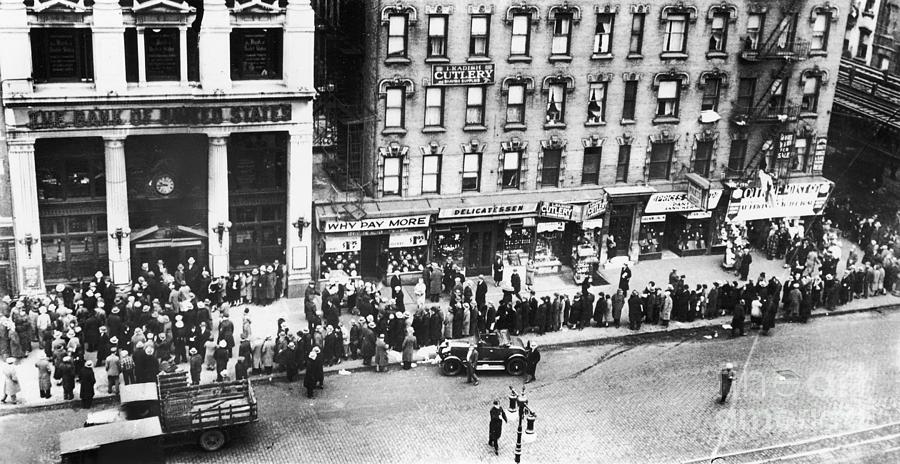
People didn’t run to the banks in full-blown hysterics; not at first. They went cautiously. The lines that started to form outside the polished brass doors were born of a fatalistic kind of foresight more than panic. The rumor of trouble one town over—the sight of a sign taped to the door of a bank branch a mile away—triggered an instinct: take out a fraction. “Just enough to cover the coal bill,” a husband would instruct his wife. “Just a little cushion, until things settle.”
This act of caution, repeated by thousands, was a kind of self-fulfilling prophecy, and it proved just as deadly as pure panic. Banks, even the sound ones, operated on the assumption that only a small portion of their assets would ever be requested in cash at any given moment. They invested the rest.
When large numbers of depositors began withdrawing just twenty or thirty percent of their savings simultaneously—not because they believed the bank was bad, but because they feared their neighbors might panic—the bank’s liquid cash reserves vanished.
The institution might be perfectly solvent, holding millions in solid loans and securities, but was suddenly unable to meet the daily demand for paper money. It was cash-poor, caught in a trap where solvency meant nothing against the immediate need for currency.
The fear, then, became contagious. The system was now vulnerable to rumor more than to reality. A whispered, unfounded concern at a bus stop about a bank’s holdings could empty its vault by noon. What mattered wasn’t the bank’s balance sheet, but the public’s belief in its neighbors’ belief in the bank.
And winter itself was an unrelenting character in this drama. It was the season when cash was an absolute, immediate necessity. The costs of heating a home—coal, wood, oil—could not be deferred. Unemployment figures were climbing, meaning fewer new dollars coming in, and only old savings to rely on.
People weren’t pulling out money to buy futures; they were pulling it out to keep the pipes from freezing and to keep their children fed. The chilling cold heightened the stakes, turning the abstract “financial crisis” into the concrete threat of a freezing house.
The trust that broke this year was no longer vague or about the market; it was personal. When a man stood in a line outside his own neighborhood bank, watching the bank teller count out bills with an air of strained politeness, he wasn’t just worried about his money. He was witnessing the possible failure of a system he had always been told was impervious.
The sense began to spread that it wasn’t just individual banks that were fragile, but the very mechanism and structure of currency exchange itself. Society functioned based on that structure, and now it was clearly buckling.

Winter 1932–33: “The Freeze”
By the time the third winter arrived, the slow, creeping anxiety had given way to a kind of national emotional exhaustion. Fear was no longer a surge of adrenaline, but a routine and predictable feature of everyday lives.
The crisis had passed the point of being about bad lending practices or poor investments; it was now a total crisis of faith. Banks were failing simply because every person knew, deep down, that every other person was going to try to pull their money out. The expectation of failure had become the cause of it.
Across the country, the machinery of finance began to seize up. The winter of 1932 into 1933 became the era of the “bank holiday.” These weren’t festive, government-declared breaks; they were frantic, desperate measures taken by state governors to stem the bleeding. The logic was simple enough: if we prevent people from withdrawing cash for a few days, the panic might subside, and the bank might survive. States began to close their banks preemptively, before the money could leave, sometimes for days, sometimes for weeks.
What this created was an emotional and practical void. Imagine an entire state—Michigan was an early example—waking up one morning to find that every bank, every financial institution, was locked. No cash could be deposited, and none could be withdrawn. Paychecks were worthless pieces of paper. Businesses couldn’t make change. The entire function of the market, which relies on the fluidity of money, simply stopped.
Cash hoarding became the survival strategy of necessity. If you couldn’t trust the bank to hold your money, you held it yourself. Mattresses, coffee cans, Bible drawers—these became the new vaults.
The scarcity of currency grew so intense that communities reverted to barter, or they issued temporary local scrip, homemade money that was only good within a limited geographic radius. These small pieces of stamped paper and printed tickets were a kind of tombstone for the death of the nation’s unified economic confidence.
The feeling of the country had shifted from panic to resignation. People stopped rushing and started waiting. The sense of urgency gave way to a numb uncertainty. They had fought the failures of 1930, feared the failures of 1931, and now they simply endured the paralysis of 1932.
The terrible realization that set in was this: the crisis wasn’t confined to the greedy, or the careless, or even the simply unfortunate. The crisis was rooted in the system they had been told was solid. The local bank, which they had trusted as a fixture, was proving to be as temporary as anything else.
By February 1933, the country was not just in a depression; it was in a state of financial paralysis. Thousands of banks had already failed, and those that remained open were often operating under tight restrictions.
People had the overwhelming and unsettling feeling of living in a country without money, a place where the basic mechanisms of commerce had simply ceased to function. The nation was waiting, uncertain and numb, for something to break the failed, endless cycle.

March 1933: “Everything Closed”
The end of the Freeze arrived with the inauguration of Franklin D. Roosevelt on March 4, 1933. The previous day had seen a rush of financial desperation, as people attempted a last-ditch effort to pull their savings out before the incoming administration took action. By the morning of the inauguration, over half the states in the Union had declared some form of bank holiday, meaning the American economy was already more or less shut down.
Roosevelt’s first, most extraordinary action was to nationalize the paralysis. Within hours of taking office, he declared a nationwide bank holiday—a complete, total closure of every bank in the United States. No exceptions.
Again, this is a remarkable thing to imagine. No banks, anywhere, were open for business. If you had twenty dollars in your pocket, that was all the cash you had. This was an act of radical surgery, a desperate attempt to stop the systemic hemorrhage of money and confidence.
People didn’t fully grasp what it meant, only that every vault was sealed and the system was completely inaccessible. It was a frightening experience, but for many, beneath the fear lay a sliver of relief: at least the relentless, daily drain had finally been stopped by decree.
The sheer radicalism of the move cannot be overstated. The government had, in essence, suspended the nation’s monetary system, betting everything on the idea that the problem wasn’t a lack of money, but a lack of belief. The gamble was that if the government took control and certified the integrity of the banks, the confidence would return, and the cash would flow out of the mattresses and back into the vaults.
Over the next few days, a massive, unprecedented inspection effort began. Teams of federal regulators and examiners descended upon the nation’s banks, reviewing ledgers and liquidity. The plan was to reopen the banks in three waves: those that were unquestionably sound would open first; those that needed minor restructuring would open second; and the hopelessly insolvent would be shuttered permanently.
When the first wave of certified “sound” banks finally reopened—starting on March 13th—the feeling was overwhelming nervousness. People stood outside, wary, waiting to see what others would do. Would they rush in and drain the banks again? Or would they tentatively put their money back in?
The difference was the government’s guarantee, delivered over the radio by Roosevelt himself. His calm, conversational “fireside chat” about the banking system assured the public that any bank reopening was now backed by the full faith of the federal government.
The fear was not entirely dispelled, but the immediate crisis passed. People deposited more money than they withdrew. The system had begun to breathe again. What emerged was the birth of federal guarantees—the mechanism that would eventually become the Federal Deposit Insurance Corporation (FDIC).
This was a cautious relief, not a celebration. A fundamental change had occurred: trust was no longer local, residing in the character of the banker, but institutional, placed in the hands of the government.
“The Banks Reopened. Trust Did Not.”
The banks reopened, the panic subsided, and the financial structure was officially stabilized. But the behavior of the American people, influenced by three long, cold winters of watching institutions fail, was permanently altered.
The crisis had provided a devastating lesson: the system could, and did, simply stop working. This fact burrowed itself deep into the collective memory, long outlasting the official proclamation of recovery.
Many people never fully returned their savings to the banking system. They had witnessed friends, neighbors, and family members lose everything—not through poor investment, but through their trust in a local institution that proved vulnerable. This memory became a kind of remembered wisdom, a hard truth passed down.
The evidence of this lasting change could be seen in the practical, private rituals of household finance. The old envelope system—where cash was physically divided into labeled envelopes for “Rent,” “Food,” and “Coal”—made a lasting comeback.
It wasn’t about budgeting; it was about immediacy and family safety. The cash hidden at home, beneath floorboards or in canning jars, was now a sign of caution, not criminality. It represented the emergency fund that could not be sealed off by government decree.
Those who did return to the banks were cautious, forever looking over their shoulders. They maintained smaller balances, favoring liquidity over interest. They became suspicious of anything too complex or too far removed from the tangible local community.
Loyalty became fixed to a single, local bank that had somehow survived or been restructured, often out of a sense of gratitude or personal insight and connection, not just convenience.
The experience of the early 1930s became a generational hallmark, a lesson taught through habits, not words. By the time my grandparents were raising families of their own, the lesson had already hardened into their norm. Grandparents and parents who lived through the “Freeze” exhibited a financial conservatism that seemed mystifying to later generations. They saved meticulously, mistrusted credit, and kept a sizable amount of physical cash on hand, often without explaining why.
The reason was simply embedded in the cold memory of 1932: that moment when the money in the bank became inaccessible. The fear was remembered as wisdom, a lesson learned.

What Winter Taught Them
The story of the Great Depression’s banking crisis is not one rapid, cinematic collapse, but of a slow, agonizing erosion. It took three winters for the idea of failure to move from the abstract farm towns to the crowded city streets, and finally, into the core assumption of American life.
The experience taught a nation that security was an illusion, maintained only by collective belief, and that when belief failed, even the seemingly most solid institutions would buckle and fail.
The distrust that followed was rational. It was the long-term consequence of witnessing the total systemic failure of a foundational promise. The American people saw their government take the radical step of shutting down every bank. That act, while necessary, was an admission that the system was, at its core, vulnerable.
The shadows of those winters stretched across the decades. The habits of hoarding, the skepticism toward financial institutions, and the preference for tangible assets were passed down through generations.
These were not eccentricities; they were survival mechanisms learned during a time when the difference between cash in hand and a number in a ledger could be the difference between heating your home and going cold.
The banks reopened, guarded now by the federal guarantee. But trust, once broken, is never fully repaired by a simple government seal. It requires decades of stability to restore what was lost in three winters. That experience left an indelible mark: nothing financial is ever truly safe, and sometimes, the only thing you can truly rely on is the currency in your pocket.







Leave a Reply