
It is 1937. Pick a house, any house in working-class America, and the odds are good you’ll find one in some version of the same condition. The furniture is modest. The walls could use paint. Dinner was whatever was affordable, stretched as far as it would go.
The man of the house has probably spent the day doing something that used his back more than his mind, assuming he had work at all. The Depression hasn’t loosened its grip. It has only, in some places, begun to pretend it might.
But it is Monday night, and that changes things.
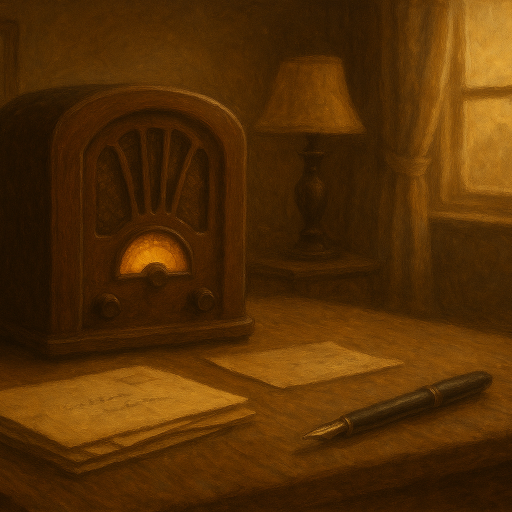
The radio sits in the front room like it owns the place. For a lot of families, it might as well. By 1937, roughly three-quarters of American homes have one. It wasn’t always that way; a decade earlier, radio was a curiosity, something for tinkerers and enthusiasts.
Now it is a fixture and a lifeline rolled into one wooden cabinet. It is the newspapers and the concert hall, the comedy club and the church social, all broadcasting from the same dial. For a country that can’t always afford any of those things, that matters more than it’s easy to say.
At nine o’clock, something comes through the speaker that stops the room.
An announcer’s voice, polished and certain, cuts through the static: Ladies and gentlemen, Lux presents Hollywood. And then, an orchestra. A full orchestra, strings and brass, filling whatever room the family has arranged itself in for the evening.
In a moment, someone the listener recognizes, someone they’ve seen on a marquee, or in a magazine, or in the rare and special circumstance of an actual trip to the picture house, is going to speak. Right here. In this room. For free.
Think about what that meant. A movie ticket in 1937 cost a quarter. That doesn’t sound like much until you understand that a quarter, to the family in that house, was a considerable expense. Going to the pictures was an impactful decision, not a habit.
Hollywood was a place that existed in photographs and gossip columns; glamorous and faintly unreal. The stars who populated it were something closer to mythology than to people.
Lux Radio Theatre removed that distance every Monday night. It handed forty million Americans something they had not been offered before: direct access to the stories and the stars, delivered through the air and into the home at no cost beyond the price of the radio already sitting in the corner.
Nobody planned it as an act of generosity. That’s not how it worked, and we’ll get to that. But intentions don’t always determine outcomes. What Lever Brothers and J. Walter Thompson and Cecil B. DeMille built, whatever their reasons, was the closest thing the era had to a genuine democratic art form.
Forty million people. Same Monday night. Same signal. Same Humphrey Bogart, same Barbara Stanwyck, same full orchestra swelling between acts.
The family in that house didn’t know or care how the machinery worked. They knew the radio was on, and Hollywood had come to them.
The Man at the Microphone
Hollywood, June 1, 1936. The Music Box Theatre on Wilshire Boulevard is sold out for a radio broadcast, which tells you something about the era.
Cecil B. DeMille has just taken over as host of Lux Radio Theatre, and the first thing he’s doing with the job is putting Marlene Dietrich and Clark Gable at the microphone for an adaptation of Morocco.
The show costs $17,000 for a single hour. DeMille takes $2,000 of that. Dietrich gets $5,000. Gable, the biggest male box office draw in Hollywood, gets $3,500; less than the woman beside him, a fact nobody seems to have made much of at the time.
DeMille is fifty-four years old and already a monument. He has been making movies since 1914, when he directed Hollywood’s first feature-length picture in a rented barn in what was then a quiet suburb of Los Angeles.
In the decades since, he has built the kind of career that stops being measured in individual films and starts being measured in cultural impact. Epic is the word most people reach for, and it fits: The Ten Commandments, The King of Kings, Cleopatra, Union Pacific, pictures on a scale that made other directors feel like they were working in miniature.
By 1936, the name DeMille doesn’t just mean movies. It means the idea of movies. The spectacle of them. The sheer American nerve of them.
Which is exactly why Lever Brothers wanted him.
His title was producer, though the reality was closer to ringmaster. He rehearsed with the cast through the week, shaped the productions, and took the whole enterprise as seriously as anything he put on film.
What he brought that no announcer could was authority, and the work ethic to back it up. When Cecil B. DeMille told a Monday night audience that what they were about to hear was worth their time, they believed him, because he had already spent the week making sure it was.
What nobody in that theater on Wilshire Boulevard fully understood, including DeMille, was what they were actually building.
A radio program, sure. A clever piece of advertising, certainly. But also something that would reach into tens of millions of American homes every week for the next nine years, carrying Hollywood’s biggest names into living rooms that would never see the inside of a picture palace.
DeMille had spent his career thinking in terms of scale. He understood spectacle. He understood audiences. He did not yet understand that the audience he was about to find on radio would dwarf anything a movie theater could hold.
He stepped to the microphone. The orchestra played. Dietrich and Gable took their places. Forty million people were waiting, most of them without knowing it yet.

How It Started
Lux Radio Theatre did not begin in Hollywood. It began in New York, on a Sunday afternoon in October 1934, with a fictional producer named Douglass Garrick.
Garrick wasn’t real. He was a character, voiced first by an actor named John Anthony, then by Albert Hayes, designed to give the show a host with the air of theatrical legitimacy; curating material and lending prestige to the whole operation..
It was a reasonable enough idea. The show was drawing from Broadway for its material in those early years, adapting stage plays for radio audiences, and the fictional producer fit the format. It just wasn’t very compelling. Nobody tuned in for Douglass Garrick.
Behind Garrick stood the people who actually mattered: the J. Walter Thompson advertising agency, one of the most powerful firms in the country, and their client Lever Brothers, the company that made Lux soap.
Understanding what Lux Radio Theatre was requires understanding what Lever Brothers was trying to do with it, because the show didn’t exist as an artistic project that happened to have a sponsor. It existed as a marketing strategy that happened to produce art.
Lever Brothers had been selling Lux since 1899, when it started as a laundry flake under the name Sunlight. By 1925, they had repositioned it; rebranded as a beauty soap, priced at ten cents a bar, marketed with the tagline “made as fine as French soap.”
The change worked. What they needed next was an image. Soap is soap. What separates one bar from another in the mind of a consumer is almost entirely the story told about it.
Lever Brothers wanted Lux associated with glamour, with beauty, with the kind of woman that other women aspired to be. Hollywood, in 1934, was the most efficient glamour-generating machine on earth.
Their competitors were chasing daytime audiences with fifteen-minute serial dramas; the format that would eventually give the English language the term “soap opera,” a label that tells you everything you need to know about who was buying what.
Lever Brothers made a different assessment. They wanted primetime. They wanted prestige. A daytime serial aimed at housewives between chores was fine for moving product. A Monday night broadcast that made Lux feel like it belonged in the same sentence as Clark Gable was something on a completely different level.
The show spent its first two seasons in New York, working through Broadway material with its fictional host and a roster of stage actors. It was competent radio. It wasn’t destination radio.
The ratings were decent and the concept was sound, but something was missing, and everyone involved knew what it was. Broadway was prestigious, but it wasn’t what Americans were dreaming about in 1934. The movies were.
In the spring of 1936, Lux Radio Theatre packed up and moved to Hollywood. The fictional Douglass Garrick was retired. The show needed a real face; specifically, the most recognizable face in American film. Lever Brothers went looking for Cecil B. DeMille, and DeMille, after some negotiation, said yes.
The show that had been good enough became something else the moment he walked through the door.

Ladies and Gentlemen, Lux Presents Hollywood
Monday night was the most coveted real estate the CBS network had, and by the late 1930s, Lux Radio Theatre owned it.
The format never varied much, which was part of the point. DeMille opened each broadcast with a few words about the evening’s production, warm and authoritative, the voice of a man who had been doing this long enough to make it look effortless.
The orchestra played. The drama unfolded in three acts, with Lux commercials between them; DeMille himself delivering some, reminding the audience that the finest women in Hollywood trusted their skin to Lux soap, a claim delivered with such conviction that it almost didn’t matter whether anyone believed it.
After the final act, DeMille would sit down with the stars for a brief conversation, during which they would say complimentary things about Lux that had been written for them in advance and that everyone pretended were spontaneous.
Then he told the audience what was coming next week, which reliably produced audible gasps from the studio crowd, and the broadcast ended.
It sounds mechanical described that way. In practice, it was anything but.
The productions were live, before a studio audience, with a full orchestra and a cast that spent the better part of a week in rehearsal. Movie stars were accustomed to the safety net of multiple takes. Radio offered no such comfort.
What went out over the air was what happened in the room, mistakes and all, which gave the broadcasts an energy that no film could quite replicate. Some of the biggest names in Hollywood discovered, standing at a microphone in front of a live audience, that they had genuine stage fright.
Most of them worked through it. The ones who didn’t gave performances that were interesting for different reasons.
The roster reads like someone made it up. Humphrey Bogart and Lauren Bacall. Cary Grant and Katharine Hepburn. James Stewart, Barbara Stanwyck, Judy Garland, Ingrid Bergman, John Wayne, Frank Sinatra, Orson Welles. The show paid up to $5,000 per appearance, serious money in an era when the average American worker was clearing less than $1,500 a year, and it went to considerable lengths to secure the original stars of whatever film it was adapting.
Sometimes contracts or scheduling made that impossible and a replacement was found. Alan Ladd stepped into Bogart’s role for the radio adaptation of Casablanca in 1944 and, by most accounts, acquitted himself well. But the preference was always for the real article, and more often than not, that’s what listeners got.
The studios were happy to cooperate. This is worth understanding. Lux wasn’t just broadcasting Hollywood’s catalog; it was advertising new releases and keeping contracted talent visible during the gaps between pictures.
A star who appeared on Lux on Monday was a star whose name was in forty million homes by Tuesday morning. The studios understood publicity, and Lux Radio Theatre was the best publicity machine in the country, and what’s more is that they didn’t have to pay for it. Lever Brothers was picking up the tab, and everyone else was collecting the benefit.
By 1938, DeMille told an interviewer that he wouldn’t take a million dollars for his experience in radio. That’s the kind of thing people say, except that in his case the math was almost plausible. He was reaching more people every Monday night than his biggest films had reached in their entire theatrical runs.
The scale of it was unlike anything the entertainment industry had produced before. Forty million listeners isn’t a niche audience or a demographic. It’s a country.
To put it another way: the percentage of Americans tuning in to Lux every Monday night was roughly equal to the share that watches the Super Bowl today. The Super Bowl happens once a year. Lux happened fifty-two times.
What Lever Brothers had set out to build was a vehicle for selling soap. What they ended up with was the dominant cultural institution of the American Monday night. Those two things coexisted without contradiction for nearly a decade, which is longer than most institutions of any kind manage to hold together.
The arrangement, it turned out, had one weakness. It depended on Cecil B. DeMille staying in the room.

The Other Side of the Signal
There is a tendency, when talking about this era, to get misty about it. The warmth of the communities with family gathered around, the simpler time. That version of the story is sentimental and not especially useful. The useful version is more specific.
The 1930s were brutal in ways that are difficult to overstate. At the Depression’s peak, roughly a quarter of the American workforce was unemployed. Another quarter were woefully underemployed, on reduced wages, reduced hours, or both.
Families made calculations about money that people in more comfortable eras don’t have to make: which bill gets paid this month, whether the kids need new shoes badly enough to justify the expense, whether a quarter for a movie ticket is a reasonable thing to spend or a small indulgence that needs to wait. These weren’t abstract anxieties. They were daily decisions.
Entertainment was not a priority. It couldn’t be. And yet people needed it, in the way that people always need something that takes them out of their own circumstances for an hour or two. That need doesn’t go away because times are hard. If anything, it grows.
Radio was the answer that the Depression era stumbled into. The set itself was an investment, but it was a one-time cost, and once it was in the house it delivered everything for free. Comedy, music, news, drama, sports; all of it arriving through the air without another dime spent.
For working-class families, and for the rural households that a movie theater could never reach anyway, radio wasn’t a luxury. It was the primary window into a larger world.
Lux Radio Theatre was the best thing that window ever showed them.
This is the part of the story that gets undersold when people focus on the advertising machinery or the studio arrangements or the commercial interests at work. All of that is real.
And sitting alongside all of it, without contradiction, is the fact that a family in a coal town in southwestern Pennsylvania, or a tenant farm in Mississippi, or a row house in South Boston, could hear Humphrey Bogart on a Monday night. For free. Performing at the top of his ability, backed by a full orchestra, in a production that had spent a week in rehearsal. The same Bogart that the people in the first-run theaters in New York and Los Angeles were paying to see.
That’s access. Real access, not a watered-down version of it. Lux didn’t send a lesser product down the signal to the working-class audience. The show cost what it cost; production budgets that climbed from $10,500 per episode in 1935 to more than $25,000 by 1937, and every dollar of it went out over the air to whoever was listening.
The coal miner’s family got the same broadcast as the Hollywood executive’s.
This may sound outlandish, but there’s an argument to be made that no other institution in American life, before or since, has delivered that kind of parity. Libraries come close. Public schools try. Lux Radio Theatre did it every Monday night for twenty-one years without anyone involved particularly intending to.
Lever Brothers wanted to sell soap. The studios wanted publicity. DeMille wanted……well, DeMille wanted what DeMille always wanted, which was an audience worthy of his efforts and a production worthy of that audience. What all of them built together, in the process of pursuing their own interests, was something that belonged to everybody.
That’s rarer than it sounds. And it was about to get complicated.

The Dollar
Cecil B. DeMille broadcast his last episode of Lux Radio Theatre on January 22, 1945.
The show that night was an adaptation of Welcome Home, and there was nothing about the broadcast to suggest it was the end of anything. DeMille was as polished as ever. The production was as sharp as ever. Forty million people listened, as they did every Monday night.
The trouble had started the previous summer, and it started, as so many large disputes do, with a small amount of money.
The American Federation of Radio Artists — AFRA — was the union that represented performers working in radio. DeMille was a member, had been since the union’s founding in 1937, though by his own admission he had not attended a single membership meeting in six years.
In August 1944, the Los Angeles local of AFRA voted to assess each member one dollar. The money was earmarked for a specific purpose: fighting Proposition 12, a California ballot measure that would have abolished the closed shop in the state and given every worker the right to hold a job without joining a union.
The assessment was due by September 1. Failure to pay meant suspension. Suspension, under AFRA’s closed shop contract with the radio industry, meant losing the right to work.
One dollar. DeMille was making $100,000 a year from Lux alone.
He refused to pay it.
His objection wasn’t to the amount, and he was clear about that. It was the principle of being compelled to fund a political cause he didn’t believe in as a condition of keeping his union card.
DeMille believed in the right to work without compulsion. Proposition 12 was, in his view, a defense of exactly that right. Paying the assessment would mean using his own money to defeat a proposition he supported, under threat of losing his livelihood if he didn’t. That was the line he wouldn’t cross.
He sat down with his wife Constance and laid out the situation clearly. The $100,000 salary. The radio program. The near-certainty that refusing would brand him as anti-labor and pull him into a fight that could last years. All of it on one side of the scale.
One dollar on the other. Her answer, by his own account, came without hesitation: he had no choice.
AFRA saw it differently, and they had a rebuttal that landed. DeMille had publicly claimed the assessment was levied without membership meetings or a vote. The union’s Ken Carpenter went on the radio to correct him: the action had been put to the membership at a regular meeting, and DeMille had been sent written notice of both meetings.
He hadn’t attended one union meeting in all six years of his membership. The man making a stand on principle, it turned out, hadn’t shown up to participate in the process he was now objecting to.
Both things were true simultaneously. DeMille genuinely believed what he said about compelled political speech. And he had also been an absent member who declined to engage with his union until the moment it cost him something. History is full of principles that arrive right on schedule with the personal inconvenience.
AFRA suspended him in January 1945. He walked away from the most listened-to show in America rather than pay a dollar to a cause he opposed. Whatever else you want to say about Cecil B. DeMille, the conviction was real.
The irony is worth noting without overplaying. DeMille’s objection was never to workers or to Hollywood or to the audience that had made him a Monday night institution. It was to compulsion; to the idea that a man should be forced to fund a political position as the price of keeping his job.
Reasonable people disagreed then, and still do, about whether that principle serves workers or undermines them. DeMille knew where he stood. He proved it by walking away from $100,000 a year to make the point.
After DeMille
William Keighley took over as host of Lux Radio Theatre in the spring of 1945, and he was, objectively, a perfectly capable man for the job. He was a respected Hollywood director — The Man Who Came to Dinner, Torrid Zone — with enough industry credibility to stand behind a microphone without embarrassing anyone.
He knew the business. He understood the format. He showed up every week and did the work.
Nobody remembers William Keighley.
That’s not a knock on the man. It’s a statement about what DeMille had been, which turned out to be clearer in his absence than it ever was while he was there. Keighley’s name didn’t carry the weight that DeMille’s did, and no name could have.
DeMille hadn’t just been a host. He had been the show’s identity; the thing that told the audience, before a single note of the orchestra played, that what they were about to hear was worth their Monday night. Keighley told them the same thing every week. They just believed it a little less.
The show continued for another decade without missing a broadcast. Irving Cummings eventually succeeded Keighley as host, and the productions remained as lavish and star-studded as they had ever been.
The talent kept coming — the $5,000 appearance fee still worked wonders — and the writing and direction stayed sharp. By any standard, Lux Radio Theatre in 1950 was still among the best dramatic programming on American radio.
The audience felt the difference anyway. Ratings, which had been untouchable under DeMille, began a gradual decline. Not a collapse — the show was still enormously popular by any standard other than its own previous peak — but a slow settling.
Meanwhile, DeMille went back to the movies and did not slow down.
Samson and Delilah in 1949. The Greatest Show on Earth in 1952, which won the Academy Award for Best Picture. The second Ten Commandments in 1956, with Charlton Heston, which became one of the highest-grossing films in history and remains, to this day, the movie most people think of when they think of Cecil B. DeMille.
He never worked in radio or television again. AFRA became AFTRA, the American Federation of Television and Radio Artists, and DeMille’s suspension carried over into the television era without adjustment. The door closed in January 1945 and never reopened.
He died in January 1959, thirteen days after suffering a heart attack on the set of a new production he was already planning. He was seventy-seven years old and still working, which surprised no one who knew him.
Lux Radio Theatre outlasted him. The final broadcast aired on June 7, 1955, nearly four years before DeMille’s death. By then the television era was well underway, and Lux Video Theatre had been running since 1950; a different animal, thirty minutes instead of an hour, the intimacy of radio replaced by the demands of the camera. It wasn’t the same show. Nothing after January 22, 1945, was quite the same show.

The Signal Goes Quiet
June 7, 1955. The final broadcast of Lux Radio Theatre goes out over the air, and nobody in the audience knows quite what to do with that.
Shows end. Everything ends. But twenty-one years is long enough that ending feels less like a conclusion and more like a loss.
The numbers, at the finish, are staggering. 927 episodes. Fifty-two weeks a year, more or less, for two decades. An estimated 52,000 pages of scripts. Nearly 500 featured stars. Eighteen thousand musical cues.
The tallying of it has a slightly absurd quality, like counting the bricks in a cathedral, but the cathedral was real and so were the bricks.
By 1955, the family from the start of this story has changed. The kids who sat on the floor in 1937, listening to Dietrich and Gable come through the speaker, are adults now. Some of them fought in a war. Some of them moved to the suburbs, bought televisions, started lives that looked nothing like the one the radio sat in the middle of.
The Depression that made Lux feel like a miracle is twenty years gone, which means an entire generation has grown up without the hunger that made Monday night appointment listening. Television offers pictures now, which radio never could. The competition is different. The country is different.
And still, for twenty-one years, the signal came through.
What Lux Radio Theatre gave the country during those years wasn’t just entertainment, though it was that, in abundance and at a level of quality that the medium rarely matched before or since.
It gave ordinary Americans a seat at a table they had never been invited to. Not a folding chair in the back; the same seat, the same performance, the same stars that the rest of the country was paying to see. A bar of soap paid for it. A soap company’s ambition made it possible. And the audience, forty million strong on a Monday night, made it matter.
The television era brought its own Lever Brothers, its own sponsored programming, its own arrangements between commerce and entertainment. It always does. Every generation gets the version of this bargain that its technology allows; someone with something to sell, someone with talent to offer, and somewhere in the middle of that transaction, if the conditions are right, something that turns out to belong to everybody.
Lux Radio Theatre was the version that belonged to the 1930s and 1940s. It found its audience in the Depression and kept them through a World War and into a prosperity that eventually made it obsolete.
It gave Cecil B. DeMille the largest audience of his life and then lost him over a dollar. It ran for a decade after he left on the strength of what he’d built, which is its own kind of testament.
On June 7, 1955, the announcer signed off for the last time. The orchestra played its final cue. The signal went quiet.
In living rooms across the country, someone reached over and turned the dial.








Leave a Reply