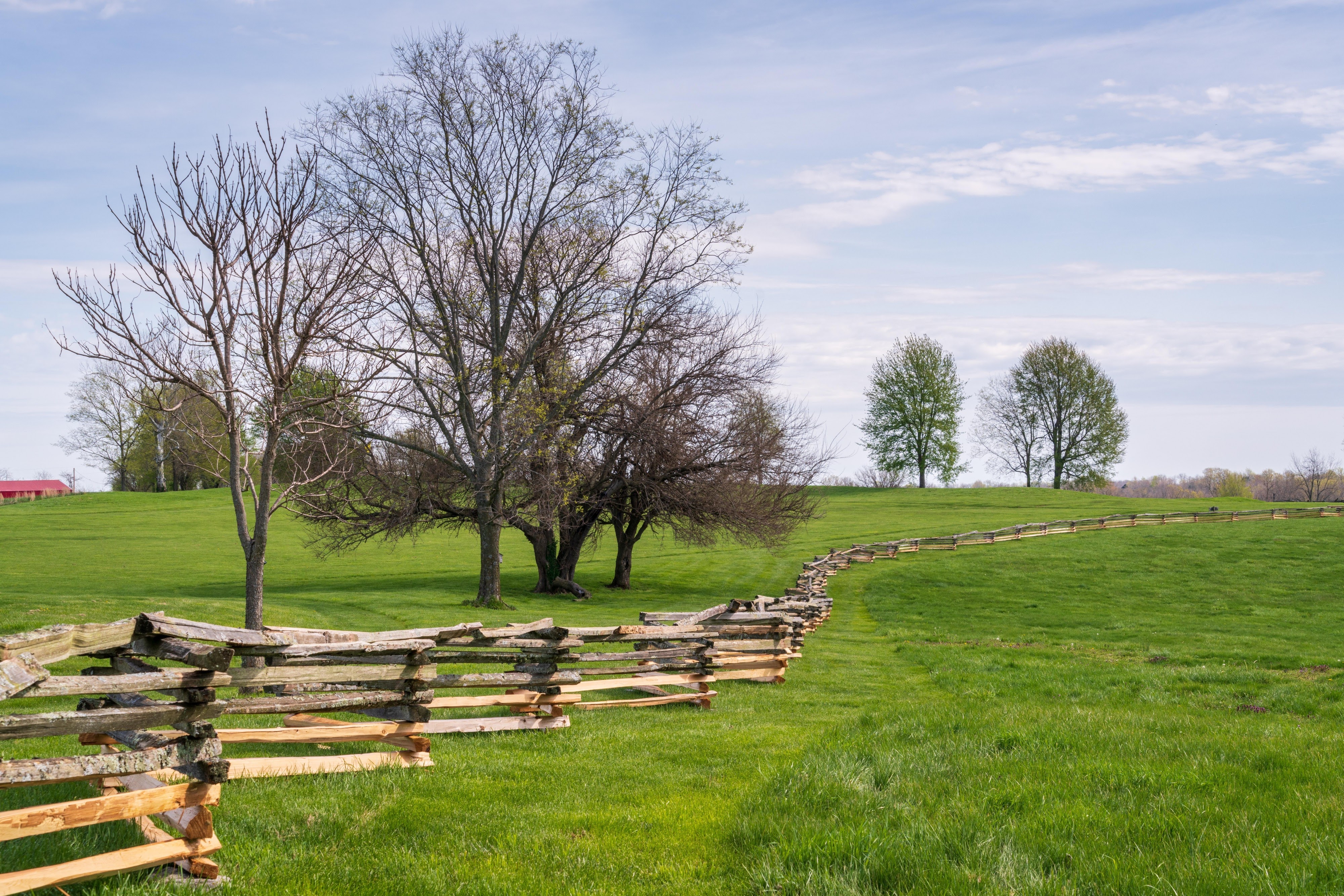
A fort, a hospital, a headquarters, a bustling supply depot—in the spring of 1863, Camp Nelson was an outpost at war, a strategic stronghold for the Union Army in Jessamine County, Kentucky. Its purpose was to supply a military machine and press the fight against the Confederacy in the Western Theater. But even as its cannons faced the enemy, a different kind of battle was being waged within its walls.
This was a struggle for freedom, a struggle that would transform the camp from a simple military outpost into one of the most powerful symbols of emancipation in the nation. This is the story of Camp Nelson, a dynamic and often heartbreaking location where the future of liberty was created by the actions of both the enslaved and the soldiers. It is a a great example of how the pursuit of freedom can turn a place of military necessity into the center of a human story.

A Fortress in a Divided State
Established in a state that, despite its Union loyalty, maintained slavery, Camp Nelson occupied a uniquely complicated position. Its strategic location was vital to the Army it supported. Situated along the Kentucky River and adjacent to the vital Lexington-Danville Turnpike, it served as a logistical hub for Union campaigns to invade East Tennessee, a region with a large Unionist population under Confederate control.
At its peak, the camp sprawled across 4,000 acres, boasting over 300 buildings that included barracks, a massive quartermaster depot, an ordnance depot, a sprawling 700-bed hospital, and an elaborate system of earthen fortifications.
The construction of this immense military complex relied heavily on manual labor. Initially, the Union Army “impressed” enslaved African Americans from the surrounding area to perform the backbreaking work of building the fortifications, felling trees, and digging trenches. They toiled under the watchful eyes of white officers and soldiers because, despite performing service for the Union cause, they were still considered property under Federal and Kentucky law.
This situation created significant friction, as slaveholders protested the use of their “property” by the federal government. The Federal Army met its labor needs by seizing and using enslaved people themselves. These laborers, though not free, worked in the shadow of liberty—exposing the obvious hypocrisy of a war message centered on a fight for freedom in a Union state that still maintained the institution of slavery, and was more than willing to take advantage of it when it suited them.
The Logistical Engine of the Western Theater
While the story of emancipation is Camp Nelson’s heart, its original mission was purely pragmatic: to be the linchpin of Union military movement in the upper South. Kentucky, though officially neutral for a period, became a critical staging ground, and Camp Nelson was the largest permanent supply and troop-training base in the entire state.
Its construction in 1863 was not a temporary measure but a strategic investment designed to support major, multi-year campaigns. The camp’s location was chosen carefully. Its position high on the ridges overlooking the Kentucky River offered a naturally defensible site, but more importantly, it was situated where the Lexington-Danville Turnpike and the river crossing made it an ideal transfer point for materiel. Supplies were often brought by rail to nearby Nicholasville, then transferred to wagons for the final haul to the camp.
At its operational peak, Camp Nelson was a massive, self-contained city of war. The Quartermaster’s Department was an industrial marvel, encompassing immense storage buildings and facilities for the maintenance of thousands of animals. These operations included massive commissaries, stocked with provisions for thousands of soldiers, ensuring that Union armies pushing into East Tennessee and beyond—like those under General Ambrose Burnside—were kept fed and equipped. Hundreds of laborers, initially seized slaves, and later USCT soldiers and freedmen, worked endlessly in wagon and harness shops, repairing wagons, tack, and harnesses for the vast numbers of mules and horses necessary for transport.
Furthermore, the Ordnance Depot held countless tons of ammunition, cannon, and small arms, carefully guarded within the earthwork fortifications. The security of this depot was vital, as its loss would cripple the entire Union effort in the region. The sheer volume of resources moving through Camp Nelson meant that any military operation in East Tennessee—a crucial area for disrupting Confederate supply lines—was fundamentally reliant on the smooth operation of this Kentucky base.
It was the critical, beating logistical heart that allowed the Union to project power deep into Confederate territory, illustrating that the Union victory in the West was as much an achievement of engineering and supply chain management as it was a battlefield accomplishment.
This scale also explains why, when the families of the USCT arrived, the military initially viewed them as a threat to operational efficiency rather than as people deserving of sanctuary.
The Tide of Freedom
The year 1864 marked a significant shift in the camp’s history. The Union Army, facing mounting casualties and a desperate need for manpower, began actively recruiting African American men in Kentucky for the United States Colored Troops (USCT) program. For enslaved men, this was the moment they had been waiting for—a clear and legal path to their own emancipation.

The word spread through the state like wildfire, and a massive migration began. Hundreds, then thousands, of enslaved people—men, women, and children—braved dangerous, secret journeys, navigating hostile slave patrols and Confederate guerrillas to reach the safety of the Union lines. For many, Camp Nelson was their escape, a beacon of hope and a place where the promise of freedom, once a distant dream, was now within their grasp.
Camp Nelson rapidly became one of the nation’s largest USCT recruitment and training centers. By the end of the war, more than 10,000 of the 23,000 African American men who served in the Union Army from Kentucky had been recruited or trained at the camp. Their service was an important statement of self-determination, an act that not only secured their own freedom but also helped to dismantle the legal system that had enslaved them.
However, the flood of refugees created a humanitarian crisis the military was ill-prepared to handle. While the enlisted men were provided for, their families were left in a precarious limbo. Their legal status was uncertain, and military policies regarding their presence were inconsistent and often cruel.
With little official support, these wives, children, and elderly parents built makeshift homes—crude shanties and tents—on the outskirts of the camp, clinging to the hope that their husbands’ and fathers’ service would guarantee their own freedom.

The Expulsion and the Birth of a Community
This untenable situation came to a head in November 1864 with one tragic decision. Under the command of Brigadier General Speed S. Fry, approximately 400 African American women and children—families of the USCT soldiers—were forcibly expelled from the camp. Their makeshift homes were demolished, and they were driven out into the frigid winter air with no food or shelter.
The callous act, carried out by Union soldiers, resulted in the deaths of 102 people from exposure and disease. This cruelty was a dark moment in the camp’s history, and an awful reminder that the fight for freedom was not yet won.
The expulsion, however, proved to be a critical turning point. The event drew immediate and fierce national outrage. Humanitarian workers and abolitionists, including the Reverend John G. Fee, rallied to the refugees’ cause, and the tragedy made headlines in newspapers across the country.
The public outcry forced a complete re-evaluation of military policy. In a landmark reversal, the army established the “Home for Colored Refugees” in January 1865. This government-sponsored initiative provided much-needed food, clothing, shelter, and medical care. It was the first step toward a new life, a secure and protected community. The camp’s officials, now charged with caring for the refugees, built over 97 duplex cottages, a school, and a mess hall, creating a safe haven for over 3,000 African American civilians.

Influenced by the tragedy and the unwavering determination of the refugees, Congress passed a law in March 1865 granting freedom to the wives and children of all enlisted USCTs. This act not only offered legal protection but also provided a clear foundation for these families to build a new life.
Education, Faith, and the Forging of a New Community
The moment the government formally established the Home for Colored Refugees in January 1865, the camp shifted from a place of uncertain waiting to a true center of reform. For the formerly enslaved, literacy and spiritual autonomy were vitally important—they represented the actual break from the intellectual bondage of slavery. The establishment of schools and churches was not an afterthought but an immediate, driving priority for the refugees themselves, aided by benevolent societies.
Education was understood as the most powerful tool for securing a future. The refugees’ determination to learn was widely noted by observers. Teachers from the American Missionary Association (AMA), a key abolitionist group, were among the first to arrive, establishing schools for both children and adults, often teaching in overcrowded, hastily converted rooms and buildings.
Many elderly and middle-aged refugees devoted themselves to learning the alphabet, seeing it as a crucial step toward reading the Bible, signing legal documents, and understanding their rights as free people. They understood that citizenship required not just freedom of the body but freedom of the mind. The curriculum was not limited to basic reading, writing, and arithmetic. It often included elements of civics and morality, essentially preparing the students for the responsibilities of citizenship in the future postwar nation.
The camp’s school, often referred to as the Fee School after abolitionist Kentuckian Reverend John G. Fee, quickly became one of the largest and most effective schools for African American children in Kentucky during and immediately after the war. This focus on education signaled a commitment to inter-generational advancement that would define the community of Ariel that grew out of the refugee home.
Alongside education, the refugees built autonomous religious institutions. Under slavery, African American religious expression was often controlled or supervised by white masters. Freedom meant the ability to worship and organize independently. At Camp Nelson, the community rapidly established its own places of worship, which were essential for providing the foundations necessary to endure the hardships of the war and the expulsion. Preachers and lay leaders who had come to the camp with the migrating families led services that affirmed their God-given dignity and reinforced the justice of their cause.
The churches served as key community organizing centers, helping to manage aid distribution, provide comfort to the sick and bereaved, and uphold the moral code of the new community. These autonomous religious institutions also trained and empowered African American leaders who would go on to be ministers, politicians, and community pillars in the postwar Reconstruction South.
This commitment to spiritual and intellectual growth shows that the refugees were not passive recipients of freedom; they were active architects of their own liberation and future citizenship, leveraging the temporary sanctuary of the military camp to build the institutions of a permanent, self-determined society.
The Enduring Memory
After the Civil War, Camp Nelson’s military purpose faded, but its legacy was just beginning. The “Home for Colored Refugees” became the foundation of a permanent African American community, later named Ariel. Here, refugees and veterans built new lives, established schools, and began to shape their own futures as free people. They faced the immense challenges of the Reconstruction era, but they did so with the same determination that had brought them to Camp Nelson in the first place.
Today, the site is preserved as Camp Nelson National Monument, a powerful place of history and reflection administered by the National Park Service. A visit to this place comes with the invitation for people to consider the long and often painful struggle for freedom that unfolded there. Archeological surveys have revealed a wealth of information about the camp’s daily life, from the living conditions of the soldiers to the layout of the refugee homes.

The monument, along with the adjacent Camp Nelson National Cemetery where many USCT soldiers are buried, provides a tangible link to the past.
It honors the courage of the USCT soldiers who fought for a nation that had enslaved them, and it stands as a monument to the courage of the men, women, and children who braved everything to secure their own emancipation. Camp Nelson is more than just a historical site; it is a monument to the enduring human spirit and a vital part of the complex, often painful, journey toward a more peaceful future.







Leave a Reply