On the evening of May 10, 1869, a telegraph operator in Washington, D.C. sent two words across the wire: Done and dot. That was it.
The signal traveled instantly to every major city in the country, and what followed was the closest thing to a collective national nervous breakdown the United States had ever produced.
Church bells rang in Philadelphia. A hundred-gun salute shook the streets of New York. In San Francisco, a crowd took to the streets before the echo had even faded. In Chicago, a parade materialized, apparently out of nowhere, stretching for seven miles.
The country knew what it meant. Understood it viscerally, the way people understand something they’ve been waiting anxiously for. After six years of construction, two companies racing across a continent from opposite directions, one from Sacramento and one from Omaha, the line was complete.
The first transcontinental railroad. You could board a train in New York and ride it all the way to San Francisco. A dangerous overland journey that had taken months now took days.
The continent had been stitched together, and America wanted to celebrate – badly. It had earned that much. The Civil War had ended four years earlier, Lincoln was four years dead, and the country was still figuring out what it was supposed to be. This felt like an answer. Or at least a distraction.
What they were celebrating, most of them had no idea.
They knew the broad outline. Two railroads, two crews, building toward each other until they met somewhere in Utah Territory. Ceremony, speeches, the driving of a golden spike.
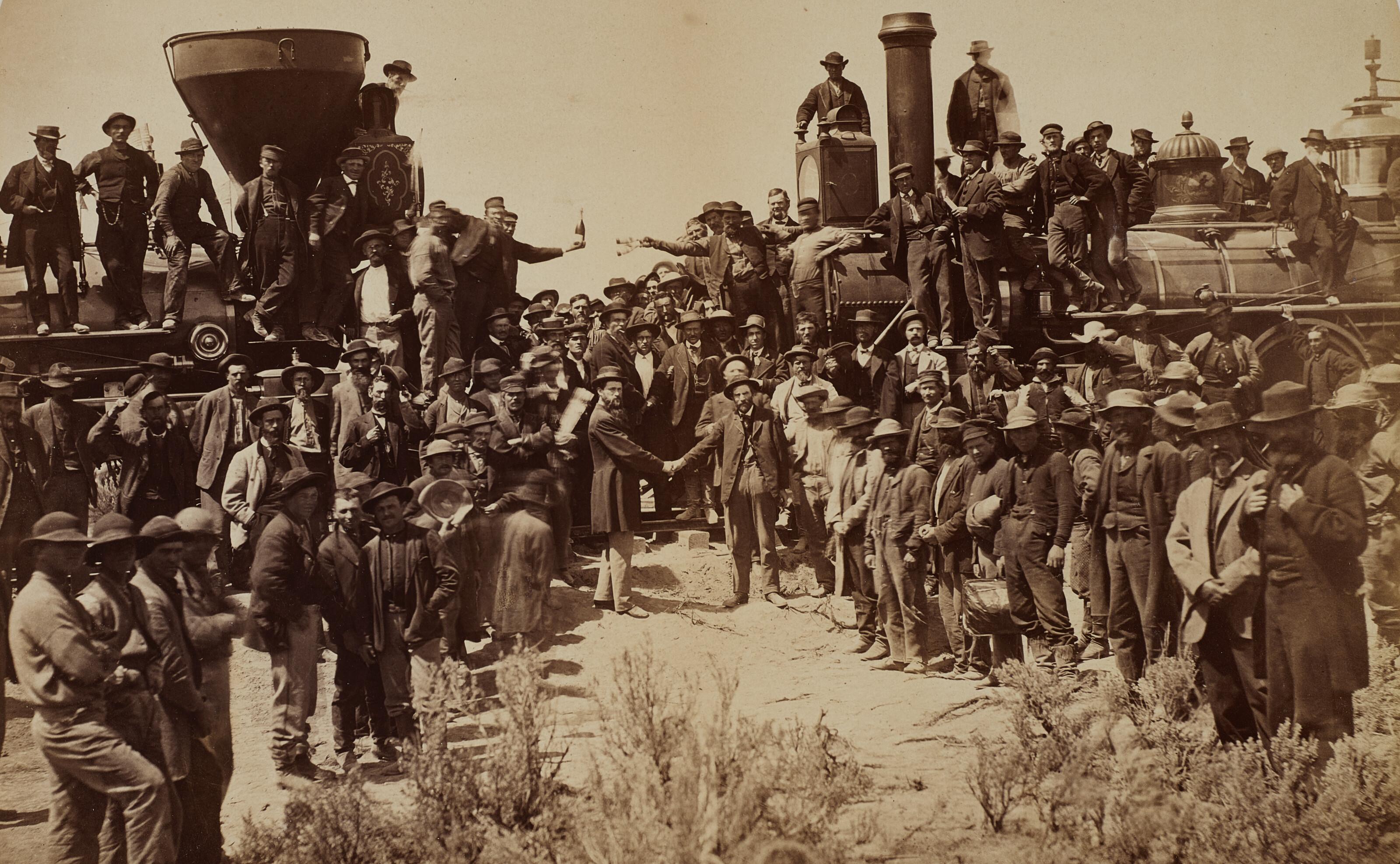
There was a photograph. By the standards of 1869, it was a remarkable document; a crowd of men pressed in around two locomotives facing each other nose to nose at Promontory Summit, hats raised, bottles produced, a moment of national triumph frozen for all time.
Look at it long enough and you start to notice what isn’t there.
The men in that photograph are foremen, executives, engineers, and Army officers. They are the men who ran things.
The men who built things, the ones who spent three years driving track across Nebraska and Wyoming, blasting through rock and fording rivers and sleeping in rolling camps that moved like armies, are conspicuously absent.
The photograph got the ending right. The ending was real. The celebration was real. The achievement was very real, for that matter, and it’s worth being very clear about: the transcontinental railroad was one of the most consequential feats of engineering and organization in human history. Nobody should have to apologize for marveling at it.
The problem isn’t the golden spike. The problem is everything the golden spike buried.
Over the course of roughly three years, across a thousand miles of the Great Plains and the Wyoming basin, three entirely different groups of men converged on the same strip of ground with entirely different reasons for being there.
They didn’t share a language, a culture, a flag, or a future. What they shared was the ground; the same brown Nebraska grass, the same Wyoming wind, the same consequence.
The Irish veterans who swung the hammers. The Pawnee scouts who patrolled the flanks. The Sioux warriors who understood, better than anyone, what the railroad actually meant.
All three of them lost. Just not in the same way, or on the same schedule.
That’s the story the photograph didn’t take.
The Pawnee
On the morning of August 7, 1867, a band of Cheyenne warriors under Chief Turkey Leg pulled up a rail near Plum Creek Station in central Nebraska, tied telegraph wire across the track, and waited.
A handcar crew hit it first. One man was killed, another wounded. A third, a telegraph repairman named William Thompson, was scalped alive, left for dead, and had the presence of mind to pick up his own scalp off the ground and carry it with him when he crawled away.
He eventually made it to Omaha, where doctors tried and failed to reattach it. He donated the scalp to the public library. It sat in a jar of alcohol on display for years. You couldn’t make that up.
The freight train that came behind the handcar hit the damaged track and derailed. The Cheyenne looted the cars, killed the engineer and fireman, and rode off with bolts of bright-colored calico tied to their horses tails, streaming behind them across the Nebraska grass.
By the next morning, Major Frank North and a company of Pawnee scouts had arrived on a special train. Within ten days they had tracked the raiders down, killed fifteen of them, and captured Turkey Leg’s wife and nephew. The nephew was later exchanged for American prisoners the Cheyenne were holding. Business concluded.
The men who chased down Turkey Leg’s band weren’t soldiers in any conventional sense. They were Pawnee; traditional enemies of the Cheyenne and the Sioux, hired and armed by the U.S. Army for exactly the kind of work they’d been doing for generations anyway.
Frank North, their commander, was a white Nebraska frontiersman who’d learned the Pawnee language as a teenager working at the agency trading post and had been organizing them into military units since 1864.
He was not a figure who needed a buckskin costume. He dressed in business suits when he wasn’t in uniform, ran a successful trading operation on the side, and turned down a dime-novel deal that subsequently went to Buffalo Bill Cody instead. North was the anti-Cody; competent, professional, uninterested in fame, good at his job.
The Pawnee who served under him were not, to be clear, doing it out of loyalty to the United States. They were doing it because the United States happened to be fighting their enemies. That point matters significantly.
By the time the Pawnee scouts were patrolling the Union Pacific’s flanks in 1867, the Pawnee as a nation were in serious trouble. They had numbered somewhere around 10,000 in the early part of the century. Smallpox, cholera, and forty years of Sioux raids had cut them down to perhaps 3,000 by the late 1860s.
The 1857 treaty with the United States had promised federal protection from Sioux attacks. That protection never materialized. The scouts weren’t volunteers in any romantic sense; they were men from a nation that had been left essentially defenseless on a reservation in Nebraska, fighting the same people who had been trying to exterminate them for decades.
The Army was handing them horses, rifles, and a paycheck to do it. The decision wasn’t complicated.
What makes the Pawnee story genuinely hard to categorize is that it doesn’t fit the available templates. The “friendly Indian” framing the Army preferred was condescending nonsense; the Pawnee weren’t friendly, they were strategic.
The victimhood framing misses the agency entirely. These were experienced warriors making a rational choice in a situation with very few good options, allying with a stronger power against a more immediate threat.
That the stronger power would eventually do to them what the Sioux never quite managed to finish — push them entirely off their Nebraska lands and onto a reservation in Oklahoma — is the final bitter irony.
They ended up in Oklahoma anyway, by 1875, the railroad they’d bled for having made the entire question of who controlled the central plains effectively moot.
They weren’t betrayed, exactly. Nobody lied to them about the long-term trajectory of American expansion. The deal was always transactional, and they knew it. The tragedy is that the transaction was the best available option, and it still wasn’t enough.

The Last Good Job
In the summer of 1867, a newspaper reporter from the East stood on the embankment west of Omaha and watched Jack Casement’s crews work.
What he saw stopped him. A horse drawn car galloped up to the end of the track with a load of rails. Men swarmed it, unloaded it, moved it forward, and the whole sequence began again; spikers, tie-layers, gaugers, all of them moving in a chain that rolled forward across the Nebraska plain at something close to walking speed.
The reporter wrote that he watched with a feeling of “amusement, curiosity and profound respect.” He’d never seen anything like it. Most people hadn’t.
Casement ran his crews the way he’d run his brigade at Franklin and Nashville; with absolute clarity about who did what and what happened if they didn’t. He was five feet four and carried a bullwhip. His men called him General Jack.
In a report to chief engineer Grenville Dodge about a discipline problem at Cheyenne, where murders were outrunning accidental deaths four to one, Casement noted that few of the offenders had survived the encounter. Dodge apparently found this satisfactory.
The men doing the actual work were mostly Irish, many of them recently off troop transports from the war’s eastern theaters. The Enrollment Act of 1863 had conscripted or bounty-pushed thousands of them into Union blue; Appomattox had put them back on the street with a discharge paper and nowhere particular to go.
The railroad agents found them in New York and Boston and shipped them west at company expense. They were paid $35 a month with board included; not bad wages for 1866, for men who’d been sleeping in the mud at Petersburg for three dollars a month.
They lived in rolling bunkhouse cars that moved with the railhead, ate beef and bread and black coffee, and spent what downtime they had in the Hell on Wheels towns that materialized behind the construction camps like a traveling circus of vice. Cheyenne went from a survey stake to a city of several thousand people in roughly four months.
These were not naive men. They’d survived the war, which had a way of burning the naivety out of a person. They understood they were working for an organization that viewed them as a variable cost, something to be optimized rather than protected.
Thomas Durant, the Union Pacific’s vice president and the closest thing the operation had to a villain in residence, withheld pay over minor disputes as a matter of routine. There were strikes. The strikes went nowhere. The men went back to work because the alternative was worse.
What none of them could see clearly, what was hard to see from inside it, was the full look of what they were building. The transcontinental railroad didn’t just connect coasts. It rewired the operation of the American economy.
Goods that had required weeks and significant expense to move could now move in days, cheaply, in bulk. The same efficiency that made the construction operation impressive made unskilled labor progressively less valuable everywhere the line reached.
The Gilded Age economy that the railroad helped create was not an economy that needed large numbers of strong men willing to do dangerous work for $35 a month.
It needed a different kind of worker; skilled and specialized, replaceable in a different way. The men who built the line were exactly the kind of labor the line was helping to make obsolete.
There’s no evidence they spent much time thinking about it. The work was too physical, too dangerous for philosophical detachment. A 500-pound rail doesn’t invite contemplation.
The Cheyenne snipers along the right-of-way were a more pressing concern than macroeconomics. But the irony was structural, baked into the operation, and it played out exactly as the logic demanded.
By the 1870s and 1880s, the men who’d driven the transcontinental west found themselves in an industrial economy that had absorbed the railroad’s lessons about scale and efficiency and applied them everywhere, including to labor.
The strikes that went nowhere on the Union Pacific were a rehearsal for the ones that would go nowhere at Homestead and Pullman and a hundred other places where the same argument was made and lost by men in the same position.
They built the mechanism. It ran without them.

The War He Won
On the morning of December 21, 1866, the temperature at Fort Phil Kearny was well below freezing and a wood train had come under attack in the hills northwest of the fort.
Colonel Henry Carrington sent Captain William Fetterman to relieve it with 80 men, with explicit orders not to pursue beyond Lodge Trail Ridge. Fetterman had recently boasted that with 80 men he could ride through the entire Sioux nation. He was about to test that theory.
Crazy Horse and nine other warriors appeared on the ridge, goading and mocking the soldiers, staying just out of rifle range. When the troops advanced, they retreated. When the troops slowed, they came back.
Fetterman followed them over the ridge and down into the Peno Valley, where somewhere between 1000-2000 warriors were waiting.
The fight lasted about forty minutes. All 81 men died. It was the worst defeat the Army had suffered on the plains; until Little Bighorn a decade later. The Lakota call it the Battle of the Hundred-in-the-Hands.
Red Cloud had been planning and executing variations of that same ambush for months. He understood something that the Army kept refusing to accept: the Bozeman Trail ran directly through the last good hunting grounds the Sioux had. Protect those grounds or lose everything; that was the assessment, and it was accurate.
He didn’t have illusions about what a completed railroad across the plains would mean. He just couldn’t stop the railroad the way he could stop the Bozeman Trail, and by 1867 the two fights had become dangerously linked for the Army.
After Fetterman, the Army planned a massive punitive expedition into the Powder River country. Grenville Dodge, the Union Pacific’s chief engineer, killed it. He told Washington that pulling troops north would leave the railroad exposed, and Washington agreed. The railroad was the priority.
The Bozeman Trail forts were a liability. Red Cloud had been fighting the right war in the wrong place, and the federal government’s inability to fight two wars simultaneously handed him the opening he needed.
By the summer of 1868 the Army had abandoned all three Powder River forts. Red Cloud refused to come to the treaty table at Fort Laramie until the soldiers were physically gone.
When they left, his warriors burned the forts to the ground.
He arrived at Laramie in November, three months after the Army had withdrawn, and signed the Fort Laramie Treaty on his own timeline. It was, by any standard, but particularly in that era, a remarkable victory. The United States Army had sued for peace, abandoned its positions, and waited while its enemy burned what it had left behind.
The trap was already built into the victory, though Red Cloud couldn’t have seen the full consequence of it yet. The treaty guaranteed the Sioux the Powder River country and the Black Hills.
It also required them to stop opposing the railroad; which was essentially asking them to accept the instrument of their own eventual dispossession in exchange for land the railroad would soon make strategically irrelevant anyway.
The Bozeman Trail had mattered because it was the route to the Montana goldfields. The transcontinental line, running through southern Wyoming, made a faster and safer alternative. Red Cloud had fought brilliantly for two years over ground that the railroad’s completion had already begun to render beside the point.
He didn’t stop understanding things after 1868. When gold was discovered in the Black Hills in 1874 and the government began maneuvering to take them, Red Cloud saw it coming.
He spent the rest of his life fighting that battle through lawyers and Washington lobbying and newspaper interviews; the only weapons left to him. He didn’t take up arms for Little Bighorn in 1876. He knew how that math worked. The war he’d won in 1868 was the last one that was winnable, and he’d known it even as he was winning it.
The Bozeman Trail closed forever. The railroad made it unnecessary. Red Cloud had defeated the United States Army and accomplished nothing permanent. That’s not a moral judgment; it’s just what happened.

What the Photograph Got Right
At 12:47 in the afternoon on May 10, 1869, a telegraph operator wired a single word to the nation: Done.
The spike was already in. Leland Stanford had swung the silver maul and missed. Thomas Durant had swung and missed.
It was reportedly a railroad worker who actually drove it home; both the spike and the maul wired to the telegraph line so the country could hear the blows as they landed. The dignitaries got the ceremony. The worker got the job done. That about covers it.
The photograph taken just before, the one that became the iconic image, shows a crowd of perhaps a thousand people pressed in around two locomotives nose to nose. Hats raised, bottles out, men climbing the engines for a better view.
Stanford is in there somewhere. Durant is in there. The Army officers and the railroad executives and the territorial governor of Arizona are all present and accounted for. It is a genuine moment. Nobody was performing happiness that day; the country had earned it and they knew it.
Look at it long enough, though, and the absences become their own kind of story.
The Irish veterans who drove the Union Pacific across a thousand miles of plains and high desert aren’t in it. By 1869 many of them were already drifting to the next job; other rail lines, other construction projects, the extractive industries opening across the West.
The economy they’d helped wire together had little use for their particular skills now that the line was finished.
The Gilded Age was assembling itself around them, sorting workers into new hierarchies, and the men who’d just completed one of the great engineering feats in human history were going to find themselves on the wrong side of most of those hierarchies.
The strikes that would mark the next thirty years — 1877, Homestead, Pullman — were downstream of that event. The men in those strikes were, in many cases, the same men or their sons.
The Pawnee scouts who’d kept the construction gangs alive on the Nebraska plains aren’t in the photograph either.
Frank North was there; he’d been invited to the 100th meridian celebration in 1866 as a guest of the railroad, his Pawnee warriors staging mock raids for the entertainment of the eastern investors on the excursion train. A performance of the thing they actually did, put on for people who needed it explained.
By 1869 North had moved on to other Army contracts. Within six years the Pawnee would be relocated to Oklahoma, their Nebraska reservation abandoned, the Sioux pressure that had driven them into the Army’s arms finally irrelevant because everyone was being pushed somewhere.
The railroad they’d protected had made the entire negotiation over who controlled the central plains into a settled question, and the answer wasn’t the Pawnee.
Red Cloud isn’t in the photograph because he had no reason to be anywhere near Promontory Summit. He’d signed his treaty the previous November, on his own terms, after making the Army wait.
He’d won his war. The Bozeman Trail was closed, the forts were ash, and the Powder River country was legally Sioux territory. He spent 1869 doing what he’d always done; managing his people’s affairs, watching the horizon.
The railroad’s completion registered somewhere in that watching, you can be sure of it. He’d understood what the iron road meant before most American politicians did. He just couldn’t stop it from meaning what it meant.
The photograph got the ending right. The achievement was real. The celebration was earned. The transcontinental railroad compressed the continent, unlocked the West, and announced to the world that the United States had survived its own near-destruction and come out the other side with something to show for it. All of that is true.
It’s also true that somewhere north of Promontory Summit, across the Wyoming basin and up into the Powder River country, the grass was already growing over the foundations of the burned forts.
It’s true that in Nebraska, the Pawnee were on a reservation that the government had already begun to forget about.
It’s true that the Irish veterans in the Hell on Wheels camps were packing up and moving on to whatever came next, with no particular reason to expect it would be better than what they were leaving.
Three groups of men. One photograph. None of them in it.



Leave a Reply