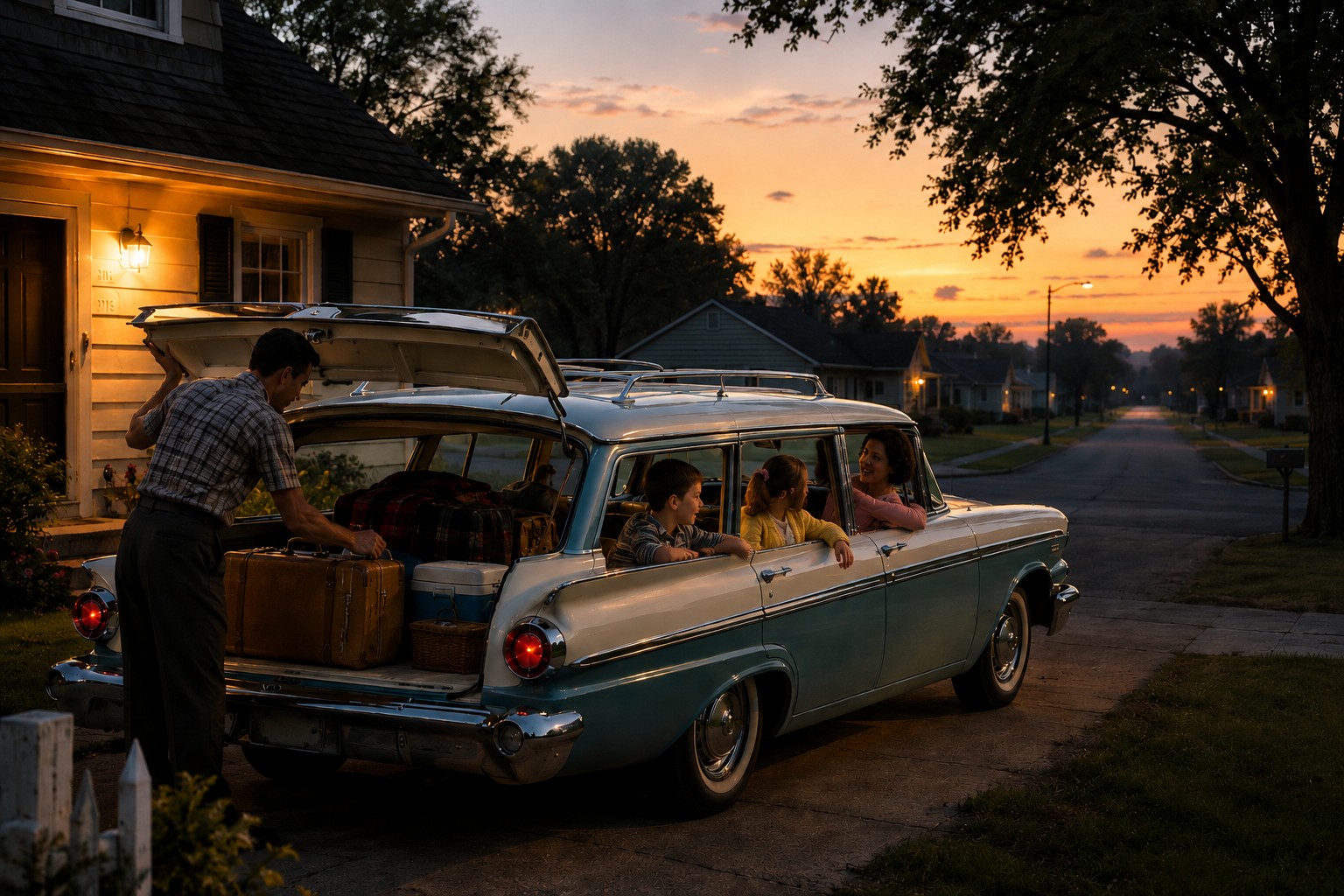
The station wagon is loaded before the sun comes up.
Somewhere in Pittsburgh, a father has spent the last twenty minutes arranging suitcases in the back with a level of focus typically seen in a man solving an important puzzle. A cooler goes in last, wedged between two duffel bags, ice already sweating through the metal.
The kids are in the back seat, sock feet up on the vinyl, arguing about whose turn it is by the window. Their mother has a picnic basket at her feet and a road atlas open on her lap, the route already traced out the night before.
This family is entirely ordinary, and that’s the whole point. They are one car among thousands pulling out of driveways across the country this particular summer morning, headed toward a destination that exists for them only in postcards and other people’s stories; a mountain, a canyon, a battlefield, a beach none of them have seen.
By the time the sun clears the horizon, they’ll already be an hour down the road, the kids already asking the question that will define the next several hundred miles.
Are we there yet.
It is such an ordinary scene that it takes a moment to notice what’s strange about it. For most of human history, travel was reserved for necessity or for the wealthy; a merchant moving goods, a soldier called to war, a nobleman moving between estates.
It was not something an ordinary working family did for pleasure, and it certainly wasn’t something they did every summer, as a matter of course, the way this family is about to.
But here they are, one car in an unbroken line of cars, all of them aimed at some version of the same idea: that this year, like last year, the family will pack up and go see something.
They are going because they want to. Not because a job or survival depends on it.
Multiply that station wagon by several million, spread it across every state in the union, and repeat it every summer for a generation, and something has clearly happened to American life; quickly, within the span of a single decade, not gradually, over centuries, the way most large social changes occur.
This became a country that couldn’t imagine summer without a vacation; a country that, one generation earlier, had never taken one at all, not in any sense the word would come to mean.
The question worth asking is what changed? What combination of money and machinery, law and mood, arrived at the same moment to turn the family road trip from something almost nobody did into something almost everybody expected to do, within the space of one American generation?
Whether it happened isn’t really in question; the evidence is sitting in driveways all over America, engine running, atlas open.
That’s where this story has to start: with the disappearance of a barrier nobody had thought to question, not with the invention of anything in particular; because until the middle of the twentieth century, almost no one had the chance to question it at all.

Before Vacation Was a Thing
A farmer in 1930 worked straight through July the same as every other month. The cows needed milking and the fields needed walking on the Fourth just as much as any Tuesday, and the work waited for nobody’s vacation.
A shopkeeper’s situation worked the same way, just measured in dollars instead of livestock. His livelihood was the store, and every day the doors stayed open was a day the register earned something.
Close it for a week and the losses were began immediately, and were compounding; the week’s earnings gone, plus whatever customers wandered to a competitor down the street in the meantime and simply stayed there. A week off was financial contraction, not rest.
A factory worker had it slightly better, in that Sunday was reliably his. Beyond that single day, a week at the beach depended entirely on what he could personally negotiate with his employer, plant by plant and worker by worker, with no law and no guaranteed benefit behind him.
Even a family with the time to travel still had to deal with the expense of it. A cross-country trip by rail cost real money, and that money had a dozen more urgent places to go before it went toward seeing the Grand Canyon.
None of this was hidden or disputed at the time. In 1939, Gallup asked Americans whether they or their husbands usually received paid vacation. Roughly three in ten said yes. Better than two-thirds of the country, the people doing the actual work of the country, had no paid time away from it.
A war changed it, and a rule about money that had nothing to do with vacations in the first place.
During World War II, the federal government capped wages and raised income taxes to control inflation and fund the war effort.
Employers still wanted to attract and keep good workers in a labor market drained by the draft, so they started offering things that weren’t cash and didn’t count against the wage ceiling: pensions, health coverage, paid holidays, paid vacation. All of it counted with the worker standing at the plant gate deciding where to take a job.
Then came the ruling that made the change permanent. The National Labor Relations Board determined that these fringe benefits were subject to collective bargaining, the same as wages were, a decision the Supreme Court later upheld.
Vacation time became something a union could put on the table and fight for, the same way it fought for a raise, backed by law instead of an employer’s goodwill.
By 1949, Gallup asked the same question it had asked a decade before. This time, just under half of Americans said they received paid vacation with their job.
Ten years. Three in ten to nearly half. The machinery of getting paid to take a vacation had finally been built, in the middle of a war nobody would have guessed would produce it.

America Gets the Keys
Paid vacation solved the question of whether a family could leave. What came next solved the question of how, and answered it so thoroughly and fast that the two problems seemed to dissolve together.
Start with wages. The postwar economy paid working Americans more than it ever had, and it kept paying them more through most of the 1950s, which meant a family had money left over after rent and groceries for the first time in a generation.
Next came family size. Millions of servicemen came home within a few years of each other, married within a few years of each other, and had children within a few years of each other, which meant the country was suddenly full of young families with kids old enough to sit still in a back seat but young enough to still think a trip was a magical adventure.
Then there was the car. Americans bought 21.4 million automobiles between 1945 and 1949 alone, and new car sales quadrupled over the following decade. By the end of the 1950s, roughly three out of four American families owned one.
A car had gone from something a family aspired to into something a family simply had, the same way it had a stove or an icebox.

None of that would have mattered much without somewhere to drive. On June 29, 1956, President Eisenhower signed the Federal-Aid Highway Act, authorizing $25 billion to build 41,000 miles of interstate; the largest public works project in American history to that point.
Eisenhower had his own reasons for wanting it, tied up in Cold War defense planning and a young officer’s memory of a miserable cross-country military convoy back in 1919, but the reasons didn’t matter to the family loading a station wagon.
What mattered was that five weeks after Eisenhower’s signature dried, Missouri’s highway commission awarded a contract to lay the first stretch of concrete on U.S. 66 in Laclede County, and within a few years a driver could cross half the country on roads built for exactly that purpose, with no stoplight, no crossing traffic, and no reason to slow down.
Layer one more thing on top of all of it: a country that had just won a world war and buried the Depression that came before it had earned the right to feel confident about its own future, and confidence of that kind tends to spend itself.
A family that believed things were going to keep getting better didn’t save every dollar against a catastrophe that might not come. It bought the car, packed it up, filled the tank, and headed towards Yellowstone.
No single piece of this explains the road trip on its own. Take away the wages and the car sits in the driveway with nowhere to go. Take away the highway and the wages buy a faster way to sit in traffic. Take away the vacation time secured back during the war and none of the rest matters, because there’s no week free to use it.
What actually happened is that all of it arrived within roughly the same decade, each piece reinforcing the others, until an ordinary family had the money, the machine, the road, and the week off, all at once, for the first time in American history.

The Great American Road Trip
The trip started at the AAA office, often days before the car ever left the driveway.
A member walked in with a starting point and a destination, and an agent sat down with them and built a route by hand; a highlighter tracing a path across a series of numbered maps, bound together into a spiral notebook the company called a TripTik.
The format had been around since 1937, but by the 1950s it had become one of the organization’s most popular services, and the agent didn’t just draw a line between two cities.
They marked construction zones, noted where traffic bunched up, flagged a scenic overlook worth ten minutes of the schedule, and pointed out where a rest stop or a gas station would be waiting when the tank ran low.
A family in Wilmington, Delaware, did exactly this in the summer of 1947, walking out with a green-marker route toward Hollywood and a companion volume for the trip home; mileage, gas costs, places to stop, and tolls already worked out before they’d covered a single mile.
Packing came next, and packing had its own ritual. The cooler went in last so the ice would last a bit longer, wedged wherever it would fit against the suitcases already loaded. A thermos or two rode up front, close enough to reach without stopping.
Somebody remembered the camera; increasingly a small one loaded with Kodachrome film, saved for the moment the destination came into view rather than wasted on the drive.
Then the road, and the road had a culture of its own, built mostly around the fact that everyone in the car was moving at roughly the same speed and had roughly the same amount of nothing else to do. License plate games passed the hours between towns; spotting all forty-eight states, or working through the alphabet sign by sign along the shoulder.
Every so often, a set of red-and-white signs appeared along a straight stretch of highway, spaced a hundred feet apart, each one holding a single line of verse, the last one always ending on the same word: Burma-Shave.
The whole car read them aloud together as the miles between signs ticked by, chasing the punchline even though the people chasing the joke already suspected the ending.
The Odell family had started the campaign back in 1925 on two roads outside Minneapolis with two hundred borrowed dollars, and by the time this family passed through, it had grown into seven thousand sign sets spread across most of the country; a shaving cream company that had become, almost by accident, one of the most beloved forms of advertising ever produced.

Stopping meant choices that hadn’t existed a decade earlier, and the choices told a story.
Howard Johnson’s had been building its reputation since 1925, when Howard Deering Johnson borrowed two thousand dollars for a struggling drugstore in Wollaston, Massachusetts, and discovered his soda fountain outperforming everything else in the shop.
He built a recipe with double the usual butterfat, worked his way up to twenty-eight flavors, and by 1954 had four hundred restaurants spread across thirty-three states, each one topped with the same bright orange roof and church-like steeple that told a tired driver, from a mile off, exactly what was waiting.
Holiday Inn told a different version of the same story.
In 1951, Kemmons Wilson drove his wife and five kids from Memphis to Washington and spent the whole trip frustrated by cramped rooms, no air conditioning, and motels that charged extra for every child in the back seat.
He came home, borrowed $325,000, and opened the first Holiday Inn in Memphis a year later; air-conditioned rooms, a pool, a restaurant, and kids under twelve staying free. The sign out front stood fifty feet tall and cost thirteen thousand dollars, and within twenty years there were fourteen hundred of them standing along highways the family could now expect to actually reach.
Along the way there were routines nobody had to be taught. A picnic table at a roadside park or rest area, the basket unpacked while the car ticked as it cooled. A gas station attendant checking the oil and washing the windshield without being asked, part of the price of the fill-up rather than an extra.
A rack of postcards by the register, chosen and mailed from wherever the family happened to stop, arriving home sometimes before the family did.
A souvenir pennant, cheaply made and treasured anyway, tacked to a bedroom wall as proof the trip had happened.
A brochure from whatever national park sat at the end of the route, picked up at the entrance station and kept in the glovebox long after the ink had faded.
None of it was expensive by the standards of the road trip’s own decade, and that was rather the point. The whole apparatus, the TripTik, the roadside sign, the orange roof, the postcard rack, existed to make an ordinary family feel like the road had been built with them in mind.
For a country that had only just gained the time and the money and the machine to make this kind of trip in the first place, that feeling was worth more than anything money could have bought.

What the Country Built
A child from Kentucky and a child from Oregon had almost nothing in common on paper. Different accents, different schools, different weather, different lives and cultures.
But by the late 1950s, there was a decent chance both of them had stood at the same railing at Old Faithful, waited through the same long minutes for the same eruption, and felt the same excitement when the water finally went up.
That wasn’t an accident, and it wasn’t rare. It was happening to millions of families at once, in the same handful of places, within the same few years.
National park visitation had sat around 17 million a year in 1940. By 1956 it had nearly tripled, to 49 million, and the Park Service was projecting 80 million annual visitors within another decade.
The parks had been built for a much smaller and slower era of travel; narrow roads, modest parking lots, lodges designed in the 1930s when the whole system saw a fraction of the crowd now showing up at the gate.
Yellowstone’s Old Faithful Lodge and its counterparts across the system simply weren’t built to hold what the interstate and the family car were about to deliver, and the Park Service spent the back half of the 1950s and into the 1960s rebuilding the infrastructure under a program called Mission 66, racing to keep pace with a public that had discovered its own parks all at once.
Gettysburg worked the same way, and so did the Smokies, Colonial Williamsburg, the Grand Canyon, Washington’s monuments.
These were places that had existed in schoolbooks and newsreels for generations, known secondhand at best by most Americans, who had never had the money, the time, or the road to go see them in person. Now a family with a station wagon and a week off could simply go, and did, in numbers the country had never produced before.
What that meant for the country was harder to measure than visitation figures, but no less real for being hard to count. A shared national memory doesn’t require everyone to have lived through the same event. It only requires enough people to have stood in the same place, felt the same thing, and carried that feeling home with them.
Two children who would never meet, raised a continent apart, now had the Grand Canyon in common, or Gettysburg, or the sulfur smell of Yellowstone’s geysers, in the same instinctive way earlier generations of Americans had shared a president’s assassination or a war’s end.
The nation was knitting itself together through several million small, private, nearly identical events, repeated all across the country, one family at a time.
The same thing was happening at a smaller scale inside individual households, and the two scales reinforced each other rather than competing for time.
A father who’d never left his home state as a boy now drove his own children three thousand miles and back, and the trip became a story he told for the rest of his life; the year the transmission overheated outside Amarillo, the night they slept in the car because every motel between Flagstaff and the canyon was full.
A mother filled a photo album with snapshots that had no obvious use beyond being looked at again later, which turned out to happen with smiles to accompany the looking. Grandparents who had never seen a mountain in person heard their grandchildren describe one at the dinner table and asked for the story twice.
A family drove west because they wanted to see something they’d only read about, several million times over, across a single decade, and in doing that they built a kind of common inheritance the country hadn’t quite had before; not because the places were new, but because reaching them finally was.
Nobody planned it that way. No one needed to sit a family down and explain that a trip to Yellowstone would help hold the country together; the country held together anyway, one station wagon at a time.

Business Picks Up
W.S. Stuckey Sr. started out selling pecans from a roadside stand in Eastman, Georgia, in 1937, and built the operation into a chain of stores stretched along the routes families were already driving toward Florida.
Each one used the same trick that Howard Johnson had already proven worked: a building bright and strange enough to spot from the highway at sixty miles an hour, in Stuckey’s case a signature teal roof, so a family running low on patience with three hours still ahead of them had a reason to pull off and buy a bag of pecan log rolls before getting back on the road.
The same instinct built an entire economy around towns that happened to sit on the right highway.
A stretch of road with enough traffic could support a motel, a diner, and a miniature golf course within a few hundred yards of each other, each one competing for the same passing cars rather than for local business, since local business alone had never been enough to keep any of them open.
Some towns built their whole identity around being a good place to stop rather than a destination in their own right, and there was no shame in it; a well-placed diner or a roadside attraction with a two-story fiberglass dinosaur out front could support a family for a generation, provided the traffic kept coming and the sign was bright enough to catch a driver’s eye before the exit passed.
None of these businesses would have existed twenty years earlier, because the traffic that sustained them hadn’t existed either. The road built the demand, and small operators up and down its length spent the 1950s and 1960s figuring out how to meet it.

Same Road, Different Car
The cars have changed almost beyond recognition, and so has nearly everything else about the trip.
GPS now speaks the directions a TripTik used to draw by hand (though they’re still an option in a pinch), and the map lives on a phone mounted to the dashboard.
LED signs blink from the same poles where neon used to glow.
A cooler may still ride in the trunk, but it’s just as likely to be a plug-in unit as a block of ice wedged between suitcases.
Burma-Shave no longer exists. Plenty of the roadside attractions never survived the interstate that made the road trip possible in the first place.
None of that has stopped families from making the trip. Every summer, station wagons have given way to minivans and SUVs, and those cars still pull out of driveways before sunrise, still loaded the night before, still headed toward somewhere the kids have only seen in pictures.
The tools have changed. The impulse underneath them hasn’t moved an inch.
That impulse is younger than it feels, worth remembering because it feels so permanent. A generation earlier, this trip depended on paid time off and a reliable car. It also depended on a road built to get families there and back in one piece.
All of it arrived within the same handful of years, stacked on top of a country that had just won a war and finally believed its own future was worth spending money on.
The road trip had to be built, not discovered. A labor ruling helped build it. A highway act helped build it too. So did a Memphis motel owner’s bad experience with his own family vacation. Together, they turned the road trip into the thing many American families now take completely for granted.
Picture that Wilmington family again, the one that walked into the AAA office on June 25, 1947, and left with a green-marker route toward Hollywood. They couldn’t have made that trip ten years earlier, and their own parents almost certainly never made one like it at all.
They didn’t know they were doing anything historic. They were just a family with a week off and a car that ran, headed down a road that finally went somewhere worth driving.
That’s still what’s happening every summer, in driveways all over the country, before the sun is even up. A family loads the car with no idea that the whole arrangement is barely older than their own grandparents; the time off, the open road, the reason to go looking for something they’ve never seen.
They just know they’re headed somewhere new, and that feels, as it has for less than a hundred years now, like exactly what a summer is for.



Leave a Reply