NOTE: The battles and the generals have earned their place in the books and the movies. D-Day, Midway, Eisenhower, Patton; those stories get told, and told well, as they should be. The home front fought a different war. That war produced enough material for volumes and mostly went unknown outside the archives. This four-part series is my attempt to help close some of that gap: The Sell, The Long Wait, We Are Ready, and Victory Valley.
In August 1942, Franklin Roosevelt wrote a letter to the children of America.
It was a short letter. Roosevelt was quite busy and didn’t have time to waste words when he didn’t have to, and he didn’t waste them here. The country’s boys and girls, he wrote, could perform a great patriotic service by helping the national salvage effort.
Millions of young Americans, turning their energies to collecting scrap metals, rubber, and rags, could help turn the tide in the war effort. They would earn the gratitude of every fighting man by helping get them the weapons they needed. He knew they would do their part.
The letter was dated August 27, 1942. Nine days later, the War Production Board sent its own letter, this one to the school teachers of America, laying out the machinery that would give Roosevelt’s appeal its practical . The Schools at War program was officially underway.
Two hundred thousand schools. Thirty million children. Those are the numbers the program tallied, and they are worth looking at before anything else is said about what the children did with the .
The government was not making a token gesture toward youth participation. It was building the largest single mobilization of children in American history, administered jointly by the Treasury Department and the Office of Education, aimed at every classroom in every school in every corner of the country.
The program ran from the 1942-43 school year through the end of the war and never stopped growing.
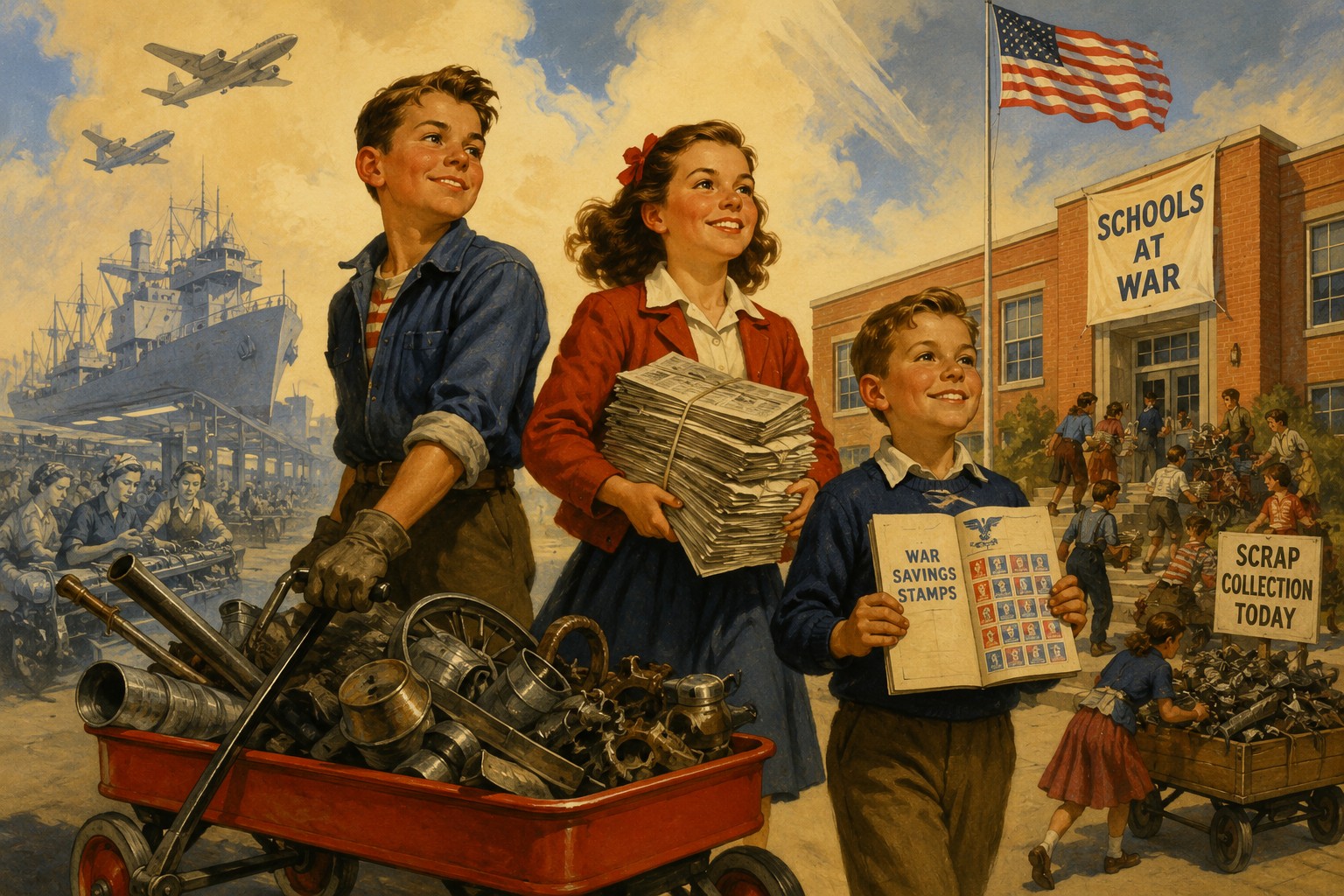
The official poster asked a question: We Are Ready: What About You? A group of idealized children in the foreground, engaged in the program’s three major activities: scrap collection, bond sales, patriotic support, with the implicit challenge aimed as much at the adults standing behind them as the children looking at it.
The government understood something about its audience. Children were not just participants in the home front campaign. They were a message aimed at everyone else.
That dynamic was deliberate and it was transparent to anyone paying attention. The War Production Board’s letter to teachers said the school salvage program would accomplish two things simultaneously.
It would gather materials the war effort needed. And it would give every school boy and girl a desired opportunity for patriotic participation in backing up their fathers and brothers at the fighting fronts.
The second goal was as important as the first. A child visibly doing their part was a standing reproach to an adult who wasn’t; and the government knew it, and used it, and wasn’t particularly embarrassed about the fact.
What the government couldn’t have fully anticipated was what was about to . The machinery it built was real and the programs it designed were well-structured and the institutional support it provided through schools and scout groups and community organizations was genuine.
All of that is true. And then the children got hold of it, and it became something the government hadn’t entirely planned for.
They ran with it. Flat out, full bore, for four years, without flagging.
The adults around them, the ones the OWI and the War Advertising Council were simultaneously working every available medium to keep motivated and compliant; those adults showed the predictable human patterns.
Enthusiasm in 1942. Some slippage by 1943. Black market beef by 1944. The gap between what people said and what people did was a documented and persistent problem that the home front information apparatus never fully closed.
The children didn’t have that gap. They collected scrap until there was no more scrap to collect in their immediate vicinity, then went looking for more. They pestered neighbors. They organized competitions against other classrooms, other schools, other neighborhoods.
They turned in their own toys when the drives called for metal. They saved their mothers’ cooking grease and carried it to collection points. They pasted war stamps into booklets while showing they understood exactly what the stamps were for and didn’t need to be reminded.
Thirty million children, in 200,000 schools, across four years of war. The government asked. The children answered. And the answer was considerably louder than anyone had expected.

The Scrap Drives
The wagon was the essential piece of equipment.
Every neighborhood had at least one kid who had figured this out; that a wagon dramatically increased your operational capacity on collection day, and that operational capacity was the difference between a respectable contribution and a legendary one.
You loaded it up at your own house first, then worked the block, then the next block, then as far as your young legs or your mother’s patience would allow. You came back when the wagon was full, unloaded, and went out again.
The school or the collection shop would weigh everything at the end of the drive and post the totals, and the totals mattered, and everyone knew whose class or neighborhood had the most and whose had fallen short.
The scrap drives were the most visible and most viscerally satisfying of the home front activities available to children, and the government understood that visibility and satisfaction were not incidental features of the program.
The War Production Board needed metal, rubber, and paper. It also needed the home front to feel like it was doing something concrete and measurable. The scrap drive delivered on both counts simultaneously; and in the hands of American schoolchildren, it delivered with an intensity that the adults running the program had not anticipated.
The materials the drives targeted were for very practical . Steel and iron went into tanks, ships, artillery pieces, and the thousand other metal objects a mechanized war consumed at rates that peacetime production couldn’t have imagined.
Rubber was desperately short after Japan’s conquest of Southeast Asia cut off 90 percent of the country’s natural rubber supply; tires, gas masks, life rafts, and boots all competed for a material that had suddenly become precious.
Paper went into shell casings, insulation, and packaging for military supplies. Tin foil, the kind that came wrapped around sticks of chewing gum, was collected by children who peeled it off carefully and rolled it into balls, which were then turned in at collection points. Those balls had a use. The children knew it.
The scale of what they collected is difficult to absorb from a distance. In Portland, Oregon, during the nation’s first full-scale scrap metal drive in the fall of 1942, competitions between nine high schools and 54 grade schools produced a combined 1,210 tons of scrap metal.
Lincoln High School won the high school competition outright with 200 tons collected; earning its students a field trip to the Oriental Theatre for a free showing of a Ginger Rogers comedy, which was apparently considered an adequate prize for moving 200 tons of metal, and perhaps it was.
Oregon had been assigned a quota of 100,000 tons for the war effort. The schools went after it like it was a personal challenge.
This was the competitive structure that made the scrap drives work in the hands of children in a way they didn’t always work in the hands of adults.
Adults could be motivated by guilt, by patriotism, by fear, by the rotating emotional pitch of the OWI’s campaigns; and they were, imperfectly and inconsistently, for varying lengths of time.
Children could be motivated by all of those things too, but they could also be motivated by the prospect of beating the third grade down the hall. That is a fundamentally different and considerably more durable source of energy, and the program’s designers were smart enough to build the competitive framework in from the start.
Schools earned flags for hitting participation thresholds. Classes earned recognition for collection totals. Individual students earned certificates and, in the Paper Troopers program, arm patches; the War Production Board had named the paper collection effort deliberately to echo the word “paratroopers,” and outfitted participants accordingly.
For a generation of boys who were closely tracking the progress of airborne divisions in Europe and the Pacific, the arm patch was not nothing. It meant something to wear it. It meant something to earn it.

The Boy Scouts and Girl Scouts threw themselves into the drives with organizational efficiency that put many adult civic groups to shame. Scout troops ran regular collection routes through their neighborhoods, coordinating pickups with the same logistical seriousness that the military was applying to supply chains overseas.
Girl Scouts collected and processed milkweed pods; the silky fibers inside were used as filler for life preservers and flight suits, replacing kapok that could no longer be imported from Japanese occupied territories. They gathered two and a half million pounds of the stuff. Nobody asked them twice.
The toy sacrifice is a detail that gets to you.
When the drives called for metal, children brought metal; and the most available metal in a child’s possession was frequently metal toy. Cap pistols went into the collection bins. Tin cars and trucks. Lead soldiers, the kind that came in sets and represented entire armies and had been arranged into formations on bedroom floors across the country.
A boy who turned in his lead soldiers to the scrap drive was making a decision that had nothing to do with propaganda and everything to do with a genuine understanding of what the war required. The soldiers were his. The war needed metal. The math was simple, and children did it without being asked to show their work.
Don Kallander, who was twelve or thirteen during the war, remembered it clearly decades later. It seemed like you were really doing something, he said, even when it didn’t feel like very much.
That conflict, between the smallness of any individual contribution and the certainty that it mattered, was something the children of the war years held without apparent difficulty.
They understood that 200 pounds of scrap from one school was not going to win the war on its own. They understood that their contribution was one piece of a very large picture. They collected the 200 pounds anyway, and then went looking for more.
The drives swept entire neighborhoods clean. Rural children cleaned out barnyards, tree lines, and gullies of old iron that had been sitting unused for decades; equipment from farms that had been abandoned during the Depression, tools that had outlived their usefulness, machinery that had been left to rust in back fields because nobody had gotten around to dealing with it.
The war gave it all a purpose. Children were the ones who went and got it.
In 1942, 24 million tons of metal was salvaged nationally. The children didn’t collect all of it. They collected a significant portion of it, and more importantly, they collected it with a consistency and enthusiasm that the adult campaigns couldn’t match and couldn’t entirely explain.
The wagon went out again. It always went out again.

The Bond Drives
A war stamp cost twenty-five cents.
That was the entry point; a quarter, the same price as a movie ticket, the same price as a decent lunch at the drug store or the school cafeteria. You bought the stamp and you pasted it into a booklet, and when the booklet was full you had $18.75 worth of stamps, which you exchanged for a war bond that would mature in ten years to pay you back $25.
The idea was and the format was familiar. American children had been collecting things and putting them into booklets for years; cereal box tops, baseball cards, postage stamps. The war bond program spoke the same language, in the same format, toward a different end.
The government understood its audience.
Superman knew about the drives. Batman did too. Bugs Bunny showed up in promotional materials alongside the real celebrities, because the people designing the children’s bond program knew that a ten-year-old who would walk past a poster featuring a senator would stop for one featuring the Man of Steel.
The comic book publishers cooperated enthusiastically; here was a chance to make their characters part of something real and serious, to give the fantasies children were already living inside a connection to the actual world outside the window. We’re all in this together was the slogan, and the illustrated heroes made the claim real.
The Schools at War program gave the bond drives the same institutional support that made the scrap drives work. Schools held their own drives, separate from the national campaigns aimed at adults. Classes competed against classes. Schools competed against schools.
A class that hit its target earned recognition. A school that reached 90 percent student participation earned a special flag to fly outside. The competitive organization that had turned scrap collection into a neighborhood sport turned bond sales into one as well; with the difference that bond sales required children to go beyond their own resources and become, in effect, a sales force.
This was the piece that the adults running the program had recognized early and built around deliberately. Children didn’t have money. What they had was access; to parents, to neighbors, to the wider community of adults who would respond to a child’s request in ways they might not respond to a government poster or a radio appeal.
A ten-year-old standing on a doorstep with a booklet of war stamps and a straightforward ask carried a moral pressure that no advertising campaign could replicate. The child wasn’t selling. The child was representing something; the war, the boys overseas, the shared obligation, and doing it in a form that was very hard to say no to.
The numbers reflect that access. By the end of the 1944-45 school year alone, American schoolchildren had raised $715 million through war bond and stamp purchases. Across the full run of the program, the total exceeded $2 billion, about $40 billion today; enough to sponsor at least 90,000 jeeps and several thousand aircraft. The kids made that happen.
The Treasury Department was sufficiently impressed that President Truman personally received a formal presentation from the program’s organizers at the end of the war, a certificate documenting what the children had contributed. He accepted it as the solemn and serious contribution it was.
The individual stories underneath that $2 billion figure are the kind of thing that draw you in. A child bringing a nickel to school on Monday because that was what the allowance allowed, and doing it again the following Monday, and the Monday after that.
A class that decided to sponsor a jeep and organized itself around that specific goal; calculating how many stamps it would take, dividing the work, tracking the progress on a chart on the classroom wall.
A girl who sold bonds to every adult in her apartment building by going door to door on a Saturday morning, alone, with her booklet and her , because she had decided the building should help.
The bond drives also gave children something the scrap drives didn’t quite provide in the same way: a named connection between their contribution and a piece of equipment.
A sponsored jeep was a jeep. It had a number. It was going somewhere to do something. The abstraction of the war effort — the global reach, incomprehensible in its scale — compressed itself into a vehicle that children had helped buy, which was being driven somewhere by someone who needed it.
That compression made the contribution feel real in a way that moved a lot of children to work harder than the program required.
The stamp booklets accumulated on desks and in backpacks across 200,000 schools. Quarters and dimes and nickels and pennies moved from children’s pockets into the war economy with a steadiness that would have impressed the OWI, had the OWI been able to achieve anything like it with its adult campaigns.
The emotional pitches aimed at grown Americans kept rotating; fear, guilt, pride, humor, idealism, because nothing held the needle steady for long.
The children didn’t need the needle moved. They already knew what the stamps were for, and they already cared, and they showed up on Monday with their nickels.
The government had asked them to help finance a war. They treated it as the most important thing they had ever been asked to do. Because it was.

Wartime Was the Only Time They Knew
The question that hangs over all of it is the obvious one.
Why them? The government had every tool available; radio, film, newspapers, billboards, the entire American advertising industry organized in its service, Hollywood, the comic book publishers, the most sophisticated propaganda operation a democracy had ever assembled.
It aimed all of it at the American public and got compliance that was but uneven, enthusiastic in bursts and flagging in between, requiring constant replenishment and tonal adjustment to keep from going flat.
The black market ran. The X stickers went to the congressmen. The OWI’s internal polling kept surfacing the same gap between what Americans said and what Americans did.
And then there were the children. No gap. No flagging. No rotation of emotional pitches required to keep them going. Just the wagon out on Monday morning and the stamp booklets filling up and the scrap piling higher than the program administrators had thought to plan for.
Three things help to explain it, and none of them alone is sufficient. Together they describe a generation that was, for a particular historical moment, uniquely and almost perfectly suited to the ask being made of them.
The first is structure. School gave children something the adult civilian world couldn’t fully replicate; a daily institutional support structure with authority, continuity, and a built-in peer group. The scrap drive had a collection day. The bond drive had a goal posted on the classroom wall. The teacher had standing to make participation feel like an obligation rather than a choice.
Adults were navigating their war effort contributions alongside jobs, families, household management, and the accumulated fatigue of four years of privation; a loose and easily disrupted set of individual motivations with no external enforcement mechanism.
Children went to school every day. The program was there every day. The structure held them in a way that nothing held the adults.
The competitive element enhanced that structure into something more powerful than obligation. Children didn’t just participate in the scrap drives; they competed in them, class against class and school against school, neighborhood against neighborhood, with the same intensity they brought to any other contest.
Winning mattered. Falling behind mattered. The class that hit its collection target before anyone else mattered. Competition is a renewable energy source in a way that guilt is not, and the children’s programs had been designed, whether by intention or instinct, to tap it.
The adult campaigns had no equivalent. You couldn’t organize a competition between neighborhoods over who bought more bonds without it becoming something uncomfortable. With children it was just a regular day.
The second explanation is the Depression. The children who were ten or twelve or fourteen in 1942 had been born between 1928 and 1932, directly into the worst economic collapse in American history.
Their entire conscious lives, before the war, had taken place inside an economy of scarcity. Doing without was not a wartime imposition for these children. It was the baseline.
The world had always been a place where you didn’t get everything you wanted and where the adults around you were carefully managing limited resources and where collective hardship was the shared condition of the neighborhood, not the exception.
The firsthand accounts make this clear. One Alabama boy, looking back decades later, put it simply: “wartime was the only time we knew.” He didn’t mean it as an observation about deprivation. He meant it as a description of normalcy.
The rationing, the shortages, the saving and collecting and making do; that was just the world as it existed. His parents, he noted, were steeled by the Depression and accustomed to making the most of anything. He had absorbed that orientation before he was old enough to understand it as an orientation.
When the war arrived and asked him to apply it toward a specific purpose, he applied it. It didn’t feel like sacrifice. It felt like every other day, pointed in a direction that mattered.
The adults around those children had a harder time with the same ask, not because they were less patriotic but because they had more recent memories of what normal looked like without scarcity.
They had been clawing their way back from the Depression to some version of stability, and the war was asking them to give things up again. The children had never had the stability to give up in the first place. The war’s language of shared sacrifice landed differently on ears that had never heard anything else.
The third explanation is agency, and it may be the most important one.
The war was, from a child’s perspective, almost entirely out of reach. You couldn’t vote. You couldn’t enlist. You couldn’t make decisions about strategy or production or diplomacy or any of the thousand other things the adults were managing.
The war happened to you; it took your father or your brother or your uncle, it emptied the shelves at the grocery store, it put a blue star in the front window and made the evening radio broadcast a source of dread, and there was nothing you could do about any of it.
Except collect scrap. Except sell stamps. Except turn in your lead soldiers and peel the tin foil from your gum wrappers and knock on the neighbor’s door with your booklet and your ask.
Those things were within reach. They were concrete and measurable and real. The scrap drive gave a twelve-year-old a job that the war effort actually needed done, and the program treated that job as real work rather than some token gesture toward inclusion.
The totals were posted. The weights were recorded. The jeeps were counted. A child who collected 200 pounds of scrap had collected 200 pounds of scrap, and that was a fact, it was important, and everybody said so; the teacher, the principal, the War Production Board poster on the classroom wall, the neighborhood, the President’s letter that started the whole thing.
For a generation that had grown up with very little power over anything, that accomplishment was not no small thing. It was, for many of them, the first time the adult world had looked at what they were doing and said: hey, that counts!
So they made sure it counted. They went back out with the wagon. They knocked on more doors. They organized the next drive before the current one was finished. They kept the stamp booklets going when the excitement of the initial push had faded, because the excitement was never really the point.
The point was the jeep on the wall and the brother in the Pacific and the president’s letter that said he knew they would do their part.
They had decided he was right. And they were not going to let him down.

What They Accomplished
The war ended in two stages; Germany in May 1945, Japan in August, and the children who had spent three or four years collecting scrap and pasting stamps and pulling wagons through neighborhoods put that work down and went back to being children. Or tried to.
The truth is that what they had done during the war years wasn’t something you simply set aside when the occasion for it passed. It had shaped them in ways that wouldn’t become fully visible for another decade, when this generation grew up and started building things.
They became some of the parents of the baby boom. The builders of the interstate highway system and the suburban subdivisions and the civic institutions that defined postwar American life. The joiners of PTAs and Rotary Clubs and church committees and every other form of organized community participation that characterized American social life in the 1950s and into the 1960s.
Observers of that era have often noted the extraordinary civic density of mid-century America; the sheer number of organizations, the depth of participation, the assumption that collective action was both possible and worthwhile.
Robert Putnam, decades later, would identify this generation as the high-water mark of American social capital, the cohort whose civic participation rates dwarfed anything that came before or after.
Where did that orientation come from? Partly from the war itself; from the experience of shared sacrifice and collective purpose that the home front had provided at every level of American society. But for the people who had been children during the war, it came from something more specific.
It came from the experience of being taken seriously. Of being handed a wagon and a collection quota and a classroom competition and told that what they did with it mattered to the outcome of the largest disaster in human history. Of finding out that they were right; that it had mattered, that the jeeps had been built and the planes had flown and the war had been won and their stamps and their scrap metal had been part of it.
I suspect that experience doesn’t leave you. It becomes the template against which everything else is measured. Collective action works. Individual contribution adds up. Institutions can be trusted to take what you give them and use it for the purpose stated.
The civic generation of postwar America believed these things because they were lived facts, not some abstract idea or platitude. It had been confirmed by personal experience at an age when personal experience is most formative.
The programs themselves left something behind too. The Schools at War program ended with the war, but the relationship between the school system and civic participation it had demonstrated didn’t end with the program.
The idea that schools were an appropriate venue for organized community contribution, that children could and should be mobilized through their educational institutions toward collective social purposes, became embedded in American educational thinking in ways that outlasted the specific wartime emergency.
Every subsequent generation of American schoolchildren who collected canned goods for a food drive or sold candy bars for a community project was repeating an that the war had built and normalized.
The Paper Troopers arm patches were put away. The stamp booklets were filled and redeemed and the bonds were tucked into family files to mature over the next decade. The wagon went back to its peacetime uses.
The scrap piles were gone, processed into the ships and tanks and artillery pieces that had won the war, and the neighborhoods that had been swept clean of their accumulated iron and rubber and paper were quiet again.
But the children who had done all of that were not quiet about it. They talked about it for the rest of their lives; not with the boastfulness of people claiming credit, but with the matter-of-fact clarity of people describing something that had simply been true about their world.
They had done it. It had made a . That was the whole story, and it didn’t require embellishment.
Ruthie Kallander, whose husband Don had remembered feeling like he was really doing something, put it her own way: there wasn’t a question at that time, she said, about the fact that it was necessary, whatever that was.
No question. Not among the children. The government had spent four years and enormous resources trying to eliminate that question from the minds of American adults, with mixed results that required constant maintenance to sustain.
Among the children it had never existed in the first place.
This is the thing that the history of the home front tends to miss almost completely: that the constituency which required the least persuasion and delivered the most consistent performance was the one with no vote, no wages, no formal stake in the outcome, and no capacity to understand the full strategic picture of what their wagon-loads of scrap metal were contributing to.
They were children. They showed up anyway. They showed up the following week. They showed up in 1943 when adult participation in comparable programs was slipping, and in 1944 when the bond drives had to keep escalating their emotional pitch to maintain momentum, and in 1945 when the war was finally close enough to ending that the adults began to relax.
The children didn’t relax. They kept the stamp booklets going until the war was over and the booklets weren’t needed anymore. Then they stopped, without ceremony, because the job was done.
That’s the whole story. They were asked. They showed up. They didn’t stop.
Everything else is details.





Leave a Reply