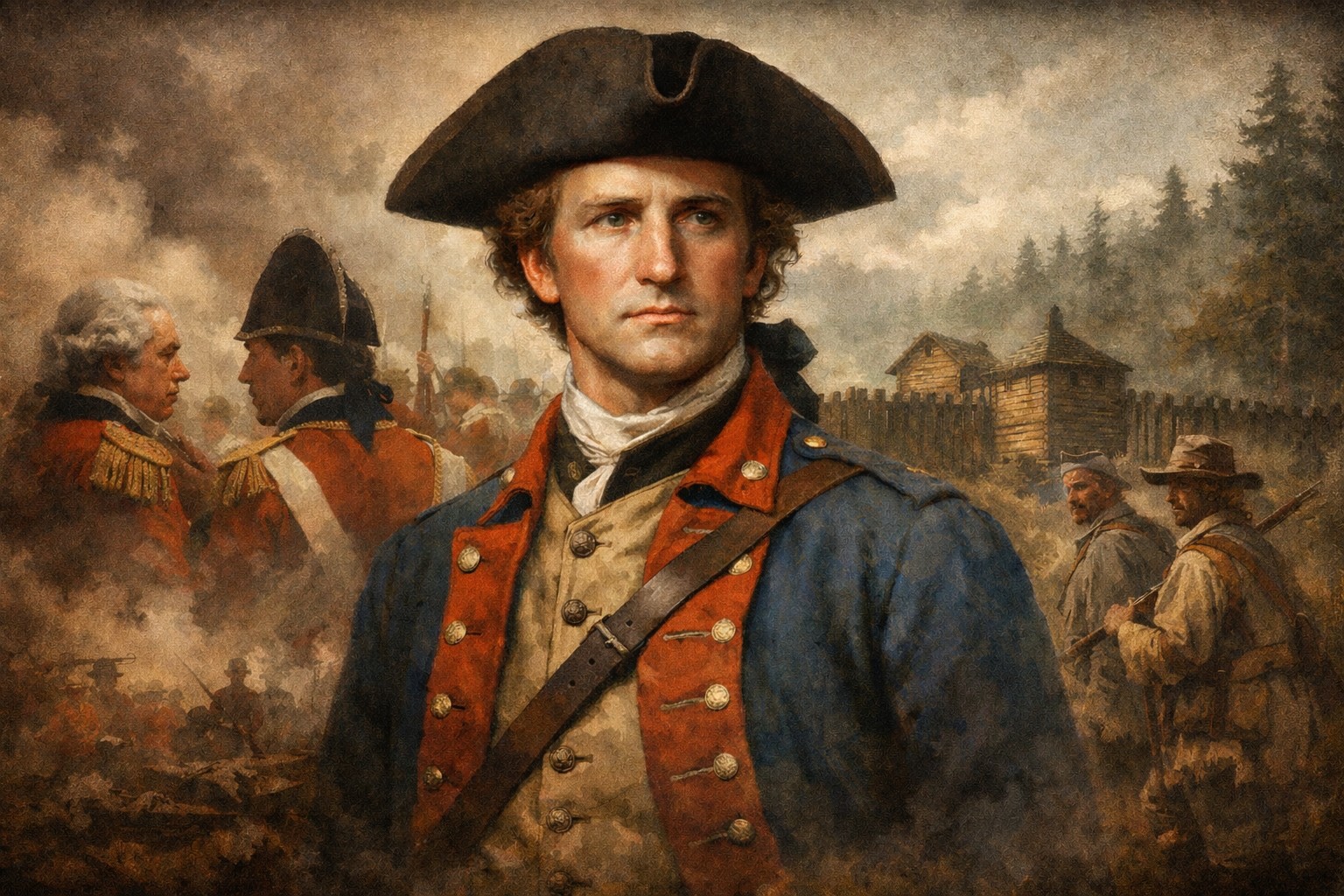
Note: History rarely provides a clear dress rehearsal, but the French and Indian War is a striking exception. Long before the first shots at Lexington and Concord, the foundations of the Revolution were already being laid and foreshadowed in the woods of the Pennsylvania and Virginia frontiers.
You can catch up by reading about Washington’s trial by fire. In this story, we see a young George Washington navigating the same obstacles that would define his later career: the struggle to lead citizen-soldiers, the logistical nightmare of maintaining an army, and the growing realization that the British Empire viewed its colonial subjects as secondary to the crown.
The carnage at the Monongahela didn’t just stay in the mind. In the July heat, the smell of it stayed on a man’s clothes for days. Washington rode away from the wreckage of Edward Braddock’s army with four bullet holes through his coat and two horses dead behind him.
He had just watched the finest professional force in the world fall apart; red-coated soldiers running in every direction, climbing over each other to get away from an enemy they couldn’t see.
Leading the survivors back toward Virginia, Washington found himself in an odd position. To the frontier families, he was already something close to a legend; the man who stayed upright when everything around him collapsed. To the British high command, he was a lucky colonial who had managed not to get killed.
That gap—colonial hero, imperial afterthought—was going to follow him for the rest of the war.
Braddock’s defeat had shattered something the French couldn’t have planned: the idea that British regulars were unbeatable. Washington had watched Braddock insist on parade-ground tactics in a Pennsylvania forest, trying to fight an enemy that wouldn’t stand in formation.
The result was a massacre. Now there were three hundred miles of open frontier between the Virginia settlements and whatever the French decided to do next.
Back in the colony, Washington’s name was doing something interesting. The stories traveled faster than the retreating troops. He was the one who didn’t run. He was the one who held it together.
In the woods, he had commanded men through sheer force of presence while the King’s commissioned officers lost control of everything around them.

After the Smoke Clears; Reputation Without Acceptance
The British regulars, now under Colonel Thomas Dunbar, had no interest in defending the Virginia backcountry. They retreated toward Philadelphia, leaving the mountain passes and Shenandoah farmsteads wide open. Washington watched them go. To the British, the colonies were a theater to be managed. The men who lived there were someone else’s problem.
The regulars were already drawing up plans for winter quarters. It was the middle of July.
Washington was left to answer to panicked Virginians, and he did it sick. A lingering fever had nearly put him in the ground before the battle, and he’d spent the retreat managing the wounded and holding together a makeshift rearguard anyway. By the time he reached Williamsburg, the House of Burgesses had a clear read on him. He understood the terrain and the enemy. He’d walked out of the disaster that killed Braddock.
In London, newspapers were running accounts of the “brave Virginian.” None of it opened a single door with the professional officer corps. To a regular officer, a provincial was a social inferior, period. No battlefield record was going to change that.
Washington had spent months in Braddock’s camp studying British military life; how rank bore out in practice, how it was enforced. He wanted a King’s commission. He believed he’d earned one at the Monongahela.
He was viewed as a useful local guide. That was the ceiling, and he was only beginning to understand it.
Elevated in Virginia: Command at Home
By late summer of 1755, Williamsburg was running on panic. The British regulars were gone, the frontier was wide open, and the House of Burgesses needed someone to put in charge of what was left. They needed a man who could hold together backwoodsmen and Tidewater gentry at the same time.
Washington was twenty-three. He was also the only choice. In August, Lieutenant Governor Robert Dinwiddie signed the commission making him Colonel of the Virginia Regiment and Commander-in-Chief of the colony’s forces.
The job was enormous. He was now responsible for thousands of men and three hundred miles of frontier. He threw himself into the details. Were the muskets the right caliber? Was powder adequately supplied? Had the flour spoiled? Were the men’s boots going to hold for another week?
He’d seen what happened when those questions went unasked, and he wasn’t going to let it happen again.
His authority had a hard limit, though. It stopped at the colony’s border. He could command Virginians; he couldn’t touch the British regulars operating in his own territory. Any junior British officer who wandered into camp outranked him on paper, and his own officers knew it. The command structure was a standing invitation to disaster.
Winchester taught him the rest. He had to lead men who didn’t especially want to be led, while navigating a colonial assembly that wanted the frontier protected but kept finding reasons not to fund it. He was the most powerful military figure in Virginia and a professional outsider in the army he was serving, sometimes in the same afternoon.
The Difficult Reality of the Frontier
Between late 1755 and 1757, the war became a smaller, meaner thing. Washington and the Virginia Regiment, three hundred miles of frontier, and an enemy that had no interest in being found.
The Virginia Regiment was not a professional force. It was mostly the poor and the conscripted; men who cared considerably more about their own farms than the King’s war. Desertion spread through the unit like a fever.
Washington’s response was unsentimental. He had a massive gallows erected in the center of Winchester as a standing reminder of consequences, and he pushed the House of Burgesses relentlessly for harsher military laws. A force without discipline, he understood, was just a mob with muskets.
Supply was the other war, and it was just as brutal. Beef spoiled and wagons went missing. Roads turned to mud and stayed that way. His letters to Lieutenant Governor Dinwiddie, polite at first, gradually became closer to blunt demands.
He was working out a truth that every general eventually learns: battles are won with courage, campaigns are won with wagon trains.
His defensive strategy, a chain of small stockades anchored by Fort Loudoun, looked reasonable on a map and failed in practice. The French and their Indian allies simply went around them. Raiding parties would slip past a fort at night, hit a farm miles away, and vanish before a patrol could saddle up.
Washington spent months chasing the aftermath. He’d march his men through the mud for days on the basis of a massacre report and arrive to find smoking ruins and nothing else.
He did all of this sick. Camp fevers and dysentery kept a running claim on him throughout these years, and he rode through most of it anyway. Settlers blamed him for losses he couldn’t have prevented, and he knew it. His letters from this period have the tone of a man being asked to do the impossible with what amounted to nothing.
The administrative misery ran deeper still. The governors of Maryland and Pennsylvania were theoretically his partners in frontier defense. In practice, each was primarily interested in his own border and his own budget.
Washington was coordinating across three colonies that shared a threat and almost nothing else. He filed it away. The lesson, that scattered colonies defending separate interests made everyone weaker, was one he wouldn’t forget.

A Foreign Hierarchy: Rank and Resentment
The frontier wasn’t Washington’s only fight. Running alongside all of it was an ugly battle over a piece of paper.
A royal commission was the only credential the British military recognized. Without one, Washington was a “provincial”; useful and tolerated, but definitively not one of them.
The tactical consequences were serious. British regulars of lower rank could, and did, refuse orders from colonial colonels. It was a command structure with a gap in it wide enough to get men killed.
In early 1756, Washington rode five hundred miles to Boston to put the issue in front of William Shirley, the acting Commander-in-Chief in North America. The immediate grievance was a Captain John Dagworthy, who was using a defunct royal commission to ignore Washington’s authority at Fort Cumberland.
The larger ask was a royal commission of his own; an official absorption of the Virginia Regiment into the regular army.
Washington traveled with aides and servants and wore his best uniform. He intended to be received as an officer and a gentleman, not a colonial curiosity. Shirley was polite. He ruled in Washington’s favor on the Dagworthy matter and left the commission question entirely alone.
Washington rode back with one problem solved and the one that mattered still open.
The following year brought Lord Loudoun, and things got worse. Loudoun was a rigid soldier with undisguised contempt for colonial troops and the assemblies that funded them.
Washington went to Philadelphia in March 1757 with a detailed memo on frontier conditions and a carefully constructed argument for why provincial officers needed royal commissions. Loudoun made him wait for days. When they finally met, he dismissed the Virginia Regiment as a minor nuisance and gave nothing on rank.
Washington had fought bravely and managed impossible logistics. He’d made his case in person to every commander who would see him. The British military’s answer was consistent: birth and patronage outranked all of it.
He went back to Winchester understanding something he’d been reluctant to accept. The King’s commission was never going to come.
The Forbes Expedition
By 1758, William Pitt had seen enough of defensive posturing. The new strategy was aggressive; a coordinated assault on French positions across the continent.
In the Ohio Valley, the target was Fort Duquesne. The man chosen to take it was General John Forbes, and Washington was ordered to mobilize the Virginia Regiment and join a force of over six thousand men.
For Washington, this was the campaign he’d been waiting for since he helped bury Braddock.
The conflict started almost immediately, and it was about roads.
Washington had spent years on the terrain between Virginia and Fort Duquesne. His argument was straightforward: use the Braddock Road. It was already cleared and ran directly from Virginia. Forbes, persuaded by Pennsylvania commercial interests, decided instead to cut an entirely new road through the Pennsylvania wilderness from Raystown.
Washington thought this was a disaster waiting to happen, and he said so at length. His letters to Forbes and Colonel Henry Bouquet were detailed and urgent; pointed enough to test the limits of military etiquette.
Carving a road through the Alleghenies would eat the summer. The army would arrive at Fort Duquesne in winter, if it arrived at all, and the French would have had months to reinforce.
He was right, and it didn’t matter. Forbes grew tired of the argument. In his private papers, he reduced Washington’s objections to the parochial complaints of a colonel too attached to his home colony’s roads. Washington’s tactical case was sound; his Virginia loyalties made it easy to dismiss.
There was nothing to do but follow. The army spent the summer as a construction crew, hacking a path through old-growth forest and over ridge after ridge of Allegheny terrain.
Washington rode the line watching his men work with axes and shovels while the logistical problems he’d predicted arrived more or less on schedule; wagons stuck in mud, the pace of advance slowing week by week.
He kept his regiment the best-prepared unit in the column anyway. Whatever he thought of the orders, he followed them completely. The regular officers noticed. I didn’t matter, but they noticed.

Fort Duquesne Falls: Victory Without Glory
The autumn push toward Fort Duquesne moved at a crawl. Washington had been pointed at this place for five years, and the campaign still wasn’t done making him wait.
As the army tightened its approach, the anxiety that comes with close-quarters forest movement returned in force. In November, near Loyal Hanna, that anxiety produced a near-catastrophe.
Two scouting parties from the Virginia Regiment stumbled into each other in a cold, fog-thick evening and opened fire, each convinced the other was the enemy.
Washington didn’t wait. He rode directly between the two firing lines, using his sword to knock muskets skyward while the shots went past him. He got the shooting stopped.
It was the kind of thing witnesses remember for the rest of their lives, and several of them said as much. It also left Washington shaken, another reminder of how quickly the woods could turn a disciplined force into a killing mob pointed in the wrong direction.
Shortly after, the British captured a French partisan who filled in the picture at the fort. Fort Duquesne was starving. Its Indian allies, recognizing that the French could no longer supply or protect them, had largely gone home.
The garrison that had haunted Washington’s career for years was down to a skeleton. General Forbes, so ill by this point that he was being carried on a litter, ordered the final advance, with Washington and the Virginians out front.
They came expecting a siege. What they found, cresting the last ridge on November 25, 1758, was a pillar of black smoke rising from the forks of the Ohio. The French had blown their powder magazines and torched what was left before retreating downriver.
By the time Washington rode in, there was nothing to take. Charred timber and collapsed walls. Scattered across the ground in the ash were the unburied bones of Braddock’s men, still there from three years before.
Washington had spent the better part of his adult life pointed at this place. He’d lost men getting here and burned through his health more than once. He’d fought a parallel war with his own army’s command structure the entire time.
Fort Duquesne was now in British hands, and it was a pile of rubble. The threat to Virginia was finished, but the decisive victory he’d wanted, the kind that ends with a battle, had retreated downriver with the French. He had outlasted them. That was all.

The Resignation Decision: Ambition Meets Reality
By the end of 1758, Fort Duquesne was ash and Washington was twenty-six years old. The last four years had taken a toll that was more than physical. In December, he resigned his commission as Colonel of the Virginia Regiment.
The decision was uncomplicated. The British commission he’d spent years working toward was never coming. He’d spent years cutting roads and holding a frontier together on almost nothing. He’d risked his life in ways the British army never formally acknowledged.
The hierarchy’s position on all of it was consistent: he was a provincial, and provincials did not become regular officers. He could wait for the next insult, or he could leave with his Virginia reputation intact. He left.
His men’s response settled something that the British never had. When he announced the resignation, his officers drafted a public letter; warm in a way that military correspondence rarely is.
They wrote of the happiness they’d felt serving under him and their deepest regret at his leaving. These were men who had marched through the mud with him, who had watched him ride between two firing lines to stop a massacre.
Their opinion of him had been earned in the field, not granted by a London patronage system, and Washington knew the difference.
With the commission behind him, Washington moved fast. On January 6, 1759, he married Martha Dandridge Custis, a wealthy widow, and the marriage transformed his circumstances overnight.
He gained control of a vast estate and thousands of acres. Mount Vernon replaced the frontier, and a seat in the House of Burgesses replaced the officer’s tent. The transition from soldier to elected official took less than a month.
The frontier stayed with him, though. He brought its habits to everything that followed; the obsessive record-keeping and the distrust of distant authority that had been building since Braddock’s retreat.
He’d entered the war as a young man trying to earn a place in the British military. He left it as a man of property who had measured that military up close and found it considerably less impressive than advertised. The resignation closed one chapter. What it opened was something completely different.
What Washington Took Away: Lessons Learned
The education Washington carried out of the Pennsylvania woods wasn’t the kind that comes from a military academy. It came from four years of hard lessons, some of them his, some of them Braddock’s.
The most durable one was logistical. He had watched Braddock’s professional army dissolve because it couldn’t adapt to the terrain, but the deeper lesson came in the years that followed: campaigns don’t fail on the battlefield, they fail in the supply chain.
Spoiled flour and missing wagons had done as much damage to his frontier defense as any French raiding party. The old military saying holds that amateurs study tactics while professionals study logistics. Washington didn’t read it anywhere. He lived it.
The repeated rejections over his royal commission did something they weren’t intended to do.
Every time a British officer dismissed him—Shirley’s polite evasion, Loudoun’s contemptuous waiting room—Washington was being handed evidence. The British military hierarchy ran on birth and patronage. Local knowledge and battlefield experience were beside the point.
That realization had a side effect. A man who spends years being told his judgment doesn’t count, and is then repeatedly proven right, eventually stops doubting his own judgment.
By the time he left the frontier, his confidence in his own read of a situation had been tested against the British professional class and come out ahead more than once. He knew it.
The Virginia Regiment taught him something the British couldn’t have. Colonial troops, the poor and the conscripted, men who’d rather be home, couldn’t be commanded by tradition and rank alone. They needed a reason, or at least a commander who seemed to understand why the reason mattered.
Washington had spent years figuring out how to hold those men together: with punishment when he had to, with presence always. He’d also spent years navigating the civilians behind them; the assembly that controlled the money and the governors who prioritized their own borders.
It was, in miniature, the exact political geography he’d face again twenty years later, scaled up to a continent.

A Young Officer Shaped by Limits
Washington left the French and Indian War having gotten almost none of what he came for. No royal commission and no decisive battlefield victory. No formal acknowledgment from the British military that he’d done anything worth noting.
What he got instead was something the British couldn’t have given him on purpose: a precise understanding of their limitations and his own capabilities, earned in conditions that killed better-credentialed men.
He went back to Mount Vernon knowing things that weren’t written in any manual. He knew how an army fell apart from the inside, through bad boots and a command structure nobody respected.
He knew what happened when professional soldiers refused to adapt to terrain they didn’t understand. He’d watched it happen at the Monongahela, and he’d spent the next four years cleaning it up.
The man who married Martha Custis in January 1759 and took his seat in the House of Burgesses was operating on a different set of assumptions than the young aide-de-camp who’d ridden into Braddock’s camp in 1755.
That man had wanted British approval. This one had stopped needing it. The frontier had done what the frontier tends to do: stripped away what didn’t hold up and left behind what did.
When he resigned in December 1758, Washington almost certainly believed his military career was finished. The war was over, the frontier was quiet, and there was a plantation to run. He had no particular reason to think otherwise.
What he couldn’t have seen was that everything the British put him through—the rank disputes and the impossible logistics, the years of commanding men who had no interest in being commanded—was preparation. Not for the life of a Virginia planter, as it turned out. The British had spent four years refusing to take him seriously.
They’d have cause to regret that.





Leave a Reply