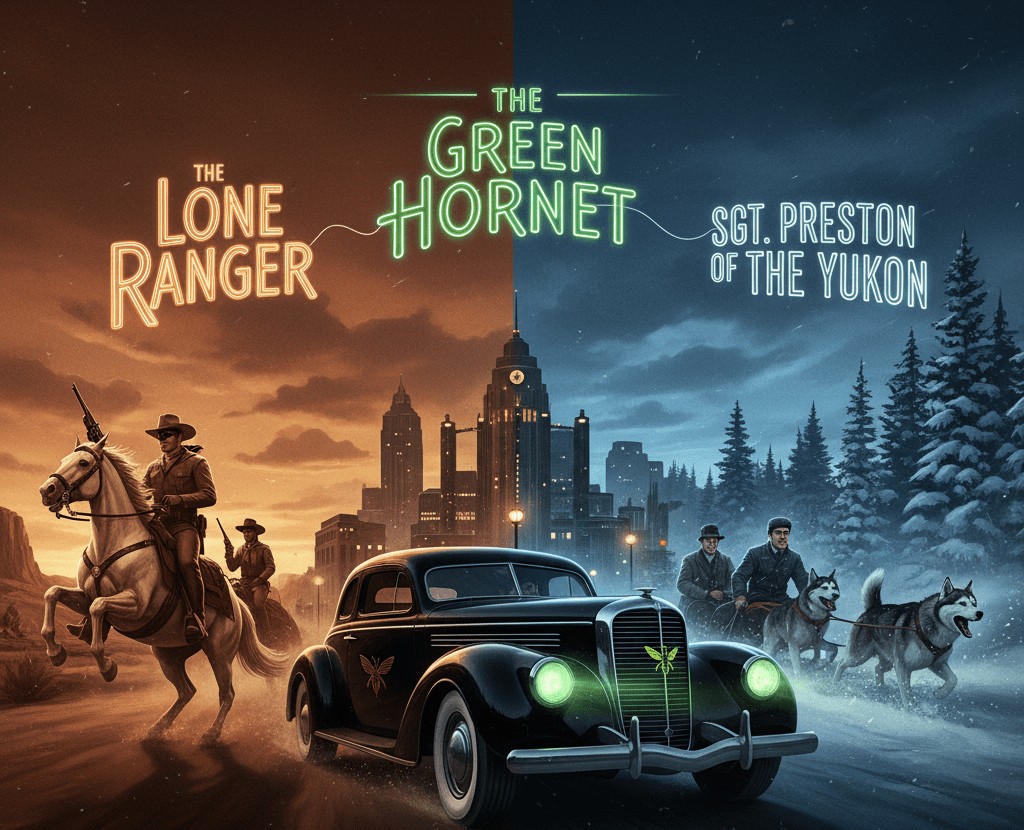
The room sits above the fourteenth floor of the Maccabees Building in Detroit, past the point where the elevators stop. You get there through a locked door and up a staircase. If you didn’t know it was there, you wouldn’t look for it. Most people don’t.
That’s where the Lone Ranger was born. The Green Hornet, too. Sergeant Preston of the Yukon. Three of the most recognizable characters in American popular culture, all coming out of a single radio studio in a city that had no business producing them.
That’s the thing about WXYZ. It shouldn’t have happened there.
In the 1930s, American radio meant New York and Chicago. NBC and CBS ran their empires out of Manhattan. WGN in Chicago was a powerhouse. WLW in Cincinnati was broadcasting at 500,000 watts, ten times the legal standard, and calling itself “The Nation’s Station.” Against that landscape, a 1,000-watt independent in Detroit had no particular reason to matter.
WXYZ mattered anyway.
By the time the golden age of radio wound down, this one station had produced nearly 3,000 episodes of The Lone Ranger, sixteen years of The Green Hornet, and seventeen years of Sergeant Preston of the Yukon.
It helped launch a national radio network. It put characters into the culture that are still there today; in film, on television, and in the back of the American imagination. The station’s slogan was “The Last Word in Radio.” That turned out to be more accurate than anyone intended.
This is the story of how it happened. It involves a calculating businessman and a desperately prolific writer who built something between them that neither fully owned. The mythology and the machinery were never very far apart at WXYZ. Understanding one requires reckoning with the other.
The Station
WXYZ didn’t start as WXYZ.
It started as WGHP, licensed in 1925 to a Detroit advertising man named George Harrison Phelps; the call letters were his initials. It was a 500-watt station, a charter member of the CBS Radio Network, and according to accounting, a money-loser. When Phelps sold it, it was bleeding $125,000 a year.
In April 1930, at the opening of the Great Depression, two Detroit movie theater impresarios named George Trendle and John Kunsky bought it anyway, for $250,000.
They pulled some strings with the federal government to acquire the call letters WXYZ, which had been reserved for military use, and moved the operation back to Detroit. Trendle relocated the station to the Maccabees Building on Woodward Avenue.
Most of the programming, though, would come out of a converted mansion on East Jefferson Avenue, the Mendelson Building, where Foley artists, writers, engineers, and actors would eventually fill the rooms producing some of the most listened-to radio in the country.
First, they had to figure out how to stop losing money.
Trendle was a lawyer by training, a theater man by trade, and a cost-cutter by disposition. He was not a dreamer. He was a calculator.
When CBS pushed back on some of his programming ideas, he made a decision that would define everything that followed: in June 1932, he dropped the network affiliation entirely. WXYZ would go independent. Rather than pay for syndicated programs, the station would produce its own.
This was either brave or foolish, and for a while it was both.
Trendle hired a dramatic director named James Jewell, who brought along his own repertory company, the Jewell Players, to supply actors. He also began working with a freelance writer out of Buffalo named Fran Striker, who had been selling radio scripts to stations across the country.
For music, Trendle issued a standing order: classical only. Not because he had any particular affection for the classical canon, but because it was old enough to be out of copyright. Free music was the right price.
The early productions were modest; Thrills of the Secret Service, Dr. Fang, Warner Lester, Manhunter. They found an audience, but nothing that would turn heads outside Detroit.
The formula was taking shape, though. Striker was learning what worked. Jewell’s actors were finding their footing. The pieces were assembling themselves into something, even if nobody in that converted mansion on East Jefferson Avenue could quite see what it was going to be yet.
In the fall of 1932, Trendle told Striker he wanted a western.

The Writer
Fran Striker is the most important person in this story that most people have never heard of. That’s not an accident.
He was born in Buffalo in 1903, dropped out of the University of Buffalo, knocked around New York briefly with an amateur theater company, and ended up back in Buffalo working as a radio announcer.
By the late 1920s he was managing a station, writing everything — skits, mysteries, westerns, dramatic serials — and selling scripts to anyone who would buy them. He was, above all things, a man who could produce. In 1939, estimates put his output at 60,000 words a week.
To put that in perspective, the book you’re reading right now would take most novelists a year. Striker was doing that every seven days, on top of everything else.
When Trendle came calling, Striker was already building what would become his signature template: morally upright hero, exotic or dangerous setting, loyal companion, recurring villains, a clear code of conduct that separated the protagonist from everyone around him.
He’d been testing these ideas at WEBR in Buffalo before WXYZ ever entered the picture. The earliest Lone Ranger scripts were largely reworked from an earlier Striker series called Covered Wagon Days. He didn’t invent the wheel so much as figure out exactly what shape it needed to be.
The working relationship with Trendle was productive and, from the start, lopsided.
Trendle had the station, the money, and the contacts. Striker had the words and, as it turned out, the characters. On January 30, 1933, the day the Lone Ranger premiered on WXYZ, Trendle wrote Striker a letter giving him full and explicit credit for creating the character. That letter still exists.
By 1934, it didn’t matter much.
Striker was supporting his wife, two children, and roughly a dozen other family members who had lost everything in the Depression. Trendle knew this. When he pressed Striker to sign over all past, present, and future rights to the Lone Ranger — and to any other creative work produced under the WXYZ arrangement — Striker signed. The price was $10 and the security of a steady paycheck, reported to be $100 a week.
In 1939 alone, the Lone Ranger generated half a million dollars in profit for Trendle.
In 1954, Trendle sold the Lone Ranger rights to an oil man named Jack Wrather for $3 million: the largest asset sale in television history at that point. Striker and Jewell were not shareholders in The Lone Ranger, Inc., the corporation Trendle had formed to handle the franchise. They had never been.
None of this stopped Striker from working. If anything, it seemed to accelerate him. He wrote 156 Lone Ranger scripts a year. He wrote The Green Hornet. He wrote Challenge of the Yukon. He wrote Lone Ranger novels, comic strips, movie serials, and eventually television scripts.
He adapted his old radio work for the small screen, often without credit, while other writers were listed as the scriptwriters on the finished product.
He appeared on the television game show To Tell the Truth in 1960, a program where panelists try to identify which of three claimants is telling the truth about their identity, and made the case that he had created the Lone Ranger.
One of the most beloved characters in American popular culture, and its actual creator had to go on a game show to make that argument.
Striker died in a car accident in September 1962. His papers went to the University at Buffalo. His family received nothing from the franchise he built.
He was inducted into the Radio Hall of Fame in 1988, twenty-six years after his death. Better late than never, though you could be forgiven for thinking otherwise.

Hi-Yo, Silver
On January 30, 1933, a radio show premiered on WXYZ and the seven stations of the Michigan Regional Network.
Within months it would be one of the most popular programs in the country. Within a year it would be helping to launch a national radio network. Within a decade it would be a genuine American institution, the kind that gets its own mythology and its own merchandise and, in this case, its own arguments about who really created it.
It started with an ambush.
Six Texas Rangers ride into a canyon called Bryant’s Gap, chasing an outlaw gang led by a man named Butch Cavendish. They’ve been led there by a scout working secretly for Cavendish. The gang is waiting on the rim above them.
When the dust settles, five Rangers are dead. The sixth, John Reid, the younger brother of the captain, is barely alive when a Potawatomi tracker named Tonto stumbles onto the scene. Tonto nurses him back to health, digs six graves so the Cavendish gang believes everyone is dead, and waits.
When Reid recovers, he cuts a mask from his dead brother’s vest. He is, as Tonto observes, the lone ranger. He will stay dead to the world, ride under that name, and spend the rest of his life hunting down the men responsible; and every other outlaw who crosses his path.
The details that followed became as familiar as anything in American folklore. The great white stallion Silver, found half-dead in a fight with a buffalo and nursed back to health.
The silver bullets, forged from the family mine; because, as Reid tells the old friend who makes them, life has value and is not to be wasted.
The code of conduct that Trendle and Striker drew up and enforced with something close to religious consistency: perfect grammar, no profanity, never shoot to kill, never win against hopeless odds, always leave people better than you found them.
At the end of every episode, as the William Tell Overture swelled and hoofbeats faded into the distance, someone would ask the question. “Who was that masked man?”
The public response was a bit staggering. In May 1933, the station offered a free toy gun to the first 300 listeners who wrote in. Nearly 25,000 letters arrived. In July, the Lone Ranger made a public appearance at a Detroit park. An estimated 70,000 people showed up.
Trendle, to his credit, understood immediately what he had. The Lone Ranger, Inc. was incorporated in 1934 to handle the franchise separately from the station. Merchandise deals followed. Movie serials followed. A safety club with nearly half a million members followed.
Silvercup Bread signed on as the first national sponsor, and Allen Campbell, Trendle’s advertising man, reportedly turned down a bread company that wanted to rename Silver after their product. The Lone Ranger would not be shouting “Hi-Yo, Gingham, Away!” on Campbell’s watch.
The voice behind all of it, for the first 1,300-plus episodes, belonged to a man almost nobody knew by name. Earle Graser was born in Ontario, moved to Detroit as a child, studied law and speech at Wayne University, and ended up at WXYZ almost by accident.
He was under six feet tall, slightly heavyset, didn’t know how to ride a horse, and had fired a pistol exactly once in his life. He was, in other words, nothing like the Lone Ranger.
Trendle knew this, which is why Brace Beemer — tall, athletic, expert rider, crack shot — made all the public appearances in costume while Graser stayed behind the microphone where nobody could see him.
For eight years, three times a week, Graser put on the voice of one of the most famous characters in America and then went home. He never missed a performance. His identity was kept from the public. He entered a nightclub contest once to see who could shout “Hi-Yo, Silver!” most convincingly, and he lost.
On April 8, 1941, Graser fell asleep at the wheel on his way to the WXYZ studios and drove into a parked truck trailer. He was thirty-one years old.
The show had three live broadcasts scheduled that week. There were no recordings to fall back on. The producers needed a new Lone Ranger immediately, and they needed one whose voice was different enough from Graser’s that a transition story would be required.
Several candidates were considered, including a young staff announcer named Myron Wallace, who would later become considerably more famous as Mike Wallace of 60 Minutes. In the end they went with Beemer, who had been narrating the show and making public appearances for years and was the logical choice.
The solution they came up with for the transition is one of the more ingenious pieces of storytelling in radio history. For five episodes, the Lone Ranger had been shot and gravely wounded, unable to speak above a whisper.
Tonto carried the action. The Ranger grunted, breathed, and communicated by scrawling notes in pencil while an Army surgeon tended to him. Over those five episodes, the audience adjusted. When Beemer’s deeper voice finally emerged fully, it felt earned rather than abrupt.
Beemer played the Lone Ranger for thirteen years, contractually forbidden from taking any other radio work. In 1949, when the show moved to television, he was passed over for the role — no film experience — and watched Clayton Moore become the face of the character he had voiced for over a decade.
Moore imitated Beemer’s sound in the earliest episodes. The show became ABC’s first genuine hit, finishing seventh in the Nielsen ratings in its second season.
Beemer eventually moved on to play Sergeant Preston in the final stretch of Challenge of the Yukon, then retired to a 300-acre farm in Oxford Township, Michigan, where he raised horses. For a time before his death in 1965, he was doing automobile commercials on Detroit radio, still using the voice.
The famous shout, “Hi-Yo, Silver!”, was Earle Graser’s. The show kept using his recording of it long after he was gone.

The Machinery
George Trendle did not run WXYZ so much as he operated it like a piece of industrial equipment with a sharp eye on the gauges.
He was not cruel in any dramatic sense. He was simply a businessman who had grown up in the theater industry, where margins were thin and labor was plentiful, and he applied those lessons to radio without much modification.
Dick Osgood, a longtime WXYZ employee who later wrote a memoir about the station called Wyxie Wonderland, documented the working conditions after having lived them.
New hires were sometimes brought on without pay, on the understanding that the experience itself was the compensation. The station’s books, Osgood reported, were kept in a manner that consistently showed the Lone Ranger, by then one of the most profitable programs in American radio, operating at a loss.
This was useful when talent asked for raises. Trendle would open the ledger, spread his hands, and explain that there simply wasn’t any money.
In December 1936, with Christmas approaching, Trendle called twenty-six employees into his office and let them all go on the same day.
The sound effects department, faced with the ongoing need to produce a convincing telephone ring for various productions and denied the budget for actual equipment, built a fake pay phone out of scrap wood and spare parts. It rang on cue. Trendle approved of the initiative, if not exactly the circumstances that produced it.
Striker, who was generating the content that made all of it possible, asked for a raise at some point in the mid-1930s. Trendle fired him. The firing lasted until Striker, with a family to feed and no comparable offer on the table, came back on Trendle’s terms.
This is the part of the story where it would be easy to render a simple verdict. Trendle as villain, Striker as victim, curtain.
But that’s not quite right, and it doesn’t hold up against the actual record. Trendle took a genuine financial risk in 1930 when he bought a failing station at the start of the Depression, and he took another in 1932 when he dropped the CBS affiliation and bet everything on original programming.
The shows he backed were good because he was demanding about their quality. He enforced the Lone Ranger’s moral code with the same iron consistency he applied to his payroll; no advertiser could compromise the character, no sponsor could insert a product into the narrative in a way that degraded it.
He turned down deals because they were wrong for the brand. There are not many cost-cutters in the history of American entertainment who can claim they held that particular line.
What Trendle built was real, and it required someone with his particular combination of vision and ruthlessness to build it. The people who worked for him paid a price for that. Both things are true, and the story is less interesting if you pretend otherwise.
What’s undeniable is the scale of what came out of that operation. By 1934, the Lone Ranger had outgrown Detroit entirely. It was time for a bigger stage.

Going National
By 1934, the Lone Ranger was airing on the Michigan Regional Network; seven stations, all Midwest, all small-market by national standards. Trendle wanted more. His advertising manager, Allen Campbell, was already working the problem.
What Campbell put together that year was one of the more consequential deals in American broadcasting history. He approached WGN in Chicago, WOR in New York, and WLW in Cincinnati — three of the most powerful independent stations in the country — with a proposition: form a cooperative network, share programming, and take on NBC and CBS together.
All four stations had the same complaint about the existing networks. They were paying for content they didn’t control, on terms they didn’t set. A cooperative arrangement would change that.
The Mutual Broadcasting System launched on October 29, 1934. The Lone Ranger was its first program.
There’s an argument among broadcasting historians about whether Mutual was built around the Lone Ranger or whether the Lone Ranger simply happened to be available when Mutual launched.
The cleaner version of the story, that Trendle’s show was the anchor that made the network possible, is probably a little generous. But it isn’t entirely wrong, either.
The show gave Mutual an immediate, proven commodity at a moment when the new network needed exactly that. By the late 1930s the Lone Ranger was airing on 150 stations, three times a week, with a national audience in the tens of millions.
Trendle eventually moved the show to the NBC Blue Network in 1935 — the money was better — though contractual obligations kept it on Mutual for another seven years while NBC got the newer programming. It was the kind of overlap that made lawyers wealthy, but it didn’t slow the franchise down noticeably.
The merchandise operation was already running independently of the broadcast rights. Safety clubs, comic strips, toy guns, rings, and badges were moving through retail channels across the country. A bread sponsorship. A movie serial deal.
The Lone Ranger had become less a radio show than a property, in the modern sense of the word; something that could be licensed and sold in pieces.
Trendle understood this earlier than almost anyone in American entertainment at the time. The show wasn’t the product. The character was the product. The show was just the most efficient delivery mechanism.
In a 1933 meeting with a potential sponsor, a representative suggested that since Silver was already associated with a bread company, perhaps the horse could simply be renamed after the bread. Campbell threw them out. The Lone Ranger was not adjustable in that direction, regardless of what the check looked like.
It was a principle Trendle held with genuine conviction, and one that paid off handsomely. By the time he was done with the franchise, the Lone Ranger’s name and image were among the most recognized in the country.
A masked man on a white horse, a silver bullet, a thundering overture. You didn’t need to explain it to anyone. You still don’t.

The Green Hornet
In 1935, Trendle went back to Striker with a new assignment. He wanted another show, something built on the same bones as the Lone Ranger but set in the present day. No open range or outlaws on horseback.
The modern world had its own criminals, and Trendle thought a modern hero could chase them just as effectively.
The connection to the Lone Ranger was deliberate. Trendle didn’t want a show that merely resembled his western; he wanted one that was genetically linked to it. The result was Britt Reid, publisher of the Daily Sentinel, a crusading newspaper in an unnamed American city.
Reid’s father was Dan Reid, the nephew of John Reid, the Lone Ranger himself. The Green Hornet was the masked man’s grandnephew, born into a different century and fighting a different kind of outlaw. The bloodline ran straight through.
The Green Hornet premiered on WXYZ on January 31, 1936, three years to the day after the Lone Ranger’s debut. That date wasn’t a coincidence.
Where the Lone Ranger operated in the open, riding into towns and dispensing frontier justice in plain sight, the Green Hornet worked in the shadows. Britt Reid posed as a criminal himself, allowing the underworld to believe he was a gangster muscling in on their territory, which gave him access the police couldn’t get.
His weapon was a gas gun that rendered targets unconscious rather than dead. His car, the Black Beauty, was armored and fast. His sidekick was Kato, his valet, initially written as Japanese, then quietly shifted to Filipino as tensions between the United States and Japan intensified through the late 1930s.
After Pearl Harbor, Kato became simply “his assistant,” with no national origin specified at all.
The theme music was Rimsky-Korsakov’s “Flight of the Bumblebee,” played on a theremin. It was strange and unsettling in the right way; the kind of sound that told you immediately this wasn’t the William Tell Overture, wasn’t the frontier, wasn’t anything you’d heard before.
Trendle had a specific civic purpose in mind for the show. He wanted it to demonstrate how corruption actually functioned — how it moved through institutions, how it bought and compromised the people who were supposed to stop it — and he wanted young listeners to come away with some understanding of how a single person could fight it.
This was not an accident of theme. It was a design specification. Trendle told Striker in so many words that the Green Hornet should function as civic education.
J. Edgar Hoover had objections. The original premise positioned the Green Hornet as a vigilante who could succeed where law enforcement failed, including, in one early formulation, where the G-men couldn’t. Hoover was not amused.
The language was adjusted. The FBI’s honor was preserved. The show went on.
Al Hodge played Britt Reid from the premiere through 1943, delivering a performance that made the character work on its own terms rather than simply as a Lone Ranger echo. The show ran until 1952, cycling through cast members and time slots while maintaining a consistent audience.
The shared universe detail, the genealogical link between the two shows, was played straight throughout the run. In a 1947 episode, Britt Reid’s father Dan visits his son and mentions a vigilante ancestor he once rode with in Texas.
The William Tell Overture plays softly in the background as he speaks. It is an elegant piece of radio storytelling, the kind that rewards the audience for paying attention across two separate programs spanning more than a decade.
Most people who know both characters today have no idea they’re related. The connection was always there. Nobody told them to look for it.
The Rest of the Factory
The Lone Ranger and the Green Hornet were the flagship productions, but WXYZ was running something closer to an assembly line by the late 1930s.
Striker was writing constantly, Jewell’s repertory company was cycling through roles across multiple shows, and Trendle was looking for the next property with the same methodical appetite he’d applied to the first two.
He found it in the Yukon.
In 1938, Trendle approached Striker with another assignment. He wanted an adventure show set in the frozen north; the Klondike Gold Rush era, the Northwest Mounted Police, wilderness survival.
He also wanted a dog, a working animal who functioned as a genuine partner to the human lead, with as much presence on the air as the man holding the badge.
Striker delivered Sergeant William Preston of the Yukon and his husky, Yukon King. The show premiered on WXYZ in February 1938 under the title Challenge of the Yukon and ran for seventeen years.
The formula was identical to the Lone Ranger’s in its structural bones. Heroic lawman in an exotic setting, loyal animal companion, classical theme music pulled from the public domain; in this case, Sousa’s “Riders for the Flag” and excerpts from Mendelssohn.
The villain of the week, the chase, the resolution, the moral intact at the end. Trendle had identified a template that worked and saw no reason to deviate from it. He was right.
The audience for Challenge of the Yukon was substantial and loyal throughout the show’s run, and it made the jump to television in 1955 as Sergeant Preston of the Yukon, lasting three more seasons on CBS.
Beyond the three flagship programs, WXYZ churned out a parade of shorter-lived productions that history has largely swallowed. Ned Jordan, Secret Agent. Warner Lester, Manhunter. The Crimson Skull. Most ran for a season or two, found modest audiences, and disappeared.
They were Striker’s workshop as much as anything. Places where he tested ideas, refined the template, and kept the machinery running between the bigger assignments.
What made the whole operation function was the repertory model. The same small company of actors appeared across all of the major productions, swapping roles and character names while the essential dynamic stayed constant.
John Todd, who played Tonto in the Lone Ranger from the very first episode through the entire radio run — more than 2,900 episodes over two decades — also appeared in Challenge of the Yukon.
The WXYZ world was compact by necessity and efficient by design. Trendle was not paying for more talent than he needed, and the talent he had was versatile enough to cover the spread.
Radio historian John Dunning, who catalogued the golden age of American radio in exhaustive detail, summed up the WXYZ formula with characteristic precision: simple, vigorous adventure plotting, a bigger-than-life male hero, and lively music lifted from the classical catalog.
That description fits every show that came out of the Mendelson Building, from the first Lone Ranger episode to the last Sergeant Preston. Trendle and Striker had built something reproducible, and they reproduced it.
The question, by the mid-1940s, was how much longer the model would hold. Television was coming. Radio’s golden age had a fixed expiration date, even if nobody knew exactly when it was. Trendle, characteristically, saw it first.

The End of the Empire
Trendle sold WXYZ and the Michigan Radio Network to ABC in 1946 for $3.65 million.
The timing was nearly perfect. Television was already pulling advertising dollars away from radio, and the economics of broadcasting were about to shift in ways that would make a portfolio of radio stations a steadily less attractive asset.
Trendle took his money and walked away from the station business entirely, retaining only the character franchises he had incorporated separately from WXYZ. Whatever else you want to say about the man, he knew when to leave a room.
The Lone Ranger made its television debut on ABC in 1949 with Clayton Moore in the mask and Jay Silverheels, a Mohawk actor from the Six Nations Reserve in Ontario, as Tonto. The show became ABC’s first genuine hit, finishing seventh in the Nielsen ratings in its second season and running for 221 episodes over five years.
Moore’s performance was so committed, so thoroughly identified with the character, that the two became functionally inseparable in the public mind. He wore the mask at personal appearances for decades after the show ended. He was, to most of America, simply the Lone Ranger.
Brace Beemer, who had voiced the character on radio for thirteen years, was not offered the television role. The stated reason was his lack of film experience. He watched from his farm in Oxford Township while Moore became famous in the part Beemer had inhabited since 1941.
In 1954, Trendle sold the Lone Ranger rights to Jack Wrather, a Texas oil man turned entertainment entrepreneur, for three million dollars. It was, at that point, the largest single asset sale in television history.
Trendle was seventy years old. He had started with a failing radio station and a $125,000 annual loss and had turned it into this. He retired to Grosse Pointe and lived another twenty years, dying in 1972.
Fran Striker kept working. He adapted his radio scripts for television, wrote Lone Ranger novels, produced comic strip material, and kept generating output at a pace that would have exhausted most writers half his age.
He died on September 4, 1962, when his car left the road near Buffalo and struck a tree; the same kind of accident that had taken Earle Graser twenty-one years earlier. He was fifty-eight.
The Green Hornet reached television in 1966 as an ABC series, notable primarily because it introduced Bruce Lee to American audiences in the role of Kato.
Lee’s physical performance was so far beyond anything else on the screen that he frequently had to be asked to slow down for the cameras. The show lasted one season. Lee went on to become the most influential martial artist in the history of American film. Kato got him there.
The last significant chapter in the WXYZ story played out in 1979, when the Wrather Corporation, by then controlling the Lone Ranger franchise, took Clayton Moore to court to prevent him from making public appearances in the mask.
Wrather had a new Lone Ranger film in production and wanted to clear the field. A judge granted an injunction. Moore responded by swapping his mask for a pair of large wraparound Foster Grant sunglasses and kept making appearances anyway, which was both legally defensible and, as a public relations maneuver, absolutely inspired.
The public sided with Moore without hesitation. The 1981 film bombed. Wrather dropped the lawsuit in 1984 and died two months later. Moore got his mask back and wore it until his death in 1999.
Fran Striker was inducted into the Radio Hall of Fame in 1988. His family has never received royalties from the franchise he built. His papers sit in the archives at the University at Buffalo, available to researchers who know to look for them. Most people don’t.

The Last Word
There’s a version of this story that ends with a simple moral: creative genius exploited by corporate machinery, talent ground up by the business of entertainment. It’s not wrong, exactly. But it’s too clean, and clean endings are almost never honest ones.
What came out of that studio above the fourteenth floor of the Maccabees Building was something genuinely improbable.
A failing 500-watt station, bought at the worst possible moment by a man who had no background in entertainment production, staffed by a writer churning out 60,000 words a week and a repertory company of actors who played every role in the catalog — and from that, characters who are still walking around in the culture nearly a century later.
The Lone Ranger. The Green Hornet. Sergeant Preston. The masked man on the white horse, the silver bullet, the thundering overture. You don’t need to explain any of it. That’s the standard for cultural permanence, and WXYZ cleared it.
Consider what Trendle and Striker actually built, stripped of the grievances and the mythology both.
The secret identity protecting a man who operates outside the law for the greater good. The rigorous moral code that separates the hero from the villains he pursues. The loyal sidekick. The signature weapon and vehicle. The recurring cast of antagonists.
The universe that extends across characters and generations, with one hero’s bloodline running directly into the next. These are the structural grammar of the American superhero, and they were assembled in Depression-era Detroit, on a shoestring, by a cost-cutting businessman and a writer who never stopped typing.
Marvel and DC didn’t invent this. They inherited it. The template was already sixty years old by the time the Marvel Cinematic Universe started connecting its characters across franchises. WXYZ did it first, with two shows, a deliberate genealogy, and, oddly, a theremin playing Rimsky-Korsakov.
What gets lost in the nostalgia — and there is genuine nostalgia here, warranted nostalgia — is how strange and unlikely the whole enterprise was. Radio drama was a young medium in 1933. Nobody had established what it could or couldn’t do.
Striker and Jewell’s company were figuring it out in real time, three episodes a week, broadcast live, with no safety net and a boss who was watching every dollar.
The five transition episodes after Earle Graser’s death — the Lone Ranger whispering, Tonto carrying the action, the audience quietly adjusting to a new voice — that’s not just an ingenious production solution. That’s a piece of storytelling that holds up against anything the medium ever produced.
The Maccabees Building still stands on Woodward Avenue in Detroit. The studio above the fourteenth floor is still there, accessible by the staircase above the elevators. The building has been through several tenants and a long period of disrepair. Detroit has seen worse fates than that.
Fran Striker’s papers are at the University at Buffalo. The 1933 letter, in which Trendle explicitly credited Striker with creating the Lone Ranger, is among them. It has never been especially hard to find for anyone willing to look.
The last word in radio, it turns out, wasn’t a broadcast. It was a body of work; characters and stories that outlasted the medium that made them, the men who built them, and the arguments about who deserved the credit. Fran Striker’s typewriter has been quiet since 1962. The characters haven’t.




Leave a Reply