
For generations, the collective memory of Orson Welles has been fixed, frozen in time in the lights of fame and a movie screen. We picture the confident young man who burst onto the scene, the cinematic boy-wonder of Citizen Kane—a film so advanced it set the artistic standard for modern moviemaking.
We picture the aged artist, heavy and weary, delivering wine commercials and battling stubborn studio executives who never really grasped his vision. His story is told as a spectacular rise followed by a tragic decline—a narrative arc defined entirely by the camera.
This perspective, however common, may well be a distortion. It treats Welles’s work outside of film, particularly his extensive career in radio, as little more than a side hustle, a means to pay the rent or finance another frustrating picture.
But what if the popular image is wrong? What if the medium we think of as secondary was, for Orson Welles, the primary place of his creative belonging?
Welles spent years living inside the airwaves. He wrote for radio, directed for radio, acted in radio, hosted in radio, and innovated its form more drastically than perhaps any other single figure. Far from seeing it as a minor art, he confessed a genuine, lifelong affection for the microphone, repeatedly citing the incredible freedom and direct intimacy it offered him. The core question for any examination of Welles’s life changes when we consider his own devotion to it:
What if radio, not film, was the medium that best fit the expansive, visionary genius persona of Orson Welles, the place where he was most whole?
The Sound of Authority: A Voice for the Air
Radio did not merely tolerate Orson Welles; it welcomed him with open arms, accepting him fully and immediately. This acceptance had a simple origin: the singular quality of his voice.
Even as he began his radio career in the early 1930s, Welles possessed a voice of astonishing depth and maturity. It was a natural baritone that conveyed innate intelligence and commanding presence. In a visual medium like theater or film, Welles was a young man and had to act the part of an older, authoritative figure; on the air, his voice did all the work.
The microphone stripped away his youthful appearance and left only the substance of his sound and the picture he painted with it, allowing him to be instantly believable as a detective, a statesman, a philosopher, or a terrifying villain.
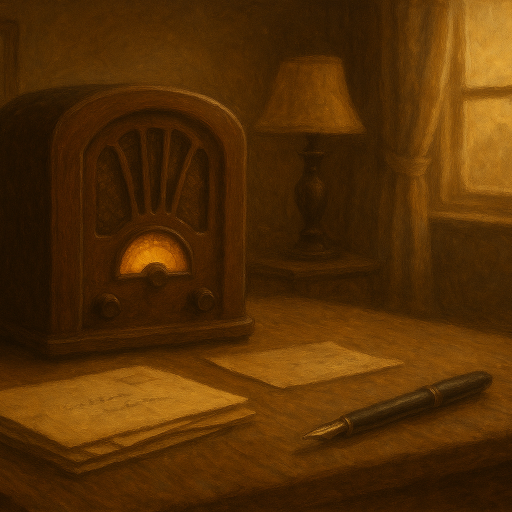
The nature of radio in 1930s America magnified this advantage. The wireless was a trusted appliance, a focal point for the American family. News, sermon, and entertainment all came through the same speaker, lending every broadcast a gravity that is hard to imagine today. The moment Welles spoke, his instrument conferred instant credibility. His voice didn’t just belong on the air; it sounded like it belonged in charge of the air.
But Welles was not merely a voice actor; he was a technical master of the medium. He instinctively grasped that radio was not recorded theater, but a distinct form requiring specialized direction. He understood how to leverage the listener’s imagination. He didn’t just rely on scripts; he directed the listening experience himself.
His technique was characterized by a few key elements that showed his deep understanding of sound as drama. He utilized silence, not as a mistake or a gap, but as a deliberate moment to heighten the anticipation in a scene. He controlled the dramatic pace of a broadcast, knowing exactly when to hold on a moment of dread and when to accelerate the listener through a sudden burst of action.
Interestingly, his use of narration established a direct, almost conspiratorial bond with the listener, speaking straight to them, personally. Welles didn’t simply perform on radio; he truly understood how it worked, manipulating its core elements to achieve maximum imaginative impact right from the beginning of his career.

The Mercury Theatre on the Air: Building a Cinematic Imagination
The legendary Mercury Theatre on the Air, which began broadcasting in 1938, was the laboratory where Welles honed the aesthetic he would later take to Hollywood. It was born out of the same experimental, shoestring theatrical company Welles and John Houseman had run, and its aim was to translate that sense of creative daring into sound.
The broadcasts rejected the rigid routine of radio drama, which often sounded like stage plays read aloud. Welles’s vision was something altogether more immersive and fluid. His approach to adaptation was radical for its day: he treated source material with a kind of irreverence, valuing the emotional core and dramatic potential of a story over a literal reading of the text.
The broadcast of Dracula serves as a perfect example. Instead of focusing on Victorian melodrama, Welles edited the novel down to its essentials, focusing on atmosphere and slow, mounting menace. He understood that on radio, the invisible enemy is the most frightening.
Similarly, his adaptation of Victor Hugo’s Les Miserables transformed the lengthy, rambling novel into a momentum-driven serial, demonstrating an understanding of how to pace a narrative for episode-by-episode consumption—a precursor to modern dramatic television.
When he tackled Joseph Conrad’s Heart of Darkness, he explored interior narration, putting the listener inside the conflicted mind of the character, a feat of psychological storytelling few radio artists had attempted.
The Mercury Theatre established a signature sound characterized by techniques that broke from the norm. The programs featured a naturalism often missing in the studios of the day, including the use of overlapping dialogue to make conversations sound real, busy, spontaneous.
Furthermore, they employed sound effects not just to signify literal events (a car door slamming) but to construct a complete sensory atmosphere—the echoes of a stone hall, the muffled noise in a heavy fog. The narration itself was fluid, weaving the announcer’s voice, the character’s voice, and the narrative voice into one seamless stream of story.
The inescapable conclusion here is that Welles was already a cinematic storyteller well before he ever stepped onto a film set. He was using sound and language to manipulate perspective in ways that were highly advanced. The innovations of Citizen Kane—the fragmented narrative, the deep focus, the unique points of view—did not appear out of thin air; they were the fully formed ideas that first came to life in the sound-only world of the microphone. Long before viewers ever saw his product on a screen, the creation, and mastery of it, had already taken place inside the mind of Orson Welles.

War of the Worlds: The Voice of Public Trust
The night of October 30, 1938, is a chapter in American folklore that has become almost entirely defined by its immediate consequence: mass panic. The cultural shorthand for the War of the Worlds broadcast is “the night America panicked,” but this often obscures the program’s real lesson regarding public trust and the power of the medium.
While some scattered panic did occur, the impact was less about the widespread fear of Martians and more about the sudden, shocking realization of radio’s immense hold on the public imagination. The key to the broadcast’s effectiveness was not just the drama itself, but Welles’s shrewd format choice.
The show began with the comforting predictability of a dance band performance, which was then broken by increasingly urgent and realistic news bulletins. This clever use of a news bulletin framework exploited the public’s faith in the voice of authority coming from the speaker.
Welles’s production staff worked hard to make the sound design mimic real news coverage, including the short, anxious tone of “on-the-scene” reporters. The voices reporting the destruction of New Jersey were measured, not hysterical. This restraint in delivery made the outlandish content—alien war machines—seem terrifyingly plausible. The audience was not listening to actors; they were listening to voices they believed to be journalists and experts.
The fallout was instantaneous, rocketing Welles to overnight national fame and notoriety. The broadcast was not an intentional hoax, but an experiment that revealed the shocking vulnerability of a society dependent on a single, trusted source of information. It proved that Welles, a man still in his early twenties, held a startling degree of power over the American psyche. It was a demonstration of radio’s immense power and the responsibility that necessarily came with such a platform. That reputation for brilliance and controversy followed him for the rest of his life.
Radio as Freedom, Film as Struggle
To understand Welles’s attachment to radio, one must hold it in sharp contrast to the exhausting and frustrating reality of his film career. The two mediums offered him fundamentally different experiences as an artist.
In radio, Welles found everything he valued most: creative control over the final product, the speed to execute an idea almost instantly, and an imaginative freedom not burdened by sets, budgets, or the physical limits of a camera. If the script called for a crumbling cathedral or a fleet of warships, the sound engineers could conjure it. The vision went directly from the artist’s mind to the listener’s ear.
In film, the process was the opposite. It was defined by frustrating studio interference, bitter battles over financing, and the constant threat of re-edits and compromised final visions—to say nothing of the vicious battle with William Randolph Hearst and his campaign to destroy Citizen Kane.
Where radio was instant, film was protracted. Where radio was cheap, film was ruinously expensive. The result was a dramatic difference in his emotional investment and output. Welles often spoke of his radio work with a sense of play, joy, and rapid invention; his film career, by comparison, was a decades-long struggle.
This contrast is a key to his overall career arc. His repeated returns to the airwaves, even after his early Hollywood success, were not simply opportunistic choices for quick cash. They were a necessary artistic retreat. Radio was not a nostalgic hobby; it was a source of relief. It was the space where he could be the complete master of his own creative process, crafting complex narratives without needing to appease a single executive, financier, studio, or censor.

The Voice of Conscience: A Moral Platform
Welles’s relationship with the microphone went beyond entertainment and artistic experimentation. Especially during and immediately after the Second World War, he viewed radio as a serious moral and civic medium that reached deep into American homes.
He utilized his airtime not just for drama, but for pointed civic and social commentary. These broadcasts included urgent anti-authoritarian messaging, appeals to national unity, and thoughtful discussions on contemporary issues. The tone of these addresses was earnest, deliberate, thoughtful, and deeply serious. He spoke with the conviction of a man who believed his medium carried a duty to elevate public discourse.
Welles took his place alongside other influential broadcasters of the era, such as Edward R. Murrow, who understood that the radio could serve as the nation’s conscience, bringing moral clarity to complex events. Welles felt that speaking into the personal space of the listener’s living room carried a heavy responsibility to speak truthfully and thoughtfully about the state of the world. He was committed to using his voice for serious purpose, positioning the airwaves not just as a stage for acting, but as a forum for citizenship.
The Postwar Return: Harry Lime and the Comfort of the Microphone
The decade following the war saw Hollywood become increasingly difficult for Welles. Financing his passion projects was exhausting, creative control became elusive, and his reputation as a difficult figure preceded him everywhere. This landscape drove him back to his true refuge: the microphone.
The most celebrated of these later radio productions was The Lives of Harry Lime, a serial that followed the charismatic, amoral smuggler Welles had popularized in the film The Third Man (1949). The series was produced in London and broadcast across the globe.
Harry Lime is significant because it gave Welles total creative authorship and a direct line to his audience. He didn’t just play the title character; he introduced the stories himself, speaking directly to the listener, setting the scene, and framing the narrative with a wry, knowing style. The voice here was different: older, more relaxed, perhaps more morally ambiguous, but radiating a supreme, confident charm.
Harry Lime served as a kind of avatar for Welles himself—a rogue figure who controlled the story by being the one to tell it. He charms, he misleads, and occasionally, he confesses, all through the magnetism of his voice and storytelling. In this series, Welles wasn’t simply returning to a familiar job; he was reclaiming authorship of his own career and persona in a space where no studio executive could take the microphone away.

Later Radio Work: A Voice That Aged Gracefully
Welles continued his work in radio well into the later stages of his life, proving that the medium continued to accommodate his evolving presence in a way that film often did not. Later projects, such as The Black Museum, showcased a structure that leaned heavily on narration, fitting his skill set perfectly.
As he aged, his voice changed, acquiring a darker, more reflective quality. There was less of the youthful bravado and more of a deeper, settled gravity. Radio honored this transformation. The aging voice was not an indicator of decline. It was nearly an enhancement, adding weight and wisdom to his storytelling. The close-up nature of the microphone allowed the nuance of Welles to be appreciated, something the visual distance of film rarely achieved.
Why We Remember the Wrong Medium
The distortion in Welles’ legacy—the focus on film as his primary contribution—is not a sign of his preference, but a matter of historical and cultural bias.
We value what we can see, and we tend to dismiss what we are asked to imagine. Films are physical objects, easily reproduced, canonized, cataloged, and shown. Radio, by contrast, is scattered, ephemeral, and historically difficult to preserve. The cultural inclination is to lionize the visual medium and overlook the imaginative one.
The irony is that much of Welles’s radio work survives today in a more intact state than many of his compromised, even butchered, film cuts. The argument here is simple: Welles’s legacy is incomplete and often misleading because radio’s own legacy is distorted and undervalued.
Viewing Orson Welles’s career through the lens of radio reveals a different artist than the one Hollywood mythologized.

Radio spotlights his complete devotion to the power of imagination, his complete trust in the audience to collaborate in the creation of the drama, and his desire for total creative control without the need for visual spectacle. It reframes his career, instead of a spectacular rise and tragic fall, to a lifelong search for a medium that would not betray his singular vision.
Ultimately, radio did not betray him. It remained his most loyal artistic home.
The most telling final image of Orson Welles is not the exhausted figure on a film set, battling creditors or executives. It is the simple picture of the artist alone in a sound studio. There is no camera, no cast, and no producer looking over his shoulder. There is only a single performer, a single writer, and a voice speaking directly to millions of listeners.
In that room, behind that microphone, radio allowed him to be simultaneously the performer, the director, the writer, and the conscience of his own material. It gave him the universe he needed to explore, bounded only by the power of his voice.
Perhaps Orson Welles was not a difficult filmmaker constantly striving to recapture his youth; perhaps he was the most successful radio artist of all time, one we have simply forgotten how to recognize. When the curtain fell on his cinematic struggles, it was the glow of the “On the Air” sign that always remained, illuminating the true, uninterrupted scope of his genius.




Leave a Reply